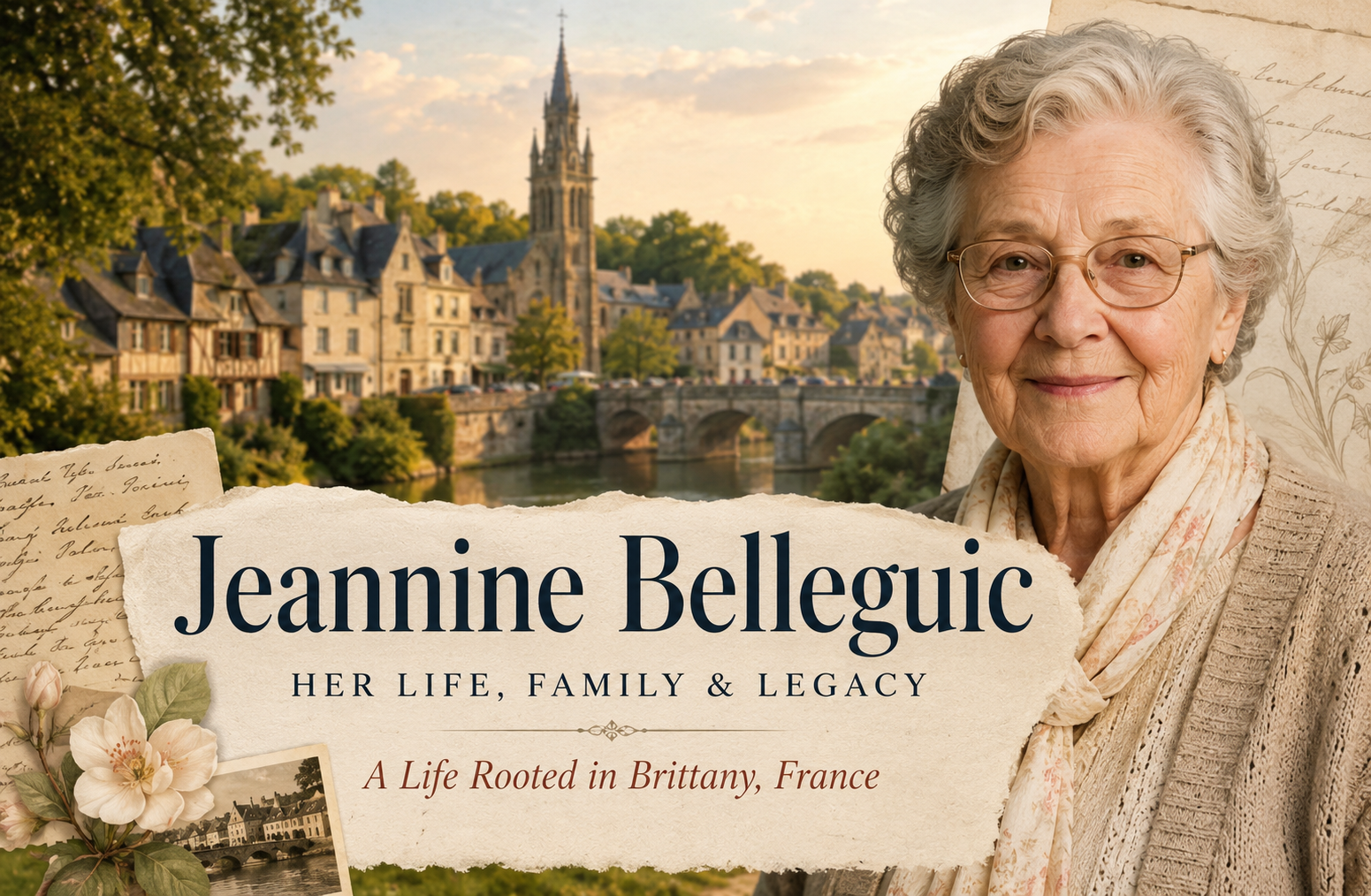
Jeannine Belleguic: Her Life, Family, Background, and Legacy
The name Jeannine Belleguic has attracted attention from people searching for information about her identity, family background, personal history, and connection to France. Unlike celebrities and widely recognized public personalities, her story is primarily preserved through family announcements, civil records, and memorial information. Understanding who she was requires looking beyond brief online biographies and separating documented information from claims that have not been independently verified.
Jeannine Belleguic is particularly interesting from a biographical and genealogical perspective because her name appears in different forms, including Jeannine Belléguic and Jeannine Bleuzen. These variations are important when researching her background, as they help connect records associated with her birth name and married surname. Available information identifies her as a French woman associated with Quimperlé, a town in Brittany, and her life story offers an example of how family records preserve the histories of people who were not public figures.
This article examines her identity, early background, family connections, life in Brittany, available historical information, and the reasons her name continues to appear in online searches. It also distinguishes established facts from unsupported claims to provide a more responsible and useful account.
Who Was Jeannine Belleguic?
Jeannine Belleguic was a French woman whose publicly available biographical information is closely connected with family and civil records from Brittany. She is identified in family notices as Jeannine Belléguic, née Bleuzen. The French word née means born and indicates the surname a woman used before marriage.
Available records identify her full birth name as Jeannine Joséphine Annick Bleuzen. They associate her with Quimperlé in the Finistère department of western France and record her death in Lorient, in the Morbihan department, on April 18, 2025.
She was not widely documented as an entertainer, politician, business leader, or media personality. Instead, her public footprint comes mainly from information preserved by family announcements and civil records.
This distinction matters because searching for someone online does not necessarily mean that person had a public career. A name can become widely searchable because of an obituary, a family announcement, or increased interest in genealogy.
In her case, the available information offers a limited but meaningful picture of a woman whose identity is connected with family history and the local community.
Quick Facts About Jeannine Belleguic
| Category | Available information |
| Full birth name | Jeannine Joséphine Annick Bleuzen |
| Commonly searched name | Jeannine Belleguic |
| Alternative spelling | Jeannine Belléguic |
| Birth date | May 28, 1931 |
| Birthplace | Quimperlé, France |
| National background | French |
| Husband | Jean-Charles Belleguic |
| Date of death | April 18, 2025 |
| Place of death | Lorient, France |
| Age at death | 93 |
| Region associated with her life | Brittany, France |
| Public profile | Private individual |
These details provide a starting point for understanding her identity. However, not every aspect of her personal history is available through reliable public documentation. Her occupation, education, personal interests, and many details of her everyday life should not be presented as established facts without additional evidence.
Jeannine Belleguic and Her Early Life in Brittany
The available biographical records place Jeannine’s birth in Quimperlé on May 28, 1931. This town is located in the Finistère department of Brittany, a region known for its distinct cultural traditions, historic settlements, and strong regional identity.
Her early life began during a period of significant change in France and Europe. She was born eight years before the beginning of the Second World War. As a child and young person, she would have lived through a period when French society experienced major political, economic, and social transformations.
However, it is important to distinguish historical context from personal experience. The fact that she lived during wartime does not establish what she personally witnessed, where she lived during particular events, or how those events affected her family.
Growing Up in Quimperlé
Quimperlé, Finistère, Brittany, France
Quimperlé provides an important geographical connection in understanding her background. The town is situated where the rivers Isole and Ellé meet to form the Laïta. Its historical identity is reflected in its architecture, religious buildings, and long-standing regional traditions.
Growing up in a regional French town during the 1930s and 1940s meant belonging to a society where family connections and local communities played important roles in everyday life.
Brittany also has a strong cultural identity. Its history includes regional languages, traditional music, local festivals, distinctive architecture, and long-standing community customs.
These details help readers understand the historical setting associated with her birthplace. They should not, however, be mistaken for proof that she personally participated in particular cultural activities or followed specific traditions.
The most reliable starting point remains her documented connection with Quimperlé and her family name.
The Meaning of the Belleguic and Bleuzen Surnames
One of the most useful details when researching this family history is the appearance of two surnames associated with the same individual.
Jeannine was born with the surname Bleuzen and later appeared under the surname Belleguic. In French records, this distinction is often preserved through expressions such as née Bleuzen.
Understanding this naming convention makes it easier to follow historical documents and avoid confusing people with similar names.
Why Does Her Name Appear as Belléguic?
There are two commonly encountered spellings:
- Belleguic: The unaccented version frequently used in online searches.
- Belléguic: The accented version appearing in French-language family references.
The difference is primarily orthographic. French accents are important in formal writing, but international websites and search engines frequently omit them.
When researching her identity, it is useful to search both spellings alongside her birth surname. This can help locate relevant records that might otherwise be missed.
Why Is the Maiden Name Important?
The surname Bleuzen is particularly important because it provides another way to identify her in historical and genealogical information.
For example, a researcher looking only for Jeannine Belleguic might overlook a civil record indexed under Bleuzen.
Using multiple name variations is a practical approach when investigating French family histories. It also reduces the risk of combining information about unrelated individuals.
Her Marriage to Jean-Charles Belleguic
Another established part of her publicly available history is her marriage to Jean-Charles Belleguic.
Family information connects the two individuals and helps explain why Jeannine appears under the Belleguic surname in later records.
Marriage is an important element of genealogical research because it can connect different generations, family branches, and historical documents.
In Jeannine’s case, her married name is one of the main identifiers through which her later family history became publicly accessible.
Understanding Her Family Connections
Available family information identifies Jean-Charles Belleguic as her husband. The family announcement also provides information about relatives across several generations.
However, a responsible biography should not turn a family announcement into a complete account of someone’s private relationships.
There is a difference between identifying a documented family connection and inventing details about the relationship.
For example, it would be inappropriate to claim that a couple shared particular hobbies, personal ambitions, or experiences unless a reliable source actually documents those details.
What can reasonably be established is that the Belleguic surname became an important part of Jeannine’s identity and that her family connections form a central part of the available historical record.
The Importance of Family Records
Family announcements are valuable sources of information because they can preserve details that are not always available through general historical databases.
They may include:
- Names of close relatives.
- Family relationships.
- Married and birth surnames.
- Funeral information.
- Places associated with the family.
- References to different generations.
For people researching their ancestry, these details can provide a starting point for further investigation.
They also help preserve connections between people who might otherwise become difficult to identify as time passes.
Did Jeannine Belleguic Have Children and Grandchildren?
Available family information indicates that Jeannine had three children, six grandchildren, and ten great-grandchildren.
These figures provide a useful indication of the generations represented in her family history.
Her family announcement is particularly relevant because it preserves information about descendants and relatives rather than presenting her as a public personality.
Family relationships can be among the most meaningful parts of a person’s historical record. They show how an individual’s identity remains connected with later generations.
Her Children and Family Generations
The publicly reported family information identifies three children.
Their existence is part of the documented family history, but it does not provide permission to speculate about their private lives, occupations, personal achievements, or relationships.
The same principle applies to her grandchildren and great-grandchildren.
A person’s relatives may have their own professional and personal identities, and those identities should not automatically become part of a biography about another family member.
The Importance of Preserving Family History
Family records have value beyond the immediate circumstances in which they are published.
For future generations, they can help answer questions such as:
- What surname did an individual use before marriage?
- Which town was associated with their birth?
- Who were their immediate relatives?
- When did they pass away?
- Where were their funeral arrangements held?
These questions may seem simple, but together they can help reconstruct a family timeline.
Jeannine’s family information demonstrates how a relatively brief public announcement can preserve several generations of connections.
Jeannine Belleguic’s Life During the Twentieth Century
Jeannine was born in 1931 and lived until 2025. Her lifetime covered nearly an entire century of major historical developments.
This period included the Second World War, the reconstruction of postwar Europe, the expansion of modern technology, changing social expectations, and the development of contemporary France.
Her life therefore provides a useful chronological connection to an important period in French history.
It is worth exploring this historical background without pretending that every major event directly shaped her personal experiences.
Childhood During a Period of Uncertainty
When Jeannine was born in 1931, Europe was experiencing economic and political uncertainty.
The Second World War began in 1939, when she was eight years old, and ended in 1945, when she was fourteen.
These years were particularly important in French history. Communities across the country experienced occupation, shortages, displacement, and changes in everyday life.
Brittany also experienced the wider effects of the conflict.
Although this context helps explain the historical period in which she grew up, there is no sufficient evidence to describe her specific wartime experiences.
A careful biography should make this distinction clear rather than inventing childhood memories or dramatic personal events.
Adulthood and Postwar France
The decades following the war brought significant changes to French society.
Economic reconstruction, industrial development, changing employment patterns, and improvements in transportation transformed everyday life.
The country also experienced changes in family structures and social expectations.
Jeannine’s adult years took place during these decades. However, the available public information does not establish her education, profession, employment history, or individual role in these wider developments.
The historical setting can provide context, but it cannot replace personal documentation.
Later Life and Changing Technology
During the later decades of her life, communication and recordkeeping changed dramatically.
Printed family announcements increasingly became searchable online. Digital databases also made it easier to find historical information about people who had never maintained a public profile.
This development helps explain why the names of private individuals can become visible to people outside their immediate communities.
A person who was known primarily through family and local connections can become the subject of international searches once information about them is indexed online.
Where Was Jeannine Belleguic From?
Jeannine’s documented connection with Quimperlé makes Brittany an important part of her geographical background.
Brittany is a historic region in northwestern France with a distinctive cultural identity. It is known for its coastline, traditional communities, historic architecture, and regional heritage.
Quimperlé, Finistère
Quimperlé is located in southern Finistère, close to the boundary with Morbihan.
The town has a long history and is recognized for its historic centre, riverside setting, and architectural heritage.
Its geographical position also makes it an important reference point for understanding the connection between different communities in southern Brittany.
For genealogical researchers, identifying Quimperlé is useful because it narrows the geographical area in which relevant historical records may be located.
Lorient, Morbihan
Lorient is another important location associated with Jeannine’s public record.
It is a coastal city in Brittany and is known for its maritime history, port activity, and regional economic importance.
Her death was recorded in Lorient on April 18, 2025.
The connection between Quimperlé and Lorient provides two important geographical references for understanding her available records.
Guidel and the Wider Family Geography
Guidel is another place mentioned in material associated with the wider family notice.
Located in Morbihan, it is part of the same broader region of southern Brittany.
Quimperlé, Lorient, and Guidel are geographically close enough to provide a regional context for understanding the family references.
However, a place appearing in a family announcement does not necessarily establish that someone lived there permanently.
It is important to distinguish a person’s birthplace, residence, place of death, and the locations connected with their relatives.
When Did Jeannine Belleguic Die?
Jeannine Belleguic died on April 18, 2025, in Lorient, France, at the age of 93.
Her birth date is recorded as May 28, 1931.
These dates establish a clear chronological outline of her life.
Her death announcement became an important source of information for people searching for her identity and family connections.
Funeral Arrangements in Quimperlé
The available family announcement records that her funeral took place on Friday, April 25, 2025, at Église Notre-Dame de Quimperlé.
The ceremony was scheduled for 2:30 p.m., followed by burial at Cimetière Saint-David in Quimperlé.
These details connect her final arrangements with the town associated with her birth.
They also demonstrate the importance of local religious and memorial records in documenting family history.
Why Death Notices Matter
A death notice can provide much more than a person’s date of death.
Depending on the information supplied by relatives, it may preserve:
- The person’s full or married name.
- Their birth surname.
- Family relationships.
- Funeral date and location.
- Burial arrangements.
- Names of relatives across generations.
For genealogists, such information can be particularly useful when official records and family documents need to be compared.
In Jeannine’s case, the family announcement helps connect her married surname with her birth identity.
Was Jeannine Belleguic a Neuropsychologist?
One question that appears in online searches concerns whether Jeannine Belleguic worked as a neuropsychologist.
Some internet articles have associated her name with psychology, cognitive disorders, rehabilitation, and professional institutions.
However, these claims should not be treated as established facts.
The strongest publicly described family and civil records do not confirm a neuropsychology career. The available research also does not establish a reliable professional history connecting her with the institutions sometimes mentioned in online biographies.
This is an important distinction.
The absence of a publicly accessible professional record does not prove that someone never worked in a particular occupation. Many people have careers that leave limited online documentation, especially when their working years took place before the internet became widely used.
Nevertheless, a professional title should not be attributed to someone without supporting evidence.
Why Unverified Professional Claims Spread
There are several reasons why unsupported biographical information can spread online.
- Repetition between websites
One website publishes an unsupported statement, and other websites repeat it. Eventually, the same claim may appear in several search results.
- Confusion between people with similar names
Historical records sometimes contain multiple people with identical or similar names. Without comparing dates, birthplaces, and family relationships, information can be incorrectly combined.
- Lack of primary documentation
A biography may contain detailed claims without linking to university records, professional directories, publications, or institutional profiles.
- Search engine visibility
A claim appearing prominently in search results is not necessarily accurate. Search visibility and documentary evidence are separate things.
For these reasons, the most responsible conclusion is that Jeannine’s profession has not been reliably established through the available evidence.
Was Jeannine Belleguic a Public Figure?
The available evidence does not establish her as a nationally recognized public figure.
There is no sufficiently verified public biography demonstrating that she was a celebrity, politician, entertainer, prominent businessperson, or widely recognized academic.
Her name is primarily associated with personal, family, and civil information.
This does not make her life unimportant. Public recognition is not the only measure of a person’s significance.
Millions of people have meaningful lives without appearing in newspapers, professional directories, or entertainment publications.
Jeannine’s historical record is valuable because it preserves a connection between generations and provides information that family members and researchers can use.
Private Individuals and Public Information
Writing about private individuals requires particular care.
A biography should not automatically include claims about:
- Personality and character.
- Religious beliefs.
- Personal interests.
- Financial circumstances.
- Medical history.
- Private family disagreements.
- Professional achievements that cannot be verified.
These details should only be included when reliable and appropriate documentation exists.
The goal should be to preserve available information accurately rather than create an attractive but fictional personal story.
Another Person With a Similar Name: Avoiding Historical Confusion
An additional issue in researching this name is the existence of a separate historical record for another Jeannine Gisèle Marcelle Belleguic.
That individual is associated with a 1987 death record and different identifying details.
She should not be confused with the Jeannine Belléguic born in Quimperlé in 1931 and recorded as having died in 2025.
This distinction is important because genealogy research frequently encounters people with matching names.
How to Identify the Correct Person
When comparing historical records, researchers should consider several identifying details together.
Birth date: The date of birth is one of the strongest ways to distinguish people with similar names.
Birthplace: Different birth locations can help separate individuals who share a surname.
Family relationships: A documented spouse or family connection can provide additional confirmation.
Death date: Comparing death dates can prevent information from different generations being combined.
Name variations: Maiden names, married names, accents, and spelling differences should all be considered.
A name alone is rarely enough to establish identity with confidence.
How to Research Jeannine Belleguic’s Family History
Anyone interested in learning more about Jeannine Belleguic can use a structured research approach.
This is particularly useful for readers interested in French genealogy, historical family records, or the origins of surnames.
Step 1: Start With Her Full Birth Name
Begin with Jeannine Joséphine Annick Bleuzen rather than relying exclusively on the surname Belleguic.
The full birth name may help identify records that use her original surname.
Step 2: Search Different Name Variations
Use several combinations:
- Jeannine Belleguic.
- Jeannine Belléguic.
- Jeannine Bleuzen.
- Jeannine Joséphine Annick Bleuzen.
This approach can reveal records that use different spellings.
Step 3: Compare Important Dates
The birth date of May 28, 1931, and the death date of April 18, 2025, provide useful reference points.
Comparing dates is particularly important when several people have similar names.
Step 4: Identify Relevant Locations
Quimperlé and Lorient are important geographical references.
Researchers can use these locations to narrow searches for civil records and historical documents.
Step 5: Consult Reliable French Records
French civil-status records and official administrative resources can help researchers understand birth, marriage, and death documentation.
The French government’s Service-Public information on civil-status documents provides a useful starting point for understanding the relevant administrative procedures.
Step 6: Separate Facts From Assumptions
Keep a record of which details are confirmed and which remain uncertain.
A simple research table can help:
| Information | Research status |
| Birth name | Documented |
| Birthplace | Documented |
| Birth date | Documented |
| Married surname | Documented |
| Husband | Identified in family information |
| Death date | Documented |
| Funeral arrangements | Documented |
| Professional career | Not reliably established |
| Personal interests | Not established |
| Net worth | Not publicly established |
This final step is especially important when researching individuals whose public information is limited.
Why Is Jeannine Belleguic Receiving Online Attention?
The growth of online searches for Jeannine Belleguic can be understood through several factors.
Increased Interest in Biographical Searches
Search engines make it easy to investigate unfamiliar names.
People may search for someone after seeing a family announcement, finding a historical record, or encountering the name in another online article.
The Role of Obituaries and Memorial Records
Obituaries often become the first publicly searchable source of information about private individuals.
They preserve names, dates, family connections, and locations that might otherwise remain difficult to find.
Once indexed by search engines, these announcements can attract attention from people researching genealogy or trying to establish someone’s identity.
Conflicting Information Across Websites
Another reason the name attracts attention is that different online articles have presented varying descriptions of her background.
Some concentrate on family records and geographical information, while others make claims about professional achievements that lack comparable documentation.
These differences create uncertainty for readers.
A useful biography should therefore explain which details are supported and which require further verification.
The Importance of Accurate Digital Records
The internet has made historical information easier to access, but it has also made inaccurate information easier to reproduce.
When an unsupported claim is copied across multiple websites, it can begin to appear established.
This is why reliable biographical writing should prioritize original documentation, clear explanations, and careful wording.
Jeannine’s story illustrates how important these principles are when researching private individuals.
Understanding Her Legacy and Family History
The word legacy is often associated with famous people, major achievements, or public contributions.
However, a person’s legacy can also exist through family relationships, memories, and historical records.
In Jeannine’s case, the available information preserves several important elements of her identity.
Her birth name connects her with the Bleuzen family. Her married surname connects her with the Belleguic family. Her geographical history connects her with Quimperlé and the wider region of Brittany.
The family information also records several generations of descendants.
These details create a basic historical framework that future researchers can use.
A Family-Centred Historical Record
The available record is primarily family-centred rather than career-centred.
It documents identity, relationships, important dates, and funeral arrangements.
That makes it different from the biography of a public figure, where interviews, publications, professional achievements, and public appearances might provide a much larger collection of information.
For Jeannine, the family record itself is the most meaningful starting point.
Why Accuracy Matters More Than a Detailed Story
A long biography can appear impressive while still containing inaccurate information.
Adding an unsupported profession, personal achievement, or financial estimate does not make a historical account more complete.
It makes it less reliable.
A better approach is to explain what is known, provide historical context, and clearly identify the limits of the available evidence.
This approach respects both the individual and the readers who want trustworthy information.
Her story is a reminder that ordinary family histories deserve the same care and attention to accuracy as biographies of internationally recognized personalities.
Frequently Asked Questions About Jeannine Belleguic
1. Who was Jeannine Belleguic?
Jeannine Belleguic was a French woman associated with Quimperlé in Brittany. She was born Jeannine Joséphine Annick Bleuzen on May 28, 1931, and died in Lorient on April 18, 2025, aged 93.
2. What was Jeannine Belleguic’s maiden name?
Her maiden name was Bleuzen. French family references identify her as Jeannine Belléguic, née Jeannine Bleuzen. The word née indicates her birth surname.
3. When was Jeannine Belleguic born?
She was born on May 28, 1931, in Quimperlé, located in the Finistère department of Brittany, France.
4. Who was her husband?
Her husband was Jean-Charles Belleguic. Their family connection is reflected in the available family and memorial information.
5. Did Jeannine Belleguic have children?
Yes. Available family information identifies three children, six grandchildren, and ten great-grandchildren.
6. Was Jeannine Belleguic a neuropsychologist?
Her profession has not been reliably established. Although some online articles describe her as a neuropsychologist, the available evidence does not independently verify those professional claims.
7. Where did she die?
She died in Lorient, in the Morbihan department of France, on April 18, 2025.
8. Where was her funeral held?
Her funeral took place on April 25, 2025, at Église Notre-Dame de Quimperlé. The announcement also identifies Cimetière Saint-David in Quimperlé as her burial location.
9. Was she a celebrity or famous personality?
There is no reliable evidence establishing her as a celebrity or nationally recognized public figure. Her publicly available history is primarily associated with family and civil records.
10. Why does her name appear with different spellings?
Her surname appears as both Belleguic and Belléguic. She also appears under her birth surname, Bleuzen. These variations reflect differences in accents and the use of maiden and married surnames.
Conclusion
The available historical information presents a clear starting point for understanding Jeannine Belleguic and her connection with Brittany, France. Born Jeannine Joséphine Annick Bleuzen in Quimperlé on May 28, 1931, she became associated with the Belleguic family through her marriage to Jean-Charles Belleguic. She died in Lorient on April 18, 2025, at the age of 93.
Her family information preserves connections across several generations, including three children, six grandchildren, and ten great-grandchildren. Her funeral arrangements also connect her later history with Quimperlé, the town associated with her birth.
One important aspect of researching her life is understanding the difference between documented information and unsupported online claims. Although some websites attribute professional achievements and other personal details to her, those claims should not be accepted without independent evidence.
Ultimately, her publicly documented history is best understood through her identity, family connections, geographical background, and the records that preserve her memory. Her story also demonstrates why accurate genealogy and responsible biographical research matter, particularly when writing about private individuals whose lives were not extensively recorded in public media.