Dallas Mavericks vs Charlotte Hornets Match Player Stats
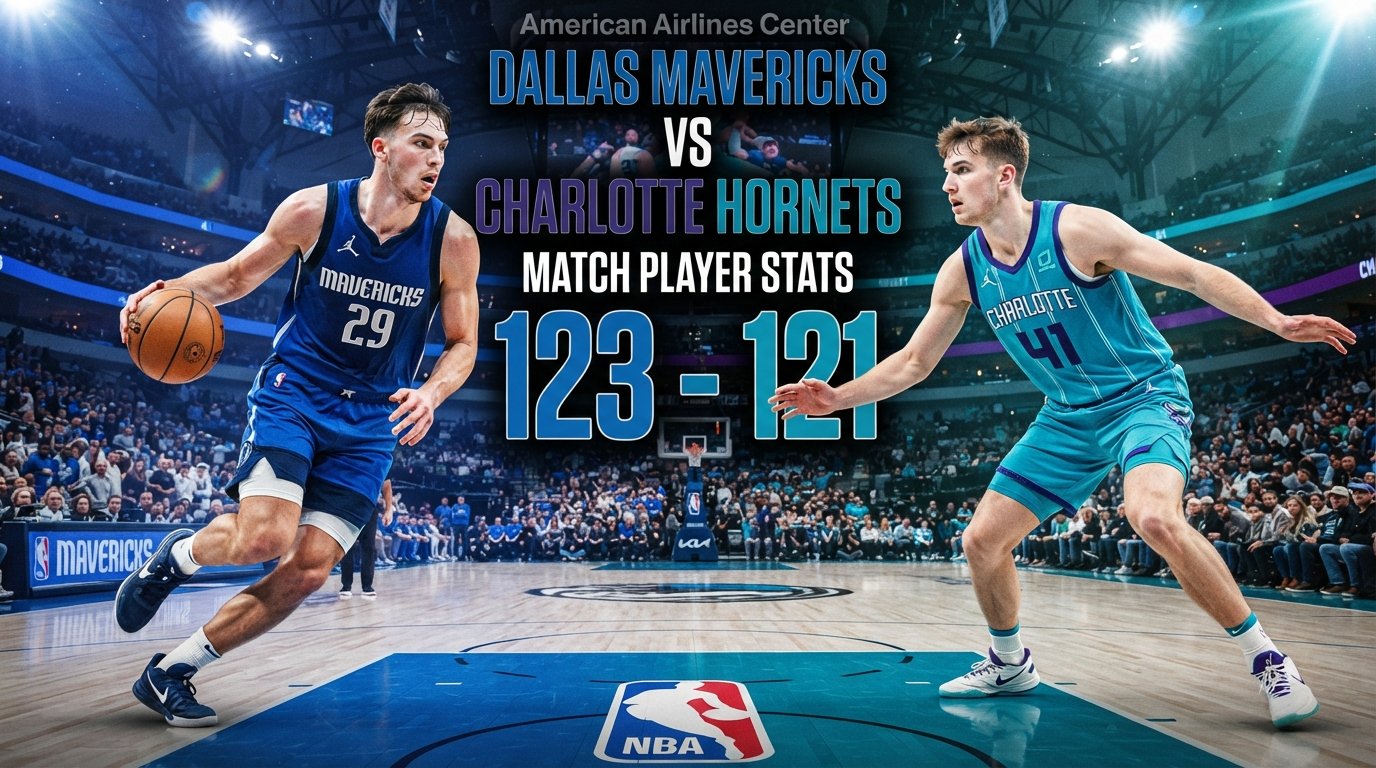
The dallas mavericks vs charlotte hornets match player stats from January 29, 2026, tell the story of a thrilling NBA contest that came down to the final moments. The Charlotte Hornets defeated the Dallas Mavericks 123-121 at the American Airlines Center in Dallas, despite an extraordinary 49-point performance from Cooper Flagg. Charlotte’s balanced scoring, outstanding three-point shooting, and Kon Knueppel’s 34-point contribution helped the visitors secure a narrow victory.
This matchup offered several interesting individual performances and important team statistics. Flagg dominated offensively for Dallas, while Knueppel delivered one of the most efficient shooting performances of the evening. LaMelo Ball controlled Charlotte’s offense with 22 points and nine assists, and Miles Bridges contributed across multiple statistical categories.
The two-point difference reflected how important individual possessions, perimeter shooting, and first-quarter momentum became throughout the game. Dallas produced strong offensive stretches in the second and third quarters, but Charlotte’s early advantage and efficient fourth-quarter execution proved decisive.
In this detailed breakdown, we examine the final score, individual player performances, shooting percentages, rebounding numbers, assists, turnovers, quarter-by-quarter scoring, and the statistical factors that explain how Charlotte secured the 123-121 road win.
Dallas Mavericks vs Charlotte Hornets Match Player Stats: Final Score and Game Overview
Hornets’ logo unveiled in Charlotte – ESPN
Charlotte Hornets
123
Winner
121
Final
January 29, 2026
Mavericks Announce New Team President As Permanent Nico Harrison Replacement – Athlon
Dallas Mavericks
121
Home team
Venue
American Airlines Center
Location
Dallas, Texas
Attendance
19,024
Season series
Charlotte leads 1-0
The Hornets entered this matchup with a 21-28 overall record and a 12-15 road record. Dallas arrived with a 19-29 overall record and a 14-14 home record.
Although Dallas played in front of its home crowd, Charlotte established control early. The Hornets scored 33 points in the opening quarter while limiting the Mavericks to just 20.
Dallas responded with a strong second quarter, scoring 38 points and reducing Charlotte’s advantage. The Mavericks continued their offensive pressure in the third period, but Charlotte maintained enough scoring production to protect its overall lead.
The fourth quarter became particularly important because neither team created a comfortable separation. Charlotte scored 30 points, compared with Dallas’ 28, preserving its two-point advantage at the final buzzer.
Final game statistics at a glance
| Game information | Result |
| Final score | Charlotte 123-121 Dallas |
| Game date | January 29, 2026 |
| Charlotte record | 21-28 |
| Dallas record | 19-29 |
| Charlotte road record | 12-15 |
| Dallas home record | 14-14 |
| Attendance | 19,024 |
| Venue | American Airlines Center |
| Season series | Charlotte leads 1-0 |
The final score was particularly interesting because Dallas actually recorded more field goals and rebounds. However, Charlotte made significantly more three-pointers and converted a higher percentage of its perimeter attempts.
That difference became one of the most important statistical explanations for the outcome.
Quarter-by-Quarter Scoring Breakdown
The scoring progression provides a clearer understanding of how the game developed. Charlotte’s first-quarter performance created an advantage that Dallas never completely eliminated.
| Quarter | Charlotte | Dallas |
| First | 33 | 20 |
| Second | 26 | 38 |
| Third | 34 | 35 |
| Fourth | 30 | 28 |
| Final | 123 | 121 |
First quarter: Charlotte establishes early control
Charlotte opened the game with 33 points, while Dallas managed only 20. The 13-point scoring difference gave the Hornets an important early advantage.
The opening period demonstrated Charlotte’s ability to create scoring opportunities through perimeter shooting and offensive movement. The Hornets established a rhythm that forced Dallas to spend much of the remaining game trying to recover.
Dallas struggled to match Charlotte’s offensive production during this stretch. Although the Mavericks eventually found their scoring rhythm, their slow beginning created additional pressure.
Second quarter: Dallas responds with a scoring surge
The Mavericks delivered their strongest quarter in the second period, producing 38 points against Charlotte’s 26.
This 12-point advantage almost completely erased the damage from the opening quarter.
Dallas improved its offensive execution and began finding more consistent scoring opportunities. The difference between the first and second quarters showed how quickly the game’s momentum could change.
Charlotte still entered halftime with a narrow advantage, but Dallas had made the contest much more competitive.
Third quarter: Both teams maintain offensive pressure
Dallas continued its strong performance in the third quarter, scoring 35 points. Charlotte responded with 34.
The Mavericks won the period by one point, but the Hornets maintained their overall lead.
This was an important stage because Dallas needed to produce a sustained scoring advantage rather than simply match Charlotte’s offensive output.
The Hornets continued to receive contributions from multiple players, preventing Dallas from concentrating entirely on one scoring option.
Fourth quarter: Charlotte protects its advantage
The final period delivered another competitive stretch.
Charlotte scored 30 points, while Dallas recorded 28. That two-point difference was enough to preserve the Hornets’ victory.
Dallas had produced 49 points from Cooper Flagg, but Charlotte’s collective offensive production proved difficult to overcome.
The fourth-quarter numbers demonstrate why a strong individual scoring performance does not always guarantee a team victory.
Complete Charlotte Hornets Player Statistics
Charlotte’s offensive performance was built around five players who combined for 106 points.
Kon Knueppel led the scoring, while Brandon Miller and LaMelo Ball provided additional perimeter production. Miles Bridges contributed through scoring, rebounding, and playmaking.
Charlotte Hornets player stats table
| Player | Points | Rebounds | Assists |
| Kon Knueppel | 34 | 4 | 3 |
| Brandon Miller | 23 | Not provided | Not provided |
| LaMelo Ball | 22 | Not provided | 9 |
| Miles Bridges | 17 | 8 | 8 |
| Moussa Diabate | 10 | 5 | 3 |
| Collin Sexton | 8 | Not provided | Not provided |
| Ryan Kalkbrenner | 5 | Not provided | Not provided |
| Josh Green | 2 | Not provided | Not provided |
Individual statistics not included in the supplied box-score information are intentionally left unspecified.
Kon Knueppel delivers a 34-point performance
Kon Knueppel Fantasy Outlook: Should You Draft the Charlotte Hornets Shooting Guard This Year?
34 points
Kon Knueppel
Charlotte Hornets
10-of-16 FG | 8-of-12 3PT | 6-of-6 FT
Kon Knueppel was Charlotte’s leading scorer and one of the most influential players in the entire matchup.
He finished with 34 points on 10-of-16 shooting from the field. His three-point performance was particularly impressive, as he connected on eight of his 12 attempts from beyond the arc.
Knueppel also converted all six free throws, giving him another reliable source of offensive production.
His complete statistical contribution included:
- 34 points
- 4 rebounds
- 3 assists
- 10-of-16 field goals
- 8-of-12 three-pointers
- 6-of-6 free throws
- Plus/minus of +7
His three-point shooting percentage was approximately 66.7%, an exceptional figure for a player attempting 12 shots from long range.
Knueppel’s efficiency also deserves attention. He scored 34 points without needing an unusually high number of field-goal attempts. His shooting performance allowed Charlotte to maintain offensive pressure without depending exclusively on difficult mid-range attempts.
His perfect free-throw shooting added six more points and ensured that Charlotte converted opportunities when Dallas committed shooting fouls.
Brandon Miller contributes 23 points
kixstats.com | Which basketball shoes Brandon Miller wore
23 points
Brandon Miller
Charlotte Hornets
7-of-13 FG | 3-of-7 3PT
Brandon Miller delivered another important scoring performance, finishing with 23 points.
He made seven of his 13 field-goal attempts and converted three of seven three-point attempts.
Miller’s contribution was valuable because Charlotte needed more than one dependable scoring option to challenge Dallas throughout four quarters.
His 23 points provided an important secondary scoring source behind Knueppel.
The combination of Miller’s shooting and Knueppel’s perimeter efficiency made Charlotte difficult to defend. Dallas could not focus all its defensive attention on a single player without allowing other Hornets to create scoring opportunities.
LaMelo Ball records 22 points and nine assists
New York Knicks v Charlotte Hornets
22 PTS, 9 AST
LaMelo Ball
Charlotte Hornets
8-of-17 FG | 6-of-10 3PT
LaMelo Ball delivered one of Charlotte’s most complete offensive performances.
He scored 22 points and recorded nine assists, helping the Hornets maintain offensive balance.
His shooting statistics included:
- 8-of-17 field goals
- 6-of-10 three-pointers
- 22 total points
- 9 assists
Ball’s six successful three-point attempts were particularly important. His ability to score from the perimeter created additional space for Charlotte’s other offensive players.
His nine assists also demonstrated that his influence extended beyond scoring.
A point guard’s contribution should not be evaluated only through points. Ball’s passing helped teammates find better scoring opportunities, while his perimeter threat made defensive positioning more difficult for Dallas.
Miles Bridges produces across multiple categories
Miami Heat v Charlotte Hornets
17 PTS, 8 REB, 8 AST
Miles Bridges
Charlotte Hornets
Near triple-double performance
Miles Bridges provided one of the most balanced statistical contributions of the night.
He finished with 17 points, eight rebounds, and eight assists.
His performance demonstrated the value of players who can influence several areas of the game rather than focusing exclusively on scoring.
Bridges helped Charlotte through:
- Creating additional scoring opportunities.
- Collecting important defensive and offensive rebounds.
- Moving the ball between teammates.
- Supporting the team’s offensive balance.
His eight assists were especially valuable because they helped Charlotte distribute offensive responsibility.
Although he finished two rebounds and two assists short of a triple-double, his overall contribution remained significant.
Moussa Diabate adds important frontcourt production
Moussa Diabate recorded 10 points, five rebounds, and three assists.
His performance gave Charlotte another productive contributor in the frontcourt.
The Hornets needed players capable of contributing around the basket while also supporting the team’s passing and offensive movement.
Diabate’s 10 points helped Charlotte maintain its scoring balance. His five rebounds also provided additional support in a game where Dallas finished with a rebounding advantage.
Charlotte’s bench contributions
Charlotte received additional scoring from its reserves.
- Collin Sexton: 8 points.
- Ryan Kalkbrenner: 5 points.
- Josh Green: 2 points.
These contributions were smaller than those of the starting group, but they added to Charlotte’s overall offensive output.
The starting five combined for 106 points, demonstrating how heavily the Hornets’ offensive production was concentrated among their primary players.
The bench supplied the remaining 17 points recorded by the listed players.
Complete Dallas Mavericks Player Statistics
Dallas received an exceptional individual performance from Cooper Flagg, who scored 49 points and collected 10 rebounds.
The Mavericks also received contributions from P.J. Washington, Max Christie, Klay Thompson, and Brandon Williams. However, their combined production was not enough to overcome Charlotte’s perimeter shooting.
Dallas Mavericks player stats table
| Player | Points | Rebounds | Assists |
| Cooper Flagg | 49 | 10 | 3 |
| P.J. Washington | 14 | 9 | Not provided |
| Max Christie | 13 | 3 | 3 |
| Klay Thompson | 16 | Not provided | Not provided |
| Brandon Williams | 15 | Not provided | 6 |
| Daniel Gafford | 5 | 4 | Not provided |
| Caleb Martin | 6 | 11 | Not provided |
The table highlights the individual figures available in the supplied game information. Missing values have not been estimated.
Cooper Flagg scores an outstanding 49 points
49 points
Cooper Flagg
Dallas Mavericks
20-of-29 FG | 3-of-5 3PT | 6-of-6 FT
Cooper Flagg delivered the most impressive individual scoring performance of the matchup.
He finished with 49 points, 10 rebounds, and three assists. His shooting efficiency was outstanding, as he converted 20 of his 29 field-goal attempts.
His complete statistical contribution included:
- 49 points
- 10 rebounds
- 3 assists
- 20-of-29 field goals
- 3-of-5 three-pointers
- 6-of-6 free throws
- Plus/minus of +2
Flagg’s field-goal percentage was approximately 69%. This level of efficiency is particularly impressive considering his offensive workload.
He scored from different areas of the floor, attacked scoring opportunities, and consistently created problems for Charlotte’s defense.
His 10 rebounds also demonstrated that his influence was not limited to offensive production.
One particularly interesting detail was his plus/minus rating. Flagg finished at +2 despite Dallas losing the game. This means Dallas outscored Charlotte by two points during his time on the court, although the Mavericks were outscored overall.
Plus/minus is a useful contextual statistic, but it should never be interpreted as a complete measure of individual performance. It reflects the team’s scoring margin while a player is on the floor, not the player’s individual contribution in isolation.
Flagg’s 49 points were also historically significant. According to the game’s official NBA recap, he established a new NBA record for points scored in a game by a teenager, surpassing the previous record of 45.
His performance became the defining individual storyline of the contest, even though Charlotte ultimately secured the victory.
P.J. Washington contributes 14 points and nine rebounds
kixstats.com | Which basketball shoes P.J. Washington wore
14 PTS, 9 REB
P.J. Washington
Dallas Mavericks
Important frontcourt contribution
P.J. Washington finished with 14 points and nine rebounds.
His rebounding contribution was important because Dallas needed additional possessions to support its comeback attempts.
Washington provided frontcourt production alongside Flagg and helped Dallas compete physically around the basket.
His nine rebounds placed him just one short of a double-double.
Although his scoring total was considerably lower than Flagg’s, Washington’s contribution was valuable in supporting the Mavericks’ offensive and defensive efforts.
Max Christie records 13 points
Indiana Pacers v Dallas Mavericks
13 PTS
Max Christie
Dallas Mavericks
3 rebounds | 3 assists
Max Christie added 13 points, three rebounds, and three assists.
His contribution gave Dallas another scoring option and reduced some of the offensive pressure on Flagg.
Christie’s three assists also helped the Mavericks distribute possession and create opportunities for teammates.
However, Dallas needed more consistent scoring from its supporting players to match Charlotte’s offensive balance.
Klay Thompson supplies 16 points from the bench
16 points
Klay Thompson
Dallas Mavericks
4-of-11 three-pointers
Klay Thompson finished with 16 points off the bench.
He connected on four of his 11 three-point attempts, giving Dallas another perimeter scoring option.
His shooting was important because the Mavericks needed additional outside production to counter Charlotte’s successful three-point shooting.
However, his four successful three-pointers came from 11 attempts, representing approximately 36.4% accuracy.
That figure was respectable but not enough to close the overall gap between the teams’ perimeter efficiency.
Brandon Williams adds 15 points and six assists
Should Mavericks re-sign Brandon Williams in free agency? – Yahoo Sports
15 PTS, 6 AST
Brandon Williams
Dallas Mavericks
6-of-10 field goals
Brandon Williams recorded 15 points and six assists.
He converted six of his 10 field-goal attempts, giving him a 60% shooting percentage.
His combination of scoring and playmaking helped Dallas maintain offensive production beyond Flagg’s individual performance.
Williams’ six assists were particularly important because the Mavericks needed to create scoring opportunities for multiple players.
Daniel Gafford supports the frontcourt
Daniel Gafford finished with five points and four rebounds.
Although his scoring contribution was limited, his presence provided additional frontcourt support.
Dallas needed to compete against Charlotte’s interior players while also protecting the basket.
Gafford’s contribution was part of the Mavericks’ broader effort to maintain rebounding strength and defensive coverage.
Caleb Martin records 11 rebounds
Caleb Martin contributed six points and 11 rebounds.
His rebounding total was particularly notable because it was the highest individual figure listed in the supplied Dallas player summary apart from Flagg’s 10.
Martin helped Dallas maintain its overall rebounding advantage.
However, collecting more rebounds did not automatically translate into victory because Charlotte generated more efficient perimeter scoring.
Team Statistics Comparison: Charlotte vs Dallas
Individual performances explain much of the game’s story, but team statistics provide a broader understanding of the result.
Charlotte finished with 123 points, while Dallas recorded 121.
The Mavericks made more field goals and collected more rebounds. However, Charlotte’s three-point shooting and free-throw efficiency helped offset those advantages.
Complete team statistics comparison
| Statistical category | Charlotte | Dallas |
| Points | 123 | 121 |
| Field goals made | 43 | 48 |
| Field goals attempted | 91 | 103 |
| Field-goal percentage | 47.3% | 46.6% |
| Three-pointers made | 20 | 11 |
| Three-pointers attempted | 41 | 33 |
| Three-point percentage | 48.8% | 33.3% |
| Free throws made | 17 | 14 |
| Free throws attempted | 18 | 16 |
| Free-throw percentage | 94.4% | 87.5% |
| Total rebounds | 45 | 50 |
| Assists | 28 | 26 |
| Steals | 4 | 7 |
| Blocks | 9 | 8 |
| Turnovers | 10 | 8 |
Percentages are rounded from the official box-score figures. Team totals are presented using the NBA box-score statistics.
Three-point shooting was a decisive difference
The most important statistical difference was the teams’ three-point shooting.
Charlotte made 20 three-pointers from 41 attempts, while Dallas converted only 11 from 33 attempts.
That created a nine-three-pointer advantage for the Hornets.
In terms of points, Charlotte scored 60 points from beyond the arc, compared with Dallas’ 33.
Three-point production
Charlotte Hornets
60 points
20 successful three-pointers
Dallas Mavericks
33 points
11 successful three-pointers
Charlotte’s advantage
+27
This 27-point difference from three-point shooting was greater than the final two-point margin.
That does not mean three-point shooting alone explains every possession. Dallas generated more points inside the arc, and other scoring categories also mattered.
However, Charlotte’s perimeter efficiency created a significant advantage that Dallas could not fully overcome.
Field-goal efficiency remained relatively close
Charlotte converted 43 of 91 field-goal attempts, while Dallas made 48 of 103.
Their overall shooting percentages were relatively similar:
- Charlotte: 47.3%.
- Dallas: 46.6%.
Dallas made five more field goals, but it also attempted 12 additional shots.
The difference shows why field-goal totals should always be evaluated alongside shooting attempts and percentages.
A team can make more shots while still producing a lower overall scoring return from a particular area of the floor.
Free-throw shooting favored Charlotte
Charlotte converted 17 of 18 free throws, producing a 94.4% success rate.
Dallas made 14 of 16 attempts, finishing at 87.5%.
Although the difference was smaller than the three-point advantage, Charlotte’s free-throw accuracy helped protect its lead.
Knueppel was particularly effective at the free-throw line, converting all six attempts.
In a game decided by two points, every successful free throw mattered.
Dallas controlled the rebounding battle
Dallas collected 50 total rebounds, compared with Charlotte’s 45.
The Mavericks therefore finished with a five-rebound advantage.
Caleb Martin’s 11 rebounds and Flagg’s 10 were important contributors to that total.
P.J. Washington also collected nine rebounds.
Charlotte’s rebounding total was lower, but the Hornets compensated through efficient shooting and better three-point production.
This is an important basketball lesson: controlling the glass can create extra opportunities, but those opportunities must be converted into points.
Charlotte recorded more assists
The Hornets recorded 28 assists, while Dallas finished with 26.
The difference was relatively small, but Charlotte’s assist total reflected its balanced offensive contribution.
LaMelo Ball’s nine assists and Miles Bridges’ eight were especially important.
Their combined 17 assists accounted for a substantial portion of Charlotte’s total.
Dallas also received six assists from Brandon Williams, while the remaining playmaking responsibilities were distributed among other players.
Turnovers and defensive production
Dallas committed eight turnovers, compared with Charlotte’s 10.
The Mavericks therefore protected possession slightly better.
Dallas also recorded seven steals, compared with Charlotte’s four.
The teams’ block totals were eight for Dallas and nine for Charlotte in the official box score.
These numbers show that Dallas produced several defensive advantages despite losing.
The result is a useful reminder that winning individual statistical categories does not automatically determine the final score. Basketball outcomes depend on how efficiently teams convert their opportunities across the entire game.
Why the Charlotte Hornets Won Despite Cooper Flagg’s 49 Points
Charlotte’s victory was not simply the result of one outstanding player. The Hornets benefited from a combination of perimeter accuracy, balanced scoring, and an important first-quarter advantage.
Several statistical factors explain the outcome.
1. Charlotte created a significant advantage from long range
The biggest difference came from three-point shooting.
Charlotte made nine more three-pointers than Dallas. That represented 27 additional points from beyond the arc.
Even though Dallas made more field goals overall, its lower three-point production created a scoring disadvantage.
Knueppel, Ball, and Miller were particularly important in this area.
Their combined perimeter production gave Charlotte multiple scoring options and prevented Dallas from concentrating exclusively on one shooter.
2. The opening quarter created an important scoring cushion
Charlotte scored 33 points in the first quarter, compared with Dallas’ 20.
That 13-point advantage established an early foundation for the victory.
Dallas responded strongly in the second quarter, but Charlotte did not completely surrender its lead.
This is important when analyzing close NBA games. A team does not need to win every quarter to secure a victory. It needs to produce enough scoring over the full 48 minutes.
3. Charlotte received scoring from multiple players
The Hornets had five players reach double figures:
- Kon Knueppel: 34 points.
- Brandon Miller: 23 points.
- LaMelo Ball: 22 points.
- Miles Bridges: 17 points.
- Moussa Diabate: 10 points.
This balanced contribution made Charlotte’s offense more difficult to contain.
Dallas had an extraordinary individual scorer in Flagg, but Charlotte distributed its scoring responsibility across several players.
The difference between concentrated and distributed scoring was one of the defining features of this contest.
4. Charlotte converted its scoring opportunities efficiently
The Hornets shot 47.3% from the field and 48.8% from three-point range.
Their free-throw percentage was also above 94%.
Dallas finished with a slightly lower overall field-goal percentage and a considerably lower three-point percentage.
The Hornets therefore received more value from their perimeter attempts.
5. Dallas could not fully capitalize on its rebounding advantage
Dallas collected five more rebounds than Charlotte.
This was a positive statistical area for the Mavericks, especially considering Martin and Flagg’s contributions.
However, the rebounding advantage did not translate into a sufficient scoring advantage.
The Mavericks needed more successful perimeter attempts to convert their overall offensive opportunities into a victory.
Cooper Flagg vs Kon Knueppel: Individual Performance Comparison
One of the most interesting aspects of this matchup was the contrast between Cooper Flagg and Kon Knueppel.
Both players delivered outstanding scoring performances, but their statistical contributions came in different ways.
Cooper Flagg
49
Points
10 rebounds | 3 assists
20-of-29 FG
Kon Knueppel
34
Points
4 rebounds | 3 assists
10-of-16 FG
| Category | Cooper Flagg | Kon Knueppel |
| Points | 49 | 34 |
| Rebounds | 10 | 4 |
| Assists | 3 | 3 |
| Field goals made | 20 | 10 |
| Field goals attempted | 29 | 16 |
| Three-pointers made | 3 | 8 |
| Three-pointers attempted | 5 | 12 |
| Free throws made | 6 | 6 |
| Free throws attempted | 6 | 6 |
| Plus/minus | +2 | +7 |
Flagg scored 15 more points than Knueppel and collected six additional rebounds.
However, Knueppel made five more three-pointers and finished with a higher plus/minus rating.
Their performances illustrate two different offensive approaches.
Flagg generated substantial scoring through overall field-goal production, while Knueppel produced a significant portion of his points from the perimeter.
Both players were highly efficient, but Knueppel’s contribution was particularly important to Charlotte’s team victory.
The Importance of the Final Possessions
The final moments of the game added another layer to the statistical story.
According to the official game recap, the score was tied before the decisive late possession.
With approximately seven seconds remaining, Knueppel intercepted an errant pass from Flagg near midcourt. He moved toward the basket and drew a foul.
Knueppel then converted both free throws with 4.1 seconds remaining, giving Charlotte a 123-121 advantage.
Dallas still had an opportunity to force overtime.
Flagg attempted a 20-foot pull-up shot at the buzzer, but the attempt missed after hitting the back of the rim.
The Hornets secured the two-point victory.
This sequence highlights the importance of decision-making under pressure.
Flagg’s scoring performance was remarkable, but the late turnover created an opportunity that Charlotte converted into the winning points.
Knueppel’s ability to make both free throws was equally important.
The final possession also demonstrates why game analysis should include more than points, rebounds, and assists. Turnovers, fouls, shot selection, and late-game execution can determine the result of a closely contested matchup.
What the Statistics Reveal About Both Teams
What Charlotte can take from the victory
Charlotte’s performance demonstrated several positive offensive characteristics.
Perimeter shooting: The Hornets converted 20 three-pointers, giving them an important advantage over Dallas.
Balanced scoring: Five Charlotte players reached double figures, reducing the team’s dependence on one offensive option.
Playmaking: Ball and Bridges combined for 17 assists, supporting the team’s ball movement.
Free-throw accuracy: Charlotte converted 17 of 18 attempts, providing reliable scoring opportunities.
However, the Hornets also had areas that deserve attention.
They collected fewer rebounds and committed two more turnovers than Dallas. Those numbers show that their victory was not built on dominating every statistical category.
Instead, Charlotte made better use of its perimeter scoring opportunities.
What Dallas can take from the performance
Dallas had several encouraging individual performances.
Flagg’s 49 points and 10 rebounds demonstrated his ability to carry a major offensive workload.
Washington contributed 14 points and nine rebounds, while Christie added 13 points.
Klay Thompson and Brandon Williams also supplied important scoring contributions.
Dallas finished ahead in rebounds and turnovers and recorded more steals.
However, its three-point shooting was a major weakness compared with Charlotte’s performance.
The Mavericks made only 11 of 33 attempts from long range.
Improving perimeter efficiency and maintaining defensive discipline during the opening quarter would have been important areas to examine after this result.
Understanding the limitations of individual statistics
There are several reasons why a box score should not be treated as a complete evaluation of a basketball game.
For example, points do not explain how a player created scoring opportunities. Rebounds do not always reveal the quality of defensive positioning. Assists do not measure every successful pass that creates an advantage.
Even plus/minus has limitations because it reflects team performance during a player’s minutes rather than individual performance alone.
For a more complete evaluation, readers should consider:
- Shooting efficiency alongside scoring totals.
- Turnovers alongside assists.
- Rebounds alongside second-chance opportunities.
- Three-point production alongside overall field-goal attempts.
- Individual contributions alongside the final team result.
This approach provides a more accurate understanding of why Charlotte won and why Dallas lost despite Flagg’s extraordinary performance.
Game Records, Venue and Additional Information
The matchup took place at the American Airlines Center in Dallas, Texas, on January 29, 2026.
The listed attendance was 19,024.
The officiating crew consisted of:
- James Capers
- J.B. DeRosa
- Evan Scott
Charlotte entered the game with a 21-28 record, while Dallas had a 19-29 record.
Following the result, Charlotte led the season series 1-0.
The matchup was especially notable because it brought former Duke teammates Cooper Flagg and Kon Knueppel together in an NBA game for the first time.
Their combined 83 points provided one of the biggest individual storylines of the contest.
For readers interested in checking the original scoring figures, player shooting totals, and official game information, the official NBA box score provides the recorded statistics.
Frequently Asked Questions (FAQs)
1. Who won the Dallas Mavericks vs Charlotte Hornets game on January 29, 2026?
The Charlotte Hornets defeated the Dallas Mavericks 123-121 on January 29, 2026, at the American Airlines Center in Dallas. Charlotte secured the victory through efficient three-point shooting and late-game execution.
2. How many points did Cooper Flagg score against the Charlotte Hornets?
Cooper Flagg scored 49 points for Dallas. He also recorded 10 rebounds and three assists while shooting 20-of-29 from the field, including three successful three-pointers.
3. Who was Charlotte’s leading scorer against Dallas?
Kon Knueppel led Charlotte with 34 points. He made 10 of 16 field-goal attempts, including eight of 12 three-pointers, and converted all six free throws.
4. How many three-pointers did the Charlotte Hornets make?
Charlotte made 20 three-pointers from 41 attempts, finishing with a 48.8% success rate. Dallas made 11 three-pointers from 33 attempts.
5. Which Dallas Mavericks players contributed the most points?
Cooper Flagg led Dallas with 49 points. Klay Thompson added 16, Brandon Williams scored 15, P.J. Washington recorded 14, and Max Christie contributed 13 points.
6. Where was the Mavericks vs Hornets game played?
The game was played at the American Airlines Center in Dallas, Texas. The venue recorded an attendance of 19,024 for the January 29, 2026 matchup.
Conclusion
The January 29, 2026 matchup between Charlotte and Dallas delivered an exciting contest featuring outstanding individual performances and a dramatic finish. The Hornets secured a 123-121 victory despite Cooper Flagg’s remarkable 49-point performance.
Kon Knueppel led Charlotte with 34 points, including eight successful three-pointers. Brandon Miller added 23 points, LaMelo Ball contributed 22 points and nine assists, and Miles Bridges recorded 17 points, eight rebounds, and eight assists.
Dallas demonstrated its offensive potential through Flagg’s scoring, Washington’s rebounding, and contributions from Thompson, Christie, and Williams. The Mavericks also finished ahead in total rebounds and committed fewer turnovers.
However, Charlotte’s 20 successful three-pointers compared with Dallas’ 11 created a significant scoring advantage. The Hornets also benefited from strong free-throw accuracy and a crucial first-quarter lead.
Ultimately, this matchup demonstrated the importance of balanced scoring, shooting efficiency, and execution during decisive possessions. Flagg produced the game’s highest individual scoring total, but Charlotte’s collective performance proved sufficient to secure the two-point road victory.