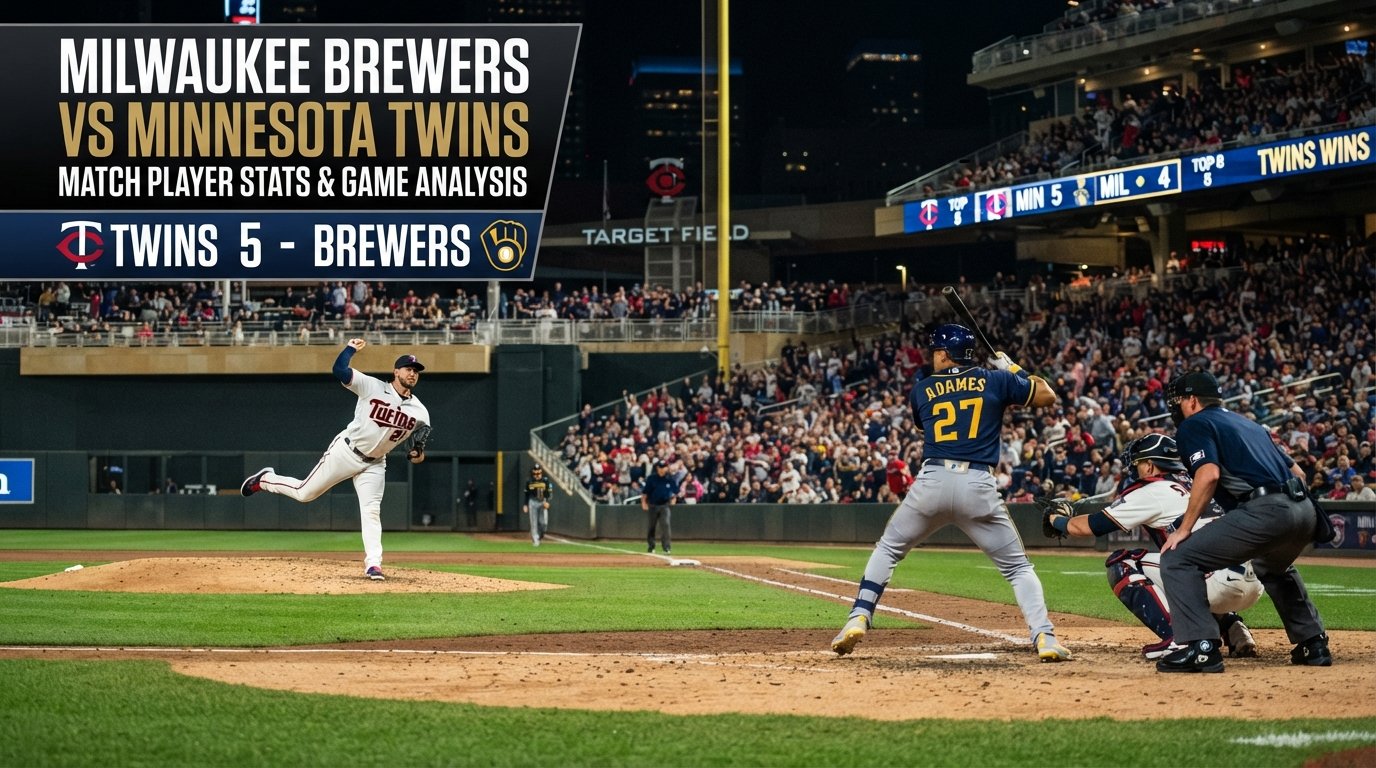
Milwaukee Brewers vs Minnesota Twins Match Player Stats
The milwaukee brewers vs minnesota twins match player stats tell the story of a close 5-4 Minnesota victory at Target Field on May 17, 2026. The Twins used timely hitting, an important home run from Ryan Jeffers, and an effective bullpen performance to defeat Milwaukee in a game that remained competitive until the final out. Although the Brewers collected 10 hits compared with Minnesota’s six, their inability to convert runners into runs proved costly. Milwaukee finished 1-for-14 with runners in scoring position and left 11 players on base, while Minnesota made better use of its limited offensive opportunities.
The matchup featured several notable individual performances. Kody Clemens delivered two doubles and two RBIs, Jeffers added a go-ahead solo home run, and Bailey Ober earned his fifth victory of the season. On Milwaukee’s side, Christian Yelich and Garrett Mitchell both homered, while Sal Frelick contributed two hits and two stolen bases. The Brewers also mounted a ninth-inning comeback attempt, but Luis García managed to protect Minnesota’s narrow advantage and record his second save.
This breakdown examines the complete batting performances, pitching statistics, important scoring plays, defensive contributions, baserunning decisions, and tactical factors that determined the result.
Milwaukee Brewers vs Minnesota Twins Match Player Stats: Game Overview
The May 17 contest at Target Field provided an excellent example of how baseball games are influenced by more than total hits or home runs. Milwaukee generated more hits and reached scoring opportunities throughout the afternoon, but Minnesota produced more effective results when it mattered.
Final Game Information
| Game Detail | Information |
| Matchup | Milwaukee Brewers vs Minnesota Twins |
| Date | May 17, 2026 |
| Final Score | Twins 5, Brewers 4 |
| Venue | Target Field |
| Location | Minneapolis, Minnesota |
| Attendance | 25,375 |
| Game Duration | 2 hours, 54 minutes |
| Winning Pitcher | Bailey Ober |
| Losing Pitcher | Grant Anderson |
| Save | Luis García |
| Brewers Record Entering Game | 26-18 |
| Twins Record Entering Game | 21-26 |
Minnesota entered the game looking to avoid losing all three contests in the series. Milwaukee had already established an advantage by winning the first two games, making the finale particularly important for the home team.
The Twins responded with a disciplined performance that combined extra-base hitting, defensive consistency, and timely bullpen contributions.
Final Score by Inning
| Inning | Brewers | Twins |
| First | 0 | 1 |
| Second | 1 | 0 |
| Third | 0 | 2 |
| Fourth | 1 | 0 |
| Fifth | 1 | 1 |
| Sixth | 0 | 0 |
| Seventh | 0 | 0 |
| Eighth | 0 | 1 |
| Ninth | 1 | 0 |
| Total | 4 | 5 |
Minnesota established its initial advantage in the opening inning and extended it during the third. Milwaukee answered with two solo home runs, temporarily bringing the contest level.
Jeffers then restored Minnesota’s advantage in the fifth inning. The Twins added another run in the eighth, which ultimately became the difference between winning and losing.
Milwaukee scored once in the ninth, but the final rally stopped short of producing an equalizer.
Complete Milwaukee Brewers Batting Statistics
The Brewers finished with 10 hits and four runs. Their offensive production included two home runs, several doubles, and multiple opportunities to score.
However, the team left 11 runners on base. That figure highlights the biggest weakness in Milwaukee’s offensive performance.
| Player | At-Bats | Hits | Runs | RBIs | Home Runs |
| Jackson Chourio | 5 | 1 | 0 | 0 | 0 |
| Brice Turang | 4 | 0 | 1 | 0 | 0 |
| William Contreras | 5 | 2 | 0 | 0 | 0 |
| Christian Yelich | 5 | 1 | 1 | 1 | 1 |
| Jake Bauers | 4 | 2 | 1 | 1 | 0 |
| Sal Frelick | 5 | 2 | 0 | 1 | 0 |
| Garrett Mitchell | 3 | 1 | 1 | 1 | 1 |
| Joey Ortiz | 1 | 1 | 0 | 0 | 0 |
| Brewers other batters | 4 | 0 | 0 | 0 | 0 |
Note: The remaining plate appearances include Milwaukee’s other lineup participants and substitutions. The complete team total was 36 at-bats, 10 hits, and four runs.
Christian Yelich’s Home Run Performance
Christian Yelich provided one of Milwaukee’s most important offensive moments.
He finished 1-for-5 with one run, one RBI, and a solo home run. His fifth-inning homer traveled approximately 398 feet and tied the score at 3-3.
The home run demonstrated Yelich’s ability to produce an important result even when his overall batting line was relatively limited.
His contribution was particularly valuable because Milwaukee needed an immediate response after falling behind during the third inning.
Yelich’s performance also showed the importance of power hitting in a close game. Milwaukee had struggled to convert multiple baserunners into runs, so a solo home run offered a direct way to change the scoreboard.
Nevertheless, the Brewers needed additional offensive support after his contribution.
Garrett Mitchell’s Power at the Plate
Garrett Mitchell also delivered a significant performance for Milwaukee.
He finished 1-for-3 with one run, one RBI, and one home run. His fourth-inning solo shot traveled approximately 405 feet and reduced Minnesota’s advantage to 3-2.
The timing was important because the Twins had scored twice in the third inning to establish a two-run lead.
Mitchell’s home run immediately reduced that advantage and gave Milwaukee renewed offensive momentum.
His performance demonstrated the value of power hitters who can change a game’s direction with one swing.
However, Mitchell’s contribution remained a single-run event. Milwaukee still needed additional production from its other hitters to take control.
Jake Bauers Delivers Important Offensive Production
Jake Bauers was among Milwaukee’s most consistent offensive contributors.
He finished 2-for-4 with one run and one RBI. His performance included a double and an important ninth-inning single.
Bauers’ final-inning contribution brought Brice Turang home and reduced Minnesota’s lead to 5-4.
That hit created pressure on the Twins’ bullpen and gave Milwaukee another opportunity to extend the game.
Bauers also scored Milwaukee’s first run after reaching base earlier in the contest.
His two-hit performance showed that he could contribute through both extra-base hitting and situational contact.
Sal Frelick’s Two-Hit and Baserunning Performance
Sal Frelick produced one of Milwaukee’s most complete performances.
He finished 2-for-5 with one RBI and two stolen bases.
His second-inning double brought Bauers home and tied the score at 1-1.
Frelick also demonstrated his value as a baserunner by successfully stealing second and third base during the game.
Those stolen bases created additional pressure on Minnesota’s defense and showed how Milwaukee could generate scoring opportunities without relying entirely on home runs.
His performance was particularly important because aggressive baserunning can change defensive positioning and create opportunities for subsequent hitters.
Frelick’s offensive contribution was productive, but Milwaukee’s overall difficulty with runners in scoring position prevented the team from getting more value from its baserunners.
William Contreras and Jackson Chourio
William Contreras collected two hits in five at-bats.
Although he did not record an RBI or score a run, his two-hit performance helped Milwaukee reach double-digit hits.
Contreras remained an important part of the team’s offensive production because of his ability to make consistent contact.
Jackson Chourio also contributed a hit and recorded a stolen base.
His speed created another baserunning opportunity for Milwaukee. However, the Brewers could not consistently bring their runners home.
Brice Turang’s Contribution
Brice Turang scored one run and drew a walk.
His ninth-inning run came after Jake Bauers delivered an RBI single.
Turang’s ability to reach base was valuable in a game where Milwaukee needed every available scoring opportunity.
Although his individual batting production was limited, his presence on the bases helped create the pressure that nearly produced a late comeback.
Minnesota Twins Batting Statistics
Minnesota collected six hits but scored five runs.
The team’s offensive performance was built around extra-base hits, timely home runs, and effective execution in important situations.
Kody Clemens and Ryan Jeffers were particularly influential.
Complete Minnesota Hitting Breakdown
| Player | At-Bats | Hits | Runs | RBIs | Home Runs |
| Alex Martin | 2 | 0 | 1 | 0 | 0 |
| Brooks Lee | 4 | 0 | 0 | 0 | 0 |
| Ryan Jeffers | 3 | 2 | 2 | 1 | 1 |
| Kody Clemens | 4 | 2 | 1 | 2 | 0 |
| Luke Keaschall | 3 | 2 | 1 | 0 | 0 |
| Victor Caratini | 1 | 0 | 0 | 1 | 0 |
| Royce Lewis | 3 | 0 | 0 | 0 | 0 |
| Ryan Kreidler | 4 | 0 | 0 | 0 | 0 |
| James Outman | 3 | 0 | 0 | 0 | 0 |
The Twins finished with six hits and five runs. Their offensive efficiency was a major difference between the two teams.
Ryan Jeffers Leads Minnesota’s Offensive Attack
Ryan Jeffers delivered the decisive offensive contribution.
He finished 2-for-3 with two runs, one RBI, and one home run.
His fifth-inning homer broke the 3-3 tie and gave Minnesota a 4-3 advantage.
The home run was his seventh of the season and came against Milwaukee reliever Grant Anderson.
Jeffers demonstrated why power hitting from the middle of the batting order can become especially important in close contests.
His two-hit performance also helped Minnesota maintain offensive pressure despite recording fewer total hits than Milwaukee.
The home run was not simply another scoring event. It changed the game’s situation by forcing Milwaukee to chase the lead for the remainder of the afternoon.
Jeffers also scored twice, making him one of the most influential players in the final result.
Kody Clemens Produces Two Important Doubles
Kody Clemens delivered one of the strongest performances in the game.
He finished 2-for-4 with one run and two RBIs.
Both hits were doubles, and each played an important role in Minnesota’s early scoring advantage.
His first-inning double brought Alex Martin home to establish a 1-0 lead.
Clemens delivered another important double in the third inning, scoring Ryan Jeffers and extending Minnesota’s advantage.
A throwing error by Joey Ortiz then allowed Clemens to score, helping the Twins move ahead 3-1.
His performance demonstrated how extra-base hits can create multiple scoring opportunities without requiring home runs.
Clemens’ ability to produce in important situations made him a central figure in Minnesota’s victory.
Luke Keaschall’s Speed and Extra-Base Hitting
Luke Keaschall finished 2-for-3 with one run and one triple.
His performance was particularly important during the eighth inning.
Keaschall delivered a triple against Jake Woodford, putting himself in scoring position with no need for an additional base hit.
Victor Caratini subsequently hit a sacrifice fly, allowing Keaschall to score.
That sequence produced Minnesota’s fifth run.
Although Keaschall was caught stealing earlier in the game, his overall offensive contribution remained valuable.
His combination of contact hitting and speed gave Minnesota another way to create scoring opportunities.
Victor Caratini’s Important Sacrifice Fly
Victor Caratini did not record a hit, but he delivered an important RBI.
His eighth-inning sacrifice fly brought Keaschall home and increased Minnesota’s lead to 5-3.
That run became especially important when Milwaukee scored once in the ninth.
Caratini’s contribution illustrates why traditional batting averages do not always capture a player’s complete offensive value.
A sacrifice fly does not count as a hit, but it can directly change the scoreboard.
His execution in the eighth inning gave Minnesota the additional insurance run it ultimately needed.
Alex Martin’s Opening-Inning Contribution
Alex Martin scored Minnesota’s opening run after reaching base and advancing into scoring position.
Clemens’ double brought him home and established an early advantage.
Martin also drew a walk, providing another example of how reaching base can contribute to team offense without recording a hit.
His opening-inning run helped Minnesota establish control before Milwaukee responded in the second.
Brewers vs Twins Pitching Statistics
Pitching was another major factor in the final result.
Milwaukee’s pitchers allowed five runs, including four earned runs, while Minnesota’s pitching staff surrendered four runs.
The difference was not simply the number of strikeouts.
Minnesota’s bullpen successfully protected the lead during the final innings, while Milwaukee’s pitching staff struggled to prevent the decisive fifth and eighth-inning runs.
Milwaukee Brewers Pitching Breakdown
| Pitcher | Innings | Hits Allowed | Runs | Earned Runs | Strikeouts | Walks |
| Robert Gasser | 4.0 | 3 | 3 | 2 | 3 | 2 |
| Grant Anderson | 1.2 | 2 | 1 | 1 | 2 | 0 |
| DL Hall | 1.1 | 0 | 0 | 0 | 2 | 1 |
| Jake Woodford | 1.0 | 1 | 1 | 1 | 1 | 0 |
| Total | 8.0 | 6 | 5 | 4 | 8 | 3 |
Robert Gasser’s Starting Performance
Robert Gasser started for Milwaukee and pitched four innings.
He allowed three hits and three runs, including two earned runs. He also issued two walks and recorded three strikeouts.
Gasser’s performance was a mixture of positive and negative moments.
His three strikeouts showed that he could retire Minnesota hitters without allowing consistent contact.
However, the Twins managed to create scoring opportunities through doubles and patient plate appearances.
The defensive error charged to Joey Ortiz also affected the final result of Gasser’s outing.
The third inning became particularly damaging because Clemens’ double and the subsequent throwing error helped Minnesota establish a 3-1 advantage.
Gasser limited Minnesota to three hits, but the damage from those hits was significant.
Grant Anderson Takes the Loss
Grant Anderson pitched 1.2 innings and allowed two hits and one earned run.
He recorded two strikeouts without issuing a walk.
Despite producing some effective results, Anderson surrendered Jeffers’ go-ahead home run in the fifth inning.
The solo shot changed the score from 3-3 to 4-3.
Anderson received the loss, moving his season record to 1-2.
His outing demonstrates how one mistake can become decisive in a close baseball game.
A pitcher can record several successful outs, but a poorly located pitch against a power hitter may still change the final result.
DL Hall Provides Scoreless Relief
DL Hall delivered 1.1 scoreless innings.
He allowed no hits and recorded two strikeouts while issuing one walk.
Hall’s performance was one of Milwaukee’s strongest pitching contributions.
He prevented Minnesota from extending its advantage during his appearance and gave the Brewers a chance to remain competitive.
His ability to generate strikeouts without allowing hits helped stabilize the pitching situation after the earlier scoring.
Jake Woodford Allows the Eighth-Inning Run
Jake Woodford pitched one inning and allowed one hit and one earned run.
He recorded one strikeout.
The important moment came when Keaschall hit a triple and Caratini followed with a sacrifice fly.
Woodford’s outing ended with Minnesota extending its lead to 5-3.
Although the run was costly, Milwaukee still had an opportunity to respond in the ninth.
Minnesota Twins Pitching Breakdown
| Pitcher | Innings | Hits Allowed | Runs | Earned Runs | Strikeouts | Walks |
| Bailey Ober | 5.0 | 6 | 3 | 3 | 1 | 2 |
| Aaron Banda | 0.2 | 1 | 0 | 0 | 2 | 1 |
| Adam Morris | 1.0 | 0 | 0 | 0 | 1 | 0 |
| Taylor Rogers | 0.2 | 1 | 0 | 0 | 0 | 0 |
| Justin Topa | 0.2 | 0 | 0 | 0 | 0 | 1 |
| Luis García | 1.0 | 2 | 1 | 1 | 1 | 1 |
| Total | 9.0 | 10 | 4 | 4 | 5 | 5 |
Bailey Ober Earns His Fifth Victory
Bailey Ober started for Minnesota and pitched five innings.
He allowed six hits and three earned runs while recording one strikeout and issuing two walks.
Ober did not dominate Milwaukee through strikeouts, but he managed to keep the game within reach.
The Brewers produced several quality offensive moments against him.
Mitchell and Yelich both homered, while Frelick and other Milwaukee hitters generated additional baserunners.
However, Ober’s team continued to compete offensively and eventually gave him the support necessary to earn the win.
His record improved to 5-2.
Aaron Banda Contributes Important Relief
Aaron Banda entered the game after Ober and recorded two strikeouts in two-thirds of an inning.
He allowed one hit and one walk without surrendering a run.
His contribution was important because Minnesota needed to prevent Milwaukee from building momentum after the fifth inning.
Banda’s strikeout ability helped limit the damage and maintain the Twins’ advantage.
Adam Morris Delivers a Scoreless Inning
Adam Morris pitched one scoreless inning and recorded one strikeout.
He did not allow a hit or walk.
His clean inning helped Minnesota move closer to the final stages of the contest without surrendering its lead.
Morris demonstrated effective control and prevented Milwaukee from creating another scoring opportunity during his appearance.
Taylor Rogers and Justin Topa Protect the Advantage
Taylor Rogers pitched two-thirds of an inning without allowing a run.
He surrendered one hit but successfully prevented Milwaukee from scoring.
Justin Topa also contributed two outs.
He allowed no hits or runs, although he issued one walk.
Their combined work helped Minnesota bridge the middle innings and prepare for the ninth-inning save opportunity.
Luis García Records His Second Save
Luis García entered the ninth inning with Minnesota leading 5-3.
Milwaukee managed to produce a run through Bauers’ RBI single, reducing the deficit to 5-4.
García allowed two hits and one earned run while issuing one walk.
However, he successfully recorded the final out and secured his second save of the season.
His appearance was not completely smooth, but the most important responsibility of a closer is to finish the game.
García accomplished that objective.
Complete Team Statistics Comparison
The overall numbers explain why Minnesota won despite collecting fewer hits.
| Statistical Category | Brewers | Twins |
| Runs | 4 | 5 |
| Hits | 10 | 6 |
| Errors | 1 | 0 |
| Home Runs | 2 | 1 |
| Doubles | 3 | 2 |
| Triples | 0 | 1 |
| Walks | 3 | 5 |
| Batting Strikeouts | 5 | 8 |
| Left on Base | 11 | 6 |
| Stolen Bases | 3 | 0 |
| Team RISP | 1-for-14 | 0-for-1 |
One of the most interesting statistics is the difference in total hits.
Milwaukee recorded 10 hits, four more than Minnesota.
However, Minnesota scored five runs compared with Milwaukee’s four.
This difference highlights the importance of sequencing. A team does not necessarily win because it produces the greatest number of hits. It wins by converting enough opportunities into runs while preventing the opponent from doing the same.
Milwaukee’s 11 runners left on base were particularly damaging.
Minnesota left six.
The Brewers also struggled with runners in scoring position, finishing 1-for-14. Minnesota went 0-for-1 in those situations, showing that the team’s scoring came through a small number of productive opportunities, including home runs and extra-base hits.
How the Game Developed: Important Moments by Inning
First Inning: Minnesota Takes the Early Lead
The Twins opened the scoring in the first inning.
Alex Martin reached base and subsequently scored on Kody Clemens’ double.
The early run gave Minnesota a 1-0 advantage.
Milwaukee’s hitters could not respond during the top half of the opening inning, allowing the home team to establish the first advantage.
Second Inning: Milwaukee Answers Through Sal Frelick
The Brewers responded in the second inning.
Sal Frelick delivered a double to right field, allowing Jake Bauers to score.
The hit tied the contest at 1-1.
This was an important response because Milwaukee prevented Minnesota from establishing an early multi-run advantage.
Frelick’s double also demonstrated Milwaukee’s ability to generate offense through extra-base hitting rather than relying only on home runs.
Third Inning: Clemens Helps Minnesota Build a Lead
Minnesota produced two runs in the third inning.
Clemens doubled again, bringing Ryan Jeffers home.
A throwing error by Joey Ortiz then allowed Clemens to score.
The Twins moved ahead 3-1.
This inning became one of the most important moments in the contest because Minnesota gained a two-run advantage through a combination of hitting and defensive mistakes.
Ortiz’s error was especially costly because it extended the scoring sequence.
Fourth Inning: Garrett Mitchell Reduces the Deficit
Milwaukee answered in the fourth inning.
Garrett Mitchell hit a 405-foot solo home run to right-center field.
The homer reduced Minnesota’s lead to 3-2.
The long ball restored some momentum for Milwaukee and made the game competitive again.
Fifth Inning: Both Teams Produce Home Runs
The fifth inning featured two important home runs.
Christian Yelich first tied the game at 3-3 with a solo shot that traveled approximately 398 feet.
Minnesota then responded through Ryan Jeffers.
Jeffers hit a solo home run against Grant Anderson, restoring the Twins’ lead at 4-3.
The back-to-back scoring responses demonstrated the importance of power hitting in the contest.
Milwaukee had successfully erased the two-run deficit, but Jeffers immediately changed the situation.
Sixth and Seventh Innings: Bullpens Control the Scoring
Neither team scored during the sixth or seventh innings.
Minnesota’s relief pitchers successfully limited Milwaukee’s opportunities.
The Brewers also managed to prevent the Twins from extending their advantage.
These scoreless innings were important because the contest remained within one run for much of the second half.
Eighth Inning: Keaschall and Caratini Create Insurance
Minnesota added a crucial insurance run in the eighth inning.
Luke Keaschall hit a triple, putting himself in an excellent scoring position.
Victor Caratini followed with a sacrifice fly, allowing Keaschall to score.
The Twins increased their lead to 5-3.
That additional run became extremely important when Milwaukee mounted its ninth-inning comeback attempt.
Ninth Inning: Brewers Come Close to Equalizing
Milwaukee refused to surrender without a fight.
Jake Bauers singled to right field, bringing Brice Turang home.
The score became 5-4.
The Brewers had another opportunity to continue the rally, but Luis García secured the final out.
Minnesota completed the 5-4 victory.
Why Minnesota Won Despite Recording Fewer Hits
The most interesting aspect of this game was the difference between offensive production and offensive efficiency.
Milwaukee collected 10 hits, while Minnesota recorded only six.
Ordinarily, more hits can create additional scoring opportunities. However, the Brewers struggled to turn those opportunities into runs.
Several factors explain Minnesota’s advantage.
1. Better Results From Important Extra-Base Hits
Minnesota received important production from Clemens, Jeffers, and Keaschall.
Clemens recorded two doubles, Jeffers hit a home run, and Keaschall produced a triple.
These hits helped the Twins score without requiring a long sequence of singles.
Milwaukee also received power contributions from Yelich and Mitchell, but its other opportunities did not consistently produce additional runs.
2. Milwaukee Left Too Many Runners on Base
The Brewers left 11 runners on base.
This was one of the most damaging parts of their performance.
A team can produce several hits and still lose when those hits occur without enough supporting offensive production.
Milwaukee’s 1-for-14 performance with runners in scoring position demonstrates the problem.
The team had opportunities to score, but its hitters could not consistently deliver productive results in those situations.
3. Minnesota Avoided Defensive Errors
The Twins finished without a defensive error.
Milwaukee committed one error through Joey Ortiz.
The mistake helped Minnesota score during the third inning.
In a one-run game, defensive reliability can be just as important as offensive production.
Minnesota avoided giving Milwaukee additional opportunities through careless fielding.
4. The Twins Bullpen Protected the Lead
Minnesota’s bullpen delivered four innings of work after Ober departed.
The relievers allowed Milwaukee to collect hits, but they limited the number of runs scored.
Luis García faced pressure in the ninth inning and still managed to secure the save.
The relief performance prevented Milwaukee from turning its 10-hit advantage into a late victory.
5. Minnesota Produced the Decisive Fifth Run
Caratini’s sacrifice fly in the eighth inning provided Minnesota with an additional run.
Without that score, Milwaukee’s ninth-inning RBI single would have tied the game.
That sequence illustrates why small contributions can have enormous consequences in close baseball games.
Defensive Performance and Baserunning Analysis
Offensive and pitching statistics provide only part of the story.
Defensive decisions and baserunning execution also influenced the outcome.
Joey Ortiz’s Defensive Error
Joey Ortiz committed a throwing error during the third inning.
The mistake allowed Clemens to score and helped Minnesota extend its advantage.
The error was particularly important because the Twins were already leading 2-1.
Without the additional run, Milwaukee would have faced a smaller deficit.
The mistake also increased the importance of Minnesota’s later home run and eighth-inning insurance run.
Sal Frelick’s Stolen Bases
Frelick successfully stole two bases.
His speed created additional pressure on Minnesota’s defense and showed how Milwaukee could generate opportunities beyond traditional hitting statistics.
Stolen bases can be especially useful when a team struggles to produce extra-base hits consistently.
Frelick’s baserunning was one of Milwaukee’s strongest individual contributions.
Jackson Chourio’s Stolen Base
Chourio also recorded a stolen base.
His speed provided another way for Milwaukee to advance runners and create pressure.
Although the Brewers could not fully capitalize on their baserunning opportunities, Chourio’s contribution added to the team’s aggressive approach.
Luke Keaschall’s Triple and Caught Stealing
Keaschall recorded a triple and was also caught stealing second base.
The triple was especially important because it helped create Minnesota’s eighth-inning insurance run.
Although the caught-stealing incident represented a lost opportunity, his overall contribution remained positive.
His speed and ability to reach extra bases gave Minnesota another offensive advantage.
Individual Player Performances That Deserve Attention
Several players produced important results beyond their basic batting averages.
Best Minnesota Offensive Performer: Ryan Jeffers
Jeffers was the most influential offensive player for the Twins.
His two hits, two runs, and go-ahead home run directly affected the final result.
His fifth-inning homer was the decisive offensive moment.
Best Minnesota Run Producer: Kody Clemens
Clemens produced two RBIs and scored once.
His two doubles helped Minnesota establish its early advantage.
His performance demonstrated the value of consistent extra-base hitting.
Best Minnesota Starting Pitcher: Bailey Ober
Ober earned the victory after pitching five innings.
He allowed three earned runs but kept Minnesota within reach.
His performance provided the foundation for the bullpen to protect the advantage.
Best Minnesota Relief Contribution: DL Hall’s Opposite on the Twins’ Side
Minnesota’s relief effort was successful because multiple pitchers contributed to the final four innings.
Banda, Morris, Rogers, Topa, and García combined to limit Milwaukee’s scoring.
Rather than depending on one reliever, the Twins distributed the workload and protected their narrow advantage.
Best Milwaukee Power Hitters: Christian Yelich and Garrett Mitchell
Both players recorded solo home runs.
Their contributions helped Milwaukee recover from an early two-run deficit.
However, the Brewers needed more offensive production from the rest of the lineup to complete the comeback.
Best Milwaukee Baserunner: Sal Frelick
Frelick recorded two hits, one RBI, and two stolen bases.
His performance showed how speed and contact hitting can contribute to an offense in multiple ways.
What the Result Meant for Both Teams
The victory allowed Minnesota to avoid a three-game series sweep.
Milwaukee had won the first two games, both by one run, before the Twins secured the finale.
The overall series therefore finished 2-1 in Milwaukee’s favor.
For Minnesota, winning the final game provided a positive ending to a difficult series.
The victory also demonstrated that the team could compete against a Milwaukee lineup capable of generating significant offensive pressure.
For the Brewers, the loss represented a missed opportunity to complete a series sweep.
The team produced more hits, recorded two home runs, and generated several scoring chances.
However, the inability to capitalize on runners in scoring position remained a significant weakness.
Understanding the Standings Context
The game-day records were Milwaukee 26-18 and Minnesota 21-26.
These are the appropriate records to use when discussing the teams’ positions entering the May 17 contest.
Season-end standings, including records such as 103-59 for Milwaukee and 77-85 for Minnesota, should not be presented as their records on that particular date.
Keeping game-day statistics separate from full-season results is important for accurate baseball analysis.
It prevents readers from confusing a team’s position during one specific matchup with its eventual season performance.
Statistical Lessons From the Brewers vs Twins Matchup
This game offers several useful lessons for understanding baseball performance.
More Hits Do Not Always Mean More Runs
Milwaukee recorded 10 hits but scored only four runs.
Minnesota recorded six hits and scored five.
This demonstrates why total hits alone are insufficient when evaluating an offense.
The timing of hits, the number of runners on base, and the ability to deliver productive at-bats all influence the scoreboard.
Home Runs Can Change the Direction of a Game
Milwaukee’s home runs from Mitchell and Yelich helped erase Minnesota’s early advantage.
Jeffers’ home run then restored the Twins’ lead.
Each home run produced a major change in the game’s momentum.
Bullpen Performance Is Essential in Close Games
Minnesota’s relievers played a major role in protecting the lead.
Although Milwaukee continued to collect hits, the Twins prevented the Brewers from scoring enough runs to take control.
Defensive Consistency Has Measurable Value
Milwaukee’s error helped Minnesota score an additional run.
Minnesota avoided defensive mistakes and maintained its advantage.
The difference between one clean defensive play and one costly error can become decisive in a close contest.
Situational Hitting Deserves More Attention
Milwaukee’s 1-for-14 performance with runners in scoring position was a major factor.
The number shows why teams must evaluate offensive performance beyond batting average and total hits.
A productive offense needs to deliver when the situation creates an opportunity to score.
Official Game Information and Further Statistical Research
For readers who want to examine the original scoring sequence, individual player contributions, and official game coverage, the MLB May 17, 2026 Brewers vs Twins game report provides additional context.
The most useful statistics to examine when reviewing this matchup include:
- Individual batting averages and at-bats.
- Runs scored and runs batted in.
- Home runs, doubles, and triples.
- Pitching innings and earned runs.
- Strikeouts and walks.
- Runners left on base.
- Batting performance with runners in scoring position.
- Stolen bases and defensive errors.
- Bullpen performance during the final innings.
These numbers provide a more complete understanding of how the game developed and why Minnesota finished with the victory.
Frequently Asked Questions
1. Who Won the Milwaukee Brewers vs Minnesota Twins Game on May 17, 2026?
The Minnesota Twins defeated the Milwaukee Brewers 5-4 at Target Field in Minneapolis. The victory allowed Minnesota to avoid a three-game series sweep.
2. How Many Hits Did the Brewers and Twins Record?
Milwaukee recorded 10 hits, while Minnesota finished with six hits. Despite the difference, the Twins scored five runs compared with Milwaukee’s four.
3. Which Player Hit the Decisive Home Run?
Ryan Jeffers hit the decisive solo home run in the fifth inning. His seventh home run of the season broke a 3-3 tie and gave Minnesota a 4-3 lead.
4. Who Was the Winning Pitcher?
Bailey Ober earned the victory for Minnesota. He pitched five innings, allowed six hits and three earned runs, and improved his season record to 5-2.
5. Who Recorded the Save for Minnesota?
Luis García recorded his second save of the season. He allowed one earned run in the ninth inning but secured the final out to preserve Minnesota’s 5-4 victory.
6. Why Did Milwaukee Lose Despite Recording More Hits?
Milwaukee struggled to convert its offensive opportunities into runs. The Brewers went 1-for-14 with runners in scoring position and left 11 runners on base. Minnesota also benefited from a strong bullpen performance and fewer defensive mistakes.
Conclusion
The May 17, 2026 matchup between the Milwaukee Brewers and Minnesota Twins was decided by timely hitting, defensive execution, and bullpen performance. Minnesota secured a 5-4 victory despite recording only six hits compared with Milwaukee’s 10.
Ryan Jeffers delivered the decisive home run, Kody Clemens contributed two important doubles and two RBIs, and Bailey Ober earned his fifth win of the season. Minnesota’s bullpen then protected the narrow advantage, with Luis García recording the final three outs for his second save.
Milwaukee also produced several impressive individual performances. Christian Yelich and Garrett Mitchell both homered, Jake Bauers recorded two hits and an RBI, and Sal Frelick contributed two stolen bases.
Nevertheless, the Brewers’ inability to capitalize on scoring opportunities proved costly. Their 11 runners left on base and 1-for-14 performance with runners in scoring position explain much of the difference between the two teams.
Ultimately, this game demonstrated that offensive volume does not always determine the winner. Minnesota made better use of its key opportunities, avoided defensive errors, and received enough support from its pitching staff to secure a one-run victory.