memphis grizzlies vs 76ers match player stats
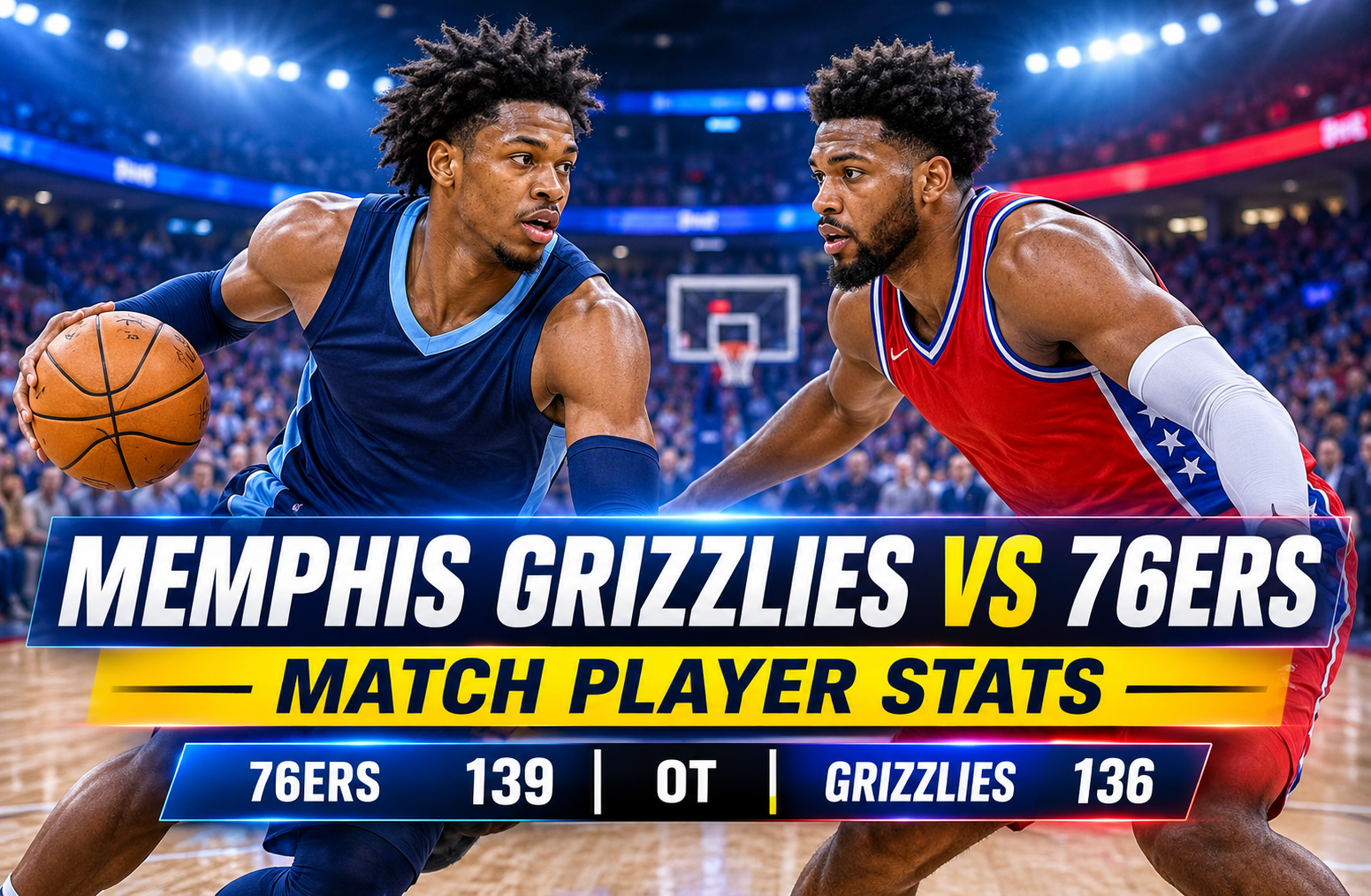
The memphis grizzlies vs 76ers match player stats from December 31, 2025, tell the story of one of the most competitive high-scoring games between Philadelphia and Memphis. The Philadelphia 76ers defeated the Memphis Grizzlies 139–136 in overtime at FedExForum in Memphis, Tennessee. Both teams produced impressive offensive performances, but Philadelphia eventually secured the victory through the combined scoring and playmaking of Joel Embiid and Tyrese Maxey.
Ja Morant delivered an outstanding performance for Memphis, finishing with 40 points while shooting 16-of-22 from the field. Cedric Coward also played an important role, recording 28 points and 16 rebounds. However, their contributions were not enough to overcome Philadelphia’s balanced offensive attack.
Joel Embiid finished with 34 points, 10 rebounds, and 8 assists, while Tyrese Maxey matched his scoring total with 34 points and added 12 assists. Their ability to score and create opportunities for teammates helped the 76ers remain competitive despite Memphis collecting more rebounds.
The final result was decided by just three points, making this matchup an excellent example of how offensive efficiency, ball movement, individual performances, and late-game execution can influence an NBA contest.
Memphis Grizzlies vs 76ers Match Player Stats: Game Overview
The December 31 matchup featured two teams capable of producing points through different offensive approaches. Memphis relied heavily on its ability to attack the basket, create opportunities through Ja Morant, and control the glass. Philadelphia benefited from the scoring combination of Embiid and Maxey, supported by better overall assist production.
Here is a quick overview of the game.
| Game Detail | Information |
| Matchup | Memphis Grizzlies vs Philadelphia 76ers |
| Date | December 31, 2025 |
| Venue | FedExForum |
| Location | Memphis, Tennessee |
| Final Score | 76ers 139, Grizzlies 136 |
| Result | Philadelphia won |
| Game Format | Overtime |
| Winning Team | Philadelphia 76ers |
| Losing Team | Memphis Grizzlies |
The final score shows how closely matched the teams were throughout the contest. Memphis scored 136 points and Philadelphia finished with 139. Neither side managed to create a comfortable advantage, and the game required overtime to determine the winner.
Philadelphia’s victory was particularly interesting because Memphis recorded more rebounds and converted a higher percentage of its field-goal attempts. However, the 76ers registered more assists and made better use of their collective offensive opportunities.
Philadelphia 76ers Player Stats
Philadelphia’s victory was built around two outstanding individual performances. Joel Embiid and Tyrese Maxey both scored 34 points, giving the team two dependable offensive options throughout the game.
Their contributions went beyond scoring. Embiid provided rebounding and playmaking from the frontcourt, while Maxey combined perimeter scoring with the responsibility of creating opportunities for teammates.
Joel Embiid Player Stats
Joel Embiid | Philadelphia 76ers
34
Points
10
Rebounds
8
Assists
Joel Embiid delivered one of Philadelphia’s most important performances, finishing with 34 points, 10 rebounds, and 8 assists. His contribution demonstrated his value as both a scoring center and an offensive facilitator.
His 34 points gave Philadelphia a reliable scoring foundation. Against a Memphis team that shot efficiently from the field, having a player capable of generating offense in different situations was especially important.
Embiid’s 10 rebounds also helped Philadelphia compete on the boards. Memphis ultimately won the overall rebounding battle, but Embiid’s individual contribution provided important support in the paint.
His eight assists were another significant part of his performance. Rather than focusing exclusively on finishing possessions, he also helped teammates find scoring opportunities. This playmaking contribution complemented Maxey’s work as the team’s primary perimeter creator.
One of the most interesting aspects of Embiid’s performance was the balance between his scoring, rebounding, and passing. Recording 34 points alongside 10 rebounds and 8 assists means he contributed in several areas that directly influenced the team’s offensive performance.
Tyrese Maxey Player Stats
Tyrese Maxey | Philadelphia 76ers
34
Points
12
Assists
4
Rebounds
Tyrese Maxey matched Embiid with 34 points, making him another central figure in Philadelphia’s overtime victory. His performance was especially valuable because he combined scoring with exceptional playmaking.
Maxey’s 12 assists were the highest individual assist total among the highlighted performances. Those assists demonstrate how important he was in connecting Philadelphia’s offensive possessions and creating opportunities for teammates.
His scoring contribution also prevented Memphis from focusing its defensive attention entirely on Embiid. When a team has two players capable of producing 34 points, opponents must consider multiple offensive threats.
Maxey also recorded four rebounds. Although his rebounding contribution was smaller than Embiid’s, his primary impact came through scoring and distributing the basketball.
His 12 assists deserve particular attention when examining the overall team statistics. Philadelphia finished with 33 assists, compared with Memphis’s 28. Maxey’s individual playmaking was a major part of that difference.
Philadelphia’s Offensive Contribution
The 76ers’ offensive performance was not limited to two players. Their overall team statistics show a strong emphasis on moving the basketball and generating scoring opportunities.
Philadelphia recorded:
- 139 total points.
- 51 successful field goals from 111 attempts.
- 15 successful three-pointers from 42 attempts.
- 33 total assists.
- 41 total rebounds.
The team’s 33 assists were especially important. They indicate that Philadelphia generated considerable offense through passing and collective involvement rather than relying exclusively on individual scoring.
The 76ers attempted 111 field goals, compared with Memphis’s 92 attempts. Although Philadelphia made the same number of field goals as Memphis, its higher attempt total reflects a different offensive profile.
Philadelphia also made 15 three-pointers. Perimeter shooting provided another scoring option alongside Embiid’s interior presence and Maxey’s offensive creation.
These figures help explain why Philadelphia remained competitive despite Memphis recording a better overall field-goal percentage.
Memphis Grizzlies Player Stats
Memphis produced an equally impressive offensive performance, led by Ja Morant and Cedric Coward. Morant was the team’s leading scorer, while Coward provided an important combination of points and rebounds.
The Grizzlies also demonstrated strong shooting efficiency and controlled the rebounding battle. Their overall numbers show that they had several reasons to believe they could win the game.
Ja Morant Player Stats
Ja Morant | Memphis Grizzlies
40
Points
16/22
Field Goals
Ja Morant was Memphis’s leading offensive performer, scoring 40 points while converting 16 of his 22 field-goal attempts.
His shooting performance was particularly impressive because he converted a high proportion of his attempts. Sixteen successful shots from 22 attempts represent approximately 72.7% field-goal accuracy.
Morant’s scoring output gave Memphis a consistent offensive threat. His ability to produce 40 points meant Philadelphia had to account for him throughout the game.
A performance of this kind can influence an opponent’s defensive strategy. Defenders must pay close attention to the leading scorer, which can create opportunities for other players when defensive attention shifts toward the primary offensive threat.
Morant’s 40-point total was also six points higher than the combined individual scoring difference between the two teams’ highlighted performances. Although Philadelphia had two players scoring 34 points each, Memphis had the highest individual scorer of the contest.
However, individual scoring does not always determine the final result. Despite Morant’s excellent shooting, Philadelphia finished with a three-point advantage after overtime.
His performance remains one of the defining features of this matchup.
Cedric Coward Player Stats
Cedric Coward | Memphis Grizzlies
28
Points
16
Rebounds
Cedric Coward delivered an important performance for Memphis, recording 28 points and 16 rebounds.
His contribution was valuable because he provided both scoring and rebounding support. While Morant carried much of the scoring responsibility, Coward helped Memphis maintain an offensive presence through his own production.
The 16 rebounds were particularly significant. Memphis finished the game with 51 rebounds, ten more than Philadelphia. Coward’s contribution represented a substantial part of that total.
His 28 points also meant Memphis had another productive scorer alongside Morant. Having two players combine for 68 points gave the Grizzlies considerable offensive production.
Coward’s double-double demonstrated his involvement in different areas of the game. His scoring helped Memphis remain competitive, while his rebounding gave the team additional opportunities to control possessions.
The result was disappointing for Memphis, but Coward’s performance was one of the major individual positives from the game.
Memphis’s Offensive Contribution
The Grizzlies finished with 136 points and demonstrated considerable efficiency from the field.
Their team statistics included:
- 136 total points.
- 51 successful field goals from 92 attempts.
- 11 successful three-pointers from 29 attempts.
- 28 total assists.
- 51 total rebounds.
Memphis converted 51 of its 92 field-goal attempts, giving the team an approximate field-goal percentage of 55.4%.
That was considerably higher than Philadelphia’s approximate 45.9% conversion rate.
The Grizzlies also made 11 three-pointers from 29 attempts. Their perimeter shooting provided another scoring option, while their overall field-goal accuracy demonstrated how effectively they converted opportunities.
Rebounding was another major strength. Memphis collected 51 rebounds and limited Philadelphia to 41.
Despite these advantages, the Grizzlies could not finish the contest with a victory. Their performance illustrates why individual efficiency and rebounding superiority must be considered alongside other team statistics.
Complete Team Statistics Comparison
The overall numbers provide a clearer understanding of how Philadelphia and Memphis approached the contest. Both teams scored 51 field goals, but they differed in shooting volume, perimeter production, assists, and rebounding.
| Statistical Category | Philadelphia 76ers | Memphis Grizzlies |
| Final Score | 139 | 136 |
| Field Goals Made | 51 | 51 |
| Field Goals Attempted | 111 | 92 |
| Field-Goal Percentage | 45.9% | 55.4% |
| Three-Pointers Made | 15 | 11 |
| Three-Pointers Attempted | 42 | 29 |
| Three-Point Percentage | 35.7% | 37.9% |
| Total Assists | 33 | 28 |
| Total Rebounds | 41 | 51 |
Percentages are calculated from the supplied makes and attempts and rounded to one decimal place.
Field-Goal Efficiency
One of the most interesting aspects of this matchup was the difference in field-goal efficiency.
Memphis converted 51 of its 92 attempts, while Philadelphia needed 111 attempts to make the same number of field goals.
This created a substantial difference in shooting percentage:
- Memphis: approximately 55.4%.
- Philadelphia: approximately 45.9%.
The Grizzlies were more efficient when converting their field-goal attempts. However, Philadelphia attempted 19 more shots.
This distinction matters because shooting percentage alone does not explain the complete offensive performance. The number of attempts, scoring opportunities, and points generated through different types of shots also influence the final result.
Philadelphia’s ability to produce more attempts helped it remain competitive despite Memphis having the better field-goal percentage.
Three-Point Shooting Comparison
Three-point shooting was another important difference between the teams.
Philadelphia made 15 three-pointers from 42 attempts, while Memphis converted 11 from 29 attempts.
The percentages were relatively close:
- Philadelphia: 35.7%.
- Memphis: 37.9%.
Memphis had a slightly better three-point percentage, but Philadelphia made four additional three-pointers.
The difference in successful three-point shots was important because each additional three-pointer represents three points on the scoreboard.
Philadelphia’s 15 successful attempts generated 45 points from beyond the arc, compared with Memphis’s 33 points.
That created a 12-point difference in three-point scoring in Philadelphia’s favor.
This is an important example of why shooting volume and shooting efficiency should be evaluated together. Memphis was slightly more accurate, but Philadelphia converted more attempts.
Rebounding Comparison
Memphis clearly controlled the rebounding category.
The Grizzlies finished with 51 rebounds, while the 76ers recorded 41. That gave Memphis a ten-rebound advantage.
The difference was particularly relevant because rebounds can create additional offensive opportunities and limit an opponent’s possessions.
Cedric Coward’s 16 rebounds were an important part of Memphis’s performance. Joel Embiid also contributed ten rebounds for Philadelphia.
However, the overall rebounding advantage did not translate into a victory.
This shows that winning the rebounding battle does not automatically mean winning the game. Teams must also convert possessions into points and manage important offensive opportunities.
Assists and Ball Movement
Philadelphia recorded 33 assists, five more than Memphis’s 28.
This was one of the clearest statistical advantages for the winning team.
Assists provide insight into how effectively a team creates scoring opportunities through passing. Although they do not explain every offensive possession, they help illustrate the role of teamwork in generating baskets.
Tyrese Maxey’s 12 assists and Joel Embiid’s eight assists accounted for 20 of Philadelphia’s 33 total assists.
Their combined contribution represented approximately 60.6% of the team’s recorded assists.
This highlights the importance of both players as offensive creators.
Memphis also recorded 28 assists, which is a strong team total. However, Philadelphia’s additional five assists demonstrate its greater assist production in this particular game.
Why the Philadelphia 76ers Won the Game
Philadelphia’s 139–136 overtime victory was not the result of a single statistical advantage. Instead, several factors combined to help the team finish ahead.
The most important elements were the scoring partnership between Embiid and Maxey, greater three-point production, and superior assist numbers.
1. Two Players Scored 34 Points Each
Philadelphia had two players who reached the 34-point mark.
Embiid and Maxey combined for 68 points, providing a consistent offensive foundation.
Having two high-scoring players creates a difficult challenge for opposing defenses. If defensive attention shifts toward one player, the other can continue generating opportunities.
This scoring balance was especially valuable against a Memphis team that had Morant producing 40 points.
2. Better Three-Point Production
Philadelphia made four more three-pointers than Memphis.
The 76ers converted 15 attempts from beyond the arc, generating 45 points from three-point shots.
Memphis made 11, producing 33 points.
Although Memphis had a slightly higher three-point percentage, Philadelphia’s additional successful shots helped create a scoring advantage.
3. More Assists
Philadelphia’s 33 assists compared with Memphis’s 28 indicate that the 76ers generated more assisted scoring opportunities.
Maxey was particularly important in this area, finishing with 12 assists.
Embiid added another eight, giving Philadelphia two major playmaking contributors.
This combination helped the team create scoring opportunities through multiple offensive actions.
4. Effective Scoring Contributions From the Frontcourt and Backcourt
Embiid and Maxey offered different offensive strengths.
Embiid contributed scoring and rebounding from the frontcourt, while Maxey provided perimeter scoring and playmaking.
This gave Philadelphia more than one way to generate offense.
It also meant Memphis had to account for different types of offensive threats instead of focusing on a single player.
5. Execution in a Close Overtime Contest
The final score was separated by only three points.
A narrow overtime result highlights the importance of individual possessions and scoring opportunities.
The available game information confirms that Philadelphia won after overtime, but it does not establish the exact sequence of final possessions. Therefore, it would be inaccurate to attribute the victory to a particular shot, defensive stop, or late-game play without additional play-by-play evidence.
What the confirmed statistics do show is that Philadelphia had enough offensive production to finish three points ahead.
Why the Memphis Grizzlies Lost Despite Strong Performances
Memphis had several statistical strengths, but they were not enough to secure the victory.
The Grizzlies were more efficient from the field, collected more rebounds, and received an exceptional scoring performance from Morant.
Nevertheless, Philadelphia finished with more points.
Rebounding Advantage Was Not Enough
Memphis collected ten more rebounds than Philadelphia.
That was a meaningful advantage, especially considering Coward’s 16 rebounds.
However, rebounding is only one part of basketball performance. Teams must turn possessions into successful offensive outcomes.
Philadelphia’s superior assist and three-point totals helped compensate for its disadvantage on the boards.
Philadelphia Made More Three-Pointers
Memphis shot slightly better from three-point range, but the 76ers made four additional three-pointers.
That difference produced 12 more points from beyond the arc for Philadelphia.
In a game decided by three points, this statistical difference is particularly important.
It does not establish that three-point shooting alone determined the result, but it identifies one of the most significant differences between the teams.
Morant Needed More Offensive Support
Morant scored 40 points, giving Memphis an outstanding individual scoring performance.
Coward also contributed 28 points.
Together, the two players accounted for 68 points, matching the combined scoring total of Embiid and Maxey.
However, Philadelphia’s team finished with three more points overall.
The supplied statistics do not provide a complete breakdown of every player’s scoring contribution, so it would be unfair to suggest that other Memphis players failed to contribute.
The more reliable conclusion is that Philadelphia’s overall scoring production was just sufficient to overcome Memphis’s strongest statistical advantages.
Key Statistical Battles That Defined the Matchup
Looking beyond the final score reveals several important comparisons.
Embiid vs Ja Morant
Embiid and Morant were among the most influential players in the contest, but they contributed in different ways.
| Category | Joel Embiid | Ja Morant |
| Points | 34 | 40 |
| Rebounds | 10 | Not provided |
| Assists | 8 | Not provided |
| Field Goals | Not provided | 16/22 |
Morant finished as the game’s leading scorer with 40 points.
Embiid scored six fewer points but contributed ten rebounds and eight assists.
Their performances demonstrate two different forms of offensive influence. Morant supplied outstanding scoring efficiency, while Embiid combined scoring with rebounding and playmaking.
It is not possible to make a complete comparison of their defensive contributions or total efficiency without additional box-score information.
Maxey vs Memphis’s Offensive Playmaking
Maxey’s 12 assists were a major part of Philadelphia’s offensive performance.
He scored 34 points while creating opportunities for teammates.
The available information does not include the individual assist totals of Memphis’s other players, so a direct player-to-player comparison would require additional statistics.
Nevertheless, the team comparison is clear: Philadelphia finished with 33 assists, while Memphis recorded 28.
Coward vs Embiid on the Boards
Coward recorded 16 rebounds, while Embiid finished with ten.
Coward therefore collected six more rebounds than Philadelphia’s leading individual rebounder among the highlighted players.
This was an important part of Memphis’s overall rebounding advantage.
However, Philadelphia still managed to produce enough offense to win the game.
What the Memphis Grizzlies vs 76ers Match Player Stats Reveal
The memphis grizzlies vs 76ers match player stats offer several useful lessons about evaluating NBA performances.
A final score provides the outcome, but individual and team statistics explain how the result developed.
There are five particularly important observations from this matchup.
First, balanced scoring can be more valuable than relying on one leading scorer. Morant scored 40 points, but Philadelphia had two players producing 34 each. This gave the 76ers multiple major offensive contributors.
Second, field-goal percentage does not tell the entire story. Memphis converted a higher percentage of its attempts, but Philadelphia made the same number of field goals with more attempts.
Third, three-point volume can change the scoring picture. Philadelphia made four more three-pointers, generating a 12-point advantage in this category.
Fourth, rebounds and assists measure different aspects of team performance. Memphis controlled the boards, while Philadelphia generated more assists.
Fifth, overtime games make overall execution especially important. When the final margin is only three points, small differences in scoring production can have a major influence on the outcome.
These observations are useful when analyzing future matchups because they encourage readers to look beyond points scored and consider the wider statistical picture.
How to Analyze NBA Player Statistics Correctly
A box score contains several categories, but not every statistic has the same meaning. Understanding the numbers helps readers distinguish individual achievements from overall team performance.
Points
Points measure a player’s direct scoring contribution.
Morant’s 40 points made him the leading scorer in this matchup. Embiid and Maxey each recorded 34.
However, points should not be used as the only measure of player performance.
Rebounds
Rebounds show how frequently players recover the basketball after missed shots.
There are offensive and defensive rebounds, although the supplied game information only provides overall team rebounding totals and the individual totals for Coward and Embiid.
Memphis’s 51 rebounds indicate that the team had a significant advantage in this category.
Assists
Assists measure passes that directly lead to successful field goals under the official scoring rules.
Philadelphia’s 33 assists suggest strong team involvement in its scoring production.
Maxey’s 12 assists were especially important.
Field-Goal Percentage
Field-goal percentage measures the proportion of successful field-goal attempts.
The formula is:
\[ FG\%=\frac{\text{Field Goals Made}}{\text{Field Goals Attempted}}\times100 \]
Using the supplied numbers:
- Philadelphia: \(51 \div 111 \times 100 = 45.9\%\)
- Memphis: \(51 \div 92 \times 100 = 55.4\%\)
This comparison shows that Memphis converted its attempts more efficiently.
Three-Point Percentage
Three-point percentage measures successful shots from beyond the three-point line.
The formula is:
\[ 3P\%=\frac{\text{Three-Pointers Made}}{\text{Three-Pointers Attempted}}\times100 \]
Philadelphia recorded approximately 35.7%, while Memphis recorded approximately 37.9%.
The percentages were close, but Philadelphia made more successful three-point shots.
Double-Double
A double-double occurs when a player records at least ten in two statistical categories.
Coward recorded 28 points and 16 rebounds, giving him a double-double.
Embiid also recorded a double-double through his 34 points and ten rebounds.
Understanding these categories makes a box score more meaningful and helps readers identify contributions that might otherwise be overlooked.
The Importance of Overtime in This Matchup
Overtime adds another dimension to a basketball game because neither team has established a winning score by the end of regulation.
The Philadelphia and Memphis contest required additional playing time before a winner could be determined.
The final score of 139–136 reflects how closely the teams competed.
An overtime result can be influenced by several factors, including:
- Maintaining offensive efficiency.
- Managing possessions.
- Avoiding unnecessary turnovers.
- Securing defensive rebounds.
- Converting scoring opportunities.
- Maintaining concentration under pressure.
These are general factors that matter in overtime basketball. The available statistics do not establish which specific factor decided the final overtime sequence in this game.
What can be confirmed is that Philadelphia produced three more points by the end of the contest.
The final margin also explains why this game deserves attention from readers interested in close NBA matchups.
Historical and Statistical Context of the Matchup
The Philadelphia 76ers and Memphis Grizzlies represent two different NBA franchises with their own playing styles, rosters, and competitive histories.
When analyzing an individual game between these teams, it is important to separate the confirmed performance from broader historical assumptions.
This particular contest provides a useful snapshot of how two teams can produce strong offensive numbers through different methods.
Philadelphia’s offensive profile in the supplied statistics was characterized by:
- Two players scoring 34 points.
- 33 team assists.
- 15 successful three-pointers.
- A combined 68 points from Embiid and Maxey.
Memphis’s profile included:
- Morant’s 40-point performance.
- Coward’s 28 points and 16 rebounds.
- 51 total rebounds.
- A 55.4% field-goal percentage.
These figures provide a factual foundation for discussing the game without assuming that the same patterns define every meeting between the franchises.
For readers comparing multiple matchups, it is useful to examine individual box scores separately before making conclusions about season-long performance or head-to-head trends.
A single game can reveal valuable information, but it should not automatically be treated as proof of a team’s overall strength.
Official Box Score and Statistical Accuracy
For readers who want to check the individual performances and complete game information, the original ESPN box score is the most relevant reference supplied for this matchup.
The box score is useful because it allows readers to examine player-level statistics rather than relying only on a final-score summary.
It is particularly important to distinguish between confirmed information and calculations made from the available figures.
For example, the field-goal and three-point percentages in this article are calculated from the supplied makes and attempts. They are not additional figures presented as independently verified official statistics.
Likewise, the article does not assign unprovided points, steals, blocks, turnovers, or minutes to individual players.
This approach helps maintain accuracy and prevents incomplete information from being presented as a complete statistical record.
For the original game record, consult the official ESPN box score.
Frequently Asked Questions
1. Who won the Memphis Grizzlies vs 76ers game on December 31, 2025?
The Philadelphia 76ers defeated the Memphis Grizzlies 139–136 in overtime at FedExForum in Memphis, Tennessee.
2. How many points did Ja Morant score against the 76ers?
Ja Morant scored 40 points for Memphis. He also demonstrated excellent shooting efficiency, converting 16 of his 22 field-goal attempts.
3. How many points did Joel Embiid score against Memphis?
Joel Embiid scored 34 points. He also recorded 10 rebounds and eight assists, making him one of Philadelphia’s most influential players.
4. How many points did Tyrese Maxey score in the game?
Tyrese Maxey scored 34 points and recorded 12 assists and four rebounds. His playmaking was an important part of Philadelphia’s offensive performance.
5. How many rebounds did Cedric Coward record?
Cedric Coward collected 16 rebounds and scored 28 points. His performance gave Memphis an important presence on the boards and earned him a double-double.
6. Which team had more rebounds and assists?
Memphis had more rebounds, collecting 51 compared with Philadelphia’s 41. However, Philadelphia recorded more assists, finishing with 33 compared with Memphis’s 28.
Conclusion
The December 31, 2025, matchup between the Philadelphia 76ers and Memphis Grizzlies delivered an exciting overtime contest that ended with a 139–136 Philadelphia victory.
Ja Morant led all players with 40 points, while Cedric Coward contributed 28 points and 16 rebounds. Philadelphia received equally impressive performances from Joel Embiid and Tyrese Maxey, who each scored 34 points.
The team statistics reveal an interesting contrast. Memphis had better field-goal efficiency and a ten-rebound advantage, but Philadelphia made four more three-pointers and recorded five additional assists.
These differences demonstrate why basketball analysis requires more than looking at the final score or identifying the leading scorer. Individual contributions, shooting volume, passing, and rebounding all help explain the outcome.
Ultimately, the memphis grizzlies vs 76ers match player stats highlight Philadelphia’s balanced offensive production and Memphis’s strong individual performances. Both teams demonstrated considerable scoring ability, but the 76ers produced just enough to secure the three-point overtime victory.