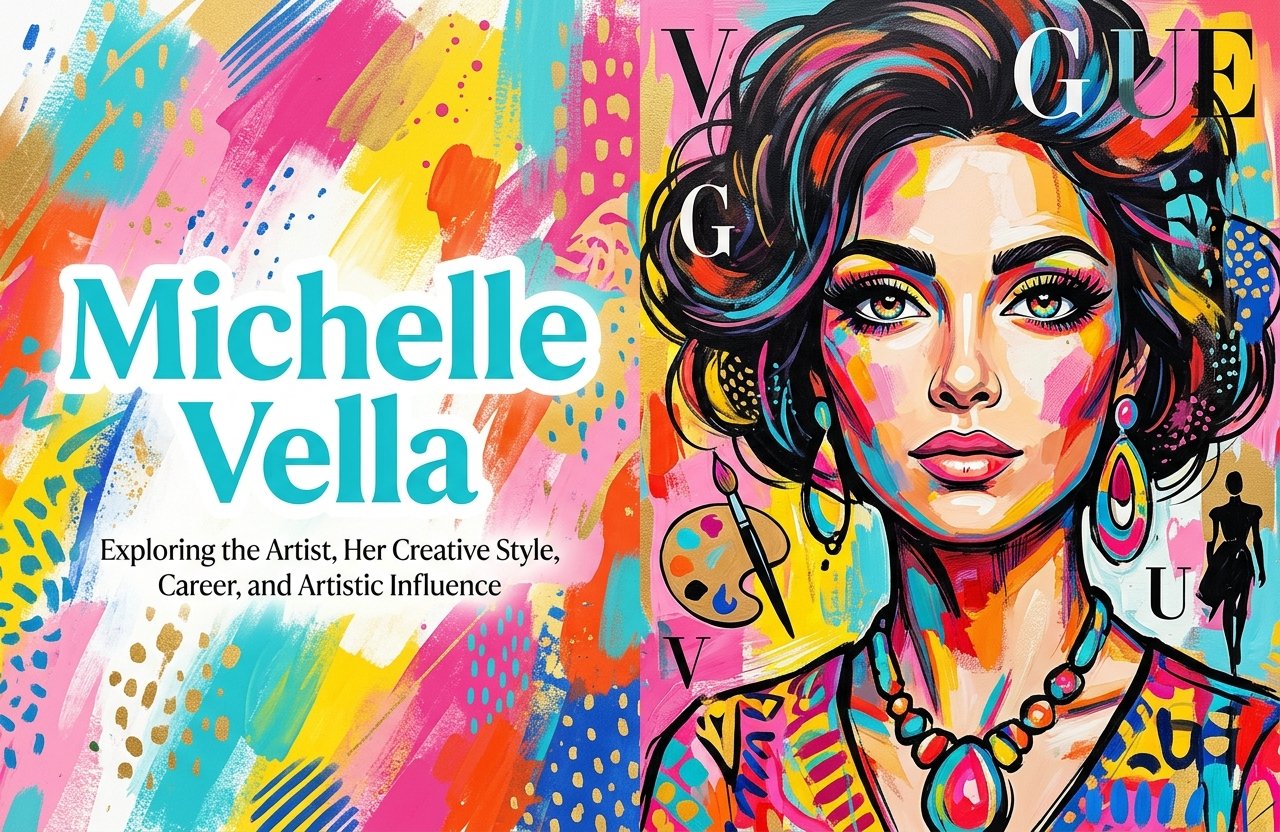
Michelle Vella: Exploring the Artist, Her Creative Style, Career, and Artistic Influence
Michelle Vella is a name associated with contemporary pop art, colourful celebrity portraits, and a distinctive artistic style that brings personality and emotion into visual expression. As a Canadian pop artist, she has attracted attention for her bold use of colour, expressive faces, and recognizable Wide Big Eyes technique. Her work offers an interesting look at how traditional portraiture can be transformed into modern art that connects with popular culture.
Understanding Michelle Vella requires looking beyond the appearance of her paintings. Her artistic identity is connected to the relationship between creativity, personality, celebrity culture, and visual storytelling. Her portraits demonstrate how an artist can take familiar subjects and present them through an individual creative perspective.
Contemporary art includes many different styles, from abstract compositions to realistic paintings and experimental digital illustrations. Pop art occupies an interesting position within this landscape because it often draws inspiration from popular culture, recognizable personalities, and everyday visual experiences. Artists working in this field use familiar imagery to create something that feels fresh and personal.
Vella’s artistic approach makes her an interesting subject for readers who want to understand contemporary portrait art and the people creating it. Her work also raises broader questions about artistic identity, the value of recognizable visual styles, and the ways artists build connections with audiences.
This article explores her background as an artist, her creative approach, the characteristics of her work, her place in contemporary pop art, and the challenges involved in developing a recognizable artistic identity. It also separates publicly established information from details that should not be assumed without reliable documentation.
Who Is Michelle Vella?
Michelle Vella is a Canadian contemporary pop artist based in Toronto, Ontario. She is best known for creating colourful portraits of famous personalities, fashion figures, musicians, and cultural icons. Her signature Wide Big Eyes style has become a recognizable part of her artistic identity.
Unlike artists who focus mainly on realistic reproductions, Vella uses artistic interpretation to create portraits with a distinctive visual personality. Her work combines expressive facial features, vibrant colours, carefully selected backgrounds, and references to popular culture.
Her professional journey is also notable because she did not follow a conventional path into full-time artistic work. Although she studied fine arts, she explored several professional fields before returning to painting and building her own art business.
This background helps explain why her career is interesting from both artistic and entrepreneurial perspectives. She brings together formal art education, graphic design experience, marketing knowledge, and a clear understanding of how people respond to visual content.
Her work has been associated with the fashion industry, celebrity culture, contemporary galleries, and private art collections. Over time, she has expanded beyond portraiture to explore objects and imagery inspired by everyday nostalgia.
Early Life and Educational Background
An Early Interest in Art
Michelle Vella’s interest in creativity began at a young age. According to published artist profiles, she demonstrated artistic ability during childhood and regularly spent time drawing.
Early creative experiences can play an important role in shaping an artist’s future. Drawing allows people to observe the world closely, understand proportions, explore shapes, and develop their own ways of expressing ideas.
For Vella, this early interest eventually developed into formal education and professional experience.
However, having artistic ability does not automatically mean that someone will immediately pursue a full-time career in painting. Many artists explore different professional opportunities before discovering the direction that suits them best.
Her career provides an example of how creative interests can remain important even when professional responsibilities lead someone into other industries.
Studying Fine Arts at McMaster University
Vella graduated from McMaster University in 1986 with a degree in Fine Arts. This education gave her an academic foundation for understanding visual creativity and artistic practice.
A fine arts education can introduce students to several important areas, including:
- Drawing and painting techniques.
- Composition and visual balance.
- Colour relationships.
- Art history and artistic movements.
- Creative experimentation.
- Visual communication.
- Developing an individual artistic perspective.
These subjects are valuable because they help artists understand not only how to create an image but also why certain visual decisions work.
For a portrait artist, composition and colour theory are particularly important. The placement of facial features, the relationship between the subject and background, and the use of light and contrast can change how viewers interpret an artwork.
Although formal education provides a useful foundation, an artist’s individual style usually develops through continued practice and experimentation.
Vella’s later career demonstrates the importance of combining academic knowledge with practical experience.
Michelle Vella’s Professional Journey Before Becoming a Full-Time Artist
One of the most interesting parts of her story is that her career did not move directly from university into professional painting.
After completing her education, she explored several different professional roles. Published profiles describe experience involving art galleries, sales, marketing, magazine publishing, portrait photography, and graphic design.
These experiences helped her develop skills that would eventually support her independent artistic career.
Experience in Different Industries
Working in different industries can provide valuable knowledge that is not always taught in an art classroom.
For example, gallery-related work can help someone understand how artwork is presented and sold. Marketing experience provides insight into audience behaviour, while publishing introduces people to visual communication and editorial standards.
Photography also offers useful lessons in portrait composition, facial expressions, lighting, and visual storytelling.
Rather than treating these experiences as unrelated career changes, it is useful to consider how they contributed to her later development.
Her professional background provided several transferable skills:
- Visual communication: Understanding how images communicate messages and emotions.
- Business management: Learning how to organize professional projects and work with clients.
- Marketing: Understanding how to introduce creative products to potential buyers.
- Customer relationships: Developing the ability to communicate with collectors and collaborators.
- Design thinking: Finding ways to combine visual appeal with practical requirements.
These skills became especially relevant when she started building a recognizable artistic brand.
Founding RealSTUDIO
Another important chapter involved graphic design.
Vella established a graphic design business called RealSTUDIO and operated it for more than a decade. This period allowed her to work professionally in design while developing entrepreneurial experience.
Running a creative business involves much more than producing attractive images. It requires communication, planning, organization, client management, and an understanding of commercial expectations.
Graphic design also encourages artists to think carefully about how visual elements work together.
Typography, colour, spacing, layout, and image hierarchy all influence the way an audience experiences a design.
These principles can also be applied to fine art. A strong portrait requires a clear visual focus, an intentional arrangement, and an understanding of how viewers move through an image.
Her experience in design therefore became a useful foundation for her later work as a pop artist.
Making a Career Change at 50
A particularly inspiring aspect of her story is that she decided to pursue art full-time at the age of 50.
According to her published artist biography and interviews, she had spent years working in different fields before deciding to return to painting as her main professional focus.
This decision challenges the idea that people must establish their final career direction early in adulthood.
Creative careers can develop through many different routes. Some people begin professionally as teenagers, while others discover a new artistic direction after decades of experience.
Vella’s journey shows that professional reinvention can be possible when someone combines personal motivation with the skills developed throughout earlier employment.
It also highlights an important distinction between having an interest in art and building a sustainable art career.
The first requires creativity and practice. The second also requires a business strategy, audience development, consistent production, and the ability to communicate the value of one’s work.
How Michelle Vella Became Recognized in the Art World
The Role of Instagram in Her Career
Social media played a major role in bringing Vella’s artwork to a wider audience.
When she returned to drawing and painting, she began sharing her work on Instagram. This gave her an opportunity to present her developing artistic identity without relying exclusively on traditional gallery exhibitions.
She started by exploring fashion illustrations and portraits. During this process, she experimented with different ways of representing faces and gradually developed the visual characteristics that would become her signature.
The platform allowed people to discover her work, respond to new creations, and share images with other audiences.
This is an important example of how digital platforms have changed opportunities for independent artists.
In the past, an emerging artist often depended heavily on gallery representation, professional introductions, exhibitions, and traditional media coverage.
Social media created another route.
Artists could now:
- Publish new work regularly.
- Build an audience around a recognizable style.
- Communicate directly with potential collectors.
- Receive feedback from viewers.
- Connect with fashion and entertainment professionals.
- Present a portfolio to people outside their local community.
However, simply posting artwork does not guarantee professional recognition. A successful creative presence requires consistent quality, an identifiable artistic direction, and an understanding of the audience.
Vella’s experience illustrates how these elements can work together.
The Diane von Furstenberg Connection
One of the major turning points in her career came in 2015 when fashion designer Diane von Furstenberg discovered her artwork through Instagram.
Von Furstenberg expressed interest in purchasing a portrait Vella had created of her. The artwork subsequently became part of the designer’s art collection at the DVF Fashion House in New York.
This was a significant opportunity for an emerging artist.
Recognition from an established fashion figure can introduce an artist to new professional networks and audiences. It can also help establish credibility in industries where visual identity and personal branding are important.
The story is especially interesting because the connection developed through an online platform rather than a conventional gallery introduction.
It demonstrates that social media can function as a professional discovery channel when an artist has a distinctive body of work.
Importantly, the recognition did not come from social media activity alone. It was connected to the quality and individuality of the artwork being shared.
Work with W Magazine
Another notable professional opportunity came through W Magazine.
Published biographies and press coverage report that Vella received a commission to create custom portraits of magazine editors, including Edward Enninful.
She also participated in live portrait painting at W Magazine’s New York Fashion Week celebrity luncheon.
These opportunities connected her work with the fashion and editorial industries.
Fashion publications often operate in a visually competitive environment. They use photography, illustration, typography, and design to communicate personality and cultural trends.
An artist with a distinctive portrait style can offer something different from conventional editorial photography.
Live portrait painting also creates an opportunity for audiences to observe the creative process rather than simply viewing a finished artwork.
This type of professional experience can help artists build relationships, gain exposure, and demonstrate their ability to work in public or client-focused environments.
Understanding Michelle Vella’s Signature Wide Big Eyes Style
Marilyn Monroe, Warhol Inspired, Original Painting – MICHELLE A VELLA
Pop art portrait painting and wall art print of fashionista Iris Apfel – MICHELLE A VELLA
12
The most recognizable element of Vella’s earlier artistic identity is her Wide Big Eyes style.
This approach places strong emphasis on the eyes, making them an important visual feature of the portrait.
Eyes are among the most expressive parts of the human face. They can communicate curiosity, confidence, sadness, excitement, vulnerability, and many other emotions.
By emphasizing them, an artist can create a portrait that feels more expressive than a straightforward realistic representation.
Why the Eyes Matter in Portrait Art
In traditional portraiture, artists often aim to reproduce facial proportions as accurately as possible.
However, contemporary illustration and pop art frequently use exaggeration to create a specific effect.
Enlarged eyes can:
- Draw immediate attention to the face.
- Create a sense of curiosity or wonder.
- Increase the emotional impact of a portrait.
- Give a familiar personality a new visual identity.
- Make the artwork easier to recognize.
- Create a playful relationship between realism and imagination.
This technique also connects with broader visual traditions in illustration, animation, and stylized portraiture.
The key is that exaggeration must feel intentional. If an artist enlarges a feature without considering the rest of the composition, the portrait may lose its balance.
Vella’s style uses the eyes as a defining feature while maintaining a recognizable relationship between the subject’s expression and overall appearance.
The Importance of Colour
Colour is another important part of her artistic approach.
Her portraits often use bold and vibrant colour combinations that create energy and visual interest.
Colour can influence how viewers respond to an artwork before they even begin examining its details.
For example:
- Bright colours can create a lively atmosphere.
- Strong contrasts can make facial features stand out.
- Warm tones can produce a feeling of energy and familiarity.
- Cool tones can create a calmer visual impression.
- A simple background can help viewers concentrate on the portrait.
In pop art, colour is not simply a decorative addition. It can become part of the message.
A familiar celebrity portrait painted in an unexpected colour combination can feel completely different from a conventional photograph of the same person.
This is one reason colour plays such an important role in contemporary pop portraiture.
Simplicity and Visual Focus
A successful portrait does not always require a complicated background.
Sometimes a simple background gives the subject more visual importance.
This approach is particularly effective when an artwork focuses on facial expression.
By limiting unnecessary details, the artist can direct attention toward the eyes, facial structure, and overall personality of the subject.
The result can feel bold without becoming visually confusing.
How the Style Has Changed Over Time
An artist’s signature style does not need to remain exactly the same throughout an entire career.
Vella’s work has evolved since her early Wide Big Eyes portraits.
An Arta Gallery profile explains that she began exploring a different approach around 2021. Her later portraits moved toward a more quasi-realistic appearance, with the eyes remaining expressive but staying within the natural boundaries of the face.
She also moved away from some of the heavier black outlines and flatter paint surfaces associated with her earlier work.
This development is important because it shows that a recognizable artistic identity can change without losing its central character.
Her later work retains an emphasis on personality, colour, and cultural familiarity while allowing for greater variation in technique.
What Subjects Does She Paint?
Pop art portrait HD Metal Print of music legends, The Rolling Stones – MICHELLE A VELLA
Marilyn Monroe, Warhol Inspired, Original Painting – MICHELLE A VELLA
12
Vella’s work draws inspiration from several areas of popular culture.
Rather than limiting herself to a single subject category, she explores recognizable personalities, entertainment history, fashion, music, and nostalgic objects.
Music Legends
Music provides a rich source of inspiration for portrait artists.
Musicians often develop visual identities that become closely connected with their public personalities.
Their clothing, hairstyles, stage performances, and expressions can become recognizable symbols.
Vella has created portraits inspired by well-known musical figures, including Elton John, Amy Winehouse, and other cultural personalities.
These subjects offer opportunities to explore different forms of expression.
For example, an artist might emphasize the confidence of a performer, the emotional character of a musician, or the distinctive appearance associated with a particular period in music history.
Music-related portraits can also connect with personal memories.
A collector may choose a portrait because it reminds them of a favourite album, a memorable concert, or an important period in their life.
Hollywood and Film Personalities
Film history is another important source of visual inspiration.
Actors and actresses often become cultural icons because of their performances, screen appearances, fashion choices, and influence on popular culture.
Portraits of figures such as Audrey Hepburn allow an artist to explore elegance, personality, and nostalgia.
The challenge is to create an interpretation that feels familiar without simply reproducing an existing photograph.
A strong portrait should communicate something about the subject while maintaining the artist’s individual perspective.
Fashion Icons
Fashion has also played an important role in Vella’s artistic development.
Her early work included fashion illustrations, and her professional career brought her into contact with influential people in the fashion industry.
Fashion portraiture offers many opportunities for artistic experimentation.
Clothing, accessories, facial expressions, and personal style can all contribute to the character of an image.
It also connects portrait art with the broader world of visual branding and design.
Nostalgic Everyday Objects
An interesting development in her work has been the exploration of objects associated with popular culture and everyday memories.
These subjects are sometimes described in connection with her Pop-Comforts concept.
A familiar product, toy, or household object can become an artistic subject because it carries personal or cultural associations.
For example, a retro food package may remind someone of childhood. A familiar game object may bring back memories of family gatherings or time spent with friends.
This approach demonstrates that pop art does not need to focus exclusively on famous people.
Objects can also carry stories, emotions, and cultural meaning.
The Influence of Nostalgia on Her Artwork
Nostalgia is an important theme in contemporary pop art.
It describes the emotional connection people sometimes feel toward experiences, objects, music, films, and cultural moments from the past.
Vella’s artistic statement emphasizes the relationship between cultural icons and personal memories.
Her portraits are not simply about depicting famous people. They also explore what those personalities represent to viewers.
One person might associate a musician with freedom and self-expression. Another might connect an actress with elegance, confidence, or a memorable film.
The same portrait can therefore mean different things to different collectors.
Why Familiar Images Create Emotional Connections
Familiarity helps viewers recognize a subject quickly.
When someone sees a recognizable face or object, their mind may connect it with memories and experiences.
This can make the artwork feel personally meaningful.
For example, a portrait of a famous musician may remind someone of:
- Their teenage years.
- A particular song or album.
- A family member who loved the artist.
- A memorable concert.
- A significant cultural period.
The artwork becomes more than a decorative object because it represents something meaningful to its owner.
This emotional dimension is one of the strengths of nostalgic portrait art.
Art as a Personal Memory
People often select artwork based on how it makes them feel.
A collector might choose a painting because it reminds them of a favourite personality, creates a sense of happiness, or reflects their interests.
This helps explain why recognizable pop culture subjects can appeal to a broad audience.
The subject provides a starting point, but the artist’s interpretation creates a new experience.
For Vella, the combination of expressive portraits and cultural references provides a way to connect artistic creativity with personal memories.
Professional Recognition, Media Coverage, and Collaborations
Recognition in the art world can take several forms.
An artist may receive attention through exhibitions, media interviews, professional commissions, gallery representation, collaborations, or inclusion in private collections.
Vella has experienced several of these opportunities during her career.
Published profiles and press material have associated her work with publications and media platforms such as:
- W Magazine.
- ELLE Canada.
- Harper’s Bazaar Thailand.
- CNN Style.
- The Marilyn Denis Show.
These references demonstrate the breadth of media attention surrounding her work.
However, media exposure and artistic achievement should be understood separately.
A feature in a magazine can introduce an artist to a wider audience, but it does not automatically determine the artistic quality or long-term significance of the work.
A more complete assessment considers the artist’s technique, development, professional consistency, and contribution to the creative field.
The Brain Project
One notable example of her participation in a broader art initiative is The Brain Project, associated with the Baycrest Foundation.
The project brings artists together to create artworks that raise awareness about brain health and aging.
Vella contributed a piece titled Hockey Genius, featuring hockey player Albert Einstein.
The artwork uses humour and visual imagination to communicate an important message about seeing older adults as people with rich histories and experiences.
This project is interesting because it demonstrates how pop art can be used outside traditional commercial and decorative settings.
Art can also support education, public engagement, and social awareness.
It gives artists an opportunity to communicate ideas in ways that may be more approachable than conventional written information.
Her Artistic Business and Ways to Collect Her Work
A professional artist must make decisions about how artwork reaches collectors.
This involves choosing the right formats, pricing structures, production methods, and distribution channels.
Vella’s business offers several ways for people to engage with her work.
Original Paintings
Original paintings are individual artworks created by the artist.
They are different from reproductions because each original has its own physical characteristics and cannot be duplicated exactly.
Collectors may value original paintings because of their uniqueness, materials, artistic process, and direct connection to the artist.
Original works can also provide an opportunity to appreciate details that may not be fully represented in a digital image.
Limited-Edition Giclée Prints
Giclée prints are high-quality art reproductions produced using specialized printing methods.
They allow collectors to access artwork without purchasing the original painting.
Limited-edition versions are produced in a defined quantity. Vella’s official collection describes editions that are hand-signed, numbered, and supplied with certificates of authenticity.
Collectors should always check the specific edition details before purchasing.
Important details include:
- Edition size.
- Print dimensions.
- Printing materials.
- Whether the print is signed.
- Whether a certificate is included.
- Whether the product is framed.
- The seller’s return policy.
These details help buyers understand exactly what they are purchasing.
HD Metal Prints
Another format offered through her art business is HD metal printing.
This type of presentation involves transferring artwork onto a metal surface.
Metal prints can produce a glossy appearance and strong colour presentation.
They may be attractive to people looking for contemporary wall art with a different finish from traditional paper prints.
Before buying, collectors should review the dimensions, mounting method, finish, and framing details.
Custom Art Commissions
Custom commissions offer a more personal way to work with an artist.
Instead of selecting an existing piece, a customer requests an artwork created around a particular person, subject, or idea.
Vella’s official website describes custom commissions as an option for capturing stories, loved ones, and meaningful cultural figures.
A good commission process should establish clear expectations before the work begins.
Customers should understand:
- The subject and purpose of the artwork.
- The expected dimensions.
- The artistic direction.
- The estimated completion schedule.
- The total cost and payment arrangements.
- The number of revisions, if applicable.
- The delivery or collection arrangements.
These details help protect both the artist and the customer.
They also reduce the possibility of misunderstandings during the creative process.
What Makes Her Artistic Approach Different?
The contemporary art world includes thousands of artists working with portraiture, illustration, abstract art, and popular culture.
Developing an individual identity in such a competitive environment is not easy.
An artist needs more than technical ability. They also need a recognizable approach that gives viewers a reason to remember their work.
Several characteristics help explain the identity of Vella’s art.
1. A Recognizable Visual Signature
Her early Wide Big Eyes portraits provided a clear visual identity.
When an artist develops a distinctive style, viewers can begin recognizing the work without immediately looking at the artist’s name.
This can be valuable for building a long-term creative business.
A signature style helps with:
- Establishing a recognizable portfolio.
- Creating consistency across collections.
- Developing collector relationships.
- Building a professional reputation.
- Making artwork easier to identify in a crowded market.
However, maintaining a recognizable style does not mean repeating the same composition forever.
Vella’s artistic development demonstrates that an artist can retain important visual characteristics while experimenting with new techniques.
2. Combining Fine Art and Popular Culture
Traditional fine art and popular culture are sometimes treated as separate subjects.
Pop artists challenge that distinction by using familiar cultural references as material for creative expression.
A famous musician, a Hollywood actress, or a nostalgic household object can become the subject of a carefully developed painting.
The value comes from the artist’s interpretation rather than the popularity of the subject alone.
This creates an accessible entry point for people who may not regularly visit traditional art galleries.
Someone who recognizes a favourite musician may feel an immediate connection with a portrait, even without having detailed knowledge of art history.
3. Emotional Communication
Technical skill is important, but visual art also depends on emotional communication.
A portrait may be technically impressive yet fail to create a strong connection with its audience.
On the other hand, a simplified or exaggerated image can become memorable when its expression communicates something meaningful.
Vella’s work frequently draws on happiness, nostalgia, recognition, and personality.
These themes help explain why her portraits can appeal to people who value both visual design and personal memories.
4. A Business-Minded Creative Process
Her experience in graphic design and marketing is another distinguishing factor.
Independent artists often need to manage several responsibilities beyond creating artwork.
They may need to:
- Develop new collections.
- Photograph finished pieces.
- Maintain an online portfolio.
- Communicate with collectors.
- Arrange exhibitions.
- Manage orders.
- Coordinate production.
- Plan promotional campaigns.
An understanding of business operations can make these tasks easier to manage.
Vella’s professional background demonstrates how skills developed outside traditional fine art can become useful in an artistic career.
The Challenges of Building a Career as a Contemporary Artist
Although her career includes significant opportunities, the broader creative industry presents challenges that every independent artist should understand.
It is important not to assume that professional recognition means a career is free from uncertainty.
Maintaining Originality
One of the biggest challenges is creating work that remains recognizable without becoming repetitive.
A signature style helps an artist build an audience, but it can also create expectations.
Collectors may become attached to a particular technique and expect future work to look similar.
At the same time, the artist may want to explore different materials, subjects, and methods.
Finding a balance between consistency and experimentation requires careful judgment.
Vella’s move toward more quasi-realistic portraiture and nostalgic objects illustrates one possible approach to this challenge.
Standing Out in a Competitive Market
The internet has made it easier for artists to share their work.
However, it has also increased competition.
An artist’s work may appear alongside thousands of other images within a single social media feed.
Creating visibility therefore requires more than uploading finished paintings.
Artists need a clear presentation strategy, consistent communication, and a portfolio that demonstrates their individual approach.
Managing the Business Side of Creativity
Creative work and business management require different types of attention.
Painting demands concentration and experimentation. Running a business involves schedules, costs, communication, marketing, and administration.
Switching between these responsibilities can be difficult.
Independent artists must also understand that revenue is not always consistent.
A successful exhibition or commission period may be followed by quieter months.
Planning production costs, maintaining records, and building relationships with repeat customers can help reduce some of this uncertainty.
Protecting Artistic Identity
As an artist becomes more recognizable, opportunities for collaborations and commercial projects may increase.
However, not every opportunity will be suitable.
Artists need to consider whether a project supports their creative identity and professional objectives.
Licensing arrangements, commissions, and commercial collaborations can introduce new audiences, but they also require clear agreements.
Questions about copyright, reproduction rights, ownership, and permitted use should be addressed before a project begins.
These considerations are important for anyone building a sustainable creative business.
How Her Story Can Inspire Emerging Artists
Vella’s professional journey offers several useful lessons for people who want to develop a career in art.
Her experience is not a guaranteed formula for success, but it provides practical examples of how creativity and professional development can work together.
Start With Consistent Practice
Artists should spend time developing their skills before expecting immediate professional recognition.
Regular practice allows people to understand their strengths and weaknesses.
A useful starting routine might include:
- Drawing faces from different angles.
- Studying facial expressions.
- Practising colour combinations.
- Experimenting with different materials.
- Creating small portrait collections.
- Reviewing earlier work to identify improvements.
The goal is not to produce perfect artwork every time.
It is to develop stronger observation skills and a more confident creative process.
Develop a Distinctive Style
Emerging artists often make the mistake of trying to reproduce the styles of successful professionals.
Studying other artists can be useful, but copying their visual identity does not create a sustainable personal brand.
Instead, artists should experiment with different approaches and identify what feels natural to them.
For example, someone interested in portraiture might explore:
- Unusual colour palettes.
- Simplified facial shapes.
- Expressive eyes.
- Minimalist backgrounds.
- Mixed-media techniques.
- Cultural and historical subjects.
Over time, repeated creative decisions can develop into a recognizable artistic language.
Use Digital Platforms Strategically
Social media can help artists reach audiences outside their immediate communities.
However, it should be used as a professional communication tool rather than simply a place to upload images.
An effective artistic profile should include:
- A clear description of the artist’s work.
- High-quality photographs of finished pieces.
- Consistent visual presentation.
- Information about available artwork.
- Contact details.
- Behind-the-scenes creative content.
- Updates about exhibitions and projects.
Artists should also consider building a professional website.
Unlike social media platforms, a personal website provides greater control over the way a portfolio and business are presented.
Understand the Audience
An artist does not need to create work that appeals to everyone.
A stronger approach is to understand the people most likely to connect with their subjects and style.
For example, a portrait artist working with music legends may attract collectors interested in music history, entertainment, nostalgia, and interior decoration.
Understanding these interests can help artists develop collections that feel relevant without sacrificing their creative identity.
Learn the Business Skills
Artistic talent is only one part of an independent creative career.
Artists should also learn about:
- Pricing original artwork.
- Calculating production expenses.
- Managing customer inquiries.
- Preparing commission agreements.
- Photographing artwork accurately.
- Understanding reproduction rights.
- Maintaining professional records.
These skills can help transform creative work into a more organized business.
The Relationship Between Social Media and Modern Art Careers
The development of Vella’s career also offers a useful example of the changing relationship between artists and digital technology.
Social media has altered how artwork is discovered, discussed, and purchased.
An emerging artist can now introduce a new collection to an international audience without first arranging a traditional exhibition.
This does not mean that galleries and physical exhibitions have lost their importance.
Instead, digital and traditional channels can support each other.
Online Discovery
Social media helps people encounter artwork while browsing content related to fashion, entertainment, design, and popular culture.
An image may attract attention because of its colours, subject, composition, or unusual style.
When viewers want to learn more, they can visit an artist’s profile or website.
This makes the quality of online presentation particularly important.
Building Relationships With Collectors
Social media also allows artists to communicate directly with their audience.
They can share the stories behind individual pieces, explain their techniques, and provide updates about new work.
These interactions may help build trust over time.
However, professional communication remains essential.
Artists should provide accurate product descriptions, clear pricing, and realistic information about availability.
The Importance of a Professional Website
A website can function as a central location for an artist’s professional activities.
It can include:
- An artist biography.
- An online portfolio.
- Original artwork listings.
- Limited-edition collections.
- Commission information.
- Exhibition announcements.
- Contact information.
For collectors, this makes it easier to understand an artist’s background and explore available work.
For artists, it provides a more organized way to present their creative identity.
Readers interested in learning about her background and current collections can explore the official artist biography and portfolio.
How to Evaluate Artwork by Michelle Vella Before Buying
People interested in collecting contemporary pop art should take time to understand the artwork before making a purchase.
A familiar subject or attractive colour combination may initially catch someone’s attention, but several additional factors deserve consideration.
Understand Whether You Are Buying an Original or a Reproduction
This is one of the most important distinctions.
An original painting is a unique physical artwork.
A reproduction is produced from an existing image using a printing process.
Both can be valuable to collectors, but they represent different products.
Always check the product description to understand which type is being offered.
Check the Artwork’s Dimensions
Artwork dimensions affect how a piece looks within a room.
A large portrait may become a central feature of a living room, while a smaller print may work better in an office or bedroom.
Before purchasing, consider:
- Available wall space.
- Furniture placement.
- Lighting conditions.
- The surrounding colour scheme.
- Whether the artwork requires framing.
These practical details can help prevent disappointment after delivery.
Review Authenticity Information
For original paintings and limited-edition prints, authenticity information is important.
Collectors should look for relevant details such as signatures, edition numbers, certificates, and seller documentation.
If the artwork is being purchased through a gallery, buyers can also ask about its relationship with the artist.
A professional seller should be able to explain the product clearly.
Consider Personal Meaning
Artwork is often a long-term purchase.
It may remain in a home for many years, so choosing a piece based on personal interest can be more rewarding than following a temporary trend.
A collector might prefer a particular musician, actress, cultural object, or colour combination.
The strongest purchase is one that fits both the buyer’s space and personal preferences.
Michelle Vella’s Continuing Creative Direction
An artist’s professional story should not be understood as something that ends after an important commission or media feature.
Creative careers continue through new projects, changing interests, collaborations, and experimentation.
In Vella’s case, her work has developed from early fashion illustrations and Wide Big Eyes portraits into a broader collection of contemporary pop art.
Her later artistic direction includes nostalgic objects and more detailed portrait approaches.
A particularly interesting development is her work with licensed cultural properties.
In 2026, Licensing International published a profile discussing her experience with licensing and her connection with Archie Comics through Bridge Licensing.
The interview provides insight into how her established visual style can be applied to recognizable characters and commercial creative partnerships.
Licensing International
This kind of development can create opportunities for artists to work across different creative industries.
It also shows that a recognizable artistic identity can provide a foundation for new forms of collaboration.
The Original Santa Claus Parade Collaboration
Another recent professional development highlighted on her official website is a historic fine art collaboration with Toronto’s Original Santa Claus Parade.
The artist’s website describes the project as the first painting commission in the parade’s 122-year history.
The collection celebrates Toronto traditions through colourful characters and nostalgic local imagery.
This project is particularly interesting because it connects contemporary pop art with a long-standing community tradition.
It also demonstrates how an artist can adapt an individual visual approach to a subject that has strong cultural and local significance.
MICHELLE A VELLA
The Future of Her Artistic Brand
There are several directions through which her existing artistic approach can continue to develop.
These include:
- Expanding nostalgic pop culture collections.
- Exploring licensed characters and properties.
- Developing new portrait techniques.
- Creating additional limited-edition artwork.
- Working with galleries and commercial partners.
- Producing custom commissions.
- Connecting with collectors through digital platforms.
These are potential areas of opportunity rather than predictions about specific future projects.
The important point is that artistic development does not need to involve abandoning an established identity.
An artist can introduce new ideas while retaining the visual qualities that initially attracted an audience.
Frequently Asked Questions (FAQs)
1. Who is Michelle Vella?
Michelle Vella is a Canadian contemporary pop artist based in Toronto. She is known for colourful portraits of cultural icons and her signature Wide Big Eyes artistic style.
2. What is Michelle Vella famous for?
She is best known for her expressive Big Eyes portraits of celebrities, musicians, fashion personalities, and other cultural icons. Her artwork combines bold colours, distinctive facial features, and nostalgic themes.
3. Where is Michelle Vella from?
She is a Canadian artist based in Toronto, Ontario, Canada.
4. What is the Wide Big Eyes art style?
Wide Big Eyes is her signature portrait approach, characterized by enlarged, expressive eyes and colourful compositions. The technique gives familiar personalities a distinctive and playful visual identity.
5. How did Michelle Vella become successful?
Her career developed through fine arts education, professional experience in graphic design, and consistent artistic experimentation. Instagram helped introduce her work to a wider audience, including fashion designer Diane von Furstenberg, who discovered her artwork in 2015.
6. Can people buy artwork by Michelle Vella?
Yes. Her official art business offers different collecting options, including original paintings, limited-edition giclée prints, HD metal prints, and custom commissions. Availability and prices depend on the specific collection and artwork.
Conclusion
Michelle Vella’s journey is an interesting example of how artistic talent, professional experience, and personal determination can come together to create a distinctive creative career.
From studying fine arts at McMaster University to working in graphic design and eventually pursuing painting full-time at 50, her professional development demonstrates that creative careers do not always follow a predictable path.
Her Wide Big Eyes portraits helped establish a recognizable artistic identity, while her relationships with fashion professionals, media organizations, galleries, and collectors expanded her professional opportunities.
Her work is particularly interesting because it connects contemporary portraiture with popular culture and nostalgia. Through expressive faces, vibrant colours, and familiar cultural subjects, she creates artwork that encourages viewers to connect personal memories with visual creativity.
Her later exploration of more realistic portraits, nostalgic objects, and licensed creative projects also demonstrates the importance of artistic development.
Ultimately, her story offers an important lesson for aspiring artists: a successful creative identity can develop through experimentation, consistent practice, professional learning, and the willingness to embrace new opportunities. Her career illustrates how creativity and business knowledge can work together in the modern art industry.