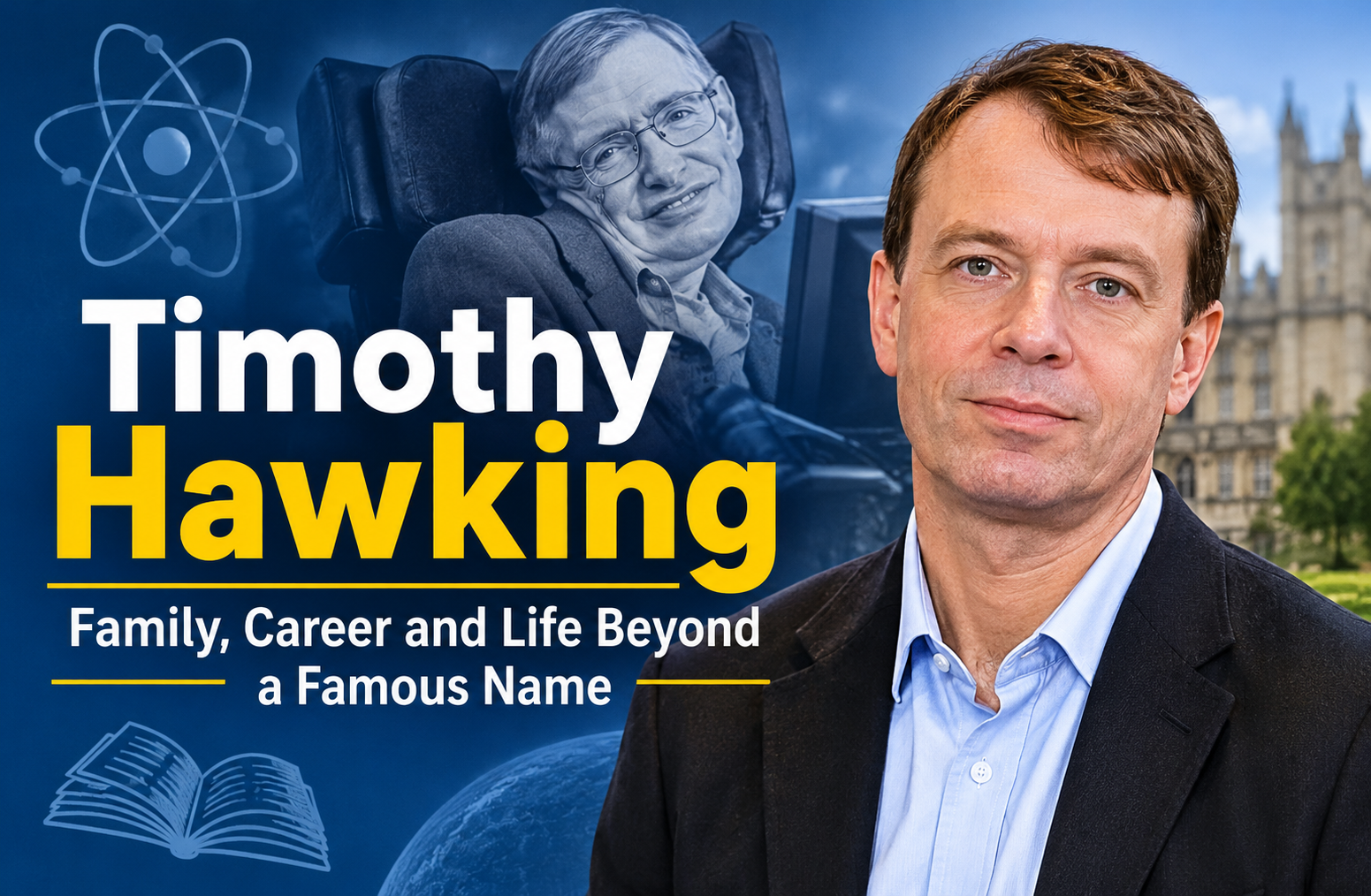
Timothy Hawking: Life, Education, Career, and Family Story
Timothy Hawking is best known as the youngest son of world-famous theoretical physicist Stephen Hawking and his first wife, Jane Hawking. Although he grew up in a family recognized around the world for its contributions to science and literature, Timothy chose a professional path different from his father’s. Rather than entering theoretical physics or pursuing a public career based on his family name, he developed an identity connected to business and marketing while maintaining a relatively private lifestyle.
His story offers an interesting look into the family life behind one of the most influential scientific figures of modern times. Growing up with a father who lived with motor neurone disease presented unusual challenges, particularly as the condition affected Stephen Hawking’s ability to communicate and move. Yet their relationship included affection, humor, and memorable family experiences.
Interest in Timothy increased further following the release of The Theory of Everything, the 2014 film that introduced a wider audience to Stephen Hawking’s personal life and family relationships. Many viewers became curious about his children and the lives they built outside their father’s scientific achievements.
Understanding his background requires looking beyond his famous surname. His education, professional interests, family relationships, and decision to remain largely outside the public spotlight help explain why his life is different from what people might expect when researching the Hawking family.
This article explores the available information about his life while separating reported details from facts that have not been independently confirmed. It also considers the wider significance of growing up in a family shaped by scientific achievement, disability, communication challenges, and international public attention.
Who Is Timothy Hawking?
Timothy Hawking is the youngest child of Stephen Hawking and Jane Hawking. He was born in April 1979 and grew up alongside his older siblings, Robert and Lucy.
His father became internationally recognized for his work in theoretical physics, cosmology, and the study of black holes. His mother, Jane, became known for her writing and for sharing her experiences of family life during Stephen’s illness.
Unlike his parents, Timothy has generally avoided becoming a public figure. Available biographical accounts associate his professional interests with business and marketing rather than academic science. He has also been linked to marketing-related work at the LEGO Group.
This distinction is important. Being the child of a globally recognized scientist does not automatically mean following the same career, interests, or ambitions. Timothy’s professional direction illustrates how someone can grow up surrounded by extraordinary intellectual achievements while choosing a separate path.
Quick Facts About Timothy Hawking
| Detail | Information |
| Full name | Timothy Hawking |
| Birth | April 1979 |
| Father | Stephen Hawking |
| Mother | Jane Hawking |
| Siblings | Robert Hawking and Lucy Hawking |
| Birth order | Youngest of three children |
| Education | Higher education reportedly connected to the University of Birmingham |
| Career | Business and marketing |
| Professional association | LEGO Group |
| Nationality | British |
| Public profile | Generally private |
Some details in online biographies are repeated without clear supporting documentation. Information about his private relationships, exact financial position, and current personal circumstances should therefore be treated carefully.
Timothy Hawking’s Early Life and Childhood
Timothy’s childhood was shaped by two very different aspects of family life. On one side was his father’s extraordinary scientific career. On the other was the everyday reality of living with a progressive neurological condition that increasingly affected his father’s physical independence.
He was born at a time when Stephen Hawking was already an established academic. His father had become a leading figure in cosmology and was gaining recognition for research that changed how scientists understood black holes and the universe.
However, scientific recognition did not make family life simple. Stephen’s motor neurone disease affected his movement, speech, and ability to perform ordinary physical tasks. As Timothy grew older, he experienced the practical realities of having a father whose communication needs were different from those of most parents.
Growing Up in a Scientifically Influential Family
Growing up in the Hawking household meant being surrounded by ideas, conversations, and experiences connected to science.
Stephen Hawking’s work attracted researchers, journalists, students, and public figures from different parts of the world. His books also introduced complex scientific subjects to general readers.
For Timothy, however, Stephen was not simply an internationally famous physicist. He was also his father.
This distinction helps explain why family accounts often reveal a more personal side of Stephen Hawking than his scientific publications or public lectures.
His achievements were extraordinary, but family relationships involved familiar experiences such as humor, disagreements, affection, and the challenges of spending time together.
Timothy’s childhood therefore existed between two worlds: the public image of a celebrated scientist and the private experience of family life.
The Influence of His Parents
Both of Timothy’s parents influenced the environment in which he grew up.
Stephen represented intellectual curiosity, scientific determination, and the ability to continue working despite serious physical limitations.
Jane brought a different perspective through her experiences as a caregiver, mother, writer, and individual managing the responsibilities of family life.
Their marriage and family experiences were complex, particularly as Stephen’s condition progressed and his professional commitments expanded.
Jane later documented many of these experiences in her writing, providing readers with insight into the emotional and practical realities of their household.
For Timothy, this family environment was likely an important influence on how he understood independence, responsibility, and personal identity. However, specific claims about his private childhood experiences should not be presented as established facts unless supported by direct accounts.
Timothy Hawking’s Relationship With His Father, Stephen Hawking
One of the most meaningful parts of Timothy’s story is his relationship with his father. Their connection developed under circumstances that were different from those experienced by many other families.
Stephen Hawking was diagnosed with motor neurone disease (MND), also known as amyotrophic lateral sclerosis (ALS), in the early 1960s. The condition gradually affected his muscles, movement, and ability to speak. Although his intellectual abilities remained exceptional, communicating with other people became increasingly difficult.
For a young child, this created a communication barrier that could affect the development of an ordinary father-son relationship.
How His Father’s Illness Affected Their Relationship
Timothy has spoken about the difficulty of understanding his father during his early childhood.
An especially revealing account appeared in a BBC Science Focus publication about Stephen Hawking’s life and communication technology. Timothy explained that he did not really get to know his father as a person during approximately the first five years of his life because he could not understand what Stephen was saying.
This detail provides an important perspective on their family relationship.
Stephen’s physical condition did not mean that he lacked thoughts, emotions, or an interest in his children. Instead, the main difficulty was finding a reliable way to communicate those feelings.
For Timothy, the introduction of electronic communication technology became an important turning point.
The Computerized Voice That Changed Their Family Life
Stephen Hawking became widely recognized for his computerized voice. It allowed him to communicate after his natural speech became severely impaired.
The technology was more than a medical or scientific achievement. It also changed his ability to participate in family conversations.
With the help of his speech-generating system, Stephen could select words and construct sentences using a computer. This gave him a more direct way to communicate with his children.
For Timothy, the technology helped create a stronger personal connection with his father.
It is an important part of their story because it demonstrates how assistive technology can affect relationships, not just physical independence.
The technology helped make possible several everyday experiences that many families take for granted:
- Having conversations about ordinary subjects.
- Sharing jokes and humorous observations.
- Expressing personal opinions.
- Discussing family experiences.
- Developing a closer emotional connection.
The computerized voice became one of the most recognizable features of Stephen Hawking’s public identity. However, for his youngest son, its importance was also deeply personal.
Humor and Memorable Family Moments
Despite his physical limitations, Stephen Hawking was known for his sense of humor.
He frequently used jokes during interviews, public appearances, and conversations. His computerized voice became part of this personality, allowing him to deliver humorous comments with a distinctive style.
Family memories also included playful moments involving his speech system.
This side of their relationship challenges the common assumption that a family living with a serious disability must be defined entirely by illness and difficulty.
Although practical challenges were part of daily life, humor and affection remained important.
Timothy’s experiences offer a reminder that family relationships are built through shared moments. They do not depend entirely on physical ability or conventional forms of communication.
Timothy Hawking’s Parents: Stephen and Jane Hawking
To understand his background, it is important to examine the lives of both parents.
Stephen and Jane Hawking were influential in different ways. Stephen became one of the most recognized scientists of his generation, while Jane became an author whose work provided a personal account of their marriage and family experiences.
His Father: Stephen Hawking
Stephen William Hawking was born on January 8, 1942, in Oxford, England. He became a leading theoretical physicist and cosmologist, making important contributions to research involving black holes, general relativity, and the origins of the universe.
His academic career was closely associated with the University of Cambridge.
One of his best-known scientific contributions was Hawking radiation, a theoretical prediction that black holes can emit radiation because of quantum effects near their event horizons.
His 1988 book, A Brief History of Time, introduced complicated ideas about space, time, and cosmology to millions of general readers.
Stephen also became an internationally recognized public figure because of his ability to continue his scientific work while living with a progressive neurological disease.
He died on March 14, 2018, at the age of 76.
For Timothy, his father’s legacy was not limited to scientific achievements. Stephen was also the person with whom he shared childhood memories, conversations, and family experiences.
His Mother: Jane Hawking
Jane Hawking, born Jane Wilde, was Stephen’s first wife and the mother of their three children.
She met Stephen before his scientific fame reached its greatest level. They married in 1965, after Stephen had received his diagnosis.
Their marriage involved decades of shared experiences, including raising children, managing the effects of Stephen’s illness, and dealing with the increasing demands of his academic career.
Jane also pursued her own academic interests and became a writer.
Her memoir, Travelling to Infinity: My Life with Stephen, offers a detailed account of their relationship and the personal responsibilities involved in caring for a husband with a progressive disability.
The book became particularly well known after its adaptation into the 2014 film The Theory of Everything.
Jane’s perspective is important because it provides insight into the family environment in which Timothy and his siblings grew up.
The Family’s Changing Circumstances
Stephen and Jane’s marriage eventually ended in divorce in 1995.
Their separation was a significant personal change, but it did not erase the family relationships they had built together.
Stephen later married Elaine Mason. That marriage ended in divorce in 2006.
Over the years, the Hawking family experienced changes in relationships, responsibilities, and living arrangements.
These circumstances are relevant when considering Timothy’s background, but it is important not to make assumptions about his personal feelings or private experiences without reliable statements from him.
Timothy Hawking’s Siblings and Family Connections
Timothy grew up with two older siblings, Robert and Lucy Hawking.
Although all three children shared the same parents, they developed different professional interests and public identities.
Robert Hawking
Robert is Stephen and Jane’s eldest child, born in 1967.
Unlike his father, Robert pursued a professional direction outside theoretical physics. Public biographical accounts have associated him with software engineering and technology-related work.
He has generally maintained a private profile.
His career illustrates that the Hawking family did not follow a single professional pattern. Different children developed their own interests and pursued separate opportunities.
Lucy Hawking
Lucy Hawking was born in 1970 and became a journalist, author, and public speaker.
She is particularly known for working with her father on a series of children’s books that introduce scientific ideas through fictional adventures.
Their collaboration helped make subjects such as astronomy, space exploration, and physics more accessible to younger readers.
Lucy has also participated in discussions about science education and her father’s legacy.
Her public career differs from Timothy’s more private professional life, but both are examples of children who developed interests beyond simply being recognized as Stephen Hawking’s children.
How the Three Siblings Differed
The professional interests of Robert, Lucy, and Timothy demonstrate that family background does not determine an individual’s career.
Their paths can be understood broadly as follows:
| Family member | Publicly associated professional interests |
| Robert Hawking | Software engineering and technology |
| Lucy Hawking | Journalism, writing, and science communication |
| Timothy Hawking | Business, marketing, and creative brand development |
These differences are important because they show how the same family environment can support different ambitions.
Each sibling developed a separate identity rather than attempting to reproduce their father’s achievements.
Timothy Hawking’s Education and Academic Background
Education is an important part of his biography because it helps explain how he developed a career outside theoretical physics.
Unlike Stephen, whose academic interests focused on mathematics, cosmology, and theoretical science, Timothy pursued studies connected to languages and later postgraduate education.
The Royal Institution’s biographical profile of the Hawking family provides a particularly useful account of his academic background.
According to its profile, Tim studied languages at the University of Exeter before completing postgraduate studies at the University of Birmingham.
This information helps correct a common misconception that he followed his father’s academic direction.
Studies at the University of Exeter
The University of Exeter is a British higher education institution with a wide range of academic disciplines.
Timothy’s studies there were reportedly focused on languages.
This is a notable difference from Stephen Hawking’s academic background, which centered on physics and cosmology.
Language studies can develop several transferable skills, including:
- Clear written communication.
- Understanding different cultures.
- Interpreting information.
- Critical thinking.
- Research and analysis.
- The ability to communicate with different audiences.
These abilities can be useful in business, marketing, public relations, and international organizations.
Although there is limited publicly verified information about the exact details of Timothy’s undergraduate experience, his reported academic direction offers a reasonable explanation for his later interest in communication and brand development.
Postgraduate Studies at the University of Birmingham
After his studies at Exeter, Timothy completed postgraduate education at the University of Birmingham.
This is another important part of his academic journey.
Postgraduate education allows students to develop more specialized knowledge and improve their professional qualifications. However, publicly available information does not establish every detail of Timothy’s course, research, or academic achievements.
It would therefore be inaccurate to assign him a particular postgraduate degree subject without reliable confirmation.
What can be established from the available institutional biography is that his education included studies at both Exeter and Birmingham.
How His Education Related to His Career
Timothy’s academic background is relevant because business and marketing require more than commercial knowledge.
Professionals working in these areas often need to understand:
- How people interpret messages.
- What makes a brand recognizable.
- How customers respond to products.
- How organizations communicate their values.
- How creative ideas can support commercial objectives.
His reported education in languages, followed by postgraduate studies, provides useful context for understanding his later professional direction.
It also shows why a person’s education should not be judged only by whether it matches their parents’ careers.
A background in one academic discipline can create opportunities in another professional field.
Timothy Hawking’s Professional Career and Work at LEGO
One of the most interesting aspects of Timothy’s life is his decision to build a career in business and creative brand development rather than follow his father’s academic path.
His professional background has been associated with marketing and the LEGO Group, an internationally recognized company known for its construction toys and creative products.
The Royal Institution’s profile of Stephen Hawking’s family describes Tim’s early professional career as being connected to creative brand development, particularly through the LEGO Group.
This is a useful institutional source because it provides information about his education and professional direction rather than relying only on repeated claims from celebrity biography websites.
His Association With the LEGO Group
The LEGO Group is one of the world’s best-known toy and entertainment brands. Its products encourage creativity, problem-solving, imagination, and hands-on learning.
Working in a marketing or brand development environment at such a company involves understanding how products connect with customers.
Marketing is not simply about advertising. It also involves understanding a company’s identity, communicating its values, and creating experiences that people recognize and remember.
Timothy’s reported association with the company is particularly interesting because it demonstrates a professional interest very different from theoretical physics.
His career has been linked to areas such as:
- Creative brand development.
- Marketing communication.
- Brand identity.
- Customer engagement.
- Commercial strategy.
- Connecting products with audiences.
However, there is an important distinction between a documented professional association and an exact employment history.
Publicly accessible information does not provide a complete record of every position he has held, his precise job responsibilities, or the dates of his employment. It would therefore be misleading to describe specific senior titles or claim that he currently holds a particular position without reliable confirmation.
Why Marketing Is a Different Career From Theoretical Physics
At first glance, marketing and theoretical physics may appear to have very little in common.
Stephen Hawking studied the fundamental laws of the universe. His work involved mathematical models, scientific theories, and questions about the nature of space and time.
Marketing focuses on how organizations communicate with people and create value through products and services.
However, both areas require certain transferable abilities:
| Skill | Application in physics | Application in marketing |
| Analytical thinking | Understanding scientific problems | Studying customer behavior |
| Communication | Explaining scientific ideas | Presenting brand messages |
| Creativity | Developing new theories | Creating campaigns |
| Research | Investigating physical phenomena | Understanding markets |
| Problem-solving | Testing scientific models | Improving business strategies |
This comparison does not mean the two careers are identical. Instead, it shows that intellectual abilities can be applied in different professional environments.
Timothy’s career direction demonstrates that a person’s interests can be independent of their family background.
Understanding Creative Brand Development
Creative brand development is a broad area of business that involves shaping how people recognize and understand a company.
It can include:
- Developing a consistent brand identity.
- Understanding the needs of customers.
- Creating meaningful marketing messages.
- Supporting product launches.
- Communicating a company’s values.
- Building long-term customer relationships.
For a company such as LEGO, creativity is especially important because the brand is closely associated with imagination and learning.
The connection between creative thinking and commercial communication makes brand development an interesting professional field.
Although Timothy’s exact contributions to individual campaigns or projects are not publicly documented in sufficient detail, his reported association with this industry gives readers a clearer understanding of his professional interests.
Timothy Hawking’s Personal Life and Relationships
Many people researching Timothy are interested in his personal relationships, marriage, children, and lifestyle.
However, this is an area where reliable public information is limited.
Unlike some members of famous families, he has not built a highly visible public identity through interviews, entertainment appearances, or regular social media updates.
His preference for privacy means that many personal details cannot be confidently established.
Is Timothy Hawking Married?
There is no sufficiently reliable public information to establish his current marital status with confidence.
Some online biographies make claims about his relationships or marriage, but these claims are not consistently supported by credible primary sources.
It is important to distinguish between information that has been publicly confirmed and details that websites repeat without providing evidence.
A responsible biography should not present an unverified relationship, wedding, or spouse’s identity as fact.
Does Timothy Hawking Have Children?
Information about whether he has children is also limited.
He has not made his family life a regular subject of public discussion, and reliable sources do not provide a confirmed account of his children.
This does not necessarily mean that he has no children. It simply means that the available public information is insufficient to establish the answer.
Privacy should be respected, particularly when discussing relatives who have not chosen to live in the public spotlight.
Why Does He Maintain a Private Lifestyle?
There can be several reasons why someone connected to a famous family chooses to maintain a low public profile.
For example:
- They may prefer to separate professional life from family recognition.
- They may value personal independence.
- They may not be interested in celebrity culture.
- They may wish to protect their relationships from unnecessary attention.
- They may prefer to be recognized for their own work.
These are general possibilities, not confirmed explanations of Timothy’s personal motivations.
His limited public presence is nevertheless an important part of how his biography should be understood.
Not every member of a famous family wants public attention. A private lifestyle is a legitimate personal choice, not an indication that someone has achieved less or contributed less.
Timothy Hawking’s Net Worth and Financial Background
Net worth is another frequently searched subject in biographies of Stephen Hawking’s family.
However, there is no reliable, publicly verified financial disclosure establishing Timothy’s exact net worth.
Various websites publish estimated figures, but many do not explain their calculations or provide evidence for the amounts they report.
For this reason, specific online estimates should not be treated as confirmed financial information.
How Is Net Worth Usually Calculated?
Net worth generally refers to the difference between a person’s assets and liabilities.
The basic calculation is:
Net Worth = Total Assets – Total Liabilities
Assets may include:
- Property and real estate.
- Savings and investments.
- Business ownership.
- Other valuable possessions.
- Financial interests.
Liabilities may include:
- Mortgages.
- Personal loans.
- Business debts.
- Other financial obligations.
Without reliable information about these categories, calculating an individual’s actual wealth is not possible.
Does His Father’s Wealth Determine His Net Worth?
No. A parent’s financial position should not automatically be treated as the wealth of their children.
Stephen Hawking was a successful academic, author, and public intellectual. His published books, professional work, and public appearances contributed to his international recognition.
However, his financial circumstances do not establish the personal wealth of each of his children.
Inheritance, personal income, investments, property ownership, and financial responsibilities are separate matters.
There is no sound basis for assigning Timothy a particular financial figure simply because he is Stephen Hawking’s son.
Why Online Financial Estimates Can Be Misleading
Celebrity net worth websites sometimes use indirect assumptions to produce estimated figures.
These assumptions may include:
- Guessing salaries from job titles.
- Assuming property ownership.
- Treating family wealth as individual wealth.
- Estimating investments without financial records.
- Repeating figures from other websites.
The result can look convincing while having little factual support.
For readers interested in his finances, the most accurate conclusion is that his exact net worth remains undisclosed and publicly unverified.
Timothy Hawking and The Theory of Everything
The 2014 film The Theory of Everything played an important role in bringing Stephen Hawking’s personal story to a wider audience.
Directed by James Marsh, the movie starred Eddie Redmayne as Stephen Hawking and Felicity Jones as Jane Hawking.
The film was based on Jane’s memoir, Travelling to Infinity: My Life with Stephen.
It explored Stephen’s university years, his relationship with Jane, his diagnosis, their marriage, and the challenges associated with his progressing illness.
The film also helped viewers understand that Stephen Hawking’s life involved much more than scientific discoveries.
Why the Film Increased Interest in His Family
Before the movie, many people primarily recognized Stephen Hawking as a scientist who studied black holes and wrote A Brief History of Time.
The film presented a more personal account of his experiences.
Audiences became interested in questions such as:
- What was Stephen Hawking like as a husband?
- How did Jane manage family responsibilities?
- How did their children grow up?
- How did the family communicate with Stephen?
- What happened to his children as adults?
These questions naturally increased interest in Timothy and his siblings.
However, it is important to remember that The Theory of Everything is a dramatic film, not a complete documentary biography.
Film adaptations select particular events and relationships to create a coherent story. Some details may be simplified, condensed, or presented differently for dramatic purposes.
Timothy’s Story Beyond the Film
Timothy’s life should not be understood only through the experiences presented in the movie.
His education, professional development, and adult life extend beyond the period covered by the film.
He was not simply a supporting figure in his father’s biography. He developed his own interests and professional identity.
This distinction is important when discussing the children of well-known individuals.
A film can introduce audiences to a family, but it cannot fully explain the separate experiences and decisions of every family member.
Stephen Hawking’s Disability and the Importance of Assistive Technology
One of the deeper themes connected to Timothy’s family background is the role of assistive technology in everyday communication.
Stephen Hawking lived with motor neurone disease for more than five decades. The condition gradually reduced his ability to move and speak, but it did not remove his ability to think, develop scientific ideas, or communicate through technology.
His speech-generating equipment became an essential part of his professional and personal life.
What Is Assistive Communication Technology?
Assistive communication technology includes tools that help people express their thoughts when speaking or writing in conventional ways is difficult.
Depending on a person’s needs, these tools may include:
- Speech-generating devices.
- Text-to-speech software.
- Eye-tracking systems.
- Alternative keyboards.
- Communication boards.
- Switch-based input systems.
Such technologies can support education, employment, independence, and social interaction.
Stephen Hawking’s communication system became one of the most famous examples of how technology can help someone participate in society despite severe physical limitations.
Why Communication Matters in Family Relationships
Communication is central to family life.
Parents and children use conversations to share experiences, express emotions, resolve misunderstandings, and build trust.
When a person cannot communicate through speech, family members may need to develop alternative methods.
This can require patience and adjustments from everyone involved.
Timothy’s account of initially struggling to understand his father illustrates this point.
It also shows how access to suitable communication technology can change a family’s experience.
The important lesson is that communication should not be measured only by a person’s ability to speak.
Someone may have a great deal to say even when their physical ability to express it is limited.
The Wider Significance of Stephen Hawking’s Experience
Stephen’s life contributed to public discussions about disability, accessibility, technology, and independence.
His scientific achievements attracted worldwide attention, but his use of assistive technology also helped demonstrate the importance of accessible communication.
His experience offers several broader lessons:
- Physical disability does not automatically limit intellectual ability.
- Technology can create new opportunities for independence.
- Accessible communication is important in education and employment.
- Families benefit from tools that support meaningful interaction.
- Society should recognize people’s abilities rather than define them only by their medical conditions.
These themes give Timothy’s family story a wider meaning beyond celebrity biography.
What Makes Timothy Hawking’s Story Interesting?
There are many reasons people search for information about Stephen Hawking’s youngest son.
At first, curiosity may simply come from wanting to know more about the scientist’s family. However, his background raises several broader questions about identity, independence, and life outside public attention.
Building an Identity Beyond a Famous Family Name
Being connected to a globally recognized person can create both opportunities and challenges.
A famous surname can attract attention, create professional connections, and generate public interest.
At the same time, it can make it difficult for someone to be recognized as an individual.
People may focus on the famous parent rather than the person’s own achievements.
Timothy’s career direction illustrates the importance of developing an independent identity.
His reported work in marketing and brand development shows that a person can choose a completely different professional environment from the one associated with their family.
Choosing a Different Professional Path
Stephen Hawking became known for exploring some of the most difficult questions in modern physics.
Timothy’s reported interests developed in a different direction.
This difference should not be viewed as a comparison of achievement.
Physics, business, marketing, writing, and technology are separate fields with different demands and contributions.
The value of a career cannot be measured simply by how closely it resembles the achievements of a famous parent.
The Importance of Privacy
Public curiosity about famous families can sometimes create unrealistic expectations.
People may assume that the children of well-known figures should provide regular interviews, maintain public profiles, or share details about their personal lives.
However, there is no obligation to do so.
A person can be connected to an internationally recognized family and still choose an ordinary private lifestyle.
Timothy’s limited public presence makes this an important part of his story.
Understanding the Human Side of Scientific History
Scientific history is often told through discoveries, awards, publications, and academic institutions.
But the people behind these achievements also have family relationships and personal experiences.
Timothy’s background helps readers see Stephen Hawking from another perspective.
It reminds us that an influential scientist was also a father whose ability to communicate with his children mattered deeply.
That human perspective makes the family story meaningful beyond the world of physics.
Important Facts to Understand Before Reading Online Biographies
When researching someone who maintains a relatively private lifestyle, it is important to separate reliable information from speculation.
Online biographies often repeat the same details without identifying their original source.
This can make an unsupported statement appear more credible simply because it appears on multiple websites.
The following distinctions help provide a more accurate picture.
| Subject | What can responsibly be stated |
| Birth | Reported as April 1979 |
| Parents | Stephen Hawking and Jane Hawking |
| Siblings | Robert and Lucy |
| Education | Languages at Exeter and postgraduate studies at Birmingham |
| Career | Early career in creative brand development, associated with LEGO |
| Marriage | Current marital status is not reliably established |
| Children | Reliable public details are limited |
| Net worth | No verified figure is available |
| Lifestyle | Generally maintains a private public profile |
The educational and professional information is supported by the Royal Institution’s family profile. Other private details should not be expanded beyond what reliable evidence establishes.
How to Evaluate Biographical Information
Readers can use a few simple steps when checking information about private individuals.
- Look for the original source.
A statement is more useful when it comes from an interview, institutional biography, published memoir, or direct public statement.
- Separate facts from estimates.
A confirmed birth year is different from a guessed financial figure.
- Check whether sources provide evidence.
Several websites repeating the same claim do not necessarily represent several independent confirmations.
- Pay attention to publication dates.
Older articles may contain outdated employment information or incomplete family details.
- Avoid assumptions about private relationships.
An absence of public information is not proof that something is true or false.
Following these steps helps readers develop a more accurate understanding of public biographies without spreading unsupported claims.
Frequently Asked Questions About Timothy Hawking
1. Who is Timothy Hawking?
Timothy Hawking is the youngest son of renowned theoretical physicist Stephen Hawking and author Jane Hawking. He was born in April 1979 and is associated with a professional career in business, marketing, and creative brand development.
2. How old is Timothy Hawking?
He was born in April 1979. As of November 2026, he is 47 years old.
3. Who are Timothy Hawking’s parents?
His parents are Stephen Hawking, the famous theoretical physicist and cosmologist, and Jane Hawking, an author known for her memoir about their family life. They married in 1965 and had three children together.
4. What does Timothy Hawking do for a living?
Timothy has been associated with business and marketing, particularly creative brand development. His early professional career was notably connected to the LEGO Group. Detailed information about his current employment is not publicly established.
5. Did Timothy Hawking study at the University of Birmingham?
Yes. According to the Royal Institution’s biographical profile, he studied languages at the University of Exeter and later completed postgraduate studies at the University of Birmingham.
6. What is Timothy Hawking’s net worth?
His exact net worth is not publicly verified. Although various websites publish financial estimates, there is insufficient reliable information to confirm a specific amount.
Conclusion
Timothy Hawking’s life provides an interesting perspective on growing up in the family of one of the world’s most influential scientists. As the youngest son of Stephen and Jane Hawking, he experienced a childhood shaped by scientific achievement, family responsibilities, and the challenges associated with his father’s motor neurone disease.
His relationship with Stephen is particularly meaningful because communication technology helped them develop a closer connection. Their experiences demonstrate how assistive technology can make a difference not only in professional life but also in personal relationships.
His education at the University of Exeter and postgraduate studies at the University of Birmingham, followed by his association with creative brand development and the LEGO Group, illustrate his decision to pursue a professional direction different from his father’s.
Although public information about his marriage, finances, and personal circumstances remains limited, this privacy is an important part of his individual identity.
Ultimately, his story is about more than having a famous surname. It highlights personal independence, different career ambitions, family connections, and the importance of developing an identity beyond the expectations associated with a well-known family.