Portland Fire vs Connecticut Sun Match Player Stats: May 2026 Game Analysis
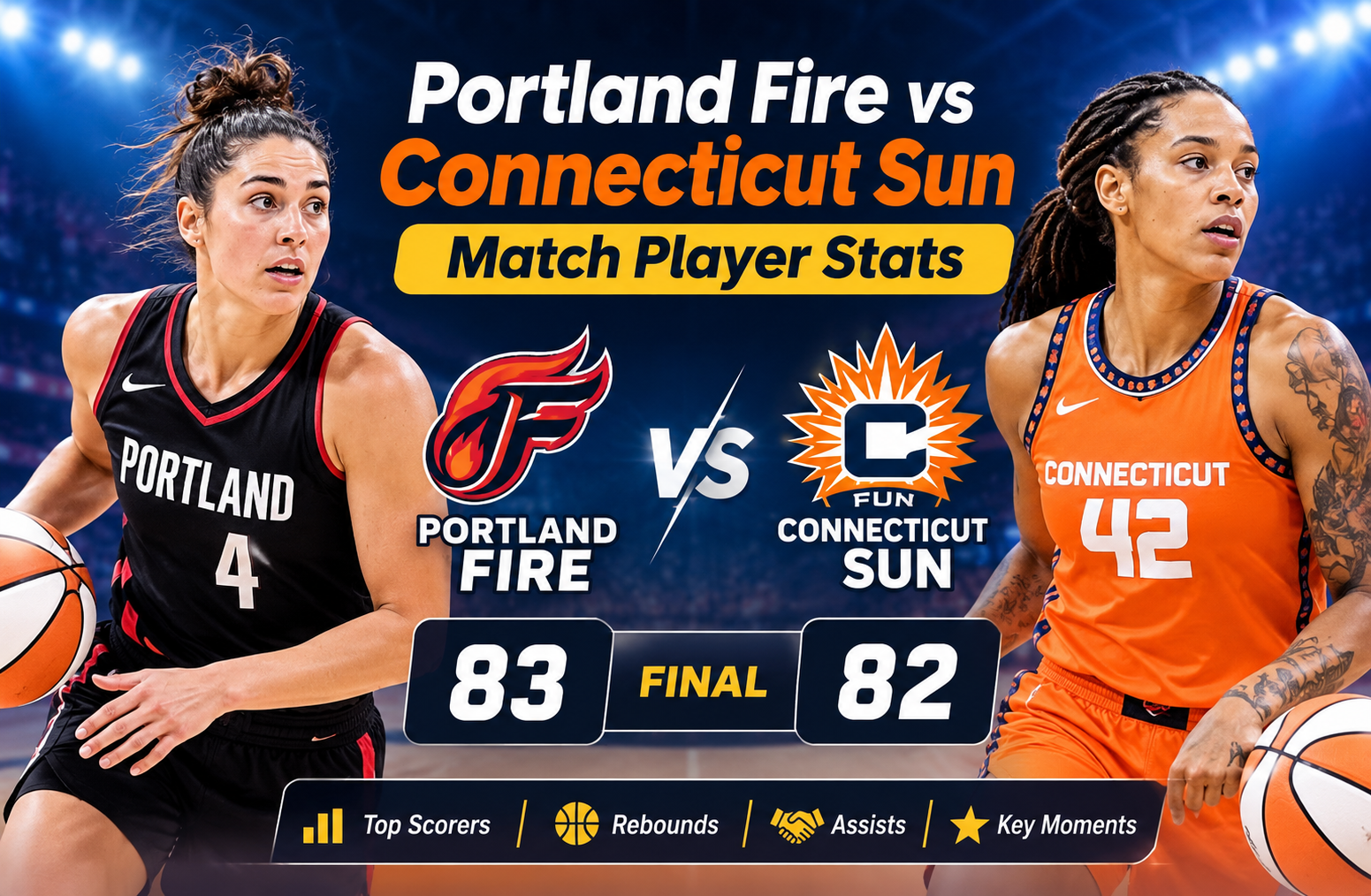
The Portland Fire and Connecticut Sun delivered a close contest on May 18, 2026, with Portland earning a narrow 83-82 victory according to the game data provided. The matchup featured strong individual scoring, contrasting shooting efficiency, and a final result that came down to a single point.
This article examines the portland fire vs connecticut sun match player stats in detail, including leading scorers, rebounds, assists, team shooting percentages, player contributions, and the statistical factors that shaped the result.
The supplied game summary contains a date discrepancy: the heading lists May 18, 2026, while the game information lists May 19, 2026. The analysis below uses May 18 as the reported game date and identifies the discrepancy rather than presenting the date as fully verified.
Portland Fire vs Connecticut Sun: Match Summary
Game date: May 18, 2026 | Venue: Moda Center, Portland, Oregon
The Fire Still Burns: Portland WNBA Team Reveals Revived Name, New Logos – SportsLogos.Net News
83
Portland Fire
Final
1-point win
Connecticut Sun Scores, Stats and Highlights – ESPN
82
Connecticut Sun
The official WNBA game summary confirms the 83-82 result, the May 18 date, and the Portland venue. The game was highly competitive, with 14 lead changes and 13 ties.
WNBA+1
Quarter-by-quarter score
| Quarter | Connecticut Sun | Portland Fire |
| First | 24 | 25 |
| Second | 18 | 13 |
| Third | 22 | 26 |
| Fourth | 18 | 19 |
| Final | 82 | 83 |
Portland opened with a one-point lead, but Connecticut took control of the second quarter and went into halftime ahead 42-38. Portland responded with a strong third quarter, outscoring Connecticut 26-22, then held on during the final period.
WNBA+1
Portland Fire vs Connecticut Sun Match Player Stats
The portland fire vs connecticut sun match player stats provide a useful picture of how a one-point basketball game can be decided by execution rather than one team’s overall shooting advantage. Connecticut made more of its field-goal attempts and collected more rebounds, but Portland converted its free throws at a much higher rate and produced enough points in key situations to secure the win.
The official final box score records Portland’s 83 points against Connecticut’s 82. It also confirms that the game was played at Moda Center, with an attendance of 12,010.
Fire
Final team statistics
| Statistical category | Portland Fire | Connecticut Sun |
| Points | 83 | 82 |
| Field goals made | 28 | 32 |
| Field goals attempted | 62 | 63 |
| Field-goal percentage | 45.2% | 50.8% |
| Three-pointers made | 7 | 7 |
| Three-pointers attempted | 22 | 20 |
| Three-point percentage | 31.8% | 35.0% |
| Free throws made | 20 | 11 |
| Free throws attempted | 26 | 20 |
| Free-throw percentage | 76.9% | 55.0% |
| Total rebounds | 27 | 32 |
| Assists | 23 | 23 |
| Turnovers | 15 | 17 |
| Steals | 11 | 9 |
| Blocks | 3 | 6 |
These numbers reveal the central statistical contrast. Connecticut was more accurate from the field, while Portland scored nine more points at the free-throw line.
Portland Fire Player Stats
Portland’s victory was a team effort, but several players made particularly important contributions. Bridget Carleton and Sarah Ashlee Barker led the Fire with 18 points each. Emily Engstler added 15, while Sug Sutton scored 12 and delivered the go-ahead basket late in the game.
Portland Fire complete player box score
| Player | MIN | PTS | REB | AST | FG | 3P | FT |
| Bridget Carleton | 33:25 | 18 | 5 | 5 | 5/12 | 2/7 | 6/6 |
| Sarah Ashlee Barker | 20:58 | 18 | 4 | 3 | 7/13 | 2/3 | 2/4 |
| Emily Engstler | 28:05 | 15 | 3 | 2 | 4/7 | 2/3 | 5/5 |
| Sug Sutton | 24:34 | 12 | 1 | 5 | 4/10 | 1/2 | 3/4 |
| Nyadiew Puoch | 21:12 | 10 | 3 | 4 | 4/8 | 0/2 | 2/2 |
| Serah Williams | 12:26 | 5 | 5 | 1 | 1/1 | 0/0 | 1/1 |
| Megan Gustafson | 7:42 | 3 | 2 | 2 | 1/2 | 0/1 | 1/1 |
| Holly Winterburn | 15:03 | 2 | 1 | 1 | 1/4 | 0/2 | 0/0 |
| Luisa Geiselsoder | 24:39 | 2 | 4 | 0 | 1/5 | 0/2 | 0/0 |
| Haley Jones | 11:55 | 0 | 0 | 0 | 0/0 | 0/0 | 0/0 |
MIN = minutes played, PTS = points, REB = rebounds, AST = assists, FG = field goals, 3P = three-pointers, FT = free throws.
Portland’s player totals add up to 83 points. The team’s scoring was spread across several players, which helped it avoid depending on one offensive option throughout the contest.
Bridget Carleton: 18 points, 5 rebounds and 5 assists
Bridget Carleton was one of Portland’s most productive players. She finished with 18 points, five rebounds, and five assists.
Her contribution was not limited to scoring. Carleton helped Portland move the ball, created opportunities for teammates, and provided an important presence on the glass.
Carleton also played a significant role in the closing moments. After Connecticut made a late three-pointer, Carleton secured a crucial rebound and was fouled. She then made two free throws with 9.7 seconds remaining, helping Portland maintain its advantage.
Her performance showed why a player’s impact should not be measured only by points. Rebounding, passing, and late-game decision-making can be equally important in a close contest.
Sarah Ashlee Barker: 18 points on efficient shooting
Sarah Ashlee Barker matched Carleton’s scoring total with 18 points.
Barker made seven of her 13 field-goal attempts, giving her a field-goal percentage of 53.8%. She also made two three-pointers and contributed four rebounds and three assists.
Her scoring efficiency was especially valuable because Portland did not shoot as well as Connecticut overall. Barker converted a high percentage of her attempts and helped keep Portland’s offense productive during stretches when the team struggled to find rhythm.
Barker’s performance was an example of how efficient scoring can compensate for a team’s lower overall shooting percentage.
Emily Engstler: 15 points and a strong two-way contribution
Emily Engstler finished with 15 points, three rebounds, and two assists.
She made four of seven field-goal attempts and converted both of her three-point attempts. Engstler also went five for five from the free-throw line.
Her perfect free-throw performance mattered in a game decided by one point. Every successful attempt helped Portland build the margin it eventually needed.
Engstler also contributed defensively, recording two steals and two blocks. Her stat line reflects a balanced performance on both ends of the floor.
Sug Sutton: The decisive late-game basket
Sug Sutton scored 12 points, collected one rebound, and recorded five assists.
The most important moment of her performance came with 22.6 seconds remaining. Sutton drove into the lane and made a floater that gave Portland an 81-79 lead.
That basket was a major turning point because the game was still within reach for Connecticut. Sutton’s ability to attack the basket under pressure created the advantage Portland needed in the final possession sequence.
Sutton’s five assists also demonstrate her role as a playmaker. She helped Portland generate offense beyond her own scoring.
Nyadiew Puoch: A valuable supporting scorer
Nyadiew Puoch contributed 10 points, three rebounds, and four assists.
She made four of eight field-goal attempts and converted both of her free throws. Puoch also recorded two steals and a block.
Her four assists were important because Portland’s leading scorers were not the only players creating opportunities. Puoch helped connect the offense and gave the team another productive option.
Connecticut Sun Player Stats
Connecticut’s individual numbers were impressive in several areas. The Sun had four players score 12 or more points, and the team shot better from the field than Portland.
However, the final result shows that good individual shooting does not always translate into a win. Connecticut struggled to convert enough free throws and committed more turnovers than its opponent.
Connecticut Sun complete player box score
| Player | MIN | PTS | REB | AST | FG | 3P | FT |
| Brittney Griner | 26:56 | 16 | 5 | 4 | 6/12 | 0/0 | 4/7 |
| Aneesah Morrow | 33:45 | 12 | 12 | 4 | 5/10 | 1/4 | 1/2 |
| Aaliyah Edwards | 16:37 | 12 | 2 | 0 | 5/6 | 0/0 | 2/3 |
| Hailey Van Lith | 24:45 | 12 | 1 | 3 | 5/9 | 1/3 | 1/2 |
| Charlisse Leger-Walker | 23:12 | 10 | 2 | 4 | 3/7 | 3/4 | 1/2 |
| Saniya Rivers | 28:28 | 9 | 3 | 6 | 4/8 | 0/3 | 1/2 |
| Raegan Beers | 4:46 | 4 | 2 | 0 | 2/2 | 0/0 | 0/0 |
| Diamon Miller | 13:08 | 3 | 0 | 1 | 1/2 | 1/2 | 0/0 |
| Gianna Kneepkens | 4:17 | 3 | 0 | 0 | 1/2 | 1/1 | 0/0 |
| Nell Angloma | 3:06 | 1 | 0 | 0 | 0/0 | 0/0 | 1/2 |
| Kennedy Burke | 21:00 | 0 | 6 | 3 | 0/5 | 0/3 | 0/0 |
Brittney Griner: Connecticut’s leading scorer
Brittney Griner led Connecticut with 16 points.
She made six of 12 field-goal attempts and added five rebounds, four assists, and two blocks. Griner was an important interior scoring option and helped Connecticut maintain its offensive efficiency.
Her 16 points represented the highest scoring total for either team in the game. However, Connecticut needed additional production in the final moments to turn that individual performance into a victory.
Griner’s four assists also show that her contribution extended beyond scoring. She helped Connecticut create opportunities for teammates and supported the team’s offensive movement.
Aneesah Morrow: A double-double performance
Aneesah Morrow recorded a double-double with 12 points and 12 rebounds.
She also contributed four assists, making her one of Connecticut’s most complete performers.
Morrow’s rebounding was especially important because Portland finished with only 27 total rebounds. Connecticut’s 32 rebounds gave the Sun a five-rebound advantage.
Morrow collected nine defensive rebounds and three offensive rebounds. Her ability to secure missed shots helped Connecticut maintain possession and create second-chance opportunities.
Despite her strong performance, Connecticut could not convert its statistical advantages into a final lead.
Aaliyah Edwards: High field-goal efficiency
Aaliyah Edwards scored 12 points on five of six shooting.
Her 83.3% field-goal percentage was the highest among Connecticut’s players who attempted at least six shots.
Edwards also collected two rebounds and recorded two steals. She was highly efficient when given scoring opportunities, but her playing time was limited to 16 minutes and 37 seconds.
Her performance highlights the value of selecting high-quality shots. Edwards did not need a large number of attempts to produce a strong scoring total.
Hailey Van Lith: Consistent perimeter scoring
Hailey Van Lith finished with 12 points, one rebound, and three assists.
She made five of nine field-goal attempts and one three-pointer. Her 55.6% field-goal percentage was a productive result for a perimeter player.
Van Lith helped Connecticut maintain its offensive rhythm and gave the team another scoring option alongside Griner and Edwards.
Charlisse Leger-Walker: Late three-point contribution
Charlisse Leger-Walker scored 10 points and recorded four assists.
She made three of four three-point attempts, giving Connecticut an important perimeter scoring threat.
Her late three-pointer with 1.9 seconds remaining reduced Portland’s lead and created another opportunity for Connecticut. The Sun still had a chance to make a final play after Portland committed an offensive foul, but Morrow’s halfcourt attempt fell short.
Leger-Walker’s shooting helped Connecticut stay competitive until the final seconds.
Team Shooting Analysis
The shooting statistics reveal why this game was so close.
Connecticut made 32 of 63 field-goal attempts, while Portland made 28 of 62. The Sun’s 50.8% field-goal percentage was significantly higher than Portland’s 45.2%.
Yet Portland won.
Field-goal percentage
Connecticut’s shooting advantage was clear:
- Connecticut: 50.8%
- Portland: 45.2%
Connecticut made four more field goals than Portland. In many games, that difference would be enough to create a comfortable lead.
But basketball scoring also depends on the value of each shot and the ability to earn points at the free-throw line.
Three-point shooting
Both teams made seven three-pointers.
Connecticut attempted 20 three-point shots and converted seven, producing a 35.0% percentage.
Portland attempted 22 and also made seven, finishing at 31.8%.
The Sun therefore had a slight advantage from beyond the arc. However, the difference was not large enough to overcome Portland’s superior free-throw production.
Free-throw shooting
The free-throw line was one of the most important statistical factors in the game.
Portland made 20 of 26 attempts, while Connecticut made 11 of 20.
That created a nine-point advantage for Portland at the line.
The difference in free throws made was almost enough to explain the final margin by itself. Portland won by one point, despite Connecticut making four more field goals.
This is a strong example of how free-throw accuracy can decide a close basketball game.
Rebounding and Second-Chance Opportunities
Connecticut outrebounded Portland 32-27.
The Sun collected 10 offensive rebounds and 22 defensive rebounds. Portland recorded seven offensive rebounds and 20 defensive rebounds.
A five-rebound advantage can be meaningful because it affects both possession length and the number of scoring chances a team receives.
Connecticut also recorded nine second-chance points, while Portland scored 12.
Portland’s advantage in second-chance scoring is notable because Connecticut had more total rebounds. The Fire converted a greater share of its second-chance opportunities into points.
This difference illustrates why raw rebound totals do not always tell the full story. A team can win the rebounding battle but still lose the second-chance scoring category.
Assists and Ball Movement
Both teams recorded 23 assists.
That equal total suggests that Portland and Connecticut each generated a similar number of assisted scoring opportunities.
However, the individual distribution was different.
Portland’s Carleton and Sutton each recorded five assists. Puoch added four, while Barker contributed three.
Connecticut’s Saniya Rivers led the team with six assists. Griner, Morrow, and Leger-Walker each recorded four.
The assist totals show that both teams used team-oriented offense rather than relying entirely on individual isolation scoring.
Turnovers and Defensive Pressure
Portland committed 15 turnovers, while Connecticut committed 17.
The two-turnover difference may appear small, but it matters in a game decided by one point.
Portland scored 22 points off Connecticut’s turnovers, while Connecticut scored 27 points off Portland’s turnovers.
Connecticut therefore had the advantage in points created from turnovers. However, the Sun’s overall turnover count was higher, and the team could not maintain enough control during the final possessions.
Portland also recorded 11 steals compared with Connecticut’s nine. The Fire’s defensive pressure helped create disruption and contributed to its ability to stay close despite lower field-goal accuracy.
How Portland Won the Game
1. Portland responded after a difficult second quarter
Portland scored only 13 points in the second quarter and went into halftime trailing 42-38.
The Fire could have allowed that momentum to carry into the second half. Instead, Portland scored 26 points in the third quarter.
That response was important because it prevented Connecticut from turning its halftime advantage into a larger lead.
2. Portland converted free throws
Portland’s 20 made free throws were a major difference.
The Fire converted 76.9% of its attempts, while Connecticut made only 55.0%.
In a close game, missed free throws can be especially costly because they represent scoring opportunities that do not require a field-goal attempt.
3. Sutton made the go-ahead basket
Sutton’s floater with 22.6 seconds remaining gave Portland an 81-79 lead.
That basket changed the pressure on Connecticut. The Sun needed to respond quickly, and the final sequence became a test of execution under time pressure.
4. Carleton made the late free throws
Carleton’s two free throws with 9.7 seconds left extended Portland’s advantage.
Connecticut still had opportunities, but Portland’s late scoring created a narrow cushion that proved decisive.
Connecticut Sun’s Biggest Statistical Advantages
Connecticut did several things well.
The Sun:
- Shot 50.8% from the field.
- Made seven three-pointers.
- Outrebounded Portland 32-27.
- Recorded 23 assists.
- Scored 36 points in the paint.
- Had four players reach double figures.
These numbers demonstrate that Connecticut was not outplayed in every category. The team was competitive and efficient for much of the game.
The main issue was the inability to capitalize on those advantages at the free-throw line and in the final possession sequence.
What the Player Stats Tell Us
The most useful way to interpret the portland fire vs connecticut sun match player stats is to compare individual production with the final team result.
Portland’s top scorers were Carleton and Barker, but Sutton’s late basket was arguably the most decisive individual moment.
Connecticut’s Griner led all players in scoring, while Morrow controlled the rebounding category with 12 boards.
The game also demonstrates three important basketball principles:
- A higher field-goal percentage does not guarantee a win.
- Free-throw accuracy becomes especially important in close games.
- Late-game execution can outweigh statistical advantages accumulated earlier.
The result was not simply a case of Portland scoring more efficiently from the field. It was a combination of timely scoring, free-throw conversion, and the ability to make a crucial basket under pressure.
Game Information and Attendance
| Detail | Information |
| Matchup | Portland Fire vs Connecticut Sun |
| Reported date | May 18, 2026 |
| Venue | Moda Center |
| Location | Portland, Oregon |
| Attendance | 12,010 |
| Final score | Portland 83, Connecticut 82 |
| Game duration | 2 hours, 15 minutes |
| Lead changes | 14 |
| Times tied | 13 |
The official gamebook lists May 18, 2026, as the game date. The NBA/WNBA game page also displays a May 19 timestamp in its game information, which appears to reflect the difference between the local game date and the page’s displayed time. For a match record or article heading, May 18 is the date shown in the official scorer’s report.
Frequently Asked Questions
Who won the Portland Fire vs Connecticut Sun game?
The Portland Fire defeated the Connecticut Sun 83-82 on May 18, 2026, at Moda Center in Portland, Oregon.
Who was Portland Fire’s leading scorer?
Bridget Carleton and Sarah Ashlee Barker were Portland’s leading scorers. Both finished with 18 points.
Who led the Connecticut Sun in scoring?
Brittney Griner led Connecticut with 16 points. She also recorded five rebounds, four assists, and two blocks.
Did Aneesah Morrow record a double-double?
Yes. Aneesah Morrow recorded 12 points and 12 rebounds, giving her a double-double. She also contributed four assists.
Which team shot better from the field?
Connecticut shot better from the field. The Sun made 50.8% of its field-goal attempts, compared with Portland’s 45.2%.
What was the biggest difference in the game?
Free-throw shooting was a major difference. Portland made 20 of 26 free throws, while Connecticut made 11 of 20. Portland’s nine-point advantage at the line helped offset Connecticut’s better field-goal percentage.
Conclusion
The Portland Fire secured an 83-82 victory over the Connecticut Sun in a competitive game that featured strong individual performances and several changes in momentum.
Carleton and Barker led Portland with 18 points each, while Engstler added 15 and Sutton scored 12. Connecticut received 16 points from Griner and a double-double from Morrow, who finished with 12 points and 12 rebounds.
The portland fire vs connecticut sun match player stats show that Connecticut had advantages in field-goal percentage and total rebounds, but Portland made better use of its free-throw opportunities and executed during the closing moments.
Sutton’s go-ahead floater and Carleton’s late free throws were the defining plays in a contest where every point mattered.