Gajgry: Meaning, Uses, Types, and Maintenance
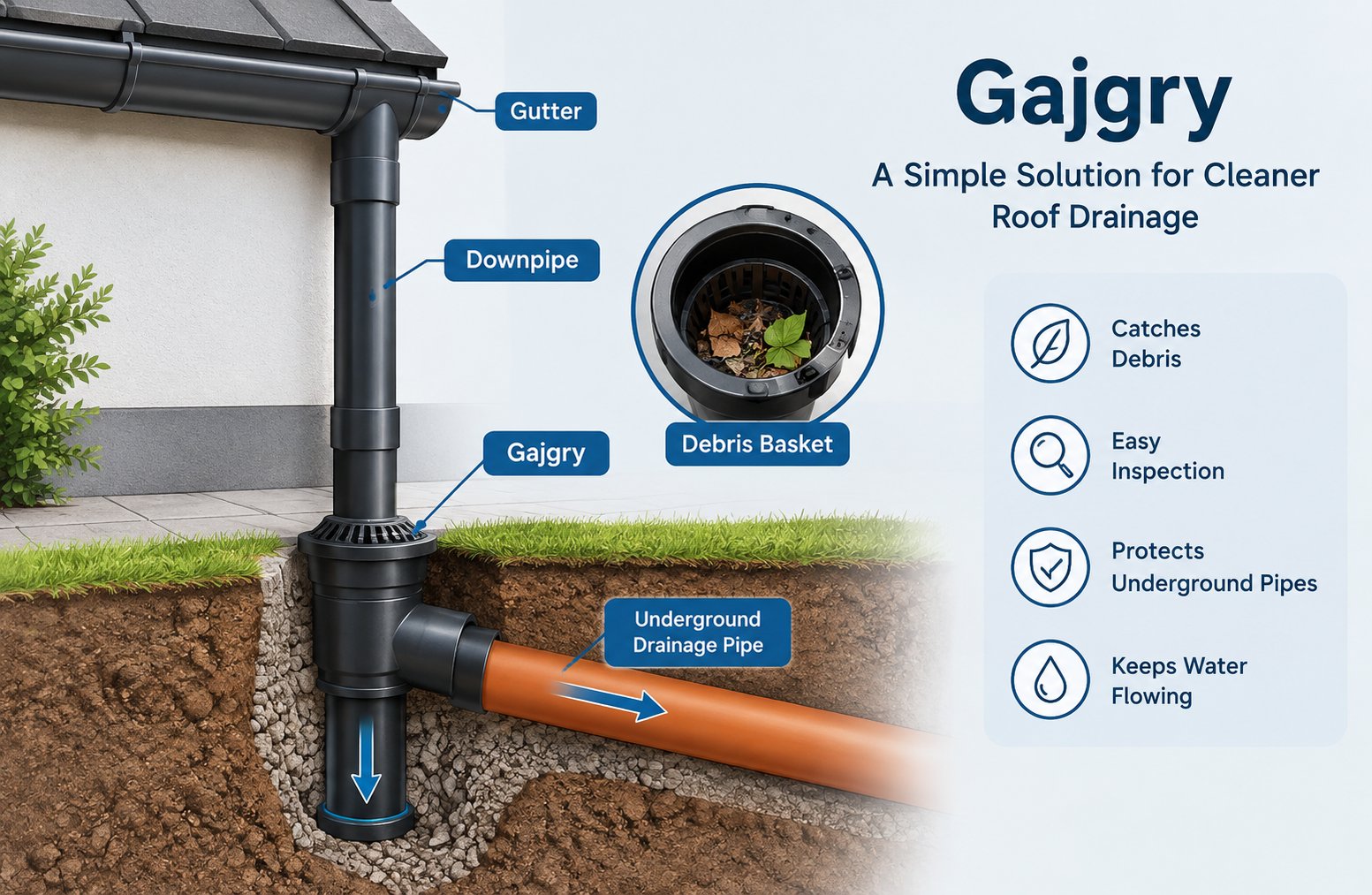
Gajgry is an uncommon term that can be confusing when first encountered, especially for readers who are more familiar with English drainage terminology. In Czech usage, gajgry refers to drainage fittings positioned between a roof gutter downpipe and an underground rainwater drainage system. Their job is simple but important: they help move rainwater away from a building while catching leaves, moss, dirt, and other debris before it enters buried pipework. The singular form is generally written as gajgr, while gajgry refers to multiple units.
The term matters because this small component can perform several practical functions within a roof drainage system. It can provide an accessible inspection point, collect roof debris, connect different pipe sections, and in some designs help reduce the movement of unpleasant drainage odors toward the downpipe.
For homeowners, builders, property managers, and anyone involved in rainwater drainage, understanding this fitting is useful because drainage failures often begin with relatively small problems. A blocked basket, unsuitable connection, poor installation level, damaged body, or incorrectly sized outlet can affect the performance of a much larger drainage network.
This guide explains what the term means, how the component works, where it is used, what types are available, how to select one, how to maintain it, and which common mistakes can create problems.
What Does Gajgry Mean?
The word gajgry comes from Czech usage. The singular term gajgr describes a transitional drainage component connecting a gutter downpipe with horizontal or underground drainage. Czech-language reference material defines it as a connecting part between a rainwater downpipe and horizontal sewer drainage.
In practical construction terminology, the component is also associated with roof-water debris collection. Modern products are commonly designed to receive water from a vertical downpipe and transfer it into an underground drainage pipe while intercepting material washed from the roof.
English-speaking readers may encounter several descriptions for a similar component, including:
- Roof-water catch basin
- Rainwater gully
- Downpipe drain trap
- Roof debris collector
- Rainwater downpipe collector
- Roof-water sediment or debris trap
These terms are not necessarily perfect one-to-one translations because product designs differ. Some units primarily provide a connection between pipes, while others include a basket, inspection cover, odor-control feature, or additional filtering arrangement.
The important point is that the fitting forms a transition between the visible roof drainage system and the underground rainwater system.
How Gajgry Fit Into a Roof Drainage System
A typical roof drainage system follows a straightforward path.
Rain falls onto the roof and moves toward the gutters. The gutters collect the water and direct it toward vertical downpipes. The downpipes then carry the water downward.
Instead of sending that water immediately into an underground pipe, a drainage fitting can be installed at the transition point.
The basic sequence is:
- Rain falls onto the roof.
- Water flows into the roof gutter.
- The gutter directs water toward the downpipe.
- The downpipe carries the water downward.
- The water enters the drainage fitting.
- Larger debris can be caught or collected.
- Water continues through the outlet.
- The underground drainage system carries the water away or toward another approved destination.
This arrangement creates an important maintenance advantage.
An underground pipe is difficult to inspect once it has been buried. If leaves, moss, stones, or other debris enter that pipe and accumulate over time, finding the blockage may require considerably more work.
A removable or accessible collection point allows much of the larger debris to be dealt with before it reaches the buried section.
That does not mean the fitting makes an underground drainage system impossible to block. Fine particles can still pass through, and poorly maintained or incorrectly installed systems can still develop problems. Its value comes from reducing the amount of larger debris entering the system and making inspection easier.
Why Gajgry Are Useful
The most important benefit is not simply connecting two pipes. It is creating a controlled transition point that can also provide access for maintenance.
1. They Help Catch Roof Debris
Roofs naturally collect material.
Depending on the surrounding environment, rainwater can carry:
- Leaves
- Small twigs
- Moss
- Seeds
- Dirt
- Small stones
- Roof surface particles
- Insects and organic material
If all of this material enters an underground pipe, some of it can settle or become trapped.
A collection basket can intercept larger material before it travels farther into the drainage network.
This is particularly useful on properties surrounded by mature trees, where autumn leaf fall can place a much greater load on the roof drainage system.
2. They Create an Accessible Inspection Point
One of the most practical advantages is accessibility.
An underground drainage pipe cannot be visually checked as easily as a surface-level fitting. A properly positioned inspection point gives the property owner or maintenance worker a place to check whether debris has accumulated.
This turns maintenance from a difficult underground problem into a relatively simple inspection task.
3. They Connect Different Drainage Components
The fitting provides a transition between the vertical downpipe and the underground drainage pipe.
Product designs vary, but manufacturers commonly provide options for different pipe sizes, inlet arrangements, and outlet configurations. Some systems offer side outlets, bottom outlets, or adaptable connections.
Correct compatibility is important because a drainage fitting should not be selected based solely on appearance.
4. Some Designs Help With Odor Control
Certain models incorporate components intended to reduce unpleasant smells traveling from connected drainage systems.
However, odor-control performance depends on the design and the condition of the component. A dry, damaged, incorrectly installed, or unsuitable trap cannot be assumed to provide effective odor protection.
This is one reason it is important to distinguish between different models rather than treating every product described as a gajgr as identical.
5. They Can Make Maintenance More Predictable
A drainage system works better when its vulnerable points are easy to inspect.
Instead of waiting for obvious overflow, a property owner can establish a routine inspection schedule and remove accumulated material before it becomes a serious obstruction.
This is a small maintenance habit that can prevent a larger drainage problem.
Main Types of Gajgry
There is no single universal design. Different properties and drainage layouts require different configurations.
Bottom-Outlet Models
A bottom-outlet design directs collected water downward into the underground drainage system.
This arrangement can be useful when the underground pipe is positioned directly below the downpipe.
The advantage is a relatively direct flow path. However, the installation must account for the available depth and pipe levels.
Side-Outlet Models
A side-outlet design sends water horizontally from the collection point into the underground drainage pipe.
This can be useful when the buried pipe runs horizontally away from the building.
Side-entry designs can also be relevant when architectural or construction constraints make a bottom connection impractical.
Adjustable or Universal Models
Some products provide adaptable connections for different downpipe arrangements.
These can be useful when the exact pipe configuration varies or when a standard connection does not fit the existing system.
Even when a product is described as universal, the actual dimensions still need to be checked. “Universal” does not mean that every diameter, shape, and drainage arrangement will automatically fit.
Plastic Models
Plastic drainage fittings are common because they can be lightweight, resistant to many outdoor conditions, and relatively easy to handle during installation.
The exact material and performance depend on the product.
For outdoor use, factors such as resistance to temperature changes, impact, sunlight, and freezing conditions can matter.
Cast-Iron Models
Cast-iron versions can provide greater physical robustness and may be appropriate for areas where the fitting is exposed to heavier loads.
For example, a drainage fitting located near a driveway or an area exposed to vehicles may require a different load rating from one located in a pedestrian-only garden.
The cover and surrounding installation must also be designed for the expected load.
A strong fitting is not automatically safe for vehicle traffic unless the complete installation has the appropriate load capacity.
Choosing the Right Gajgry
Selecting the correct fitting requires more than finding a product with a similar shape.
Several measurements and environmental factors should be considered.
Check the Downpipe Diameter
Start with the vertical pipe.
Measure its actual diameter rather than estimating it visually.
A connection that is too small may restrict the flow or fail to connect correctly. A connection that is too large may require an unsuitable adapter or create a poor seal.
Check the Underground Pipe Diameter
The outlet is just as important as the inlet.
A fitting may accept the correct downpipe but have an outlet that does not match the underground drainage pipe.
Both sides need to be compatible.
Determine the Outlet Direction
Decide whether the drainage pipe leaves the fitting from the bottom or the side.
This depends largely on how the underground drainage network is arranged.
Changing the direction after installation may require additional excavation, pipe fittings, or alterations to the surrounding drainage system.
Consider the Available Installation Depth
The vertical distance between the ground surface and the underground pipe matters.
A fitting that physically fits the pipe may still be unsuitable if the available excavation depth does not allow the correct installation level.
Drainage is dependent on levels and gradients, not just connections.
Look at the Maintenance Access
A collection basket is useful only if it can actually be accessed.
Before choosing a model, consider whether the cover can be removed easily and whether the basket can be taken out without unnecessary difficulty.
A technically effective fitting that nobody can comfortably maintain can become a maintenance problem.
Consider the Surrounding Environment
Think about what the roof drainage system is exposed to.
A property surrounded by trees may collect substantially more organic debris than a building in an open area.
A driveway location may require a higher load capacity.
A cold climate may place greater demands on freeze resistance.
An exposed installation may require material and components designed for outdoor conditions.
Installation Considerations
Installation quality has a major influence on drainage performance.
The fitting needs to be positioned correctly in relation to both the downpipe and the underground pipe.
One common mistake is treating drainage installation as if it were simply a matter of joining two pieces of pipe.
The system also needs suitable levels, stable support, secure connections, and adequate access for maintenance.
Correct Positioning
The fitting should be positioned so the downpipe enters correctly and the outlet connects naturally to the underground pipe.
Forcing pipes into an awkward alignment can place stress on joints and may contribute to leaks or movement.
Appropriate Pipe Gradient
Underground rainwater drainage generally needs an appropriate fall so that water can move through the pipe.
The exact gradient depends on the drainage design, pipe diameter, local requirements, and site conditions.
The important principle is that the fitting should work as part of the complete drainage system rather than being treated as an isolated component.
Stable Surrounding Ground
The fitting should remain stable after installation.
If surrounding soil settles significantly, the connection can shift.
Movement can place stress on the downpipe or underground pipe and may eventually create leakage or misalignment.
Correct Cover Level
The cover should sit appropriately in relation to the finished ground surface.
If it is installed too low, soil and surface debris may accumulate around it.
If it is installed too high, it may become a trip hazard or interfere with the surrounding surface.
The finished level should therefore be considered before final installation.
Maintenance: How to Keep Gajgry Working Properly
Maintenance is one of the easiest ways to protect a drainage system.
The exact cleaning frequency depends on the property.
A building beneath large trees may need considerably more frequent inspection than a building with little vegetation nearby.
Inspect the Basket
Open the accessible cover and check whether leaves, moss, dirt, or other debris have accumulated.
Do not wait until water begins overflowing.
A collection basket is designed to collect debris, so some accumulation is expected. The problem occurs when it is allowed to become completely blocked.
Remove Larger Debris
Take out the collected material and dispose of it appropriately.
If the material is compacted or wet, it may be easier to remove it gradually rather than forcing it through the outlet.
Check the Outlet
After removing debris, inspect the outlet area.
If water still drains slowly, the obstruction may be farther along the drainage line.
Do not assume that cleaning the basket automatically means the entire drainage system is clear.
Inspect the Cover
The cover protects the internal components and can also prevent larger surface debris from entering.
Look for:
- Cracks
- Broken edges
- Missing sections
- Excessive movement
- Poor seating
- Damage caused by external loads
A damaged cover should not simply be ignored.
Check Connections
Inspect the area where the downpipe meets the fitting.
Look for movement, visible gaps, or signs of water escaping where it should not.
Leaks around the connection can gradually affect surrounding soil and building surfaces.
Inspect After Heavy Rain
Heavy rainfall provides useful information about how a drainage system behaves under higher flow.
If water backs up, overflows, or remains around the fitting, the system may need inspection.
The issue could be debris, an undersized connection, a blocked underground pipe, insufficient drainage capacity, or another installation problem.
Common Problems and What They Can Indicate
Understanding symptoms can help identify problems earlier.
Water Overflowing From the Fitting
Overflow is one of the most obvious warning signs.
Possible causes include:
- A blocked debris basket
- A blocked outlet
- A downstream obstruction
- Insufficient drainage capacity
- Heavy rainfall exceeding the system’s design capacity
The first practical step is usually to inspect the accessible collection area.
Slow Drainage
If water remains in the fitting longer than expected, check for debris and visible obstruction.
If the accessible area is clean but drainage remains slow, the blockage may be farther into the underground system.
Unpleasant Smells
Odors can have several causes.
Possible factors include accumulated organic material, connected drainage conditions, or problems with an odor-control component where one is installed.
Simply adding a fragrance product does not address the underlying drainage issue.
Water Appearing Around the Outside
Water escaping around the fitting rather than through the intended outlet may indicate a poor connection, damaged component, incorrect installation, or downstream restriction.
Persistent wetness around the fitting should be investigated rather than ignored.
Cracks or Physical Damage
Cracks may occur due to impact, ground movement, unsuitable loading, temperature conditions, or material deterioration.
A damaged fitting may eventually leak or lose structural integrity.
Gajgry and Rainwater Collection
A roof-water collection fitting can also form part of a rainwater harvesting arrangement.
For example, rainwater may travel from the roof through the gutter and downpipe before passing through a debris collection point and continuing toward a storage tank.
The debris collection stage can help reduce the amount of larger roof material entering the tank.
However, this does not mean that the collected water is automatically suitable for drinking.
Rainwater can contain microorganisms, fine particles, chemicals, and contaminants from the roof and surrounding environment. If harvested rainwater is intended for a specific use, the complete treatment and filtration requirements must be considered.
A drainage debris trap should therefore not be confused with a drinking-water purification system.
Gajgry Versus Ordinary Ground Drains
These components can appear similar because both may be located near ground level.
Their purposes, however, can be different.
A roof-water fitting is primarily associated with water arriving from a gutter downpipe.
An ordinary ground drain may collect water directly from a driveway, patio, yard, paved area, or other horizontal surface.
The distinction matters because inlet configuration and flow requirements can differ.
A drainage product should be selected according to the source of the water and the pipe arrangement rather than appearance alone.
Why Debris Management Matters
Roof drainage systems are exposed to natural debris throughout the year.
During autumn, leaves can become a major issue. During storms, branches and other material may reach the roof. Moss can also accumulate over time and become part of the material carried by rainwater.
The problem is not simply the presence of debris.
The important issue is where that debris ends up.
If it remains in an accessible collection point, maintenance is relatively straightforward.
If it travels into buried pipework, the same material becomes much harder to retrieve.
This is why debris interception can be valuable even though the component itself is relatively simple.
How Property Owners Can Create a Practical Maintenance Routine
A maintenance routine does not need to be complicated.
A useful approach is to inspect the system at sensible intervals based on the property’s environment.
For example, inspection can be considered:
- Before periods of expected heavy rainfall
- After major storms
- During heavy leaf fall
- After nearby tree work
- When drainage appears slower than normal
- When water begins pooling around the fitting
Properties surrounded by trees may require more frequent attention.
Properties with little surrounding vegetation may need less frequent cleaning.
The goal is not to follow one universal calendar. The goal is to inspect often enough that accumulated debris does not become a serious obstruction.
Mistakes to Avoid
Several avoidable mistakes can reduce the value of a roof-water drainage fitting.
Choosing Only by Appearance
Two fittings can look similar while having different inlet sizes, outlet sizes, capacities, or installation requirements.
Dimensions matter more than appearance.
Ignoring the Outlet
People often focus on whether the downpipe fits and forget to check the underground pipe.
The outlet must also be compatible.
Making the Basket Difficult to Access
A collection basket that is buried, obstructed, or difficult to remove will discourage regular maintenance.
Accessibility should be considered during installation, not afterward.
Ignoring the Surrounding Load
A fitting installed in a pedestrian garden does not necessarily require the same load rating as one installed in an area exposed to vehicles.
The expected surface load must be considered.
Assuming Cleaning Solves Every Problem
Cleaning the basket is useful, but it cannot resolve every drainage problem.
If water continues to back up after the accessible section has been cleaned, the blockage may be farther downstream.
Delaying Repairs
A small crack or loose connection may appear harmless.
However, repeated water leakage can affect surrounding soil and nearby building materials.
Early inspection is usually easier than dealing with a larger drainage failure.
When Professional Help Makes Sense
Simple inspection and debris removal can often be part of normal property maintenance.
More complicated situations may require a qualified drainage or plumbing professional.
Professional assessment is particularly sensible when:
- Underground pipes need to be replaced
- Persistent blockages occur
- Water repeatedly backs up
- Ground levels need to be changed
- A drainage route must be redesigned
- Significant excavation is required
- The fitting is located beneath a load-bearing surface
- There are signs of structural movement
- Drainage problems are affecting the building
The reason is straightforward. Underground drainage depends on more than the visible fitting. Pipe gradients, connections, capacity, surrounding soil, and the final discharge arrangement all influence performance.
A Practical Selection Checklist
Before purchasing or installing a drainage fitting, check the following:
- What is the diameter of the downpipe?
- What is the diameter of the underground pipe?
- Does the outlet need to be on the bottom or side?
- Is there enough installation depth?
- Does the product include a removable debris basket?
- Can the basket be accessed easily?
- Is an odor-control feature required?
- What material is suitable for the installation?
- What load will the cover experience?
- Is the product suitable for outdoor conditions?
- Can replacement parts be obtained if required?
- Does the complete installation provide suitable drainage flow?
This checklist helps prevent a common purchasing mistake: choosing a fitting based on one measurement while ignoring the rest of the drainage system.
What Makes a Good Installation?
A successful installation is not simply one where water enters the fitting.
It should also provide:
- Secure connections
- Correct pipe compatibility
- Suitable drainage levels
- Stable installation
- Easy maintenance access
- Appropriate load capacity
- Protection from unnecessary surface debris
- A suitable route for discharged water
The best installation is one that continues to perform after months and years of normal weather exposure.
That is why long-term maintenance should be considered during the initial design.
The Real Value of Gajgry
The component itself is relatively simple.
Its value comes from how it fits into the larger drainage system.
A roof drainage network has several stages, from the roof surface to the gutter, from the gutter to the downpipe, and from the downpipe to the underground system.
Every transition is a potential maintenance point.
A well-designed collection fitting provides an opportunity to intercept debris and inspect the system before a small issue becomes a hidden underground problem.
This is particularly important because underground drainage failures can be inconvenient and expensive to investigate.
A removable basket can be cleaned in minutes. Excavating a blocked underground pipe is a much larger task.
That difference explains why seemingly modest drainage components deserve attention.
Frequently Asked Questions About Gajgry
What does gajgry mean?
Gajgry is the Czech plural form associated with gajgr, a drainage fitting that connects a roof gutter downpipe with underground drainage. It can also function as a collection point for roof debris.
What is a gajgr used for?
A gajgr is used to receive water from a roof downpipe and transfer it into a drainage system. Many designs also catch leaves, moss, and other larger debris before it enters underground pipework.
Are gajgry only used on houses?
No. Similar drainage fittings can be used around residential buildings, garages, recreational properties, commercial buildings, and other structures that require controlled roof-water drainage. The appropriate design depends on the building and drainage layout.
Do all gajgry have debris baskets?
No. Product designs vary. Many modern models include a removable basket or debris-collection feature, but buyers should check the specifications of the exact model rather than assuming every fitting has identical internal components.
How often should a gajgr be cleaned?
There is no single schedule that applies to every property. Buildings surrounded by trees may require frequent inspection, particularly during periods of heavy leaf fall. Inspection is also sensible after major storms or whenever drainage becomes slower than normal.
Can a blocked gajgr cause water to overflow?
Yes. If debris blocks the collection area or outlet, water may back up and overflow. However, persistent overflow can also indicate a downstream blockage or insufficient drainage capacity, so cleaning the accessible section may not always solve the problem.
Conclusion
Gajgry are small but useful components within roof rainwater drainage systems. Their primary role is to create a transition between a roof downpipe and underground drainage while, in many designs, providing a place where leaves, moss, dirt, and other debris can be collected.
Their usefulness becomes especially clear when considering the difference between accessible and buried drainage. A removable collection basket can be inspected and cleaned relatively easily, while debris inside an underground pipe can be considerably more difficult to locate and remove.
Choosing the correct fitting requires attention to pipe diameters, outlet direction, installation depth, material, load requirements, and maintenance access. Installation should also consider the overall drainage layout rather than treating the fitting as an isolated component.
Regular inspection is equally important. Cleaning the collection area, checking connections, inspecting the cover, and watching for overflow or slow drainage can help identify problems before they become more complicated.
The most important lesson is that effective rainwater drainage depends on the complete system. A properly selected and maintained fitting can support that system by controlling the transition between the roof drainage and underground pipework, making debris management easier and providing a practical point for inspection.