DJ Khaled Net Worth: How the Music Mogul Built His Fortune
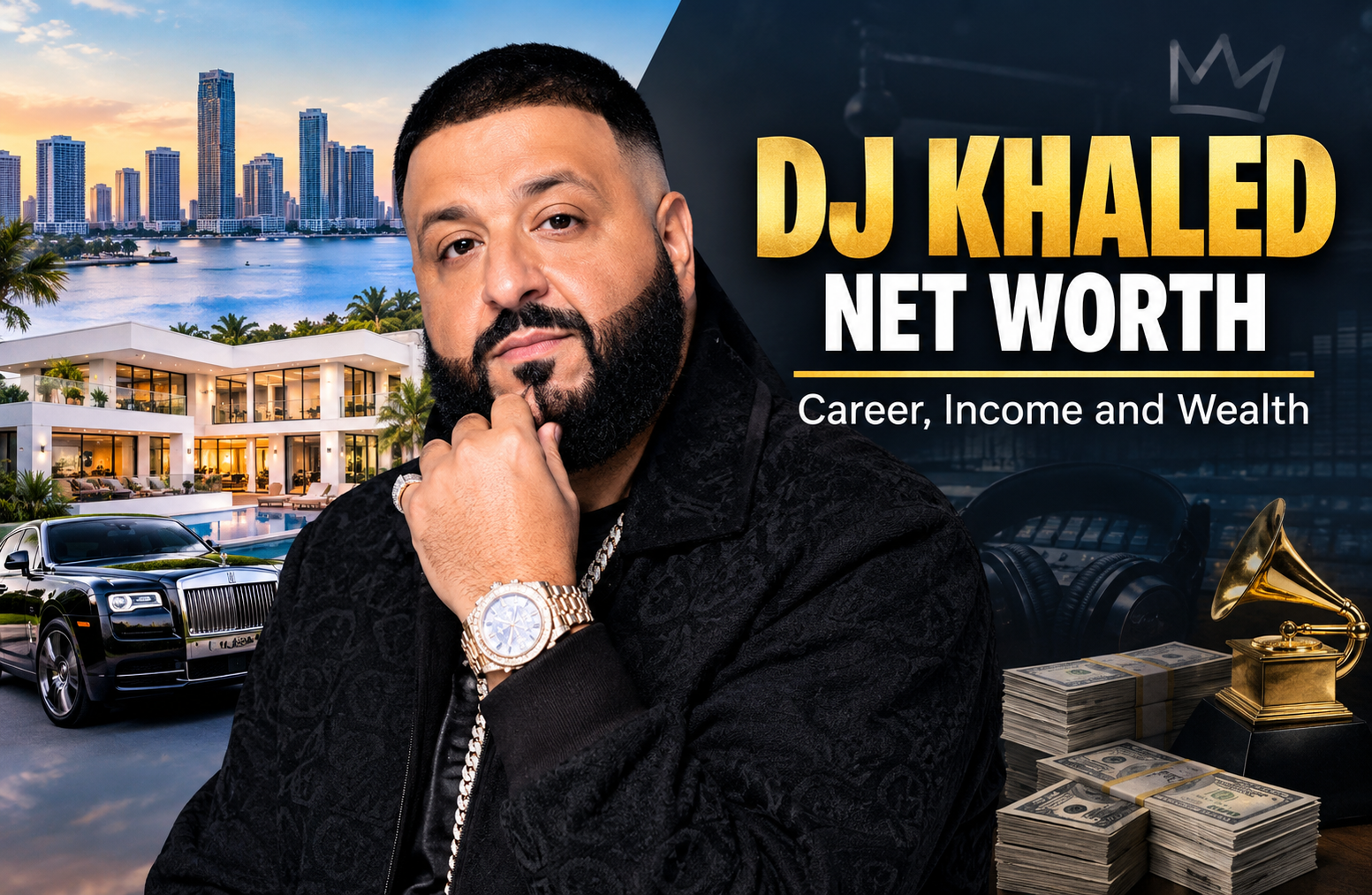
DJ Khaled net worth is a popular topic among hip-hop fans who want to understand how the American DJ, record producer, entrepreneur, and music executive built his impressive fortune. Known for his famous catchphrases, high-profile collaborations, successful albums, and business activities, DJ Khaled has transformed himself from a local radio personality into one of the most recognizable personalities in the music industry.
Unlike artists who depend mainly on album sales and concert performances, Khaled has developed several income streams throughout his career. His earnings come from music production, record sales, streaming royalties, brand partnerships, business ventures, live appearances, and entertainment projects. His ability to connect music with marketing has played an important role in his financial success.
As of 2026, Celebrity Net Worth estimates his fortune at approximately $110 million. However, this figure should be treated as a published estimate rather than an officially confirmed financial statement. DJ Khaled has not publicly released a complete breakdown of his assets, investments, debts, and personal finances.
His financial journey is particularly interesting because he did not become successful overnight. He spent years working in radio, developing relationships with artists, understanding the music business, and building his reputation before achieving mainstream recognition.
This article explores his estimated wealth, career journey, major income sources, business activities, properties, lifestyle, and the financial strategies that helped him establish a lasting position in the entertainment industry.
DJ Khaled Net Worth in 2026
The estimated DJ Khaled net worth in 2026 is approximately $110 million, according to the latest figure published by Celebrity Net Worth. This estimate reflects his long career in music, entertainment, endorsements, and business activities.
It is important to understand that celebrity wealth figures are not always exact. Public websites often calculate net worth using reported earnings, property transactions, business activities, and other available information. They generally do not have access to an individual’s complete financial records.
Therefore, the $110 million figure provides an indication of his estimated financial position, not a verified statement of how much money he currently has in his bank accounts.
Estimated Financial Overview
| Category | Details |
| Full name | Khaled Mohamed Khaled |
| Professional name | DJ Khaled |
| Profession | DJ, producer, artist, entrepreneur |
| Nationality | American |
| Birthplace | New Orleans, Louisiana |
| Main industry | Music and entertainment |
| Estimated net worth | $110 million |
| Record label | We The Best Music Group |
| Major business activity | Music, endorsements, entertainment |
| Primary source of wealth | Music and business ventures |
The most important factor behind his financial position is diversification. Instead of relying on a single successful album, he has built a recognizable personal brand that can generate opportunities across multiple industries.
Is DJ Khaled Really Worth $110 Million?
There is no publicly available audited document confirming that Khaled personally owns $110 million in net assets.
The estimate is based on publicly reported information and financial assessments. His actual wealth could be higher or lower depending on several factors, including:
- His current music royalties and licensing income.
- The value of his business interests.
- His real estate holdings.
- His investment portfolio.
- Taxes and personal expenses.
- Business liabilities and other financial obligations.
A person’s net worth is calculated by subtracting liabilities from total assets. This is different from annual income or total career earnings.
For example, an entertainer may earn millions from a successful business partnership but also have significant expenses associated with employees, management, production, taxes, and operations.
That distinction is essential when evaluating the financial position of a celebrity like Khaled.
Early Life and Background
DJ Khaled was born Khaled Mohamed Khaled on November 26, 1975, in New Orleans, Louisiana. His parents were Palestinian immigrants who had a strong connection to music. Their interest in music influenced him from an early age.
Growing up, Khaled developed an interest in hip-hop, soul, and rap music. He was fascinated by the way music brought people together and how DJs could influence the atmosphere of a room.
His parents supported his musical interests. Rather than immediately pursuing fame, he started by learning about the industry and building relationships with people who shared his passion.
His First Experience in the Music Industry
One of Khaled’s early jobs was working at a record store. This experience gave him an opportunity to understand music beyond simply listening to it.
He learned about different artists, musical styles, record releases, and the preferences of hip-hop audiences. He also began developing relationships with musicians and industry professionals.
Working in a record store might not appear to be a major step toward building millions of dollars in wealth. However, it gave him something valuable: access to the music community.
His early connections included artists such as Birdman and Lil Wayne, who later became important figures in his professional network.
This period helped him understand that success in music requires more than talent. Relationships, timing, marketing, and business knowledge can be equally important.
How DJ Khaled Started His Career
Before becoming a famous music producer, Khaled worked as a DJ and radio personality.
He moved into the Miami music scene, where he developed his reputation through radio appearances, club performances, and relationships with local artists.
His energetic personality made him recognizable among listeners. He understood how to introduce songs, create excitement, and connect different artists with audiences.
Radio Career and Miami Hip-Hop
Khaled became associated with Miami radio station 99 Jamz, where he developed a larger audience.
Radio gave him a platform to introduce music, promote artists, and establish himself as a trusted personality in hip-hop.
He also became associated with Terror Squad, the hip-hop collective led by Fat Joe.
His work with the group expanded his professional network and gave him more opportunities to collaborate with established performers.
His radio career was important for another reason: it taught him how to build an audience before becoming a recording artist.
Many entertainers become famous after releasing successful music. Khaled developed recognition first through his personality, connections, and ability to promote music.
Transition From DJ to Music Producer
As his reputation grew, Khaled began taking a more active role in producing and organizing music projects.
He understood that different artists could bring different audiences to a single record. By combining recognizable performers, he could create songs with broad commercial appeal.
This approach became one of the defining characteristics of his career.
Instead of focusing exclusively on performing himself, he became known for bringing together talented musicians and creating collaborative projects.
That business model helped him develop a valuable position within the music industry.
Music Career and Major Albums
Music has remained one of the most important foundations of Khaled’s financial success.
His career as an album artist began in 2006 with Listennn… the Album. The project introduced his style of collaborative hip-hop production and established the foundation for his future releases.
His second album, We the Best, arrived in 2007 and helped increase his recognition.
The project included collaborations with several well-known artists and contributed to the development of his signature sound.
Albums That Helped Build His Wealth
Throughout his career, Khaled released several commercially successful albums.
Some of his most important projects include:
| Album | Release year | Career significance |
| Listennn… the Album | 2006 | Introduced him as an album artist |
| We the Best | 2007 | Expanded his recognition |
| We Global | 2008 | Strengthened his collaborative style |
| Victory | 2010 | Included the hit All I Do Is Win |
| We the Best Forever | 2011 | Expanded his mainstream audience |
| Kiss the Ring | 2012 | Continued his high-profile collaborations |
| I Changed a Lot | 2015 | Maintained his position in hip-hop |
| Major Key | 2016 | Reached No. 1 on the Billboard 200 |
| Grateful | 2017 | Included major commercial hits |
| Father of Asahd | 2019 | Further expanded his commercial success |
| Khaled Khaled | 2021 | Continued his established album formula |
| God Did | 2022 | Became another major chart success |
These projects demonstrate how he maintained his relevance over an extended period.
Major Key and Grateful
Two particularly important albums in his career were Major Key and Grateful.
Released in 2016, Major Key became his first album to reach No. 1 on the Billboard 200.
It featured major collaborations and demonstrated his ability to turn a collection of artists into a commercially successful project.
The following year, Grateful achieved another major milestone.
The album featured songs such as:
- I’m the One
- Wild Thoughts
- Shining
- To the Max
“I’m the One,” featuring Justin Bieber, Quavo, Chance the Rapper, and Lil Wayne, became one of his biggest commercial successes.
“Wild Thoughts,” featuring Rihanna and Bryson Tiller, also became a major international hit.
These records strengthened his position as a producer who could organize successful collaborations between artists from different musical backgrounds.
God Did and His Grammy Recognition
In 2022, Khaled released God Did, another important project in his career.
The album debuted at No. 1 on the Billboard 200 and included collaborations with several major performers.
Its title track attracted particular attention because of its featured lineup, including Jay-Z, Rick Ross, Lil Wayne, John Legend, and Fridayy.
Khaled’s Grammy recognition also contributed to his reputation.
According to the Recording Academy, he has received one Grammy Award from 10 nominations. His winning record was “Higher,” featuring Nipsey Hussle and John Legend, which won Best Rap/Sung Performance at the 2020 Grammy Awards.
Grammy
His achievements demonstrate that his career is not based only on social media popularity. He has also maintained a substantial presence in the professional music industry.
Main Sources of DJ Khaled’s Income
Understanding his financial success requires looking beyond album sales.
Khaled has developed several business and entertainment income streams. Each contributes differently to his overall financial position.
Some generate direct payments, while others may create long-term value through ownership, licensing, or brand recognition.
1. Music Sales and Streaming Royalties
Music is the foundation of Khaled’s career.
His albums and singles have reached millions of listeners worldwide. Digital platforms have also created opportunities for artists and producers to earn money whenever their music is streamed or licensed.
Khaled’s music catalog includes successful songs such as:
- All I Do Is Win
- I’m on One
- I’m the One
- Wild Thoughts
- No New Friends
- For Free
- Higher
- Popstar
- God Did
These songs continue to attract listeners through streaming platforms, radio, playlists, and other forms of music distribution.
However, streaming revenue is more complicated than simply multiplying total streams by a fixed payment.
The amount received depends on several factors:
- The streaming platform.
- The recording agreement.
- Ownership of the master recording.
- Publishing rights.
- Producer agreements.
- Songwriting credits.
- Distribution arrangements.
A song can generate substantial revenue while the money is divided among several rights holders.
For Khaled, the commercial value of his music comes from his role as an artist, producer, collaborator, and music executive.
His large catalog provides opportunities for ongoing revenue, although the exact amount he personally receives is not publicly disclosed.
2. Brand Endorsements and Sponsorships
Brand partnerships have been another important part of his financial success.
Khaled has developed a public image that is recognizable even among people who do not regularly listen to hip-hop.
His energetic personality, motivational language, and large social media presence make him attractive to companies looking for entertainment-focused marketing campaigns.
Reported brand relationships have included:
- Apple
- T-Mobile
- Cîroc
- WeightWatchers
- Jordan Brand
These partnerships can involve advertising campaigns, promotional appearances, product collaborations, and social media marketing.
The financial value of an endorsement depends on the agreement.
A celebrity might receive a fixed payment, a campaign fee, a performance fee, or compensation connected to a longer business relationship.
Not every partnership produces the same type of income.
Some agreements may also include restrictions, exclusivity requirements, and specific promotional obligations.
Khaled’s advantage is that he has developed a recognizable personality that companies can use to communicate with large audiences.
3. We The Best Music Group
One of the most important parts of his business career is We The Best Music Group.
Khaled established the label as a way to expand his influence beyond his own recordings.
The company represents a broader music business operation involving artist development, production, management, and creative projects.
Owning or controlling a music business can provide opportunities that are different from simply receiving payments as a recording artist.
For example, a music executive may participate in revenue generated through:
- Recording projects.
- Production agreements.
- Artist partnerships.
- Music distribution.
- Licensing arrangements.
- Business collaborations.
However, it is important not to assume that every dollar generated by a record label becomes personal profit for its founder.
Companies have operating costs, contractual responsibilities, employees, and other financial obligations.
The value of a music business also depends on its agreements, catalog ownership, revenue performance, and future opportunities.
4. Def Jam and Universal Music Group Partnership
Khaled’s relationship with Def Jam has played an important role in his professional development.
In February 2023, Universal Music Group announced an exclusive partnership with Def Jam Recordings for his future music releases and his We The Best label venture.
The announcement also confirmed that Khaled would serve as Global Creative Consultant to Def Jam and Universal Music Group’s family of artists.
The company reported that his career had generated more than 20 million single sales, 6 million album sales, and over 4 billion streams at the time of the announcement.
UMG
This partnership is significant because it demonstrates that Khaled has a position beyond that of a traditional recording artist.
He can contribute as a producer, creative adviser, executive, and collaborator.
His relationship with a major music company also gives him access to professional resources and distribution opportunities.
The financial terms of the agreement have not been publicly disclosed, so it would be inaccurate to assign a specific dollar value to the partnership.
5. Concerts and Live Appearances
Live entertainment can generate substantial revenue for established music personalities.
Khaled’s popularity makes him a recognizable name for music festivals, special events, concerts, and entertainment appearances.
His performances often involve popular songs, guest appearances, and audience participation.
Live appearances can generate money through:
- Performance fees.
- Festival bookings.
- Concert arrangements.
- Promotional appearances.
- Special entertainment events.
However, the money paid for an appearance is not necessarily the amount an artist keeps.
Travel, production, management, security, staff, and other costs may reduce the final profit.
The size of the audience, event location, booking agreement, and artist demand also influence performance fees.
Although his exact current booking rates are not publicly confirmed, live entertainment remains a potential income source for an artist with his reputation.
6. Television, Film, and Entertainment Projects
Khaled has also expanded into television and film.
His media appearances have helped introduce his personality to audiences outside the traditional hip-hop market.
He served as a judge on the television competition The Four: Battle for Stardom.
He has also appeared in entertainment productions, including Pitch Perfect 3 and Bad Boys for Life.
Such opportunities can generate income through acting fees, television contracts, promotional appearances, and other entertainment arrangements.
More importantly, television exposure can increase the commercial value of a celebrity’s personal brand.
An individual who becomes recognizable across music, television, and social media may have more opportunities to negotiate sponsorship agreements.
This is one reason Khaled’s career cannot be evaluated through album sales alone.
7. Books and Publishing
Khaled entered the publishing industry with his book The Keys, released in 2016.
The book discusses his experiences, personal philosophy, career development, and approach to success.
Publishing provides another potential revenue source for celebrities.
Authors can earn money through book sales, publishing arrangements, speaking opportunities, and related promotional activities.
For Khaled, the book also helped strengthen his public identity as a motivational personality.
His famous phrases and business philosophy became part of his wider brand.
This demonstrates how an entertainer can use an existing audience to expand into a different industry.
How Social Media Helped Increase His Wealth
Social media has played a major role in Khaled’s transformation into a global entertainment personality.
Before social media became an essential part of celebrity marketing, his reputation was primarily connected to radio, music, and collaborations.
Platforms such as Snapchat, Instagram, and YouTube allowed him to communicate directly with millions of people.
The Snapchat Breakthrough
Khaled became particularly popular on Snapchat during 2015 and 2016.
His videos featured motivational messages, humorous moments, lifestyle updates, and memorable expressions.
Phrases such as “Another One,” “We the Best,” and “Major Key” became recognizable parts of internet culture.
His content attracted attention because it was different from the traditional celebrity promotional approach.
Instead of only sharing advertisements or music announcements, he created an entertaining personality that people wanted to follow.
This helped him develop a larger audience and increased his commercial appeal.
Turning Popularity Into Business Opportunities
Social media popularity can be valuable when it creates opportunities outside the platform itself.
Khaled’s online presence has supported several areas of his career:
- Music promotion: He can introduce new songs and albums to a large audience.
- Brand marketing: Companies can work with him to promote products.
- Personal branding: His recognizable personality creates long-term commercial value.
- Audience development: His content keeps fans connected between music releases.
- Media opportunities: His popularity can lead to interviews, television appearances, and entertainment projects.
The important lesson is that social media followers are not automatically equivalent to financial wealth.
An audience becomes commercially valuable when it can support genuine business activity.
Khaled has demonstrated how entertainment, personality, and marketing can work together to create a recognizable brand.
DJ Khaled’s Real Estate Investments
Real estate is another area frequently discussed when examining his financial position.
Over the years, Khaled has been associated with high-value residential properties, particularly in Florida and California.
Luxury properties can represent significant assets, but their purchase prices should not be confused with personal profit.
Los Angeles Mansion
In January 2017, Khaled purchased a property in the Mulholland Estates community in Los Angeles.
The residence was previously owned by British singer Robbie Williams.
The reported purchase price was approximately $9.9 million.
The property featured luxury residential facilities and was located in an exclusive gated community.
Khaled later sold the home in April 2021 for approximately $12.5 million.
Based on the reported purchase and sale prices, the difference was around $2.6 million before considering transaction expenses, taxes, maintenance, renovations, and other costs.
This transaction illustrates how luxury real estate can potentially contribute to wealth accumulation.
However, the gross difference between a purchase price and a selling price is not necessarily the final investment profit.
Miami Waterfront Property
Khaled also purchased a waterfront residence in Miami in 2018.
The reported purchase price was approximately $25.9 million.
The property reflected his growing financial position and connection to the South Florida lifestyle.
Miami has become an important location for entertainers, business executives, athletes, and other wealthy individuals.
Luxury waterfront properties can offer privacy, attractive locations, and access to premium residential facilities.
Nevertheless, owning an expensive home does not mean the owner has an equivalent amount of liquid cash.
Real estate also comes with ongoing expenses, including:
- Property taxes.
- Insurance.
- Maintenance.
- Security.
- Utilities.
- Renovation costs.
- Mortgage payments, where applicable.
The current ownership status and market value of individual properties should not be assumed without updated public records.
Why Real Estate Matters to His Financial Position
Real estate can help wealthy entertainers diversify their assets.
Music income can change depending on album releases, touring activity, and market conditions.
A property, on the other hand, may retain value over time or appreciate depending on its location and the wider housing market.
There are also risks.
Luxury properties can be difficult to sell quickly, and their values can decline when market conditions change.
Therefore, real estate is one part of a broader financial picture rather than a guaranteed source of profit.
DJ Khaled’s Lifestyle and Spending Habits
Khaled is widely associated with luxury living, expensive fashion, high-end vehicles, and exclusive experiences.
His public image frequently features designer clothing, luxury accessories, premium travel, and impressive residential settings.
However, it is important to distinguish between his public lifestyle and his actual financial records.
A celebrity’s social media content does not provide a complete picture of their personal spending or wealth.
Luxury Cars and Transportation
Khaled has been associated with luxury automobiles and premium vehicles.
For successful entertainers, vehicles can serve several purposes.
They may provide personal transportation, reflect their public image, or become part of promotional and entertainment content.
Luxury automobiles can be expensive to purchase and maintain.
Their value also depends on the manufacturer, model, age, condition, and resale market.
Without verified information about his complete vehicle collection, it would be misleading to assign a precise total value to his cars.
Designer Fashion and Accessories
Fashion is another important part of his public image.
Khaled has maintained relationships with major fashion and footwear brands, including Jordan Brand.
His association with the brand has included special sneaker collaborations.
In 2023, Universal Music Group highlighted the We The Best Air Jordan V collaboration as part of its announcement about his Def Jam partnership.
This relationship demonstrates how music personalities can create commercial opportunities through fashion.
Such collaborations may provide promotional value, business opportunities, and brand exposure.
However, the specific financial terms of individual collaborations are generally private.
Family-Oriented Lifestyle
Khaled is married to Nicole Tuck, and the couple have two sons, Asahd and Aalam.
Family has frequently appeared in his public content.
His son Asahd also became part of his professional story when he was credited as an executive producer on the 2017 album Grateful.
The project helped connect Khaled’s family identity with his musical brand.
His family life is an important part of his public personality, although private financial arrangements and household expenses are not publicly disclosed.
DJ Khaled’s Business Strategy: What Makes Him Different?
One of the most interesting aspects of Khaled’s financial journey is the way he approaches the entertainment business.
He has never depended entirely on being the main performer on every record.
Instead, he has built a business identity around collaboration, promotion, networking, and creative direction.
This approach has several advantages.
1. Building Relationships With Successful Artists
Khaled has collaborated with some of the biggest names in hip-hop and mainstream music.
His projects have included artists such as:
- Jay-Z
- Drake
- Rihanna
- Justin Bieber
- Lil Wayne
- Nicki Minaj
- Rick Ross
- Future
- Kanye West
- John Legend
These relationships have helped him create projects with broad audience appeal.
A collaboration can bring together fans from different musical communities.
For example, a record featuring a hip-hop artist and a mainstream pop performer can attract listeners from both audiences.
This approach can increase a song’s commercial potential.
2. Developing a Recognizable Personal Brand
Khaled’s personality is one of his most valuable professional assets.
His catchphrases, energetic presentation, and motivational content have made him recognizable.
Many music producers are known mainly for their work behind the scenes.
Khaled has taken a different approach by making his personality part of the product.
His name, voice, and public image help audiences recognize his projects before they even listen to the music.
This creates brand recognition that can extend into other industries.
3. Expanding Beyond Traditional Music Revenue
Another important part of his strategy is diversification.
He has explored opportunities in:
- Music production.
- Record label operations.
- Brand endorsements.
- Television.
- Film.
- Publishing.
- Fashion collaborations.
- Social media marketing.
Diversification does not eliminate financial risk, but it can reduce dependence on one source of income.
For example, an artist who depends exclusively on album sales may face challenges when the music market changes.
An entertainer with multiple business relationships may have additional opportunities to generate revenue.
4. Understanding Marketing and Audience Attention
Khaled has consistently demonstrated an understanding of entertainment marketing.
He knows how to create anticipation around a project and keep audiences engaged.
His album campaigns often involve interviews, social media content, collaborations, and recognizable promotional messages.
This marketing approach is particularly important in a crowded music industry.
Thousands of songs are released every year. Getting attention can be just as challenging as producing a good record.
Khaled’s ability to generate conversation around his projects has helped him maintain visibility.
DJ Khaled’s Career Earnings and Financial Growth
His financial development has taken place over several decades.
Although exact annual income figures are not publicly verified, some financial publications have reported substantial earnings during particular years.
Celebrity Net Worth has published historical annual earnings estimates totaling approximately $225 million between 2014 and 2023.
These figures are estimates of reported career earnings, not an independently verified financial statement. They should also not be added to his current net worth because income, expenses, taxes, and assets are different financial measures.
Celebrity Net Worth
The following table provides a simplified overview of the major stages of his financial development.
| Period | Career development | Financial significance |
| 1990s | Radio and DJ work | Built industry relationships |
| 2000 to 2005 | Miami hip-hop recognition | Expanded professional network |
| 2006 to 2010 | Early albums and production | Established recording career |
| 2011 to 2015 | Major collaborations | Increased commercial visibility |
| 2016 to 2017 | Major Key and Grateful | Major chart success |
| 2018 to 2020 | Endorsements and media projects | Expanded income opportunities |
| 2021 to 2022 | Khaled Khaled and God Did | Continued music success |
| 2023 onward | Def Jam partnership and executive role | Expanded industry influence |
Why His Wealth Grew Over Time
There is no single event that explains his financial success.
Instead, several developments worked together.
First, his early work in radio helped him establish relationships.
Second, his production career allowed him to participate in successful musical projects.
Third, his albums increased his commercial recognition.
Fourth, his social media popularity created new marketing opportunities.
Finally, his business relationships expanded his activities beyond music.
The combination of these factors helps explain why he has remained financially relevant across different stages of the entertainment industry.
Challenges That Can Affect DJ Khaled’s Wealth
Even highly successful entertainers face financial challenges.
A large estimated fortune does not mean that every business activity produces a profit or that wealth always increases.
Several factors can influence the value of a celebrity’s assets.
Changing Music Industry Revenue
The music business has changed significantly over the past two decades.
Physical album sales once played a major role in the industry’s revenue structure.
Today, streaming platforms, digital distribution, licensing, and social media have changed how music reaches audiences.
Artists and producers must understand the business arrangements behind digital distribution.
A large number of streams does not automatically guarantee that an artist receives all the associated revenue.
Competition and Changing Audience Preferences
The entertainment industry is highly competitive.
New artists enter the market regularly, and audience preferences can change quickly.
An established celebrity must continue producing relevant content and maintaining relationships with fans.
Khaled has managed to remain recognizable through music, media, and brand partnerships.
However, long-term commercial success requires consistent work rather than relying only on previous achievements.
Business Expenses and Financial Obligations
Running a music business involves expenses.
A producer or executive may need to pay for recording facilities, production teams, marketing, legal services, management, travel, and other professional requirements.
Personal wealth can also be affected by taxes, property expenses, investments, and financial obligations.
This is why total revenue should never be treated as personal profit.
The Difficulty of Valuing Private Business Interests
Another challenge is determining the value of private companies and business partnerships.
Unlike publicly traded companies, private businesses do not necessarily publish detailed financial statements.
The value of a business may depend on its contracts, assets, revenue, ownership structure, and future earning potential.
Since the full details of Khaled’s private financial arrangements are not publicly available, any attempt to calculate his exact wealth would involve assumptions.
What Makes DJ Khaled’s Financial Journey Interesting?
His career offers several useful lessons about the relationship between entertainment and entrepreneurship.
His success is not simply the result of producing popular songs.
It also reflects the value of relationships, audience development, brand recognition, and business diversification.
Networking Can Create Long-Term Opportunities
Khaled’s early relationships with musicians helped him build a career.
Working in radio and record stores allowed him to meet people and understand the music business.
These relationships later created opportunities for collaborations and professional partnerships.
Networking alone does not guarantee success, but meaningful professional relationships can open doors that might otherwise remain closed.
Personal Branding Can Become a Business Asset
Khaled’s personality became a recognizable part of his business identity.
His catchphrases and online content helped him establish a distinctive position in popular culture.
For entrepreneurs, this demonstrates that a recognizable personal brand can create opportunities beyond the original profession.
However, branding must be supported by actual products, services, or professional value.
Diversification Can Reduce Dependence on One Industry Activity
His career includes music, television, endorsements, publishing, and executive work.
This demonstrates how an individual can expand from one professional skill into related commercial activities.
For a musician, that might mean developing a record label.
For a content creator, it might mean launching a business or developing licensing opportunities.
The broader lesson is that long-term financial growth can involve building several complementary income sources.
Consistency Matters More Than Short-Term Attention
Khaled spent years working before becoming a major international personality.
His story shows that professional recognition often develops gradually.
His early radio work, music relationships, production projects, and later albums all contributed to his long-term career.
A single viral moment can generate attention, but maintaining a successful career requires consistent performance.
Frequently Asked Questions (FAQs)
1. What is DJ Khaled’s net worth in 2026?
DJ Khaled’s estimated net worth is approximately $110 million, according to Celebrity Net Worth’s June 2026 update. This is a published estimate, not an officially verified financial figure.
2. How does DJ Khaled make his money?
He earns money through several professional activities, including music production, album sales, streaming royalties, brand endorsements, record label operations, television appearances, and business partnerships.
3. What is DJ Khaled’s real name?
His real name is Khaled Mohamed Khaled. He is professionally known as DJ Khaled and became famous through his work as a DJ, producer, radio personality, and music executive.
4. Does DJ Khaled own We The Best Music Group?
Yes. DJ Khaled founded We The Best Music Group, his music label and business venture. The company has been an important part of his career and professional identity.
5. How many Grammy Awards has DJ Khaled won?
DJ Khaled has won one Grammy Award from 10 nominations. His winning song was “Higher,” featuring Nipsey Hussle and John Legend, which received the Best Rap/Sung Performance award in 2020.
6. What are DJ Khaled’s most successful songs?
Some of his best-known songs include “All I Do Is Win,” “I’m the One,” “Wild Thoughts,” “I’m on One,” “Higher,” and “God Did.” These records helped establish his reputation as a successful music producer and collaborator.
Conclusion
DJ Khaled’s financial journey demonstrates how talent, networking, marketing, and business development can work together to create long-term success.
His estimated fortune of $110 million reflects a career that extends far beyond traditional music production. From his early days working in radio and developing relationships with musicians to becoming a successful producer, recording artist, and music executive, he has consistently found ways to expand his professional opportunities.
Music remains the foundation of his career, but endorsements, social media, television, publishing, real estate, and business partnerships have also contributed to his financial position.
One of the most important aspects of his success is his ability to turn his personality into a recognizable brand. His catchphrases, collaborations, and promotional style have made him a familiar name in entertainment and marketing.
His career also demonstrates the importance of diversification. Rather than relying on one source of income, he has developed opportunities across several related industries.
Although his exact financial position is not publicly verified, the available information shows that he has built a substantial entertainment business over several decades.
Ultimately, his story is an example of how professional relationships, creative opportunities, consistent branding, and business decisions can help transform an early career into a lasting entertainment empire.