Sacramento kings vs la clippers match player stats
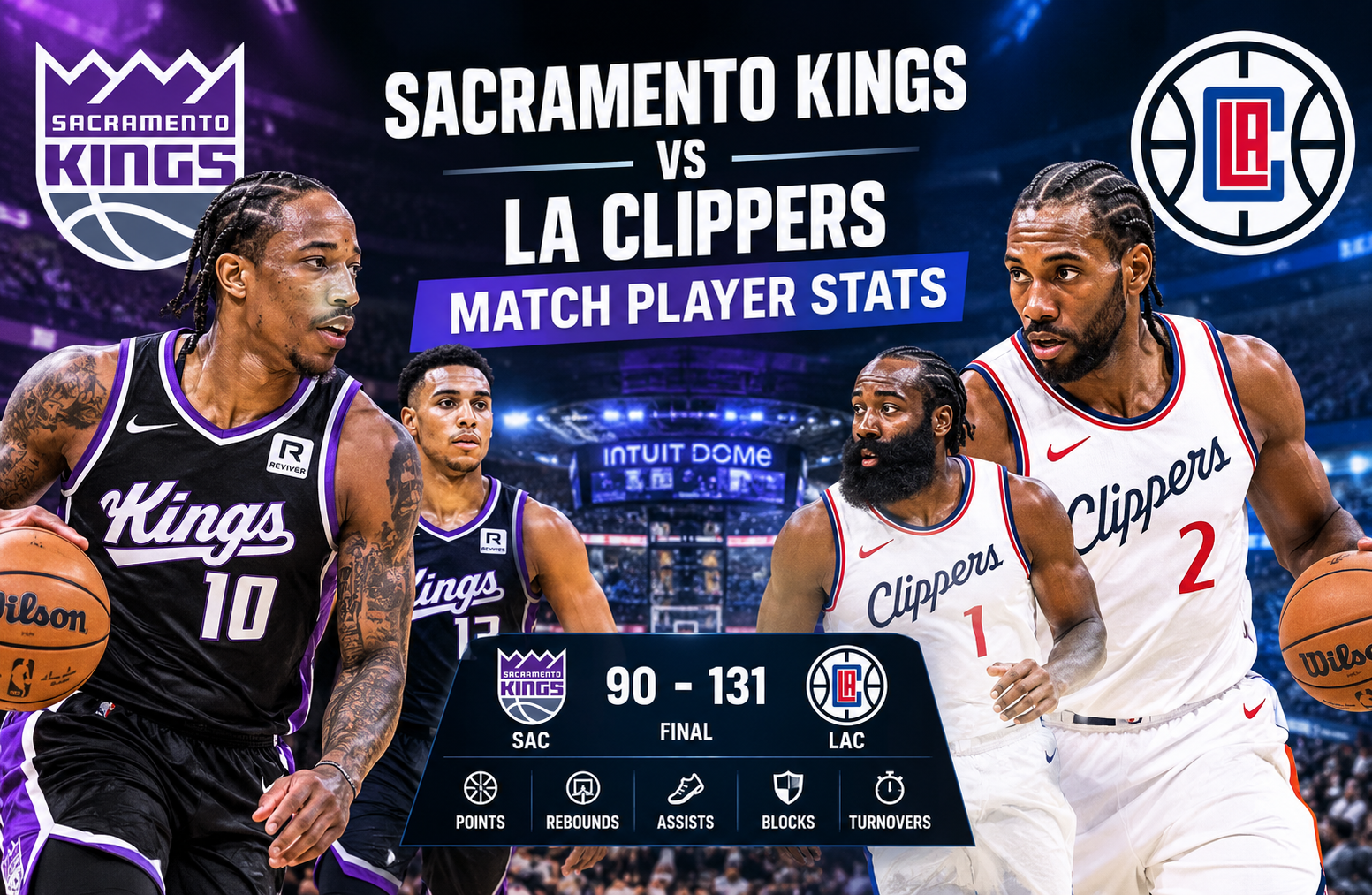
The sacramento kings vs la clippers match player stats tell the story of a game that was decided by efficiency, ball security, defensive pressure, and an explosive first half from Los Angeles. The LA Clippers defeated the Sacramento Kings 131-90 at Intuit Dome, producing a 41-point margin that reflected how sharply the two teams performed in different areas of the game. Kawhi Leonard led the Clippers with 33 points, while James Harden added 21 and John Collins and Yanic Konan Niederhauser each scored 16. For Sacramento, Nique Clifford led the team with 18 points, while Maxime Raynaud and Russell Westbrook each finished with 12.
The game was particularly notable because Los Angeles created separation almost immediately. The Clippers led 34-20 after the first quarter and extended the advantage to 70-40 at halftime. Sacramento responded with a 31-point third quarter, but the deficit was already too large to overcome. Los Angeles eventually finished with 131 points on 51.1 percent shooting, while Sacramento made 41.0 percent of its attempts. The Clippers also committed only three turnovers compared with 18 from the Kings, a difference that had a major effect on the final result.
Game overview
The matchup took place at Intuit Dome in Inglewood, California, in front of 17,927 spectators. The official NBA game page identifies the contest as the Kings at Clippers game played on December 30, 2025, while its game information is timestamped December 31. The final score was Los Angeles Clippers 131, Sacramento Kings 90.
| Category | Sacramento Kings | LA Clippers |
| Final Score | 90 | 131 |
| Q1 | 20 | 34 |
| Q2 | 20 | 39 |
| Q3 | 31 | 27 |
| Q4 | 19 | 31 |
| Field Goals | 34-83 | 46-90 |
| FG Percentage | 41.0% | 51.1% |
| Three-Pointers | 9-27 | 14-38 |
| 3PT Percentage | 33.3% | 36.8% |
| Free Throws | 13-14 | 25-32 |
| Rebounds | 39 | 42 |
| Assists | 18 | 29 |
| Turnovers | 18 | 3 |
| Steals | 1 | 13 |
| Blocks | 8 | 9 |
| Offensive Rebounds | 11 | 11 |
| Defensive Rebounds | 28 | 31 |
| Personal Fouls | 20 | 14 |
The numbers show that the difference was not simply about one hot scorer. Los Angeles won several important statistical categories simultaneously.
The Clippers shot better, moved the ball more effectively, protected possession, generated far more steals, and converted more free throws. Sacramento actually matched Los Angeles in offensive rebounds at 11 each, but that advantage did not translate into enough additional scoring opportunities to offset the turnovers and shooting gap.
Sacramento kings vs la clippers match player stats: Sacramento Kings
The sacramento had only one player reach 18 points, and that was rookie Nique Clifford. Maxime Raynaud and Russell Westbrook each scored 12, while Keegan Murray and Dennis Schroder finished with 11 apiece.
Nique Clifford
Nique Clifford was Sacramento’s leading scorer with 18 points in 29 minutes. He shot 7-of-12 from the field and 3-of-5 from three-point range, adding one free throw, one rebound, two assists, and one block.
His 58.3 percent field-goal shooting was one of the more efficient offensive performances on the Kings roster. His three-point shooting was also important because Sacramento received limited perimeter production from several of its other rotation players.
Clifford’s 18 points represented 20 percent of Sacramento’s total scoring. That is a substantial share for one player, particularly in a game where the team scored only 90 points.
Maxime Raynaud
Maxime Raynaud delivered one of Sacramento’s most productive all-around performances. He scored 12 points on 5-of-8 shooting, grabbed 12 rebounds, and recorded two blocks in 35 minutes.
His 12 rebounds gave him a double-double and helped Sacramento stay competitive on the glass. The Kings finished with 39 total rebounds compared with 42 for Los Angeles, so rebounding was not the main reason for the 41-point defeat.
Raynaud’s efficiency stands out. He made 62.5 percent of his field-goal attempts and converted both of his free throws. His challenge was not individual efficiency but the lack of enough surrounding offensive production.
Russell Westbrook
Russell Westbrook scored 12 points in 19 minutes, shooting 4-of-10 from the field and 2-of-4 from three-point range. He also recorded three rebounds and four assists.
His four assists tied several players for Sacramento’s team high, but his three turnovers also mattered in a game where possession control became one of the clearest differences between the teams.
Westbrook’s two made three-pointers provided useful perimeter scoring, especially because Sacramento struggled to maintain consistent offensive rhythm throughout the opening half.
Keegan Murray
Keegan Murray played 30 minutes and finished with 11 points on 4-of-13 shooting. He made one of four three-point attempts and converted both free throws.
His four rebounds, one assist, and one block added value outside scoring, but the 30.8 percent field-goal percentage made it difficult for Sacramento to keep pace with a Clippers team shooting above 50 percent.
Murray’s line illustrates an important part of this game. Sacramento did not have enough efficient scoring from multiple starters at the same time. When the Clippers were building their first-half lead, Los Angeles could rely on several players producing efficiently while Sacramento struggled to generate the same balance.
Dennis Schroder
Dennis Schroder provided 11 points in 25 minutes. He shot 4-of-10 from the field, made one of two three-point attempts, and went 2-of-2 at the free-throw line.
He also recorded three rebounds and four assists. However, three turnovers limited the overall value of his ball-handling workload.
Schroder’s performance was neither Sacramento’s biggest offensive problem nor its biggest defensive issue. Instead, it reflected a larger team-wide problem: too many possessions ended without the efficient scoring or clean execution needed to answer Los Angeles.
DeMar DeRozan
DeMar DeRozan scored eight points on 2-of-8 shooting. He made four of five free throws and added seven rebounds, three assists, one steal, and one block.
The seven rebounds were significant for a wing scorer, but his scoring efficiency was low. DeRozan’s 25 percent field-goal percentage meant Sacramento lost another expected scoring source during a game when the team needed reliable half-court production.
The Clippers were also able to force Sacramento into difficult possessions without giving up enough easy scoring opportunities to allow DeRozan to compensate at the free-throw line.
Precious Achiuwa
Precious Achiuwa started and played 17 minutes. He finished without scoring after going 0-of-4 from the field. He collected three rebounds, two assists, and one block.
His defensive contributions were useful, but the absence of scoring from a starting position placed more pressure on Sacramento’s other players.
Sacramento’s bench production
The Kings’ bench had several different contributors.
Nique Clifford led the reserve group with 18 points, although the supplied lineup data lists him among the team’s bench players. Drew Eubanks added six points on 3-of-4 shooting in 13 minutes. Devin Carter scored four points, Doug McDermott scored three, Malik Monk scored three, Keon Ellis scored two, and Dennis Schroder contributed 11.
The bench also showed why raw scoring totals need context. Clifford was highly efficient, while Monk finished with only three points but committed five turnovers in 11 minutes. Those turnovers were especially costly against a Clippers defense that aggressively converted mistakes into transition opportunities.
LA Clippers player performance
The Clippers received a much more balanced offensive attack. Kawhi Leonard led the scoring, but Los Angeles also had four other players reach double figures.
Kawhi Leonard
The Kawhi Leonard was the central figure in the Clippers’ offensive performance.
He scored 33 points in 33 minutes, shooting 11-of-19 from the field, 5-of-9 from three-point range, and 6-of-7 from the free-throw line. He also recorded five rebounds, five assists, three steals, and one block.
That statistical combination explains why his performance was so influential. Leonard was not simply a high-volume scorer. He contributed in multiple areas while committing only one turnover.
His three steals were particularly important because Los Angeles finished with 13 team steals. The Clippers repeatedly turned defensive activity into additional possessions and scoring chances.
The official NBA box score records Leonard with 33 points and a +31 plus-minus figure.
James Harden
James Harden scored 21 points in 30 minutes. He made 6-of-14 field goals, went 1-of-6 from three-point range, and converted 8-of-10 free throws.
He also contributed three rebounds, five assists, and one steal.
Harden’s shooting from three was not especially efficient, but his overall offensive value remained strong because he generated points at the free-throw line and helped organize the offense.
His five assists were tied with Leonard for the team lead, giving Los Angeles two major creators who could both score and distribute.
John Collins
John Collins produced 16 points in only 22 minutes.
He shot 6-of-9 from the field, made 2-of-4 three-pointers, and converted both free throws. He also collected five rebounds, one assist, one steal, and three blocks.
The three blocks were a notable defensive contribution. Collins combined interior activity with efficient perimeter shooting, creating a difficult matchup for Sacramento’s frontcourt.
His 66.7 percent shooting was one of the strongest efficiency marks among the Clippers’ high-minute players.
Yanic Konan Niederhauser
Yanic Konan Niederhauser also scored 16 points. He made 6-of-8 field-goal attempts and added six rebounds, two assists, one turnover, and one block in 25 minutes.
His performance was especially valuable because it came from the bench.
A bench player scoring 16 points on 75 percent shooting can change the structure of a game. Sacramento could not focus all defensive attention on Leonard and Harden because Los Angeles had secondary scoring options capable of punishing defensive rotations.
Kris Dunn
Kris Dunn scored 10 points in 21 minutes on 4-of-7 shooting. He made two of four three-point attempts, grabbed six rebounds, added one assist, and recorded two steals.
His contribution was not as large in scoring volume as Leonard’s or Harden’s, but his defensive activity helped create the possession advantage that became one of the defining characteristics of the game.
Brook Lopez
Brook Lopez scored eight points on 2-of-9 shooting, including two made three-pointers on four attempts.
He added six rebounds, three assists, one steal, and one block.
Lopez was not particularly efficient as a scorer from the field, but his rebounding, passing, spacing, and defensive contributions gave Los Angeles another versatile frontcourt piece.
Clippers bench impact
Los Angeles received useful contributions across the second unit.
Derrick Jones Jr. scored eight points in 20 minutes while adding three assists, two steals, and one block.
Kobe Sanders scored seven points, collected six rebounds, recorded four assists, and added two steals in 26 minutes.
Jordan Miller scored six points in seven minutes and shot 3-of-4 from the field.
Nicolas Batum contributed three points, two assists, one steal, and one block.
Kobe Brown scored three points and added two assists.
Cam Christie did not score but contributed one rebound and one assist.
This depth mattered because the Clippers did not need their leading players to carry every possession. The distribution of scoring allowed Los Angeles to maintain offensive pressure throughout the game.
How the first half decided the matchup
The most important part of the game was the first half.
Los Angeles scored 34 points in the opening quarter while Sacramento managed only 20. The Clippers then produced 39 points in the second quarter, compared with another 20 from Sacramento.
That created a 70-40 halftime advantage.
A 30-point halftime deficit changes the nature of a basketball game. The trailing team must take more risks, increase offensive pace, and attempt to generate quick scoring runs. Those decisions can also create additional turnovers or inefficient shots.
Sacramento did improve in the third quarter.
The Kings scored 31 points while holding Los Angeles to 27. That was a 35-point combined swing in the quarter compared with the first-half scoring gap. However, the improvement came after the Clippers had already built a lead that was too large to erase.
Los Angeles then closed the game with a 31-19 fourth quarter.
The quarter-by-quarter pattern was:
- First quarter: Clippers led 34-20.
- Second quarter: Clippers extended the lead with a 39-20 period.
- Third quarter: Kings responded 31-27.
- Fourth quarter: Clippers restored control with a 31-19 period.
The official NBA game summary confirms the same scoring progression and final result.
Shooting efficiency explains part of the gap
Sacramento shot 34-of-83 from the field for 41.0 percent.
Los Angeles shot 46-of-90 for 51.1 percent.
That means the Clippers made 12 more field goals despite taking only seven more attempts.
This is a major difference.
If two teams take roughly the same number of shots, the team that converts at a substantially higher rate gains a significant scoring advantage without necessarily needing a larger volume of possessions.
The three-point difference was smaller.
Sacramento made nine of 27 three-point attempts, or 33.3 percent.
Los Angeles made 14 of 38, or 36.8 percent.
The Clippers made five more three-pointers, but the difference was not purely a perimeter shooting story. Their superior overall field-goal percentage shows that they were also more effective on two-point attempts.
Turnovers were one of the biggest statistical separators
Perhaps the clearest statistical difference came from turnovers.
Sacramento committed 18 turnovers.
Los Angeles committed only three.
That is a 15-turnover difference.
The NBA’s official game summary also records that the Clippers turned Sacramento’s turnovers into 28 points.
This is one of the most useful numbers for understanding the game.
Turnovers do not simply remove a scoring opportunity. They can also create a scoring opportunity for the opponent. When a turnover leads directly to transition offense, the impact can effectively swing the possession from one team to the other.
Los Angeles finished with 13 steals, while Sacramento had only one.
That statistic further illustrates the defensive pressure.
The Clippers did not merely benefit from Sacramento making mistakes. They actively created disruption through their defense.
Rebounding was not the main problem for Sacramento
Sacramento collected 39 rebounds.
Los Angeles collected 42.
That is only a three-rebound difference.
Both teams had 11 offensive rebounds.
This is important because it rules out a simple explanation that Sacramento was completely dominated on the glass.
The Kings actually secured the same number of offensive rebounds as the Clippers. Maxime Raynaud’s 12 rebounds were particularly valuable.
The problem was what happened after those possessions.
Sacramento needed to convert additional opportunities into points, but its overall shooting efficiency and turnover rate prevented the rebounding effort from having a large effect on the final score.
Passing and offensive organization
The assist totals also favored Los Angeles.
The Clippers recorded 29 assists.
The Kings recorded 18.
That 11-assist difference provides another indication that Los Angeles generated more coordinated offense.
Leonard and Harden each had five assists, while several other Clippers contributed as secondary playmakers.
Sacramento’s leading assist totals came from Westbrook and Schroder, with four each, while DeRozan added three.
The difference was not necessarily that Sacramento had no capable passers. Instead, the Clippers consistently generated more successful possessions involving multiple players.
Defensive activity
The defensive statistics strongly favored Los Angeles.
The Clippers recorded:
- 13 steals
- 9 blocks
- 3 turnovers committed
- 14 personal fouls
Sacramento recorded:
- 1 steal
- 8 blocks
- 18 turnovers committed
- 20 personal fouls
Sacramento actually had only one fewer block than Los Angeles, showing that rim protection was not completely absent.
The much larger difference came from steals and possession security.
That combination is important. A team can block shots and still struggle defensively if it allows clean perimeter looks or fails to pressure ball handlers. Los Angeles created more live-ball defensive opportunities and converted them into offense.
Free-throw comparison
The Clippers also had a clear advantage at the free-throw line.
Sacramento made 13 of 14 attempts for 92.9 percent.
Los Angeles made 25 of 32 for 78.1 percent.
Sacramento was therefore more accurate, but Los Angeles attempted 18 more free throws.
This is a good example of why percentage alone does not tell the whole story.
The Kings’ 92.9 percent accuracy looks excellent, but 14 attempts limited the total scoring impact. The Clippers’ lower 78.1 percent rate still produced 25 points because they reached the line much more often.
What the player statistics reveal
The deeper value of the box score is found by connecting individual numbers with team outcomes.
1. Leonard combined scoring and playmaking
Leonard scored 33 points while adding five assists, five rebounds, three steals, and one block.
That gave Los Angeles production across multiple categories.
2. The Clippers had several efficient scorers
Collins shot 6-of-9.
Niederhauser shot 6-of-8.
Leonard shot 11-of-19.
Derrick Jones Jr. shot 3-of-5.
Jordan Miller shot 3-of-4.
That distribution reduced the burden on any single player.
3. Sacramento had isolated efficient performances
Raynaud shot 5-of-8.
Clifford shot 7-of-12.
Eubanks shot 3-of-4.
However, several other Kings players struggled from the field.
4. Possession control favored Los Angeles
Three turnovers against 18 is an enormous difference.
5. Defensive pressure created extra offense
The Clippers’ 13 steals helped explain why the team could score 131 points while taking only seven more field-goal attempts than Sacramento.
Sacramento’s biggest statistical challenges
The Kings’ performance can be broken into several areas.
Inefficient starting offense
Several starters struggled to convert field-goal attempts. DeRozan shot 2-of-8, Murray shot 4-of-13, and Achiuwa went 0-of-4.
That left Sacramento dependent on a smaller number of efficient contributors.
Turnover volume
Eighteen turnovers were especially costly against a defense that recorded 13 steals.
Limited playmaking output
The Kings had 18 assists compared with 29 from Los Angeles.
Slow first-half scoring
Twenty points in each of the first two quarters created the deficit that ultimately determined the game.
What worked for the Kings
Despite the result, several elements of Sacramento’s statistical profile were positive.
Raynaud’s 12 rebounds and efficient shooting gave the team interior production.
Clifford’s 18 points showed that Sacramento had a reliable scoring source from its younger rotation.
The Kings also shot 13-of-14 from the free-throw line and collected 11 offensive rebounds.
The third quarter was another positive. Sacramento scored 31 points and reduced the deficit slightly.
Those details matter because a 41-point defeat can make a box score look uniformly negative. It was not. Sacramento had specific areas of competence, but those strengths were outweighed by turnover problems, inefficient shooting from several important players, and the massive first-half deficit.
What worked for the Clippers
Los Angeles displayed balance.
Leonard provided elite scoring efficiency and defensive activity.
Harden contributed scoring and playmaking.
Collins provided efficient interior and perimeter offense.
Niederhauser supplied strong bench scoring.
Dunn and several reserves added defensive pressure.
The team also protected the basketball extremely well.
Three turnovers across a full game is an unusually clean possession profile, and in this matchup it helped maximize the value of the Clippers’ shooting efficiency.
A practical way to read the box score
When evaluating sacramento kings vs la clippers match player stats, it is useful to avoid focusing only on the highest scorer.
A better approach is to examine five layers:
- Scoring volume: Who generated the most points?
- Efficiency: How many attempts were required to generate those points?
- Possession control: Which team protected the ball?
- Extra possessions: Which team created turnovers or offensive rebounds?
- Playmaking: Which team generated more assisted offense?
Using that framework, the game becomes easier to understand.
Leonard led scoring, but the Clippers’ victory was broader than Leonard’s 33 points. Los Angeles also won the assist battle, turnover battle, steal battle, field-goal percentage battle, and overall scoring battle.
That is why the final margin was so large.
Season-series context
The supplied season-series data shows that the Clippers led the series 1-0 after this opening meeting.
The later meetings were:
| Date | Result |
| December 30, 2025 | Clippers 131, Kings 90 |
| February 7, 2026 | Clippers 114, Kings 111 |
| March 15, 2026 | Kings 118, Clippers 109 |
| April 6, 2026 | Clippers 138, Kings 109 |
The four-game sequence therefore produced three Clippers wins and one Kings win.
The later results also show why a single game should not automatically be treated as a complete description of the matchup. The Kings eventually won one meeting by nine points, while the Clippers produced another 29-point victory in the final listed matchup.
For readers researching the series, the official NBA game record is a useful source for checking the individual box score and game details. Official NBA game box score
Why the 41-point margin matters
The final 131-90 score produced a 41-point margin.
The official NBA game information records the Clippers’ biggest lead at 43 points.
That tells us the final margin actually understates how far apart the teams were at their widest point.
The Kings’ third-quarter improvement reduced some of the damage, but Los Angeles remained in control.
A 41-point margin is also significant because the teams were not separated by a huge rebounding gap. Instead, the result was built through a combination of shooting, turnovers, steals, assists, and first-half scoring.
Key statistical takeaways
The most important numbers from the matchup are easy to identify:
- Clippers scored 131 points.
- Kings scored 90 points.
- Leonard scored 33 points.
- Harden scored 21 points.
- Clifford scored 18 points for Sacramento.
- Collins and Niederhauser each scored 16.
- Clippers shot 51.1 percent.
- Kings shot 41.0 percent.
- Clippers made 14 three-pointers.
- Kings made nine three-pointers.
- Clippers had 29 assists.
- Kings had 18 assists.
- Clippers committed three turnovers.
- Kings committed 18 turnovers.
- Clippers recorded 13 steals.
- Kings recorded one steal.
- Sacramento and Los Angeles each had 11 offensive rebounds.
- Raynaud grabbed 12 rebounds.
- Leonard added five rebounds, five assists, three steals, and one block.
Taken together, these statistics explain the outcome much better than the final score alone.
Frequently asked questions
Who led the Kings in scoring against the Clippers?
Nique Clifford led Sacramento with 18 points. He shot 7-of-12 from the field and made three of five three-point attempts.
Who led the Clippers in scoring?
Kawhi Leonard led all players with 33 points. He shot 11-of-19 from the field, 5-of-9 from three-point range, and 6-of-7 from the free-throw line.
What was the final score?
The LA Clippers defeated the Sacramento Kings 131-90.
Which team shot better?
The Clippers shot 51.1 percent from the field, while the Kings shot 41.0 percent.
Which team had more turnovers?
Sacramento committed 18 turnovers, while Los Angeles committed only three.
Who had the most rebounds for Sacramento?
Maxime Raynaud led the Kings with 12 rebounds.
Conclusion
The sacramento kings vs la clippers match player stats show a game decided by several connected factors rather than one individual statistic.
Kawhi Leonard’s 33-point performance was the headline contribution, but the Clippers’ overall team execution was the bigger story. Los Angeles shot 51.1 percent from the field, recorded 29 assists, generated 13 steals, and committed only three turnovers. Those numbers created a strong foundation for a 131-point offensive performance.
Sacramento had some notable individual performances. Nique Clifford led the team with 18 points, Maxime Raynaud posted 12 points and 12 rebounds, and Russell Westbrook added 12 points and four assists. The Kings also shot 92.9 percent from the free-throw line and matched the Clippers with 11 offensive rebounds.
The largest problems came from the opening half and possession management. Sacramento scored only 40 points before halftime, while Los Angeles scored 73. The Kings also committed 18 turnovers, giving the Clippers numerous opportunities to turn defensive pressure into offense.
The box score therefore provides a clear picture of the matchup. Los Angeles combined efficient shooting, strong ball movement, aggressive defense, and excellent possession control, while Sacramento struggled to generate consistent offense during the game’s most important stretches.
For anyone studying player performance, the key lesson is to look beyond points. Shooting efficiency, assists, turnovers, steals, rebounding, and free-throw opportunities together provide a much clearer explanation of how this 131-90 result developed.