LA Clippers vs Phoenix Suns Match Player Stats
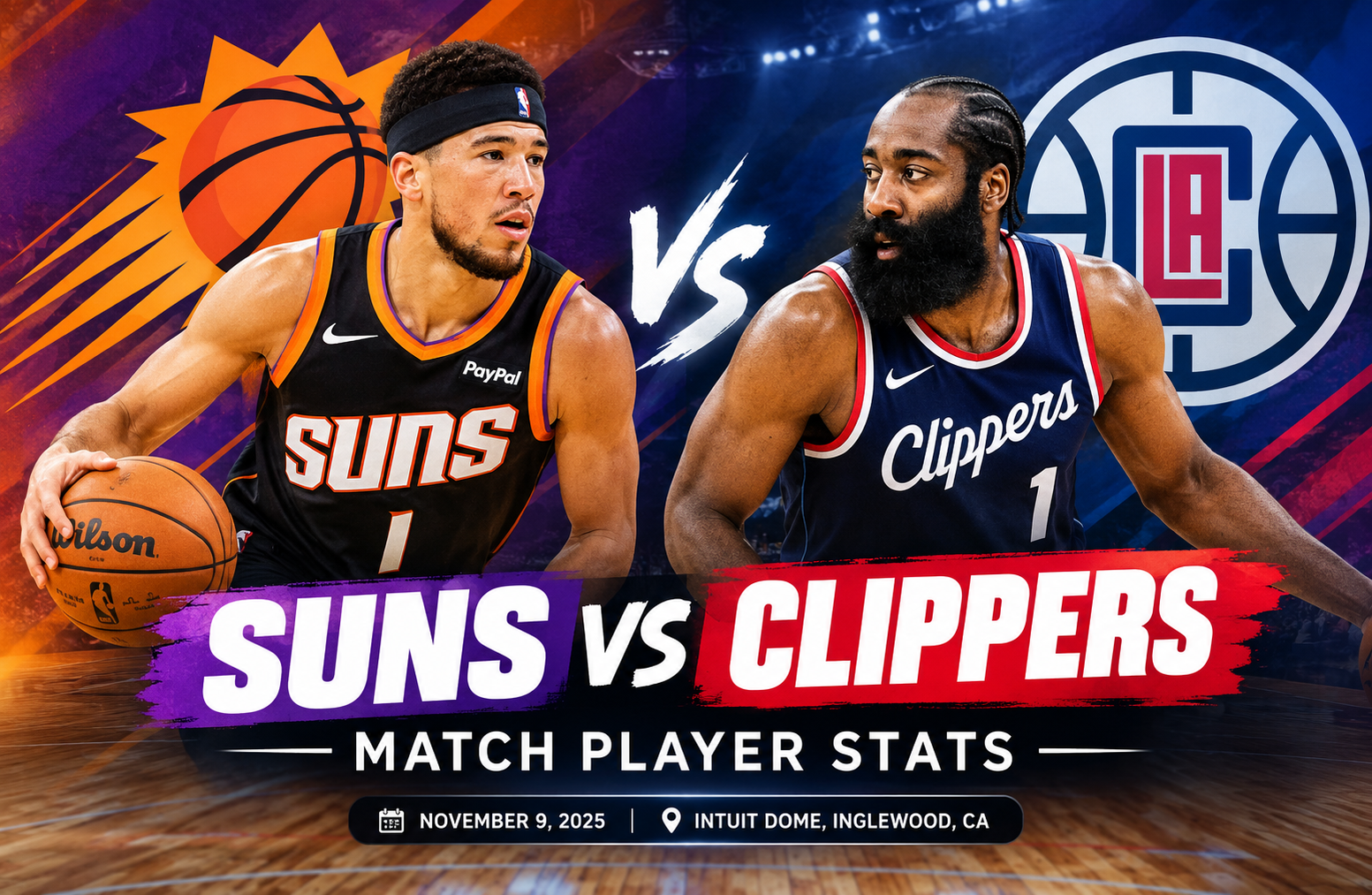
la clippers vs phoenix suns match player stats from the November 8, 2025 meeting at Intuit Dome tell a much deeper story than the 114-103 final score. Phoenix defeated Los Angeles by 11 points after building a 14-point halftime lead, surviving a strong third-quarter response from the Clippers, and then controlling the final period. Devin Booker led Phoenix with 21 points, 10 rebounds, and 9 assists, while Ivica Zubac produced 21 points and 15 rebounds for Los Angeles.
The matchup was especially interesting because Los Angeles actually shot better from the field overall. The Clippers made 41 of 77 attempts for 53.2%, compared with Phoenix’s 40 of 83 for 48.2%. Yet Phoenix created more value from three-point range, made its free throws at a much higher rate, dominated the rebounding battle, and generated more assists.
That combination explains why the Suns won despite not having the better overall field-goal percentage.
The game also had an unusual statistical shape. Phoenix led 60-46 at halftime, Los Angeles answered with a 34-point third quarter, and the Suns responded by scoring 29 points in the fourth. The result was a game where individual performances mattered, but team-level efficiency ultimately decided the outcome.
Game Overview
The Phoenix Suns defeated the Los Angeles Clippers 114-103 at Intuit Dome in Inglewood, California, in a game that was officially recorded on November 8, 2025. The matchup was played in front of a sellout crowd of 18,961.
Phoenix entered the game at 4-5 and moved to 5-5 with the victory. Los Angeles entered at 3-5 and dropped to 3-6.
The Suns won each of the first two quarters:
| Quarter | Phoenix Suns | LA Clippers |
| 1st | 35 | 29 |
| 2nd | 25 | 17 |
| 3rd | 25 | 34 |
| 4th | 29 | 23 |
| Final | 114 | 103 |
The first half was the biggest difference.
Phoenix scored 35 points in the opening quarter and added another 25 in the second. Los Angeles managed 29 and 17, leaving the Clippers 14 points behind at halftime.
The third quarter changed the momentum. Los Angeles scored 34 points while Phoenix scored 25, reducing the gap to eight entering the fourth.
That was as close as the comeback got in terms of the overall result. Phoenix scored 29 points in the final quarter and held Los Angeles to 23.
The official NBA game record confirms the 114-103 result, the quarter-by-quarter scoring, and the individual box score.
Team Statistical Comparison
A box score becomes much more useful when the numbers are compared instead of viewed separately.
| Category | Phoenix Suns | LA Clippers |
| Points | 114 | 103 |
| Field Goals | 40-83 | 41-77 |
| Field-Goal % | 48.2% | 53.2% |
| 3-Pointers | 16-38 | 10-33 |
| 3-Point % | 42.1% | 30.3% |
| Free Throws | 18-21 | 11-18 |
| Free-Throw % | 85.7% | 61.1% |
| Rebounds | 42 | 27 |
| Assists | 30 | 26 |
| Turnovers | 12 | 11 |
| Steals | 9 | 5 |
| Blocks | 2 | 5 |
| Offensive Rebounds | 13 | 5 |
| Defensive Rebounds | 29 | 22 |
| Personal Fouls | 19 | 15 |
At first glance, one statistic jumps out for Los Angeles: the Clippers shot 53.2% from the field.
Normally, shooting 5 percentage points better than an opponent would be a major advantage. In this game, however, Phoenix compensated in several other areas.
The Suns made six more three-pointers, had 15 more rebounds, made seven more free throws, recorded four more assists, and collected four more steals.
The offensive rebounding difference was particularly important.
Phoenix grabbed 13 offensive rebounds compared with only five for Los Angeles. That gave the Suns additional possessions and helped them maintain offensive pressure even when their initial shots did not fall.
This is one of the clearest lessons from the game: field-goal percentage alone does not explain winning basketball.
Why Phoenix Won Despite Shooting Worse Overall
The most important statistical question from this matchup is simple.
How did Phoenix win when Los Angeles shot 53.2% from the field and Phoenix shot 48.2%?
The answer is that the Suns were more effective in several high-impact categories.
Three-Point Shooting Created Separation
Phoenix made 16 of 38 three-point attempts.
Los Angeles made 10 of 33.
That produced a six-three advantage for the Suns.
Phoenix also converted 42.1% of its three-point attempts, while the Clippers made only 30.3%.
That difference is substantial.
The Suns received major perimeter contributions from Grayson Allen and Royce O’Neale, who combined to make eight three-pointers.
Allen went 4-for-7 from beyond the arc.
O’Neale also went 4-for-8.
Dillon Brooks added two more three-pointers, while Collin Gillespie and Jordan Goodwin each contributed two.
This distributed perimeter production made it harder for Los Angeles to solve Phoenix’s offense by concentrating defensive attention on Booker.
Free Throws Added Another Advantage
Phoenix made 18 of 21 free throws.
The Clippers made 11 of 18.
That means Phoenix converted 85.7% of its free throws, while Los Angeles converted only 61.1%.
The seven-free-throw difference translated directly into seven additional points.
Dillon Brooks was especially efficient, making all six of his successful attempts from the line except for one miss, finishing 6-for-7.
Booker also went 5-for-5.
Mark Williams was perfect at 5-for-5.
Those small details matter in a close competitive game because efficient free-throw shooting prevents scoring opportunities from being wasted.
Phoenix Controlled the Glass
The rebounding numbers were arguably the biggest team statistical difference.
Phoenix finished with 42 rebounds.
Los Angeles finished with 27.
That is a 15-rebound advantage.
Even more important, Phoenix collected 13 offensive rebounds compared with five for the Clippers.
The Suns therefore generated eight more offensive-rebound opportunities.
Mark Williams, Booker, and Royce O’Neale were among the key contributors to Phoenix’s rebounding effort.
Booker’s 10 rebounds were especially notable because he was playing primarily as a lead offensive creator. His rebounding helped Phoenix secure possessions while also limiting second chances for Los Angeles.
The Suns’ control of the glass also reduced the impact of Zubac’s excellent rebounding performance.
Devin Booker Leads Phoenix
Devin Booker was the central figure in the Suns’ victory.
His line was:
| Statistic | Devin Booker |
| Minutes | 37 |
| Points | 21 |
| Field Goals | 8-19 |
| 3-Pointers | 0-3 |
| Free Throws | 5-5 |
| Rebounds | 10 |
| Assists | 9 |
| Turnovers | 5 |
| Steals | 0 |
| Blocks | 0 |
| Plus/Minus | +7 |
Booker finished one assist short of a triple-double.
The important part of his performance was not simply his 21 points. It was the combination of scoring, rebounding, and playmaking.
He produced 10 rebounds and nine assists while carrying significant offensive responsibility.
His five turnovers were the obvious negative in the box score. That is worth mentioning because a complete player evaluation should not ignore mistakes simply because the team won.
Still, Booker’s all-around contribution helped Phoenix maintain offensive structure throughout the game.
The NBA’s official recap also highlighted his near triple-double and noted that he had 21 points, 10 rebounds, and nine assists.
Mark Williams Provides Efficient Interior Scoring
Mark Williams delivered one of the most efficient performances for Phoenix.
He finished with 19 points on 7-of-9 shooting.
He also made all five of his free throws.
His complete line included six rebounds, two steals, two turnovers, and a plus/minus of +18.
The +18 figure was the highest listed plus/minus among the highlighted Phoenix players.
Williams did not need a large number of attempts to make an offensive impact. His 7-for-9 shooting shows how efficiently he converted opportunities around the basket.
His six rebounds also contributed to Phoenix’s advantage on the glass.
Perhaps the most important point is that Williams provided efficient scoring without taking possessions away from Booker and the Suns’ perimeter shooters.
Dillon Brooks Brings Efficient Scoring and Defense
Dillon Brooks scored 16 points in 28 minutes.
He shot 4-for-6 from the field, 2-for-3 from three-point range, and 6-for-7 at the free-throw line.
That is an efficient scoring profile.
Brooks also recorded three assists, two rebounds, two steals, and only one turnover.
His +2 plus/minus was not as high as Williams’ or Allen’s, but his overall contribution was balanced.
The timing of his return also mattered to the context of the game. According to reporting from The Arizona Republic, Brooks had missed the previous six games before returning against the Clippers.
That makes his efficient 16-point performance particularly useful when evaluating Phoenix’s depth.
Grayson Allen Supplies Perimeter Accuracy
Grayson Allen scored 14 points and was one of Phoenix’s most important three-point shooters.
He finished:
- 5-of-12 from the field
- 4-of-7 from three
- 3 assists
- 1 steal
- 2 turnovers
- +13 plus/minus
Allen’s four three-pointers represented a major part of Phoenix’s perimeter advantage.
His 4-for-7 shooting from deep was considerably more efficient than the Clippers’ overall three-point shooting.
The value of this type of performance is easy to overlook when looking only at points. Four made threes can create 12 points without requiring a large number of possessions.
Royce O’Neale’s All-Around Contribution
Royce O’Neale scored 12 points and provided a strong secondary statistical contribution.
He recorded:
- 7 rebounds
- 5 assists
- 4 three-pointers
- 2 steals
- 1 turnover
O’Neale shot 4-of-8 from the field and 4-of-8 from three.
His five assists were especially useful because Phoenix did not depend entirely on Booker to create every scoring opportunity.
The one unusual part of his box score was his -3 plus/minus despite contributing positively in several categories.
This is a useful reminder that plus/minus should be interpreted alongside the rest of the box score rather than treated as a standalone player grade.
Collin Gillespie Adds Shooting Depth
Collin Gillespie scored 13 points in 27 minutes.
He made four three-pointers on 10 attempts from beyond the arc.
His overall field-goal shooting was only 4-for-13, but his three-point production still gave Phoenix an important source of spacing.
He also added six rebounds and four assists.
That combination made his contribution more complete than his 13-point total alone suggests.
Ryan Dunn and the Phoenix Bench
Ryan Dunn scored six points, grabbed four rebounds, recorded one assist and one steal, and finished +10.
Jordan Goodwin added seven points and made two of five three-point attempts.
Nick Richards scored four points and recorded five rebounds and two blocks.
Oso Ighodaro played only four minutes but finished with two assists.
Jalen Green played seven minutes and scored two points before leaving the game.
The Suns’ bench scoring was important because Phoenix received contributions from multiple players rather than relying exclusively on Booker.
The official box score records Green’s limited appearance and the contributions from the rest of the rotation.
Ivica Zubac Was the Clippers’ Interior Force
Ivica Zubac matched Booker’s 21-point total and produced one of the strongest individual statistical lines of the game.
He finished with:
| Statistic | Ivica Zubac |
| Minutes | 35 |
| Points | 21 |
| Field Goals | 10-12 |
| 3-Pointers | 0-0 |
| Free Throws | 1-2 |
| Rebounds | 15 |
| Assists | 4 |
| Turnovers | 3 |
| Plus/Minus | -10 |
Zubac’s 10-for-12 shooting was outstanding.
He was also the game’s leading rebounder with 15 boards.
The issue for Los Angeles was that Zubac’s individual production did not translate into enough team control on the glass.
Phoenix still won the overall rebounding battle 42-27.
That is one of the most interesting aspects of his performance. A center can dominate individually and still see his team lose the broader possession battle.
James Harden Creates for Los Angeles
James Harden played 41 minutes and finished with 13 points and 13 assists.
His complete statistical line was:
- 4-of-15 field goals
- 2-of-10 three-pointers
- 3-of-4 free throws
- 13 assists
- 3 turnovers
- 0 rebounds
- 0 steals
- 0 blocks
- -18 plus/minus
Harden’s 13 assists were the highest total for either team.
His playmaking was a major reason Los Angeles was able to generate offense despite Phoenix building a large early lead.
However, his shooting efficiency was a problem.
He made only four of 15 field-goal attempts and two of 10 three-point attempts.
That meant the Clippers received excellent passing production without matching it with efficient scoring from their lead creator.
This created a major contrast between Harden and Booker.
Booker produced 21 points, 10 rebounds, and nine assists.
Harden produced 13 points, 13 assists, and no rebounds.
Both were important creators, but their statistical profiles were very different.
John Collins Gives the Clippers Another Scoring Option
John Collins scored 19 points in 28 minutes.
He shot 8-of-12 from the field, 2-of-3 from three, and 1-of-1 at the free-throw line.
He also added four rebounds, two assists, and one steal.
Collins was highly efficient and finished with a +1 plus/minus.
His performance gave Los Angeles another reliable scoring option next to Zubac.
The Clippers therefore had three players who scored at least 19 points or produced 13 assists.
The problem was that the supporting statistical structure around them was not strong enough to overcome Phoenix’s advantages.
Bradley Beal Provides a Short Scoring Burst
Bradley Beal played 20 minutes and scored 12 points.
He shot 4-of-9 from the field, 2-of-4 from three, and 2-of-2 from the free-throw line.
He also recorded three assists and one steal.
Beal finished +4, which was one of the better plus/minus figures on the Clippers.
His 20-minute workload was relatively limited compared with Harden and Zubac, but he provided efficient perimeter scoring when on the court.
Clippers Supporting Cast
Derrick Jones Jr. scored seven points and shot 2-of-7 from the field.
Kris Dunn scored six points while recording two steals.
Nicolas Batum scored nine points, made three three-pointers, and blocked two shots.
Brook Lopez scored eight points in 13 minutes and also recorded two blocks.
Cam Christie added eight points, three rebounds, and one block.
These performances show that the Clippers were not completely dependent on one player.
Los Angeles had scoring contributions spread across the rotation.
The bigger issue was efficiency from outside.
As a team, the Clippers made only 10 of 33 three-point attempts.
The Three-Point Battle Changed the Game
The perimeter numbers deserve special attention.
Phoenix:
16-for-38, 42.1%
Los Angeles:
10-for-33, 30.3%
Phoenix attempted only five more three-pointers but made six more.
That difference alone represents 18 additional points from made three-pointers.
The Suns also had several players capable of creating perimeter value.
Allen made four.
O’Neale made four.
Brooks made two.
Gillespie made four.
Goodwin made two.
That is five different players making multiple three-pointers.
For Los Angeles, Batum made three and Harden made two, while Beal and Collins each made two.
Phoenix therefore received more consistent perimeter production across the lineup.
Rebounding Was the Hidden Possession Advantage
The 42-27 rebounding advantage is one of the most important statistics in the game.
Phoenix grabbed 13 offensive rebounds.
Los Angeles grabbed five.
Offensive rebounds are particularly valuable because they extend possessions without requiring a defensive stop.
Phoenix’s 13 offensive rebounds helped compensate for its lower overall field-goal percentage.
The Suns missed 43 field-goal attempts.
They still had opportunities to recover some of those misses.
Los Angeles missed 36 field-goal attempts but collected only five offensive rebounds.
This difference helped Phoenix maintain offensive pressure.
Phoenix Also Won the Assist Battle
The Suns recorded 30 assists.
The Clippers recorded 26.
The four-assist advantage is not enormous, but it reinforces an important theme.
Phoenix’s offense was not simply Booker creating everything.
Booker had nine assists.
O’Neale had five.
Gillespie had four.
Brooks and Allen each had three.
Goodwin had two.
That distribution indicates multiple passing outlets.
Los Angeles had Harden’s 13 assists, but the remaining distribution was much smaller.
The Clippers were able to create through Harden, yet Phoenix spread its playmaking across more players.
Turnovers Were Nearly Even
One area where the Clippers did not lose significantly was turnovers.
Phoenix committed 12.
Los Angeles committed 11.
That is only a one-turnover difference.
However, the Clippers scored more points off turnovers, producing 18 compared with Phoenix’s 13.
This shows that Los Angeles did create some value from Phoenix’s mistakes.
If the Clippers had converted their other advantages more efficiently, that turnover scoring could have become even more important.
Instead, Phoenix’s three-point shooting and rebounding advantages proved larger.
The Third Quarter Deserved Special Attention
The third quarter was the most important momentum swing.
Los Angeles scored 34 points.
Phoenix scored 25.
That nine-point difference cut Phoenix’s halftime advantage from 14 points to eight.
For a moment, the Clippers had control of the game’s momentum.
This is where the matchup becomes more interesting than a simple 11-point win.
Phoenix did not dominate all four quarters.
The Suns dominated the first half, lost the third quarter, and then won the fourth quarter.
That ability to respond after losing a quarter is one of the most useful tactical observations from the game.
The Suns scored 29 in the final period and prevented Los Angeles from completing the comeback.
What the Plus/Minus Numbers Tell Us
Plus/minus is often misunderstood.
It measures the team’s scoring margin while a player is on the floor. It does not measure every action performed by an individual player.
For Phoenix, the highest listed plus/minus among the highlighted players was Mark Williams at +18.
Grayson Allen was +13.
Ryan Dunn was +10.
Booker was +7.
For Los Angeles, Bradley Beal was +4 and John Collins was +1.
Harden finished -18.
Zubac finished -10.
The negative numbers for Zubac and Harden do not mean they played poorly in every respect. Zubac had 21 points and 15 rebounds, while Harden had 13 assists.
Instead, the numbers indicate that Los Angeles was outscored during their minutes on the floor.
That distinction is important when using plus/minus for player analysis.
What the Box Score Says About Both Teams
The broader statistical picture reveals two different offensive identities in this game.
Phoenix relied on balance.
The Suns had Booker as the primary creator, but Williams provided efficient interior scoring, Allen and O’Neale stretched the floor, Brooks supplied physical scoring, and Gillespie added perimeter shooting.
Los Angeles had strong individual production from Zubac, Harden, and Collins.
But the Clippers did not get the same level of three-point efficiency or rebounding support.
That difference became especially important because Los Angeles already had a field-goal percentage advantage.
If a team shoots 53.2% from the field but loses by 11 points, the natural question is where the opponent gained its advantage.
Here, the answer is clear:
- Phoenix made six more three-pointers.
- Phoenix made seven more free throws.
- Phoenix collected 15 more rebounds.
- Phoenix grabbed eight more offensive rebounds.
- Phoenix recorded four more assists.
- Phoenix made six more three-pointers despite only five additional attempts.
Those are the numbers that explain the result.
Previous Meetings Put the Result in Context
This was not an isolated matchup between Phoenix and Los Angeles.
The teams had already met earlier in the season.
On October 24, the Clippers defeated the Suns 129-102.
Phoenix then defeated Los Angeles 115-102 on November 6.
The November 8 meeting therefore represented Phoenix’s second consecutive win against the Clippers.
After this game, Phoenix had won two of the three meetings between the teams.
The first matchup was dramatically different from the November game.
Los Angeles scored 129 points in the October meeting and won by 27.
In the November 6 meeting, Phoenix responded with a 13-point victory.
The November 8 result gave Phoenix another 11-point win.
That progression shows how quickly a season series can change.
A single matchup should therefore be read in its own context rather than treated as a permanent statement about either team.
What Stands Out Most in the Player Stats
Several individual performances deserve attention when the entire box score is considered.
Devin Booker
Booker’s 21 points were important, but his 10 rebounds and nine assists made his contribution much more complete.
Mark Williams
Williams delivered 19 points on 7-of-9 shooting and finished +18.
Dillon Brooks
Brooks scored 16 points on 4-of-6 shooting and added two steals.
Grayson Allen
Allen’s four made three-pointers were a major part of Phoenix’s perimeter advantage.
Royce O’Neale
O’Neale contributed 12 points, seven rebounds, five assists, and four made threes.
Ivica Zubac
Zubac produced 21 points and 15 rebounds while shooting 10-of-12.
James Harden
Harden recorded 13 assists but struggled with his shot, finishing 4-of-15 overall and 2-of-10 from three.
John Collins
Collins scored 19 points on 8-of-12 shooting and made two of his three attempts from deep.
These performances demonstrate why player statistics should be evaluated in multiple dimensions.
Points tell you who scored.
Rebounds tell you who controlled missed shots.
Assists reveal playmaking.
Shooting percentages show efficiency.
Plus/minus gives additional context about team performance during a player’s minutes.
No single category provides the complete picture.
Understanding la clippers vs phoenix suns match player stats
For readers searching for la clippers vs phoenix suns match player stats, the most useful approach is to begin with the traditional box score and then move toward the relationships between the numbers.
Start with points, but do not stop there.
A 20-point performance on 8-of-10 shooting is different from 20 points on 8-of-22 shooting.
A 10-rebound performance from a center has a different tactical meaning than 10 rebounds from a guard.
Similarly, 13 assists with 13 points tells a different story from 13 assists with 35 points.
This game provides examples of all those differences.
Booker’s 21 points came with 10 rebounds and nine assists.
Zubac’s 21 points came with 15 rebounds.
Harden’s 13 points came with 13 assists.
Allen’s 14 points included four three-pointers.
The statistics become much more informative when those relationships are considered together.
Key Takeaways From the Matchup
The first major takeaway is that shooting percentage is only one component of offensive efficiency.
Los Angeles shot better from the field, yet Phoenix scored 11 more points.
The second takeaway is the importance of three-point volume and accuracy.
Phoenix made 16 threes at 42.1%.
The Clippers made 10 at 30.3%.
The third takeaway is rebounding.
Phoenix won the rebounding battle by 15.
The fourth takeaway is offensive rebounding.
The Suns collected 13 offensive boards compared with five for Los Angeles.
The fifth takeaway is balanced playmaking.
Phoenix recorded 30 assists and had multiple players contributing to that total.
The sixth takeaway is late-game response.
The Clippers won the third quarter 34-25, but Phoenix answered with a 29-23 fourth quarter.
Finally, the game demonstrates why individual box scores should always be placed inside the team context.
Zubac had an excellent statistical game.
Harden had 13 assists.
Collins scored 19 points efficiently.
Yet Phoenix still controlled the overall possession battle and perimeter scoring enough to win.
Frequently Asked Questions
Who led the Suns in scoring against the Clippers?
Devin Booker led Phoenix with 21 points. He also recorded 10 rebounds and nine assists.
Who led the Clippers in scoring?
Ivica Zubac led Los Angeles with 21 points. He also grabbed 15 rebounds and shot 10-of-12 from the field.
What was the final score of the Suns vs Clippers game?
Phoenix defeated Los Angeles 114-103.
Which team shot better from the field?
The Clippers shot better overall, making 41 of 77 attempts for 53.2%. Phoenix made 40 of 83 for 48.2%.
Which team had more three-pointers?
Phoenix made 16 three-pointers, while Los Angeles made 10.
How many rebounds did each team have?
Phoenix finished with 42 rebounds, while the Clippers had 27.
Conclusion
The la clippers vs phoenix suns match player stats from this matchup show why a complete basketball analysis needs more than the scoring column.
Phoenix won 114-103 despite Los Angeles shooting a better percentage from the field. The Suns compensated through superior three-point production, stronger free-throw accuracy, a major rebounding advantage, and a more distributed assist profile.
Devin Booker was the centerpiece with 21 points, 10 rebounds, and nine assists. Mark Williams provided highly efficient interior scoring, Dillon Brooks delivered an efficient two-way contribution, and Grayson Allen and Royce O’Neale supplied important three-point production.
For Los Angeles, Ivica Zubac stood out with 21 points and 15 rebounds. James Harden produced 13 assists, while John Collins scored 19 points efficiently. Those individual performances were significant, but the Clippers could not overcome Phoenix’s 15-rebound advantage and six-three advantage.
The most useful lesson from the box score is that the final score becomes easier to understand when the individual statistics are connected. Phoenix did not win because it dominated every category. It won because its advantages in several high-value categories outweighed Los Angeles’ superior overall field-goal percentage.