76ers vs Boston Celtics Match Player Stats
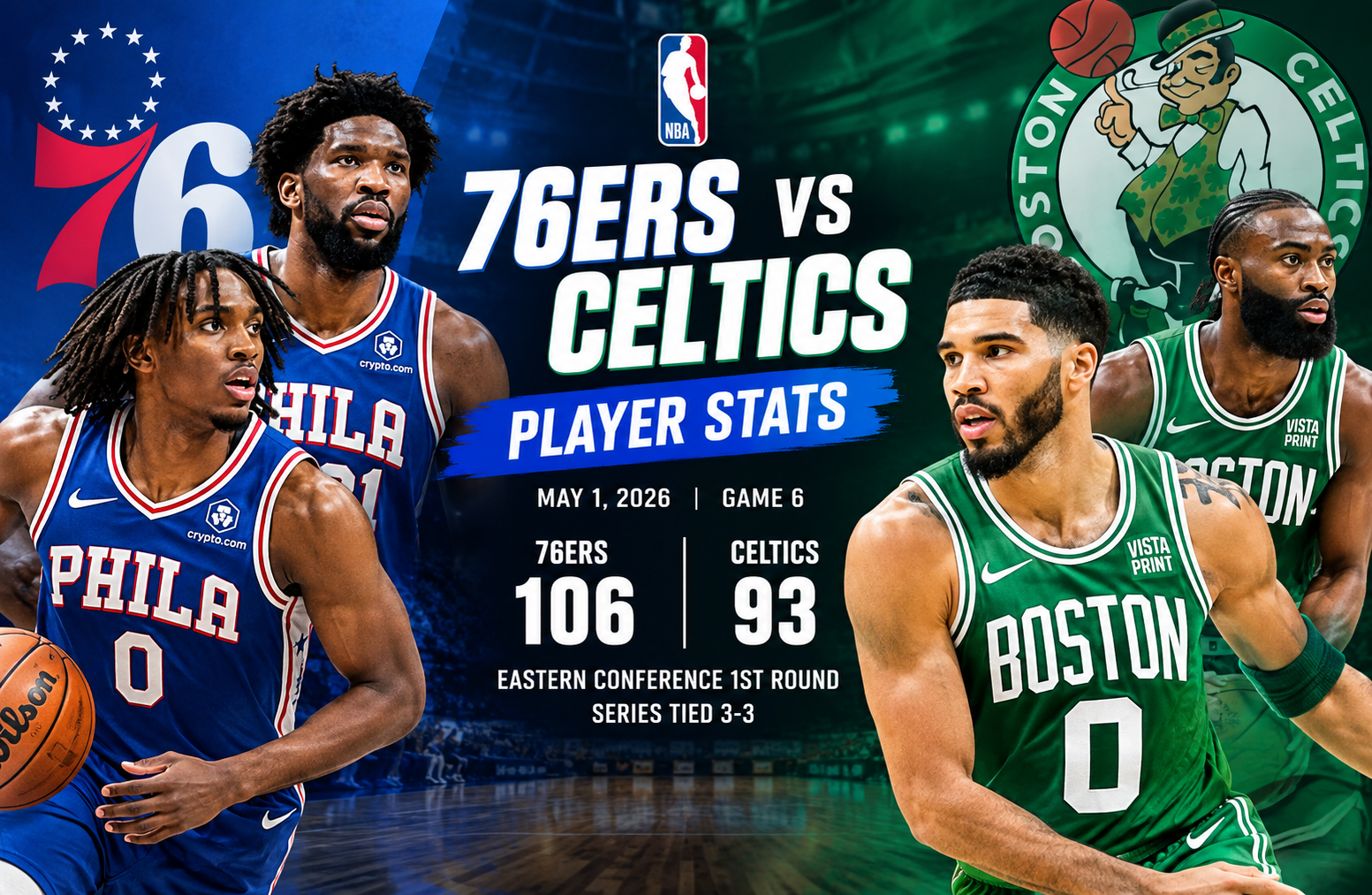
The 76ers vs boston celtics match player stats from Game 6 tell the story of a Philadelphia team that responded under playoff pressure with balanced scoring, efficient free throw shooting, stronger ball movement, and a major performance from Tyrese Maxey. The 76ers defeated the Celtics 106-93 in Philadelphia to tie the Eastern Conference first-round series at 3-3. Maxey led all scorers with 30 points, while Paul George added 23 and Joel Embiid delivered 19 points, 10 rebounds, and 8 assists. Boston was led by Jaylen Brown with 18 points and Jayson Tatum with 17 points and 11 rebounds.
This was more than a simple scoring comparison. The box score shows how Philadelphia created a more reliable offensive balance while also limiting Boston’s ability to generate efficient three-point offense. The 76ers shot 44% from the field, 33% from three, and an excellent 89% from the free throw line. Boston finished at 42% from the field, 29% from three, and 56% from the line.
For readers searching for detailed player statistics, this breakdown covers the individual numbers, team totals, shooting efficiency, rebounding, assists, turnovers, defensive production, and the tactical meaning behind the statistics.
Game Overview
The matchup was Game 6 of the Eastern Conference first round between the Philadelphia 76ers and Boston Celtics.
| Game Detail | Information |
| Teams | Philadelphia 76ers vs Boston Celtics |
| Competition | NBA Eastern Conference First Round, Game 6 |
| Date | May 1, 2026 |
| Venue | Xfinity Mobile Arena, Philadelphia, Pennsylvania |
| Attendance | 19,746 |
| Final Score | 76ers 106, Celtics 93 |
| Series Status | Tied 3-3 |
| Next Game | Game 7 in Boston |
| Philadelphia Record | 45-37 |
| Boston Record | 56-26 |
The final margin was 13 points, but the game was shaped by a major second-quarter shift and Philadelphia’s ability to maintain control after taking the lead.
Philadelphia scored 20 points in the first quarter and then produced 38 in the second. The Sixers continued their momentum with 24 points in the third before scoring 24 in the fourth.
Boston scored 23, 26, 14, and 30 points across the four quarters.
That third-quarter difference was especially important. Boston managed only 14 points in the period while Philadelphia added 24, giving the Sixers enough separation to protect the lead.
76ers vs boston celtics match player stats
The individual numbers explain why Philadelphia was able to win despite neither team producing an exceptionally high overall field goal percentage.
Philadelphia 76ers Player Statistics
| Player | PTS | REB | AST | STL | BLK | FG | 3PT | FT |
| Tyrese Maxey | 30 | 2 | 5 | 2 | 0 | 11-22 | 3-5 | 5-5 |
| Paul George | 23 | 4 | 3 | 2 | 1 | 8-17 | 5-9 | 2-2 |
| Joel Embiid | 19 | 10 | 8 | 1 | 0 | 6-18 | 1-5 | 6-7 |
| Kelly Oubre Jr. | 14 | 9 | 1 | 2 | 2 | 6-11 | 0-1 | 2-2 |
| VJ Edgecombe | 14 | 8 | 3 | 0 | 2 | 5-11 | 1-3 | 3-3 |
| Justin Edwards | 2 | 5 | 0 | 0 | 0 | Not listed | Not listed | Not listed |
| Andre Drummond | 2 | 7 | 0 | 0 | 1 | Not listed | Not listed | Not listed |
| Quentin Grimes | 2 | 3 | 2 | 0 | 0 | Not listed | Not listed | Not listed |
| Trendon Watford | 0 | 0 | 0 | 0 | 0 | Not listed | Not listed | Not listed |
| Adem Bona | 0 | 0 | 0 | 0 | 0 | Not listed | Not listed | Not listed |
| Kyle Lowry | 0 | 0 | 0 | 0 | 0 | Not listed | Not listed | Not listed |
| Dalen Terry | 0 | 0 | 0 | 0 | 0 | Not listed | Not listed | Not listed |
The most important feature of Philadelphia’s box score was its five-man scoring balance at the top.
Maxey scored 30.
George scored 23.
Embiid scored 19.
Oubre scored 14.
Edgecombe scored 14.
Together, those five players accounted for 100 of Philadelphia’s 106 points.
That concentration is important because it meant the Sixers did not need one player to carry the entire offense. Maxey supplied the primary scoring punch, George provided perimeter shooting, Embiid contributed interior scoring and playmaking, while Oubre and Edgecombe supplied two-way production.
Tyrese Maxey Leads Philadelphia
Tyrese Maxey was the leading scorer in the game with 30 points.
His shooting line was particularly useful:
- 11-of-22 from the field
- 3-of-5 from three-point range
- 5-of-5 from the free throw line
- 5 assists
- 2 rebounds
- 2 steals
Maxey converted exactly half of his field goal attempts. More importantly, he combined scoring efficiency with ball handling and playmaking.
His three-point shooting also mattered because Boston could not simply defend him by allowing open perimeter opportunities. A 3-of-5 performance from deep gave Philadelphia an additional scoring source beyond drives and mid-range attempts.
The perfect 5-of-5 free throw performance added another layer of efficiency.
For a playoff guard, the combination of shot creation, three-point accuracy, free throw reliability, and five assists is especially valuable because it creates pressure in several different ways.
Maxey did not need to score 40 points for Philadelphia to win. His 30-point performance worked because four other Philadelphia starters also reached double figures.
Paul George’s Perimeter Impact
Paul George finished with 23 points and was one of Philadelphia’s most efficient offensive players.
He shot:
- 8-of-17 from the field
- 5-of-9 from three
- 2-of-2 from the free throw line
His five made three-pointers were especially significant.
George’s 5-of-9 shooting from long range meant he converted 55.6% of his three-point attempts. That gave Philadelphia a major perimeter scoring source alongside Maxey.
He also recorded 4 rebounds, 3 assists, 2 steals, and 1 block.
That stat line demonstrates that his value was not limited to scoring. His defensive activity and secondary playmaking helped Philadelphia produce a more complete team performance.
When a team has a primary scorer such as Maxey and another high-level perimeter scorer such as George, the defense has to account for multiple shot creators. That can create cleaner opportunities for the rest of the lineup.
Joel Embiid’s All-Around Contribution
Joel Embiid finished with 19 points, 10 rebounds, and 8 assists.
The eight assists are one of the most interesting numbers in the entire box score.
Embiid did not need to lead Philadelphia in scoring to influence the game. His playmaking gave the Sixers another way to attack Boston.
His line included:
- 19 points
- 10 rebounds
- 8 assists
- 1 steal
- 6-of-18 field goals
- 1-of-5 three-pointers
- 6-of-7 free throws
The scoring efficiency was not as strong as Maxey’s or George’s, but the broader contribution was substantial.
A center producing eight assists changes the geometry of an offense. When defenses send extra attention toward him, Philadelphia can use passing sequences to move the ball away from pressure and create opportunities for perimeter players.
Embiid’s 10 rebounds also gave Philadelphia a double-digit rebounding performance from its primary interior player.
He fell just two assists short of a triple-double.
Kelly Oubre Jr. Provides Two-Way Production
Kelly Oubre Jr. scored 14 points and added 9 rebounds.
His offensive shooting was efficient at 6-of-11 from the field.
His defensive numbers were even more notable:
- 2 steals
- 2 blocks
That combination of rebounding, steals, blocks, and efficient scoring makes Oubre’s contribution easy to overlook if someone studies only the scoring column.
He was one rebound away from a double-double and provided the kind of secondary production that helps a playoff team survive stretches when the primary scorers are being pressured.
VJ Edgecombe Adds Energy
VJ Edgecombe finished with 14 points, 8 rebounds, 3 assists, and 2 blocks.
He shot 5-of-11 from the field.
The eight rebounds were important for a perimeter player because Philadelphia finished with 48 total rebounds compared with Boston’s 46.
Edgecombe also contributed three assists and two blocks, showing that his impact went beyond his 14 points.
His 14 points matched Oubre’s total, giving Philadelphia two additional double-digit scorers outside its three biggest offensive names.
Boston Celtics Player Statistics
| Player | PTS | REB | AST | STL | BLK | FG | 3PT | FT |
| Jaylen Brown | 18 | 1 | 2 | 0 | 0 | 7-17 | 2-6 | Not listed |
| Jayson Tatum | 17 | 11 | 3 | 0 | 0 | 6-13 | 2-6 | 3-5 |
| Payton Pritchard | 14 | 3 | 5 | Not listed | Not listed | 6-16 | Not listed | Not listed |
| Derrick White | 11 | 1 | 1 | 3 | Not listed | 3-8 | 3-6 | Not listed |
| Luka Garza | 9 | 2 | 1 | Not listed | Not listed | 4-5 | 1-2 | Not listed |
| Sam Hauser | 5 | 4 | 1 | 0 | 0 | 2-6 | 1-5 | 0-0 |
| Baylor Scheierman | 5 | 3 | 1 | 2 | Not listed | 2-? | Not listed | Not listed |
| Neemias Queta | 4 | 11 | 0 | Not listed | 2 | 2-5 | 0-0 | 0-0 |
| Ron Harper Jr. | 3 | 3 | 0 | 1 | Not listed | 1-3 | 1-2 | Not listed |
| Jordan Walsh | 3 | 5 | 3 | Not listed | 1 | Not listed | Not listed | Not listed |
| Nikola Vucevic | 2 | 2 | 1 | 1 | Not listed | 1-? | Not listed | Not listed |
| Dalano Banton | 2 | 0 | 0 | Not listed | Not listed | 1-1 | Not listed | Not listed |
Boston’s scoring was less concentrated at the top.
Brown led the Celtics with 18 points, followed by Tatum with 17 and Pritchard with 14.
That gave Boston three players in double figures, compared with five for Philadelphia.
This difference in scoring depth was one of the clearest statistical distinctions between the teams.
Jaylen Brown Leads Boston in Scoring
Jaylen Brown finished with 18 points on 7-of-17 shooting.
He also made 2-of-6 three-point attempts.
Brown’s scoring output was solid in isolation, but it was not enough to match Philadelphia’s top-end production.
One of the biggest challenges for Boston was that Brown and Tatum combined for 35 points, while Maxey and George alone combined for 53.
That 18-point difference between the two leading scoring duos explains a substantial part of the final result.
Jayson Tatum’s Double-Double
Jayson Tatum recorded 17 points and 11 rebounds.
He shot 6-of-13 from the field, 2-of-6 from three, and 3-of-5 from the free throw line.
The 11 rebounds tied Neemias Queta for Boston’s team-high in the game.
Tatum’s rebounding was particularly useful because Philadelphia had strong production from its frontcourt. Embiid collected 10 rebounds, while Oubre and Edgecombe combined for another 17.
Tatum therefore had to contribute on the glass while also carrying part of Boston’s scoring responsibility.
His 17 points, however, were below Maxey’s 30 and George’s 23.
Payton Pritchard’s Offensive Contribution
Payton Pritchard scored 14 points and added 5 assists and 3 rebounds.
His five assists tied Maxey for the game-high among players outside Embiid, who had eight.
Pritchard’s 14 points were useful for Boston, but the Celtics needed more efficient production from multiple perimeter options.
The Celtics’ overall three-point shooting was just 12-of-41, or 29%.
That made it difficult for the team to generate enough scoring bursts against Philadelphia.
Derrick White’s Defensive Activity
Derrick White finished with 11 points and 3 steals.
He shot 3-of-8 from the field and made 3-of-6 three-point attempts.
The three steals were among Boston’s strongest individual defensive statistics.
White’s perimeter shooting was also relatively efficient compared with Boston’s overall three-point performance. He converted half of his attempts from beyond the arc.
However, his 11 points did not provide enough secondary scoring to offset Philadelphia’s five double-digit scorers.
Team Shooting Comparison
The team shooting numbers provide one of the clearest explanations for the final score.
| Statistic | Philadelphia | Boston |
| Points | 106 | 93 |
| Field Goals | 39-89 | 36-86 |
| FG Percentage | 44% | 42% |
| Three-Pointers | 11-33 | 12-41 |
| 3PT Percentage | 33% | 29% |
| Free Throws | 17-19 | 9-16 |
| FT Percentage | 89% | 56% |
| Rebounds | 48 | 46 |
| Assists | 22 | 18 |
| Turnovers | 10 | 13 |
| Steals | 7 | 7 |
| Blocks | 6 | 3 |
Philadelphia did not dominate Boston in every category.
In fact, Boston made one more three-pointer.
The difference came from efficiency and overall offensive execution.
Philadelphia made 39 field goals compared with 36 for Boston. The Sixers also made eight more free throws and attempted three fewer shots from the field.
The 17-of-19 free throw performance was particularly valuable.
Boston made only 9-of-16.
That created an eight-point advantage at the free throw line before considering any other offensive differences.
The Three-Point Battle Was Not About Volume Alone
Boston attempted 41 three-pointers.
Philadelphia attempted 33.
Boston therefore took eight more shots from behind the arc.
Yet Boston made only one more three-pointer.
The Celtics converted 12 of 41 attempts, or 29%.
Philadelphia converted 11 of 33, or 33%.
This is a useful reminder that three-point volume alone does not determine perimeter effectiveness.
Boston’s extra eight attempts produced only one additional made three.
Philadelphia generated fewer attempts but converted at a higher percentage.
That difference helped limit the value of Boston’s long-range volume.
Free Throw Efficiency Created a Major Gap
Philadelphia’s free throw performance deserves special attention.
The Sixers shot 17-of-19.
That is an 89% conversion rate.
Boston shot 9-of-16.
That is 56%.
The result was an eight-point advantage for Philadelphia at the line.
In a 13-point game, that is substantial.
Free throws also matter because they are less dependent on live-ball shooting conditions. A team that consistently converts its opportunities at the stripe can protect a lead without needing to rely entirely on field goal percentage.
Maxey went 5-for-5.
George went 2-for-2.
Embiid went 6-for-7.
Oubre went 2-for-2.
Edgecombe went 3-for-3.
That is a combined 17-of-19 from the five principal Philadelphia contributors listed above.
Rebounding Comparison
Philadelphia finished with 48 rebounds.
Boston finished with 46.
The two-point difference is not enormous, but it mattered in a game where shooting efficiency was relatively close.
Embiid led Philadelphia with 10 rebounds.
Oubre collected 9.
Edgecombe had 8.
Drummond added 7.
Tatum led Boston with 11.
Queta also had 11.
Jordan Walsh contributed 5.
The important point is that Philadelphia received meaningful rebounding from several positions rather than relying on Embiid alone.
That helped the Sixers remain competitive on the glass despite Boston having two players with 11 rebounds each.
Assists and Ball Movement
Philadelphia recorded 22 assists.
Boston recorded 18.
The four-assist advantage suggests that the Sixers generated more baskets through coordinated offense.
Embiid’s eight assists were particularly important.
Maxey added five.
Edgecombe contributed three.
George contributed three.
Grimes added two.
This distribution shows that Philadelphia’s playmaking was not concentrated in a single guard.
Boston also received five assists from Pritchard and three from Tatum, but the team finished with fewer total assists.
The difference was not enormous, but it fits the larger picture of Philadelphia producing more connected offense.
Turnovers Favored Philadelphia
Turnovers were another quiet but important advantage.
Philadelphia committed 10 turnovers.
Boston committed 13.
That three-turnover gap gave the Sixers additional possessions and reduced opportunities for Boston to generate transition offense.
The NBA box score also recorded 16 Boston fast-break points compared with 14 for Philadelphia, so the Celtics still found ways to score in transition.
However, Boston’s extra turnovers did not translate into a sufficient overall offensive advantage.
Philadelphia’s ability to keep turnovers to 10 was especially useful while playing a high-pressure elimination-style game.
Defensive Production
Philadelphia recorded:
- 7 steals
- 6 blocks
- 10 turnovers committed
Boston recorded:
- 7 steals
- 3 blocks
- 13 turnovers committed
The biggest difference was rim protection.
Philadelphia produced six blocks, twice Boston’s total.
Oubre and Edgecombe each recorded two blocks, while Embiid’s interior presence also helped influence the paint.
Boston recorded three blocks, including two from Neemias Queta.
The defensive numbers show that Philadelphia combined active perimeter defense with stronger rim protection.
Why Philadelphia Won
The final score can be understood through several connected statistical advantages.
1. Five Philadelphia starters scored in double figures
Maxey, George, Embiid, Oubre, and Edgecombe all scored at least 14 points.
Boston had only Brown, Tatum, and Pritchard in double figures among the listed major contributors.
That difference gave Philadelphia more scoring options.
2. Maxey created the game’s largest individual scoring margin
Maxey scored 30.
Boston’s leading scorer, Brown, had 18.
That is a 12-point advantage for Philadelphia’s leading scorer.
3. Philadelphia shot better from three
The Sixers made 33% of their three-point attempts.
Boston made 29%.
The percentage gap was not huge, but it favored Philadelphia.
4. Philadelphia dominated the free throw line
The Sixers went 17-of-19.
Boston went 9-of-16.
The eight-point difference was one of the most tangible statistical advantages in the game.
5. Philadelphia protected the ball better
Ten turnovers compared with Boston’s 13 gave Philadelphia a three-turnover advantage.
6. Philadelphia produced more assists
The Sixers recorded 22 assists compared with Boston’s 18.
7. Philadelphia produced more blocks
Six blocks compared with Boston’s three helped the Sixers defend the rim.
The Second Quarter Changed the Game
The second quarter deserves its own section because it was the game’s major momentum shift.
Philadelphia scored 38 points in the period.
Boston scored 26.
That created a 12-point advantage for the Sixers in the quarter.
Philadelphia entered the half with a meaningful lead after trailing earlier in the contest.
Maxey was a major part of the offensive surge.
A game can often change quickly in playoff basketball when a team strings together efficient possessions while forcing the opponent into difficult shots. That was evident here.
Philadelphia did not simply rely on one spectacular shot or one defensive sequence. The team built separation through multiple contributors.
The Third Quarter Turned the Lead Into Control
The third quarter was even more important from a defensive perspective.
Philadelphia scored 24.
Boston managed only 14.
That 10-point advantage expanded Philadelphia’s control.
Boston’s 14-point quarter was its lowest-scoring period of the game.
For a team that entered the game with a strong regular-season record, being held to 14 points in a critical playoff quarter was a major problem.
Philadelphia’s defense limited Boston’s ability to generate efficient offense while its own attack continued to produce enough points to extend the lead.
Starters Were the Main Difference
The most striking team comparison is the production of the starting groups.
Philadelphia’s five main starters combined for 100 points.
Maxey, George, Embiid, Oubre, and Edgecombe were responsible for almost the entire offensive output.
Boston’s primary starting group was much less productive by comparison.
Brown and Tatum combined for 35 points.
White added 11.
Hauser scored 5.
Queta scored 4.
The scoring gap between the two starting groups was therefore enormous.
This is one reason the final score should not be explained simply by saying Philadelphia shot better.
The Sixers received far more scoring from their primary lineup.
What the Box Score Says About Maxey
Maxey’s 30-point performance stands out, but his five assists are almost as important.
A 30-point scoring night can happen through high-volume shooting. Maxey combined his scoring with efficient three-point shooting, perfect free throw shooting, and five assists.
That means his performance influenced both scoring and creation.
His 11-of-22 field goal line also kept his shooting efficiency respectable while allowing him to carry significant offensive responsibility.
The 3-of-5 three-point performance prevented Boston from focusing exclusively on stopping drives.
That balance is one of the most important lessons from the game.
What the Box Score Says About Embiid
Embiid’s numbers demonstrate why traditional scoring statistics do not tell the entire story.
He scored 19 points, which was third on Philadelphia.
Yet he led the team in assists with eight and finished with 10 rebounds.
That is a 19-point, 10-rebound, 8-assist performance.
His playmaking was especially significant because it created opportunities for Maxey, George, Oubre, and Edgecombe.
His six made free throws on seven attempts also helped Philadelphia capitalize on opportunities at the line.
What the Box Score Says About Boston
Boston’s statistics reveal a team that remained competitive in several areas but struggled to convert enough opportunities.
The Celtics had:
- 46 rebounds
- 18 assists
- 7 steals
- 12 made three-pointers
Those numbers are not inherently poor.
The issue was efficiency and scoring distribution.
Boston shot 29% from three and 56% from the line.
The team also committed 13 turnovers.
When those factors were combined with Philadelphia’s five double-digit scorers, the Celtics faced a difficult path back into the game.
Player Matchup: Maxey vs Boston’s Backcourt
Maxey’s 30 points were the most important individual scoring figure.
Derrick White scored 11.
Payton Pritchard scored 14.
Together, White and Pritchard produced 25 points.
Maxey alone scored five more points than the two Boston guards combined.
Maxey also matched Pritchard’s five assists while adding two steals.
This does not mean one player’s performance explains the entire game, but it demonstrates how much pressure Maxey placed on Boston’s perimeter defense.
Player Matchup: Embiid vs Boston’s Interior Group
Embiid scored 19 points, grabbed 10 rebounds, and added eight assists.
Tatum and Queta each recorded 11 rebounds for Boston.
Queta also produced two blocks.
Boston therefore had meaningful rebounding and rim protection from its interior players, but Embiid’s passing added another dimension.
His eight assists meant Boston had to account for him as both a scorer and distributor.
That dual threat helped Philadelphia create offense without asking Maxey to make every play.
What Fans Should Take From These Stats
For someone looking at a box score after the game, several numbers deserve priority.
First, look at the scoring distribution.
Five Philadelphia players scored at least 14 points.
Second, look at free throws.
Philadelphia’s 17-of-19 performance was far more efficient than Boston’s 9-of-16.
Third, examine three-point efficiency rather than attempts alone.
Boston attempted more threes but shot a lower percentage.
Fourth, look at turnovers.
Philadelphia committed three fewer.
Finally, consider playmaking.
The Sixers recorded four more assists and received eight assists from Embiid alone.
Together, those categories explain the 106-93 result much better than points alone.
A Practical Way to Read This Box Score
When analyzing any NBA playoff game, a useful approach is to move through the statistics in this order:
- Final score and quarter scoring
- Field goal efficiency
- Three-point volume and percentage
- Free throw attempts and percentage
- Rebounding
- Assists
- Turnovers
- Individual scoring distribution
- Defensive events such as steals and blocks
- Context such as series situation and home court
This method helps avoid overreacting to a single player’s scoring total.
For this game, following that sequence quickly reveals why Philadelphia won.
The Sixers scored more efficiently, received broader scoring support, converted free throws at a much higher rate, committed fewer turnovers, and produced more assists and blocks.
Game 6 Statistical Summary
Philadelphia’s winning formula can be summarized as follows:
- 106 points
- 44% field goal shooting
- 33% three-point shooting
- 89% free throw shooting
- 48 rebounds
- 22 assists
- 10 turnovers
- 7 steals
- 6 blocks
Boston finished with:
- 93 points
- 42% field goal shooting
- 29% three-point shooting
- 56% free throw shooting
- 46 rebounds
- 18 assists
- 13 turnovers
- 7 steals
- 3 blocks
The statistical profile is remarkably clear.
Philadelphia did not win because it dominated every category.
Instead, it won because it held advantages in several high-impact areas at the same time.
Important Context Around the Game
The series entered Game 6 with Boston and Philadelphia tied 3-3 after the result.
Philadelphia’s victory forced a deciding Game 7 in Boston.
The game also carried additional significance because the teams had already experienced dramatic swings during the series.
That context makes the Game 6 box score more meaningful than a normal regular-season matchup.
Every possession had greater importance because the losing team would face elimination.
The statistics therefore provide useful evidence of how each side responded to the pressure.
Frequently Asked Questions
Who led the 76ers in Game 6 against the Celtics?
Tyrese Maxey led Philadelphia with 30 points. He also recorded 5 assists and 2 steals while shooting 11-of-22 from the field, 3-of-5 from three, and 5-of-5 from the free throw line.
Who was Boston’s leading scorer?
Jaylen Brown led Boston with 18 points on 7-of-17 shooting. Jayson Tatum followed with 17 points and 11 rebounds.
How many points did Joel Embiid score?
Joel Embiid scored 19 points. He also recorded 10 rebounds and 8 assists, giving him one of the most complete statistical lines in the game.
What was the final score between the 76ers and Celtics?
Philadelphia defeated Boston 106-93 in Game 6, tying the first-round playoff series at 3-3.
Which team shot better from three-point range?
Philadelphia shot 33% from three-point range, while Boston shot 29%. Boston made 12 threes compared with Philadelphia’s 11, but the 76ers had the better percentage.
Which team had more assists?
Philadelphia recorded 22 assists, while Boston finished with 18. Joel Embiid led all players with 8 assists.
Conclusion
The 76ers vs boston celtics match player stats from Game 6 show a Philadelphia performance built around balance rather than one-dimensional scoring.
Tyrese Maxey was the leading scorer with 30 points, but the Sixers received 23 from Paul George, 19 from Joel Embiid, 14 from Kelly Oubre Jr., and 14 from VJ Edgecombe. That gave Philadelphia five major scoring contributors and 100 combined points from its leading starters.
Embiid’s 10 rebounds and 8 assists added another layer to the performance. George supplied five made three-pointers, Oubre contributed 9 rebounds with two steals and two blocks, and Edgecombe added 8 rebounds and two blocks.
Boston received 18 points from Jaylen Brown, 17 from Jayson Tatum, and 14 from Payton Pritchard. Tatum and Neemias Queta each collected 11 rebounds, while Derrick White recorded three steals.
The team comparison also explains the result. Philadelphia shot 44% from the field, 33% from three, and 89% from the free throw line. Boston shot 42%, 29%, and 56%, respectively. The Sixers also had advantages in assists, turnovers, and blocks.
The biggest lesson from the statistics is that playoff games are rarely decided by one number. Philadelphia’s 106-93 victory came from the combined effect of scoring depth, free throw accuracy, ball security, playmaking, and defensive activity.
For anyone studying the game through the box score, those connected statistics provide a much clearer picture than the final score alone.