Charlotte Hornets vs 76ers Match Player Stats
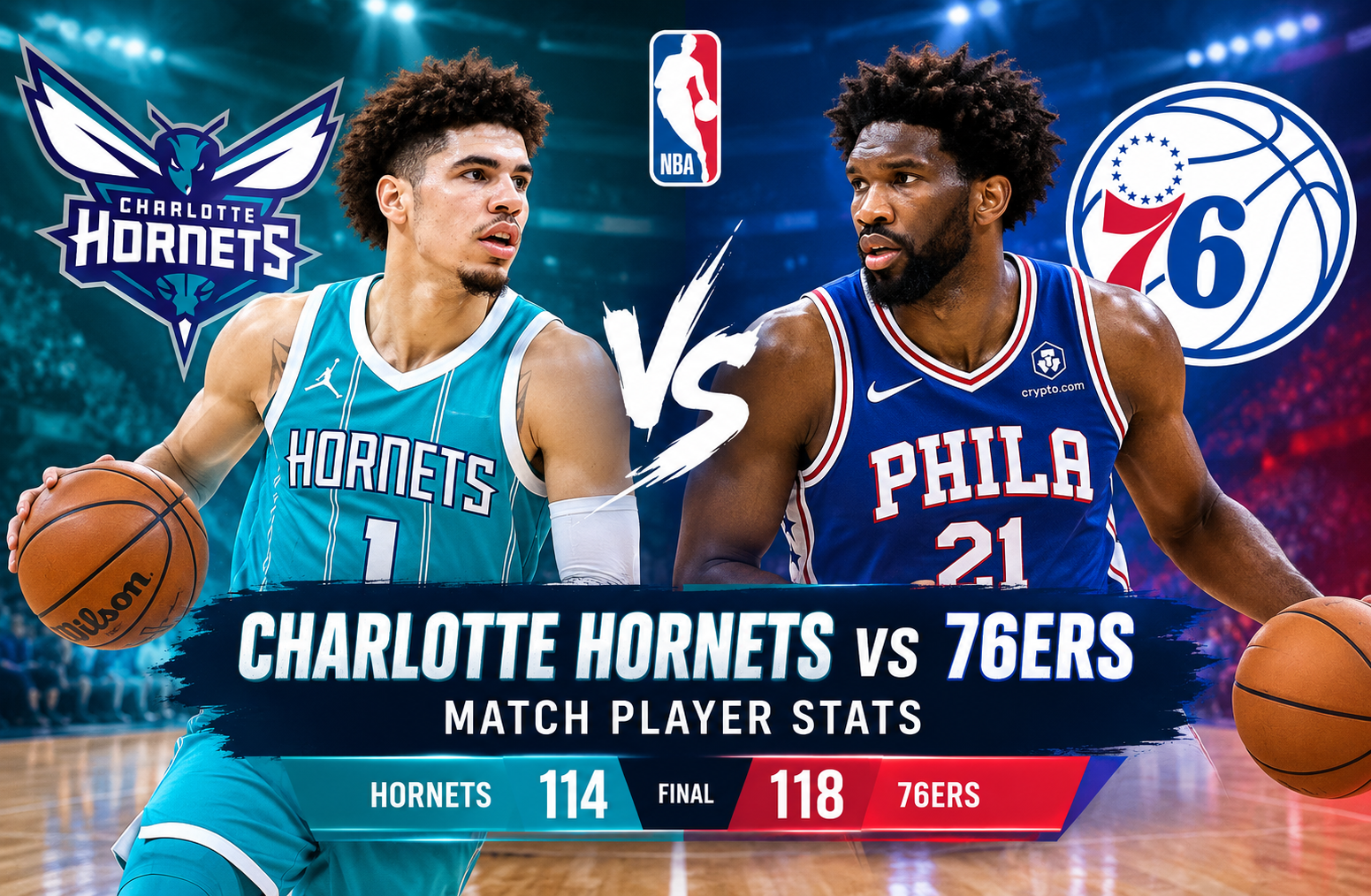
The charlotte hornets vs 76ers match player stats from the March 29, 2026 game in Pakistan time tell the story of a close Eastern Conference battle that Philadelphia ultimately won 118-114. Played at Spectrum Center in Charlotte, the 76ers overcame a difficult start and a double-digit second-half deficit before taking control during a tense fourth quarter. Joel Embiid led Philadelphia with 29 points, while Tyrese Maxey added 26 points, 8 assists, and 7 rebounds in his return to the starting lineup. Paul George also delivered a major all-around performance with 26 points and 13 rebounds.
For Charlotte, Brandon Miller matched Embiid’s scoring total with 29 points, while LaMelo Ball contributed 20 points and 8 assists. Moussa Diabate posted a double-double with 10 points and 11 rebounds. Despite winning the rebounding battle 53-41 and producing several strong stretches of offense, Charlotte could not convert its late opportunities into a victory.
The final margin was only four points, but the underlying numbers reveal a more interesting story. Philadelphia shot 49 percent from the field and 47 percent from three-point range, while Charlotte shot only 38 percent overall and 31 percent from deep. Philadelphia also committed only nine turnovers, matching Charlotte’s total, which helped the 76ers survive Charlotte’s stronger work on the glass.
Game result: Philadelphia 76ers 118, Charlotte Hornets 114
Venue: Spectrum Center, Charlotte, North Carolina
Attendance: 19,616
Philadelphia record: 41-33
Charlotte record: 39-35
Season series: Philadelphia won 2-1
Charlotte Hornets vs 76ers Match Player Stats at a Glance
The simplest way to understand this matchup is to compare the major team statistics before looking at individual performances.
| Statistic | Philadelphia 76ers | Charlotte Hornets |
| Final score | 118 | 114 |
| Field goals | 40-82 | 36-96 |
| Field goal percentage | 49% | 38% |
| Three-pointers | 16-34 | 17-55 |
| Three-point percentage | 47% | 31% |
| Free throws | 22-29 | 25-32 |
| Free-throw percentage | 76% | 78% |
| Rebounds | 41 | 53 |
| Assists | 19 | 18 |
| Turnovers | 9 | 9 |
| Steals | 7 | 4 |
| Blocks | 5 | 1 |
The most important contrast is shooting efficiency.
Charlotte actually made one more three-pointer than Philadelphia, 17 compared with 16. However, the Hornets needed 55 attempts to get there, while Philadelphia used only 34 attempts. That difference says a great deal about the offensive quality of the game.
Philadelphia made 40 of 82 field-goal attempts. Charlotte made 36 of 96. In other words, Charlotte generated 14 more field-goal attempts but made four fewer shots overall.
That is a classic example of why raw shot volume does not automatically translate into offensive efficiency.
The official NBA game record confirms the 118-114 result, the quarter-by-quarter scoring, the nine turnovers by each team, and the significant difference in shooting efficiency. (NBA.com)
How the Game Unfolded
Charlotte Controlled the First Quarter
Charlotte opened the game with far more offensive confidence.
The Hornets scored 36 points in the opening period while Philadelphia managed only 25. That gave Charlotte an 11-point advantage after 12 minutes and immediately put the 76ers in a position where they had to chase the game.
Brandon Miller was a major part of Charlotte’s early success. His scoring gave the Hornets a reliable perimeter threat, while LaMelo Ball helped organize the offense and create opportunities for teammates.
Philadelphia, meanwhile, struggled to establish control early.
The important point is that the 76ers did not respond by abandoning their offensive approach. Instead, they improved their shot-making and increased the pressure on Charlotte’s defense.
Philadelphia Exploded in the Second Quarter
The second quarter completely changed the momentum.
Philadelphia scored 39 points, its highest-scoring quarter of the game. Charlotte still scored 33, but the 76ers cut deeply into the early deficit.
At halftime, Charlotte led 69-64.
That five-point margin was significant because the game had looked much more comfortable for the Hornets after the opening quarter. Philadelphia had transformed an 11-point deficit into a five-point halftime gap in just one quarter.
Joel Embiid was especially effective during the opening half. According to the official game recap, he scored 21 points before halftime. Tyrese Maxey added 17 points during the first two quarters. (NBA.com)
That combination gave Philadelphia a much-needed offensive foundation.
Charlotte Rebuilt Its Lead in the Third
The third quarter was another momentum swing.
Charlotte opened the second half strongly and pushed its advantage back into double digits. The Hornets used an 11-0 run to build a 15-point lead midway through the period.
At that stage, Philadelphia faced its most difficult stretch of the game.
Charlotte’s ability to create separation was partly connected to its three-point shooting and the pressure generated by its offensive rebounding. The Hornets finished the game with 53 rebounds, 12 more than Philadelphia.
Yet the 76ers again refused to let the game get away.
Philadelphia responded before the end of the third quarter and reduced the deficit to five points. The score entering the final period was 97-92 in Charlotte’s favor.
That set up one of the most important fourth quarters of the matchup.
The Fourth Quarter Decided Everything
Philadelphia scored 26 points in the fourth quarter while Charlotte managed only 17.
That nine-point difference was enough to turn a five-point deficit into a four-point victory.
The game became particularly tense during the final eight minutes. The lead changed hands nine times, showing just how little separation existed between the teams.
Philadelphia eventually took its first lead of the game in the fourth quarter.
Paul George became especially important late. He hit a three-pointer with 1:04 remaining that gave Philadelphia the lead for good.
Charlotte still had opportunities to force overtime. LaMelo Ball had two three-point attempts that could have tied the game, but neither converted.
That sequence captures the difference between the teams in the final minutes. Charlotte had enough opportunities to win, but Philadelphia produced the critical shot when the game demanded it. (NBA.com)
Philadelphia 76ers Player Stats Breakdown
Joel Embiid: 29 Points
Joel Embiid was Philadelphia’s leading scorer with 29 points.
He shot 8-for-19 from the field, including 3-for-6 from three-point range, and went 10-for-13 at the free-throw line. He also recorded 6 rebounds and 2 assists while blocking two shots.
The most impressive part of Embiid’s offensive performance was his ability to generate points even when Charlotte made the game difficult.
His 10 made free throws were particularly valuable. Free throws provided Philadelphia with a reliable source of scoring while the team worked through stretches where Charlotte’s defense was forcing difficult attempts.
Embiid also established himself early. His 21 first-half points helped prevent Charlotte from turning its opening advantage into a much larger halftime lead.
The official NBA box score lists Embiid at 29 points, 6 rebounds, 2 assists, and 2 blocks. (NBA.com)
Tyrese Maxey: 26 Points, 8 Assists, 7 Rebounds
Tyrese Maxey’s return to the starting lineup was one of the biggest stories of the game.
He finished with 26 points, 8 assists, and 7 rebounds.
That stat line is important because it goes beyond scoring. Maxey provided Philadelphia with creation, rebounding from the guard position, and another player capable of putting pressure on Charlotte’s defense.
His eight assists also helped Philadelphia maintain offensive balance.
Rather than relying entirely on Embiid to generate scoring opportunities, Philadelphia had another high-level creator who could attack, distribute, and keep the offense moving.
His return also changed the pressure on Charlotte’s perimeter defenders. With Maxey and Embiid both demanding defensive attention, Philadelphia had multiple ways to create advantageous situations.
The official NBA recap confirms that Maxey returned to the starting lineup after missing time and finished with 26 points, 8 assists, and 7 rebounds. (NBA.com)
Paul George: 26 Points and 13 Rebounds
Paul George produced one of the most complete statistical performances of the game.
He scored 26 points and grabbed 13 rebounds. He also recorded 4 steals and 2 assists.
His 13 rebounds were especially valuable because Charlotte dominated the overall rebounding battle.
George’s offensive contribution was equally important. He shot 9-for-19 from the field and made four three-pointers.
Most importantly, his late three-pointer with 1:04 remaining gave Philadelphia the lead for good.
This is why box-score analysis should not focus exclusively on the highest scorer. Embiid led Philadelphia with 29 points, but George’s combination of scoring, rebounding, defense, and late-game execution had a major influence on the outcome.
VJ Edgecombe: 13 Points
VJ Edgecombe scored 13 points, while also contributing 5 rebounds and 3 assists.
His production gave Philadelphia another useful piece around its primary offensive players.
A 13-point performance might not stand out next to 29 and 26, but secondary scoring matters in a game decided by four points.
Every contribution that reduces the scoring burden on Embiid, Maxey, and George becomes more meaningful in a close game.
Kelly Oubre Jr.: 9 Points
Kelly Oubre Jr. finished with 9 points and 5 rebounds.
His production was modest compared with Philadelphia’s three leading scorers, but the rebounding contribution helped the 76ers compensate for Charlotte’s dominance on the glass.
Quentin Grimes: 8 Points
Quentin Grimes added 8 points and 3 assists.
His contribution was another example of Philadelphia receiving supporting production around its primary stars.
When a team wins a close game despite being outrebounded by 12, efficient scoring from its rotation becomes especially valuable.
Charlotte Hornets Player Stats Breakdown
Brandon Miller: 29 Points
Brandon Miller was Charlotte’s leading scorer with 29 points.
He matched Joel Embiid’s scoring total and was one of the main reasons the Hornets remained competitive throughout the game.
Miller made five three-pointers and also collected 8 rebounds.
His scoring was particularly effective early. He led Charlotte in scoring during the opening half and helped the Hornets establish their 69-64 halftime advantage.
Miller’s performance demonstrates that Charlotte had enough individual scoring power to win this matchup.
The problem was not a lack of star production.
The larger issue was the team’s overall shooting efficiency.
Miller produced 29 points, but Charlotte as a whole shot only 38 percent from the field.
LaMelo Ball: 20 Points and 8 Assists
LaMelo Ball recorded 20 points and 8 assists.
His passing remained one of Charlotte’s most important offensive tools. Eight assists indicate that he was not simply looking for his own shot.
Ball helped create scoring opportunities for Miller, Diabate, Bridges, Knueppel, and other teammates.
However, the final moments were difficult.
Charlotte had a chance to tie the game through Ball’s late three-point attempts, but neither shot fell.
That does not erase the value of his overall performance. It simply highlights how narrow the margin was between victory and defeat.
Moussa Diabate: 10 Points and 11 Rebounds
Moussa Diabate recorded a double-double with 10 points and 11 rebounds.
His rebounding was part of Charlotte’s biggest statistical advantage.
The Hornets finished with 53 total rebounds compared with Philadelphia’s 41. Diabate’s work on the glass helped Charlotte generate additional possessions and maintain pressure on the 76ers.
His 11 rebounds were tied for the team high.
Coby White: 16 Points
Coby White added 16 points and 4 rebounds.
His scoring gave Charlotte another perimeter option beyond Miller and Ball.
White’s 16 points were important because Philadelphia had to account for multiple scoring threats instead of focusing exclusively on Miller.
Miles Bridges: 11 Points
Miles Bridges finished with 11 points and 6 rebounds.
His rebounding was useful in a game where Charlotte consistently won the battle on the boards.
However, Charlotte needed greater overall shooting efficiency to turn that rebounding advantage into a victory.
Kon Knueppel: 11 Points and 11 Rebounds
Kon Knueppel recorded 11 points and 11 rebounds, giving Charlotte another double-double.
His rebounding contribution was particularly important because the Hornets repeatedly created second-chance opportunities.
The problem was that Charlotte’s advantage in extra possessions could not completely compensate for the gap in shooting percentage.
Grant Williams: 9 Points and 8 Rebounds
Grant Williams contributed 9 points and 8 rebounds.
His eight boards further strengthened Charlotte’s control of the glass.
When several players contribute to rebounding at this level, it becomes clear that Charlotte’s advantage was a team-wide characteristic rather than the result of one player.
Shooting Efficiency Was the Deciding Factor
The most revealing part of the game is the shooting comparison.
Philadelphia:
- 40-for-82 from the field
- 49 percent field-goal shooting
- 16-for-34 from three
- 47 percent from three
- 22-for-29 from the free-throw line
Charlotte:
- 36-for-96 from the field
- 38 percent field-goal shooting
- 17-for-55 from three
- 31 percent from three
- 25-for-32 from the free-throw line
Charlotte made one more three-pointer, but Philadelphia’s efficiency was much better.
The 76ers converted 47 percent of their three-point attempts. Charlotte converted only 31 percent.
That difference becomes even more important when considering the number of attempts.
Charlotte attempted 21 more three-pointers.
Normally, that type of volume can create a major advantage. But inefficient shooting means additional attempts can become wasted possessions.
Philadelphia did not need to rely on such a high volume of perimeter attempts because it converted a much greater percentage of its shots.
This is one of the clearest lessons from the matchup: shot quality and conversion rate can matter more than raw shot volume.
The Rebounding Battle Favored Charlotte
Charlotte won the rebounding battle 53-41.
That is a significant 12-rebound advantage.
The Hornets also produced strong individual rebounding performances from Diabate, Knueppel, Bridges, and Williams.
On paper, this should have created a meaningful advantage for Charlotte.
Rebounds can lead to additional possessions, especially offensive rebounds. They can also reduce the opponent’s second-chance opportunities.
Yet Philadelphia still won.
That tells us that the 76ers compensated through efficiency.
Philadelphia did not need as many possessions because it converted its opportunities at a much higher rate.
This is an important distinction when evaluating basketball statistics. One category rarely explains an entire result.
A team can dominate the boards and still lose if it gives away too much ground in shooting efficiency.
Turnovers Were Almost Identical
Both teams committed nine turnovers.
That is another important reason the game remained close.
Neither side gave away a significant advantage through careless ball handling.
Philadelphia recorded 19 assists and Charlotte recorded 18, while each team had only nine turnovers.
The assist-to-turnover balance therefore remained relatively healthy for both teams.
Because turnovers were even, the outcome came down more heavily to shooting, rebounding, and late-game execution.
Philadelphia won two of those three major areas.
Philadelphia’s Three-Point Efficiency Created Separation
Three-point shooting was one of the clearest statistical differences.
Philadelphia made 16 of 34 attempts.
Charlotte made 17 of 55.
That means Charlotte attempted 21 more three-pointers.
Yet Philadelphia finished with a substantially better percentage.
The result is an important lesson for readers studying team and player statistics: made three-pointers alone do not tell the entire story.
A box score showing 17 made threes might look better than 16. But once attempts and percentages are included, the picture changes.
Philadelphia’s perimeter shooting was more efficient.
That efficiency allowed the 76ers to stay close despite Charlotte’s strong rebounding.
Why Charlotte Could Not Protect Its Lead
Charlotte led after the first quarter.
Charlotte led at halftime.
Charlotte also led entering the fourth quarter.
Yet Philadelphia won the game.
The answer is the fourth-quarter efficiency and execution.
The 76ers scored 26 points in the final period while Charlotte scored only 17.
Philadelphia also found the most important shot of the night when George connected from three with 1:04 remaining.
Charlotte’s inability to convert its final opportunities completed the turnaround.
The game therefore demonstrates why a team can control large sections of a matchup and still lose.
Basketball games are decided by the full 48 minutes, but the final possessions often carry disproportionate importance.
Season Series: Philadelphia Won 2-1
The matchup was part of a three-game season series between the teams.
Philadelphia won two games.
Charlotte won one.
The reported results were:
| Game | Result |
| Game 1 | Philadelphia 125, Charlotte 121 |
| Game 2 | Charlotte 130, Philadelphia 93 |
| Game 3 | Philadelphia 118, Charlotte 114 |
The series was therefore much more competitive than the 2-1 record alone might suggest.
The second meeting was a 37-point Charlotte victory, showing that the Hornets were capable of completely controlling the matchup.
The first and third games were much tighter.
That variation is useful when interpreting head-to-head statistics. A season series record tells you who won more games, but it does not necessarily describe how those games were played.
What the Player Stats Tell Us About Both Teams
Philadelphia’s Main Strength
Philadelphia’s biggest strength in this game was the combination of star-level scoring and efficient shooting.
Embiid scored 29.
Maxey scored 26.
George scored 26.
Together, those three players accounted for 81 of Philadelphia’s 118 points.
That is roughly 69 percent of the team’s total scoring.
The important part, however, is that they did not simply accumulate points through volume.
Philadelphia shot 49 percent as a team.
The 76ers also converted 47 percent of their three-point attempts.
That combination made their scoring difficult for Charlotte to match.
Charlotte’s Main Strength
Charlotte’s strongest area was rebounding.
The Hornets collected 53 rebounds and had multiple players contribute heavily.
Charlotte also received 29 points from Miller, 20 from Ball, and 16 from White.
That is a strong scoring foundation.
The team was competitive because it had both offensive creators and physical advantages around the basket.
Charlotte’s Main Weakness
The major problem was efficiency.
A 38 percent field-goal percentage is difficult to overcome against a team shooting 49 percent.
The problem became even more obvious from three-point range.
Charlotte made 17 threes, but needed 55 attempts to reach that number.
That meant many possessions ended without a made field goal.
A Closer Look at the Advanced Meaning of the Box Score
The basic box score tells us who scored, rebounded, passed, and defended.
The deeper interpretation tells us why the game ended the way it did.
Philadelphia’s nine turnovers were exactly the same as Charlotte’s. That eliminates turnovers as a major explanation.
Charlotte won the rebounding battle by 12. That gives the Hornets a clear advantage in one major category.
Charlotte also made 17 three-pointers compared with Philadelphia’s 16.
Yet Philadelphia won.
The decisive difference was efficiency.
The 76ers converted 49 percent of their field goals compared with 38 percent for Charlotte.
They also shot 47 percent from three compared with 31 percent for the Hornets.
That is the statistical foundation of the result.
When one team gets more out of each shot attempt, it can survive losing another statistical category.
What Fans Should Watch When Evaluating Future Matchups
For anyone using this game as a reference point for future Philadelphia and Charlotte matchups, several categories deserve attention.
1. Three-Point Attempts Versus Percentage
Do not look only at how many threes a team makes.
Compare:
- Three-point attempts
- Three-point makes
- Three-point percentage
- Total field-goal percentage
This game shows why that approach matters.
2. Rebounding Margin
Charlotte’s 53 rebounds were a major positive.
If the Hornets can combine that type of rebounding performance with improved shooting, the team’s offensive ceiling becomes much higher.
3. Star Availability
Philadelphia’s offensive structure changes significantly when its primary creators are available.
Maxey’s return was especially important because he gave the 76ers another high-level ball handler and scorer.
4. Fourth-Quarter Execution
The final period deserves special attention in close games.
Philadelphia outscored Charlotte 26-17 in the fourth.
That nine-point difference erased Charlotte’s five-point advantage entering the period.
Why the Matchup Was So Competitive
Despite Philadelphia eventually winning, this was not a game dominated from start to finish.
There were five ties and nine lead changes.
Charlotte’s biggest lead reached 15 points.
Philadelphia’s biggest lead was only four points.
That tells us just how narrow the margin was.
The Hornets had multiple opportunities to put the game away, but Philadelphia repeatedly responded.
The result was therefore less about one dominant stretch and more about Philadelphia surviving several momentum swings.
Official Game Record and Verification
For readers who want to verify the full box score, quarter scores, player statistics, and game details, the official NBA game page provides the authoritative record for the matchup. Official NBA game record and box score
One date detail is worth clarifying. The game was played Saturday night, March 28, 2026, in Charlotte according to the official NBA record. Because the game began at 10:00 PM Eastern Time, it was already March 29 in Pakistan when the game was being played. This explains why the matchup may appear as March 29 in Pakistan-based records while the NBA lists March 28 locally. (NBA.com)
FAQs About Charlotte Hornets vs 76ers Match Player Stats
Who scored the most points in the game?
Joel Embiid led Philadelphia with 29 points, while Brandon Miller led Charlotte with 29 points. The two players therefore finished tied as the game’s top individual scorers.
What was the final score?
The Philadelphia 76ers defeated the Charlotte Hornets 118-114.
Who had the most rebounds?
Paul George led Philadelphia with 13 rebounds. For Charlotte, Moussa Diabate and Kon Knueppel each recorded 11 rebounds.
How many points did Tyrese Maxey score?
Tyrese Maxey scored 26 points. He also recorded 8 assists and 7 rebounds.
How did LaMelo Ball perform?
LaMelo Ball finished with 20 points and 8 assists. He was one of Charlotte’s primary offensive creators throughout the matchup.
Which team won the season series?
Philadelphia won the three-game season series 2-1. Charlotte won the second meeting, while Philadelphia won the first and third games.
Conclusion
The charlotte hornets vs 76ers match player stats show a game decided by efficiency, execution, and the ability to respond under pressure.
Philadelphia finished with 118 points despite losing the rebounding battle 53-41. The 76ers matched Charlotte’s nine turnovers and produced 19 assists compared with Charlotte’s 18. The biggest statistical advantage came from shooting, where Philadelphia converted 49 percent of its field goals and 47 percent of its three-point attempts.
Joel Embiid led Philadelphia with 29 points. Tyrese Maxey supplied 26 points, 8 assists, and 7 rebounds in his return to the starting lineup. Paul George added 26 points and 13 rebounds and hit the decisive three-pointer late in the fourth quarter.
Charlotte received an equally impressive 29-point performance from Brandon Miller. LaMelo Ball added 20 points and 8 assists, while Moussa Diabate and Kon Knueppel each recorded 11 rebounds.
The Hornets had enough individual production and enough control of the glass to win the game. What they lacked was consistent shooting efficiency during the most important possessions.
For anyone studying charlotte hornets vs 76ers match player stats, the central lesson is straightforward: the box score is most useful when the categories are read together. Charlotte won rebounds and matched Philadelphia in turnovers, but Philadelphia made its shots at a much higher rate and executed better during the decisive fourth quarter.
That combination turned a game in which Charlotte led for long stretches into a 118-114 Philadelphia victory.
The season series ultimately finished 2-1 in Philadelphia’s favor, but the three meetings demonstrated how dramatically the matchup could change depending on shooting, availability, rebounding, and late-game execution.