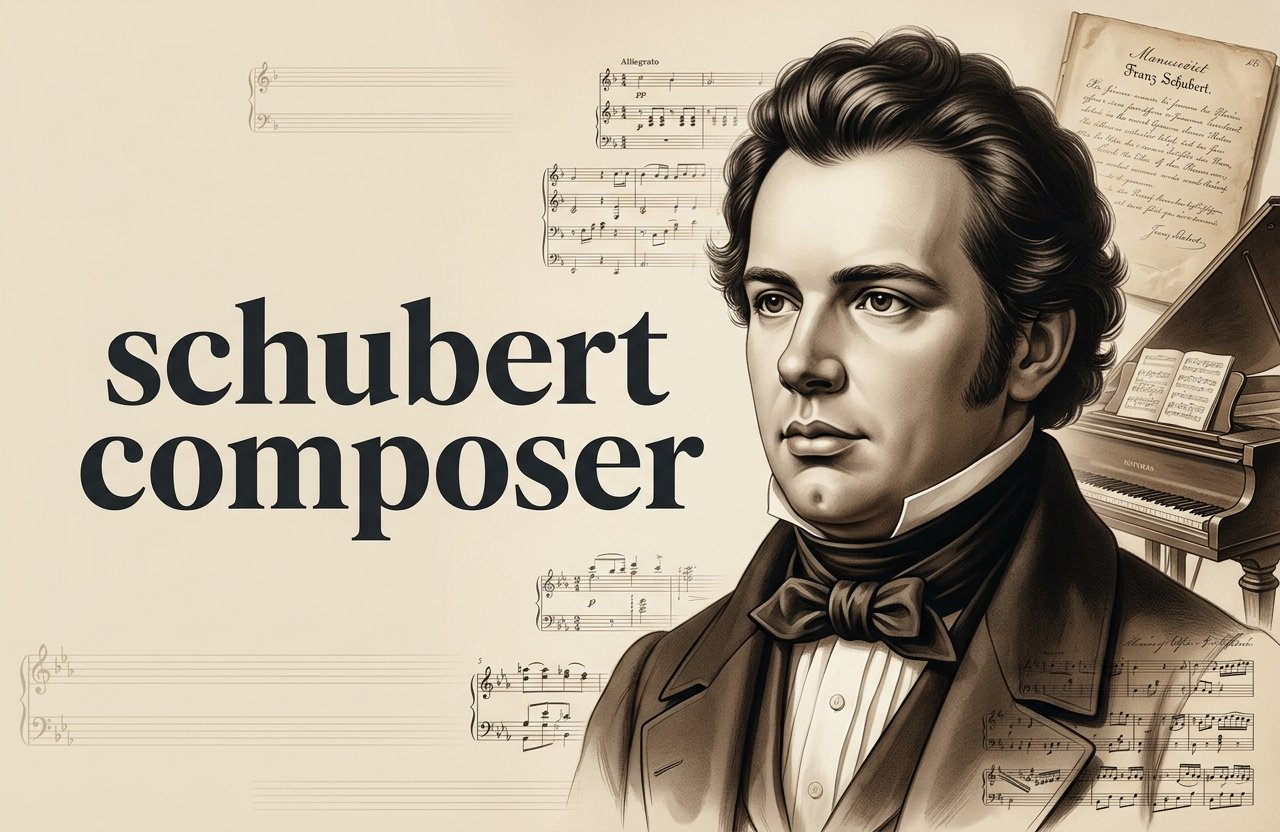
Schubert Composer: Life, Music, Masterpieces, and Legacy
Franz Schubert, widely known through the search term schubert composer, was one of the most influential composers of the early Romantic period. His music combined the clarity of Classical forms with a new depth of emotion, creating works that continue to move listeners nearly two centuries after his death. From intimate art songs and expressive piano pieces to grand symphonies and chamber music, Schubert developed a musical language that influenced generations of composers.
Born in Vienna in 1797, Schubert lived for only 31 years. Despite his short life, he produced an extraordinary body of music, including more than 600 songs, symphonies, chamber works, piano compositions, sacred music, and operas. His ability to transform poetry into music was especially remarkable. He could express longing, joy, loneliness, hope, and despair through melodies that feel both natural and emotionally complex.
Understanding Schubert requires looking beyond his famous melodies. His music often explores the tension between comfort and uncertainty, beauty and sadness, and movement and stillness. These qualities make his compositions rewarding for beginners, experienced listeners, musicians, and students of music history alike.
Who Was the Schubert Composer?
The Schubert composer most people mean is Franz Peter Schubert, an Austrian composer whose work helped shape the transition from Classical music to Romanticism. He was born on January 31, 1797, in Himmelpfortgrund, a suburb of Vienna, which was then part of the Habsburg monarchy.
Schubert grew up in a musical household. His father, Franz Theodor Schubert, worked as a schoolteacher and encouraged musical education. His mother, Elisabeth Vietz, came from a family with modest means. Music became part of his early life, and his natural talent became clear while he was still a child.
His musical education included instruction in violin, piano, singing, and composition. He also received training through the Imperial and Royal City College in Vienna and became a chorister in the imperial court chapel. There, he encountered a broad musical tradition that included the works of Wolfgang Amadeus Mozart, Joseph Haydn, and Ludwig van Beethoven.
These composers influenced his musical development, but Schubert gradually formed a voice of his own. Rather than relying only on elaborate technical displays, he often built his music around memorable melodies, subtle harmonic changes, and a strong connection between musical structure and human feeling.
Schubert died on November 19, 1828, in Vienna. His life was brief, and he did not enjoy the widespread public recognition that later generations would give him. Yet his surviving compositions established him as a central figure in Western classical music.
Early Life and Musical Education
A Childhood Shaped by Music
Schubert was introduced to music at an early age. His father taught him the fundamentals of violin playing, while his older brother Ignaz helped him develop his piano skills. His family environment provided regular opportunities to practise and perform.
His abilities soon exceeded what his immediate surroundings could offer. He studied with Michael Holzer, a local church organist and choirmaster, who recognized the young musician’s exceptional gifts. Schubert’s early education exposed him to harmony, counterpoint, singing, and instrumental performance.
A major turning point came when Schubert entered the Stadtkonvikt, a boarding school in Vienna. As a chorister, he received musical instruction and encountered works by leading Classical composers. The institution also provided access to orchestral music, which helped him develop a practical understanding of instrumental writing.
This experience was important because Schubert did not learn composition only from books. He heard music performed, studied how instruments worked together, and absorbed the musical language of his time.
The Influence of Antonio Salieri
Schubert also studied composition with Antonio Salieri, an established composer and teacher in Vienna. Salieri helped him refine his knowledge of vocal writing, counterpoint, and compositional technique.
Although Schubert’s mature style differed from Salieri’s, the instruction gave him a stronger technical foundation. His later songs demonstrate how effectively he could combine vocal melody with expressive piano accompaniment.
His education also revealed a central feature of his creative personality: he was highly productive while still very young. He began composing songs, chamber works, and other pieces during his teenage years, showing an unusual ability to turn musical ideas into complete compositions.
Leaving School and Choosing Music
Schubert eventually worked as an assistant teacher at his father’s school. Teaching offered some financial stability, but it competed with the time he wanted to devote to composition.
He increasingly sought a life centered on music. This decision was not easy. Vienna had a lively musical culture, but a young composer without secure patronage or a major publishing income could struggle to support himself.
Schubert continued writing despite these difficulties. His early career illustrates a distinction that remains important in music history: creative achievement does not always lead to immediate financial success or public fame.
Why Schubert Is Considered a Major Romantic Composer
Schubert occupies a special place in music history because he connected two musical periods without fully belonging to either one. His compositions retained the balance, clarity, and formal discipline of Classical music while exploring the personal emotions and imaginative worlds associated with Romanticism.
The Classical period had produced composers who often built large works around clear structures, balanced phrases, and carefully organized musical ideas. Romantic composers increasingly explored individual feeling, poetic imagination, dramatic contrast, and the relationship between music and literature.
Schubert combined these approaches.
His melodies can sound simple at first, yet their harmonies may lead listeners into unexpected emotional territory. A cheerful passage might shift into a darker key. A calm melody might return with a completely different meaning. A familiar musical phrase might become unsettling when its accompaniment changes.
This ability to make subtle musical changes carry emotional weight is one reason his music remains so compelling.
The Importance of Melody
Melody was one of Schubert’s greatest strengths. His themes often feel natural, almost as if they could have existed before he wrote them down.
However, memorable melodies were only part of his achievement. He understood how to develop a melody through harmony, rhythm, repetition, and changes in texture. The same musical idea could suggest comfort in one setting and loneliness in another.
His vocal works show this skill especially clearly. Instead of treating the singer’s melody as the only important element, he gave the piano an active role in expressing the meaning of the words.
Emotional Depth Through Harmony
Schubert frequently moved between major and minor keys in ways that changed the emotional direction of a composition. These changes could introduce uncertainty, sadness, hope, or surprise without requiring a dramatic increase in volume.
For listeners, this means that the emotional meaning of his music often lies beneath the surface.
A passage may sound peaceful while its harmony hints at something unresolved. A bright melody may contain a trace of sadness. This mixture of feelings gives many of his compositions their distinctive character.
A Bridge Between Classical and Romantic Music
Schubert learned from Mozart, Haydn, and Beethoven, but he did not simply copy their styles. He expanded musical forms by allowing melodies to unfold at greater length and by giving harmonic changes more expressive importance.
His instrumental compositions often take listeners through extended musical journeys. Instead of moving quickly toward a clear conclusion, a piece may explore several emotional possibilities before reaching its final resolution.
This approach influenced later composers, including Robert Schumann, Johannes Brahms, and other musicians who valued the connection between musical structure and personal expression.
Schubert’s Most Famous Compositions
The works associated with Schubert demonstrate the range of his imagination. His reputation rests on much more than songs, even though vocal music remains central to his legacy.
The following compositions offer an excellent introduction to his music.
1. Symphony No. 8 in B Minor, the Unfinished Symphony
Schubert’s Symphony No. 8 in B minor, commonly called the Unfinished Symphony, is among the best-known works in the orchestral repertoire.
He composed its two completed movements in 1822. Unlike a conventional four-movement symphony, it survives in a form with two fully developed movements, although sketches and fragments for other music also exist.
The opening movement establishes a dark, mysterious atmosphere. A quiet introduction leads into a memorable theme that develops through shifting harmonies and contrasting orchestral textures. The second movement offers a gentler, more lyrical character, although its peaceful surface occasionally gives way to moments of unease.
The work’s unusual form has encouraged considerable discussion. Why did Schubert leave it unfinished? No explanation has been established with certainty. Suggestions about illness, artistic decisions, and competing projects remain interpretations rather than proven answers.
The important point is that the symphony feels complete enough to communicate a powerful musical experience despite its incomplete history.
Why it matters: The work demonstrates how atmosphere, melody, and harmonic tension can sustain a large orchestral composition without relying entirely on the dramatic structures familiar from earlier symphonies.
2. Symphony No. 9 in C Major, the Great
Schubert’s Symphony No. 9 in C major, often called the Great, represents another side of his orchestral imagination.
Completed in 1826, it is notable for its expansive scale, rhythmic energy, and long melodic lines. Its four movements create a broad musical journey, combining moments of grandeur with passages of lyricism and rhythmic drive.
The symphony was not widely performed during Schubert’s lifetime. Robert Schumann encountered its manuscript in Vienna in 1838 and helped bring it to wider attention. Felix Mendelssohn conducted an important early performance in Leipzig in 1839.
The history of this work illustrates a recurring feature of Schubert’s career: some of his greatest compositions achieved recognition only after his death.
Why it matters: The Great C Major Symphony shows that Schubert could handle large musical structures while preserving the lyrical character that made his shorter works so distinctive.
3. Erlkönig
Erlkönig, composed in 1815, is one of Schubert’s most famous songs. It sets a poem by Johann Wolfgang von Goethe that tells a frightening story about a father riding through the night with his sick child.
The child believes a supernatural figure is approaching him. The father repeatedly tries to explain the child’s fears as ordinary sights and sounds, while the mysterious figure becomes increasingly threatening.
Schubert transforms this short narrative into a dramatic musical scene for a single singer and piano.
The piano’s repeated, rapid notes create the impression of a horse galloping. The singer must distinguish among the narrator, the father, the child, and the supernatural figure. Each character has a different musical identity, allowing one performer to present an entire drama.
The accompaniment is not merely decorative. Its movement, intensity, and changes in texture help establish the setting and communicate the growing danger.
The ending is especially powerful because the music changes abruptly when the father reaches his destination and discovers that the child has died.
Why it matters: Erlkönig shows how a song can function like a miniature opera, using melody, accompaniment, rhythm, and vocal characterization to tell a complete story.
4. Ave Maria
Schubert’s Ave Maria, originally titled Ellens Gesang III and composed in 1825, is among the most widely recognized melodies associated with his name.
The original song belongs to a setting of a poem from Walter Scott’s narrative work The Lady of the Lake. The familiar Latin words associated with the melody became popular through later adaptations.
This distinction is important because many listeners know the work through church ceremonies, recordings, and arrangements that differ from Schubert’s original version.
Its appeal comes from a sustained vocal melody, gentle accompaniment, and a sense of calm devotion. The music does not depend on elaborate dramatic effects. Instead, it creates its emotional impact through simplicity and lyrical continuity.
Why it matters: The song demonstrates how Schubert could create music that works both within its original literary setting and in later religious and ceremonial traditions.
5. The Trout Quintet
The Trout Quintet, formally Piano Quintet in A major, D. 667, was composed in 1819.
It has an unusual instrumental combination: piano, violin, viola, cello, and double bass. This arrangement gives the music a distinctive texture, with the double bass providing a deeper foundation than listeners might expect in a typical piano quintet.
The fourth movement contains variations on Schubert’s earlier song Die Forelle, or The Trout. The tune passes through different instrumental settings, changing in color and character while remaining recognizable.
The result is both playful and sophisticated. Schubert takes a simple melody and uses it as the basis for a carefully organized set of variations.
Why it matters: The work reveals his skill at combining accessible melodies with chamber music that rewards close listening.
6. String Quartet No. 14 in D Minor, Death and the Maiden
Schubert composed the String Quartet No. 14 in D minor in 1824. Its nickname comes from his earlier song Der Tod und das Mädchen, which supplies the theme for the quartet’s second movement.
The song explores a conversation between a frightened young woman and Death, who speaks in a strangely reassuring voice. The quartet develops this relationship into a broader musical exploration of fear, tension, and reflection.
Its first movement is forceful and dramatic. The second movement presents the variations on the song’s theme, moving through contrasting moods. The later movements continue the work’s intense atmosphere, with rapid rhythms and energetic passages.
The quartet is not simply a musical illustration of death. It also explores uncertainty, resistance, and the difficulty of finding peace in the face of something unavoidable.
Why it matters: The work demonstrates Schubert’s ability to create emotional intensity through instrumental music without words.
7. Winterreise
Winterreise, or Winter Journey, is one of Schubert’s greatest achievements in vocal music.
Composed in 1827, the cycle contains 24 songs setting poems by Wilhelm Müller. The central figure is a traveler who leaves a familiar world and wanders through a bleak winter landscape after experiencing romantic rejection.
The journey becomes an exploration of isolation, memory, disappointment, and psychological uncertainty.
Each song contributes to the larger emotional narrative, although the cycle does not tell a conventional story with a simple beginning and ending. The landscape often reflects the traveler’s inner condition, while changes in rhythm, harmony, and accompaniment suggest shifts in thought.
The final song, Der Leiermann, presents a mysterious hurdy-gurdy player standing at the edge of the traveler’s world. Its sparse accompaniment and restrained vocal line create an ending that resists easy interpretation.
Why it matters: Winterreise shows how a collection of individual songs can form a unified psychological journey.
8. Die schöne Müllerin
Die schöne Müllerin, or The Fair Maid of the Mill, is an earlier song cycle based on poems by Wilhelm Müller.
The cycle follows a young miller’s apprentice who travels in search of work, falls in love with a miller’s daughter, and gradually experiences jealousy and heartbreak.
Its songs move from the optimism of discovery toward increasingly painful emotions. Nature, especially the flowing stream, plays a major role in the narrative.
The stream seems at first to guide the young man toward happiness. As the story develops, however, it becomes associated with disappointment and escape.
Schubert’s musical settings give the stream a changing expressive role. The piano accompaniment can suggest physical movement, emotional excitement, or quiet reflection, depending on the song.
Why it matters: This cycle offers a useful introduction to the way Schubert connects poetry, musical motifs, and narrative development.
9. Piano Impromptus
Schubert’s impromptus for solo piano are among his most popular instrumental compositions.
They combine expressive melodies with writing that can be technically demanding without always sounding difficult. Some pieces use flowing arpeggios, while others explore variations, lyrical themes, or dramatic contrasts.
The Impromptus D. 899 and D. 935, composed in the 1820s, are especially well known.
Their titles suggest spontaneous musical invention, but the works are carefully constructed. Their apparent naturalness comes from the way Schubert balances repetition, development, and contrast.
Why it matters: These pieces offer pianists and listeners a direct encounter with his expressive keyboard style without requiring the scale of a full symphony or song cycle.
10. The Last Piano Sonatas
Schubert’s final three piano sonatas, D. 958, D. 959, and D. 960, were composed in 1828, the last year of his life.
They combine large Classical forms with an unusual depth of emotional reflection. Their opening themes can be memorable and direct, yet the music often develops through unexpected harmonic turns and extended passages.
The B-flat major Sonata, D. 960, is particularly admired for its spacious opening movement and its remarkable slow movement. A quiet tremolo in the bass interrupts the opening theme, creating a moment of uncertainty beneath the calm surface.
That small detail illustrates a characteristic Schubert effect: a passage that appears peaceful may contain an unresolved tension that changes how the entire movement is heard.
Why it matters: The sonatas demonstrate the full maturity of Schubert’s instrumental writing and show how he could create large musical structures with a deeply personal character.
Schubert’s Art Songs and His Revolutionary Approach to Lieder
The German art song, known as Lied in the singular and Lieder in the plural, is central to Schubert’s musical legacy.
A Lied typically combines a solo voice with piano accompaniment and sets a poem to music. Before Schubert, composers had already developed this form, but he greatly expanded its expressive possibilities.
He composed more than 600 songs, setting poetry by Goethe, Friedrich Schiller, Wilhelm Müller, Heinrich Heine, and other writers. The Library of Congress provides a useful research guide to Schubert’s music and surviving manuscripts.
The Piano as a Storyteller
One of Schubert’s most important innovations was his treatment of the piano.
In many earlier songs, the piano mainly supported the singer by providing harmony and rhythm. Schubert often gave it a more independent dramatic role.
In Erlkönig, repeated piano notes suggest a galloping horse. In Gretchen am Spinnrade, the moving accompaniment evokes the spinning wheel and the character’s restless thoughts. In other songs, the piano may suggest flowing water, wind, footsteps, or the emotional state of the speaker.
These musical images are not simply sound effects. They connect the physical setting to the poem’s emotional meaning.
Matching Music to the Meaning of Poetry
Schubert carefully considered the structure and emotional direction of each poem.
Sometimes he used repeated music for several verses, allowing the words to change while the musical framework remained familiar. In other songs, he changed the music from verse to verse to reflect developments in the text.
This distinction is known as the difference between strophic and through-composed approaches.
A strophic song uses substantially the same music for successive verses. A through-composed song changes its music as the poem unfolds. Schubert used both approaches, selecting the form that best served the poem.
Why His Songs Still Matter
His songs remain important because they invite close attention to both poetry and sound.
For singers, they require careful phrasing, clear diction, and sensitivity to the poem’s emotional shifts. For pianists, they demand more than accurate accompaniment. The pianist must help create the atmosphere, character, and narrative of the work.
For listeners, the songs offer a way to experience literature through music. Even without understanding every German word, a listener can often recognize changes in mood through melody, harmony, and performance.
Schubert’s Musical Style: What Makes His Music Different?
Schubert’s style cannot be reduced to a single characteristic. His music combines lyrical beauty, harmonic imagination, rhythmic variety, and an unusual ability to make ordinary musical ideas feel emotionally significant.
Understanding these features helps explain why his works appeal to both casual listeners and professional musicians.
1. Long, Expressive Melodies
Schubert often created melodies that seem to unfold naturally over extended passages. Rather than presenting a short theme and immediately breaking it into small fragments, he frequently allowed a musical idea to develop through several phrases.
This quality is especially clear in his slow movements, piano sonatas, and songs.
Long melodies require careful musical pacing. Performers must maintain direction without rushing, while listeners are encouraged to experience the music as a continuous emotional journey.
2. Unexpected Harmonic Changes
Harmony refers to the way notes and chords work together. Schubert used harmony to create changes in emotional color that could be subtle or dramatic.
A melody might begin in a major key and move unexpectedly into a distant minor key. The notes themselves may remain gentle, but the harmonic shift changes the listener’s sense of the music.
This technique appears in his songs and instrumental works alike. It allows him to create uncertainty without depending on loud passages or sudden rhythmic changes.
3. Repetition With a New Meaning
Schubert frequently returned to familiar themes. However, a repeated melody could sound different when placed in a new harmonic or dramatic context.
This is an important feature of his longer works. Instead of treating repetition as a simple return to something already heard, he often used it to reveal a different emotional aspect of the same idea.
Listeners can benefit from noticing how a theme changes each time it returns. The melody may be familiar, but the surrounding music can transform its meaning.
4. A Close Relationship Between Music and Literature
Schubert’s connection to poetry shaped much of his creative work.
He did not merely place notes beneath a poem. He used rhythm, harmony, melody, and accompaniment to highlight the words’ emotional and dramatic meaning.
In Erlkönig, the piano creates movement and urgency. In Winterreise, musical repetition and sparse textures can suggest a mind trapped in recurring thoughts.
This relationship between music and literature became a defining feature of Romantic art song and influenced composers who followed him.
5. Beauty Mixed With Sadness
Schubert’s music is often described as melancholy, but that description is incomplete.
His works also contain humor, dance rhythms, warmth, excitement, tenderness, and moments of genuine joy. What distinguishes him is his ability to combine contrasting emotions within the same composition.
A joyful passage may contain a trace of uncertainty. A sad melody may offer comfort. A peaceful ending may leave a question unanswered.
This emotional complexity helps explain why his music continues to reward repeated listening.
Schubert’s Symphonies and Chamber Music
Although his songs are central to his reputation, Schubert also made lasting contributions to orchestral and chamber music.
These works demonstrate that his imagination extended well beyond the relationship between a singer and a poem.
Symphonic Writing
Schubert’s symphonies reflect his study of Classical models as well as his interest in expansive melodies and unusual harmonic relationships.
His early symphonies show the influence of Haydn and Mozart. The later symphonies, particularly the Unfinished and the Great C Major, reveal a broader musical imagination.
One distinctive feature is the length of some of his melodic ideas. Instead of building every movement around short, sharply defined themes, he often allows musical material to unfold gradually.
This creates a sense of space and continuity, though it can also make the architecture of his longer movements challenging for performers.
Chamber Music and Intimate Expression
Chamber music is written for small groups of instruments, allowing each part to contribute to the overall musical conversation.
Schubert excelled in this form. His string quartets, piano trios, quintets, and other chamber works combine melodic clarity with sophisticated musical construction.
The Trout Quintet offers a relatively light and accessible introduction to this repertoire. By contrast, the Death and the Maiden quartet explores much darker emotional territory.
His String Quintet in C major, D. 956, composed in 1828, is another major achievement. It uses two cellos rather than the more usual combination of two violins, viola, and one cello. The extra cello creates a rich lower register that contributes to the work’s distinctive sound.
The quintet moves between expansive lyricism and moments of dramatic intensity. Its slow movement is especially admired for the contrast between its calm outer sections and more agitated central passage.
Piano Music and Musical Intimacy
Schubert’s piano compositions range from short dances and lyrical pieces to ambitious sonatas.
His waltzes and other dances reflect the social music of Vienna. They often sound spontaneous, but their phrasing and harmonic details reveal a skilled composer at work.
The impromptus and late sonatas explore more complex emotional and structural ideas. Their piano writing can be delicate, dramatic, or technically demanding, yet the music rarely loses its focus on expressive melody.
For modern pianists, these works provide an opportunity to explore the balance between Classical form and Romantic expression.
Schubert’s Personal Life, Friendships, and Schubertiades
Schubert spent most of his life in Vienna, where he maintained close relationships with friends who supported his musical ambitions.
Unlike Beethoven, who increasingly became a public figure celebrated for his symphonies and artistic independence, Schubert often worked within smaller social and musical circles.
His friends included writers, artists, musicians, and other educated members of Viennese society. They provided companionship, introduced his music to new listeners, and sometimes helped him financially.
What Were Schubertiades?
Schubertiades were gatherings at which Schubert’s music was performed and discussed. These events often took place in private homes and brought together people interested in music, poetry, and literature.
Songs, piano pieces, dances, and chamber works could be heard in an informal setting. Such gatherings suited a composer whose music often depended on close attention rather than the spectacle of a large public performance.
The tradition also illustrates how music circulated before modern recording technology. A composer needed performers, publishers, patrons, and interested listeners to help new works reach an audience.
Schubert’s friends played an important role in keeping his music alive and helping it reach a wider public.
Financial Challenges and Professional Recognition
Schubert did not enjoy a stable, prestigious position comparable to those held by some earlier composers.
He earned money through teaching, publishing, commissions, and other musical activities, but his income was often uncertain. His friends helped create opportunities for performances and publications.
It would be misleading, however, to describe his entire life as one of unrelieved poverty or to imagine that he was completely unknown. He achieved recognition in certain Viennese circles, and some of his songs and shorter pieces found audiences during his lifetime.
The broader appreciation of his orchestral and chamber masterpieces developed more fully after his death.
This distinction matters because artistic influence and public success do not always arrive at the same time.
Schubert’s Illness and Final Years
Schubert’s final years were marked by serious illness, although he continued composing with remarkable energy.
He experienced a major health crisis in the early 1820s. Many biographical accounts associate his illness with syphilis, but historical medical evidence cannot provide the same certainty as a modern clinical record. The effects of his illness and its treatment have been discussed by biographers and music historians.
By 1828, he was still producing important compositions. His final year included the String Quintet in C major, the last piano sonatas, and the song collection commonly known as Schwanengesang.
The latter is a posthumously assembled collection rather than a unified cycle planned by Schubert in exactly the same way as Winterreise.
He died in Vienna on November 19, 1828, at the age of 31. The immediate cause of death is generally recorded as typhoid fever, although the precise medical history is not entirely certain.
Schubert had requested burial near Beethoven, who had died in 1827. Both composers were initially buried in the Währing cemetery and were later reinterred in Vienna’s Central Cemetery.
His death ended a short but exceptionally productive career. It also left questions about how much more he might have achieved had he lived longer.
How Schubert Influenced Later Composers
Schubert’s influence grew significantly after his death as musicians began to recognize the breadth of his work.
Robert Schumann helped bring the Great C Major Symphony to public attention. Felix Mendelssohn conducted it, while Franz Liszt promoted Schubert’s music and made piano transcriptions of several songs.
Johannes Brahms later helped edit and publish some of Schubert’s works. Other composers studied his harmonic language, melodic writing, and approach to musical form.
Influence on Romantic Piano Music
Schubert’s piano sonatas and shorter works demonstrated how intimate musical expression could coexist with large-scale structure.
Later Romantic composers explored similar possibilities, creating piano music that could sound personal while maintaining considerable formal ambition.
His use of lyrical themes and unexpected harmonic changes helped establish an expressive vocabulary that extended beyond his own lifetime.
Influence on Art Song
Schubert’s treatment of poetry became a major reference point for later composers of German Lieder, including Schumann, Brahms, and Hugo Wolf.
His songs showed that the piano could participate actively in storytelling and that a musical setting could reveal meanings in a poem that might not be immediately apparent from the words alone.
The art song became a major form of Romantic expression, and Schubert’s achievements remain central to its performance and study.
Influence on Modern Audiences
Today, Schubert’s works are performed in concert halls, recital rooms, conservatories, churches, and private homes.
His music also appears in recordings, educational programs, films, and other cultural settings. Different works attract different audiences, from those who enjoy the familiar melody of Ave Maria to listeners who explore the complex emotional landscape of Winterreise.
His lasting importance comes from the range of experiences his music offers. It can be immediately appealing without losing the depth that rewards serious study.
How to Start Listening to Schubert’s Music
A listener does not need formal musical training to appreciate Schubert. A thoughtful listening plan can make his work easier to understand and enjoy.
Step 1: Begin With a Short, Recognizable Work
Start with Ave Maria, a selection from the piano Impromptus, or Erlkönig.
Each provides a different introduction. Ave Maria highlights lyrical beauty, the impromptus reveal his piano writing, and Erlkönig demonstrates how music can tell a story.
Step 2: Listen for the Piano’s Role
When listening to a song, pay attention to what the piano does before, during, and after the singer’s phrases.
Does it suggest movement? Does it repeat a rhythm? Does it introduce a mood that differs from the vocal melody?
These details can reveal how Schubert builds meaning through the relationship between the voice and the instrument.
Step 3: Explore a Complete Song Cycle
After becoming familiar with individual songs, listen to Die schöne Müllerin or Winterreise from beginning to end.
Notice how the songs relate to one another. Repeated musical ideas, recurring images, and changes in mood help create the larger emotional journey.
Reading translations of the poems can deepen the experience, particularly for listeners who do not speak German.
Step 4: Move to Instrumental Music
Try the Trout Quintet before exploring the Unfinished Symphony or the late piano sonatas.
The quintet introduces chamber music through memorable themes and contrasting instrumental colors. The symphony and sonatas require more sustained attention but reveal the breadth of Schubert’s musical thinking.
Step 5: Listen More Than Once
A first hearing often reveals the overall mood and melody. A second hearing may reveal changes in harmony, structure, and phrasing.
On later listens, focus on one element at a time. Follow the melody, notice the accompaniment, or compare how a theme changes when it returns.
This approach turns listening into an active experience without making it feel like a formal lesson.
Frequently Asked Questions About the Schubert Composer
1. Who was Franz Schubert?
Franz Schubert was an Austrian composer born on January 31, 1797, in Vienna. He became one of the leading figures in the transition from Classical to Romantic music. He is especially famous for his art songs, symphonies, piano sonatas, and chamber music. He died on November 19, 1828, at the age of 31.
2. What is Schubert’s most famous composition?
Several works are widely associated with Schubert, including the Unfinished Symphony, Erlkönig, Ave Maria, Winterreise, and the Trout Quintet. There is no single universally accepted choice for his most famous composition because his popularity varies across musical genres and audiences.
3. How many songs did Schubert compose?
Schubert composed more than 600 songs, known as Lieder. These works set poems by writers including Goethe, Schiller, and Wilhelm Müller. His songs helped transform the German art song into a major form of Romantic musical expression.
4. Why is Schubert important in music history?
Schubert helped connect Classical musical forms with the expressive interests of Romanticism. His lyrical melodies, innovative harmonies, and close relationship between music and poetry influenced later composers. His contributions extend beyond songs to symphonies, piano sonatas, and chamber music.
5. How old was Schubert when he died?
Schubert was 31 years old when he died in Vienna on November 19, 1828. Despite his short life, he produced an exceptionally large body of music, including more than 600 songs and numerous important instrumental compositions.
6. What is the difference between Schubert and Beethoven?
Schubert and Beethoven were both important Viennese composers, but their musical approaches often differed. Beethoven is particularly associated with dramatic development, strong structural contrasts, and the expansion of Classical forms. Schubert is especially known for lyrical melodies, expressive harmonic shifts, and the close relationship between music and poetry. Both composers made major contributions to the development of Romantic music.
Conclusion
Franz Schubert remains one of the most important composers in Western music because he combined melodic beauty with emotional and musical depth. His songs transformed the relationship between poetry and music, while his symphonies, chamber works, and piano compositions demonstrated his ability to develop expressive ideas on a much larger scale.
His short life should not overshadow the breadth of his achievement. From the dramatic storytelling of Erlkönig to the introspective journey of Winterreise and the expansive melodies of the Great C Major Symphony, his music explores a wide range of human experiences.
The most rewarding way to understand Schubert is to listen beyond the familiar melodies. Notice how the piano contributes to a story, how harmony changes the mood of a theme, and how a musical idea can acquire new meaning when it returns. These details reveal the craftsmanship behind the apparent simplicity of his music.
More than two centuries after his birth, Schubert’s compositions continue to connect with listeners because they combine technical skill with emotions that remain recognizable across generations.