Houston Rockets vs Timberwolves Match Player Stats
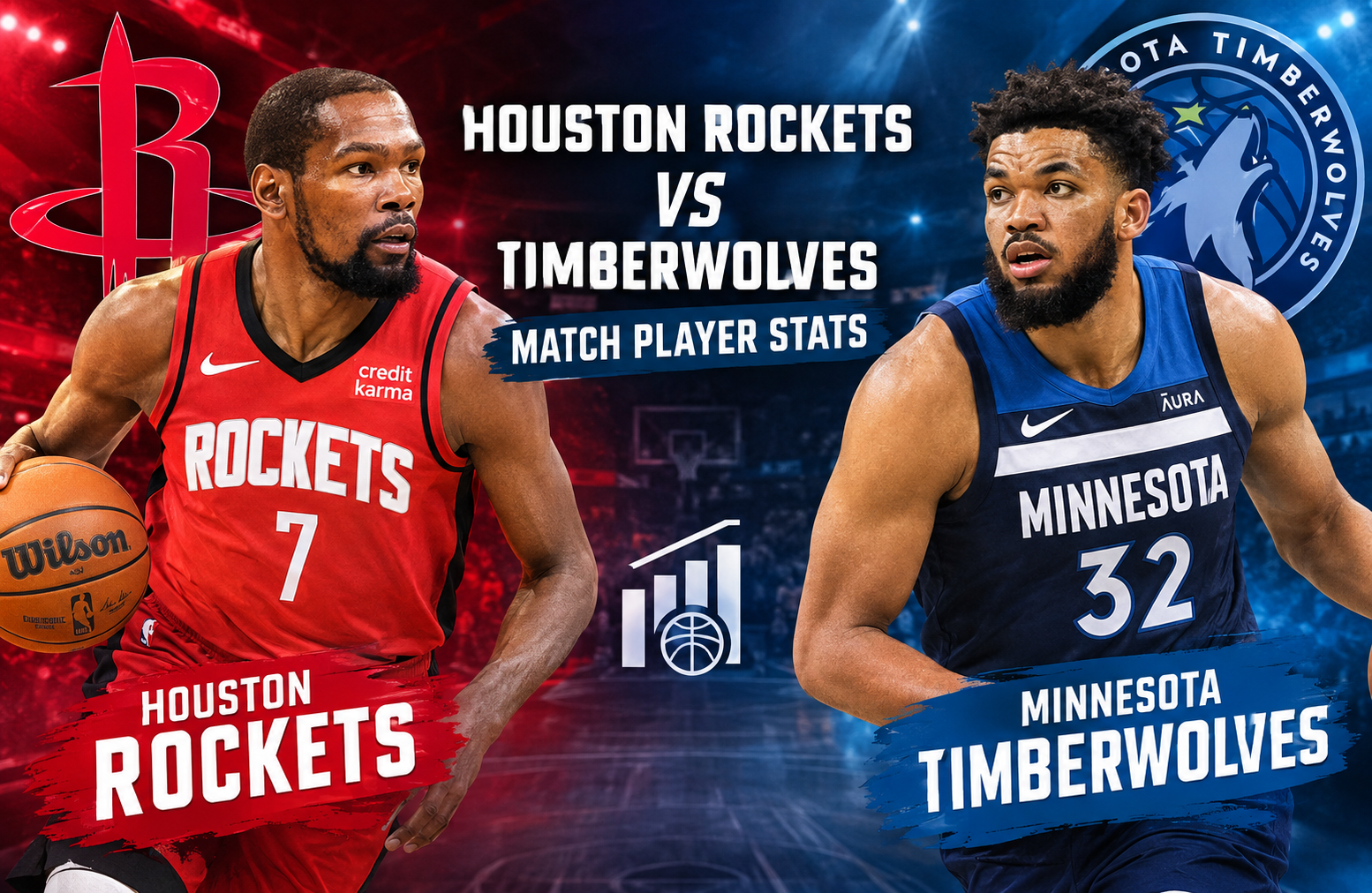
The houston rockets vs timberwolves match player stats from January 17, 2026 tell the story of a tightly contested game that Houston won 110-105 at Toyota Center. Kevin Durant and Julius Randle both finished with 39 points, but Durant’s efficiency, late-game shot making, and playmaking helped the Rockets survive Minnesota’s strong start. Alperen Şengün added 25 points and 14 rebounds for Houston, while Naz Reid scored 25 points and Rudy Gobert controlled the glass with 13 rebounds.
The final score looks close, and the box score confirms that this was not a game dominated from start to finish by one team. Minnesota led after the first quarter and remained competitive deep into the fourth. Houston’s advantage came from its ability to recover after a slow opening, improve its offensive rhythm, protect the ball slightly better, and execute when the game reached its decisive possessions.
The official record shows the game was played at Toyota Center in Houston, with 18,055 spectators in attendance. The NBA lists the matchup as a 110-105 Rockets victory, with Houston improving to 24-15 overall and 13-3 at home, while Minnesota stood at 27-15 overall and 12-9 on the road at the time. NBA official game box score
Houston Rockets vs Timberwolves Match Player Stats: Game Overview
This matchup was particularly interesting because the teams produced nearly identical overall field-goal percentages. Minnesota shot 37 of 80 from the field, or 46.3 percent, while Houston made 39 of 84 attempts, or 46.4 percent.
That similarity makes the final result more revealing.
Houston did not win simply because it shot dramatically better overall. Instead, the Rockets gained important advantages in three-point shooting, turnovers, steals, offensive execution, and late-game scoring.
Here are the major team numbers:
| Category | Timberwolves | Rockets |
| Final Score | 105 | 110 |
| Field Goals | 37-80 | 39-84 |
| Field Goal % | 46.3% | 46.4% |
| Three-Pointers | 11-30 | 12-28 |
| Three-Point % | 36.7% | 42.9% |
| Free Throws | 20-35 | 20-34 |
| Free Throw % | 57.1% | 58.8% |
| Rebounds | 45 | 42 |
| Assists | 21 | 19 |
| Turnovers | 14 | 12 |
| Steals | 7 | 10 |
| Blocks | 7 | 5 |
The shooting numbers show why the game was so competitive. Minnesota actually collected three more rebounds and recorded two more assists. Houston, however, committed two fewer turnovers and produced three more steals.
Those extra possessions mattered.
Houston also converted 42.9 percent of its three-point attempts compared with Minnesota’s 36.7 percent. That difference was not enormous in raw percentage terms, but in a five-point game, every efficient possession became more valuable.
How the Game Developed Quarter by Quarter
The quarter-by-quarter scoring provides one of the clearest explanations of the final result.
| Quarter | Timberwolves | Rockets |
| First | 34 | 29 |
| Second | 21 | 24 |
| Third | 27 | 28 |
| Fourth | 23 | 29 |
| Final | 105 | 110 |
First Quarter: Minnesota Starts Faster
Minnesota opened the game with a 34-29 advantage.
The Timberwolves were able to establish their offensive rhythm early, and Julius Randle immediately became an important scoring option. His 39-point performance ultimately tied Durant for the game high, but his influence was already apparent from the opening stages.
Houston’s five-point deficit after the first quarter was not disastrous, but it created an early requirement for the Rockets to improve their offensive efficiency.
Second Quarter: Houston Begins Closing the Gap
Houston responded by winning the second quarter 24-21.
That reduced Minnesota’s advantage to two points at halftime.
The importance of this period should not be overlooked. Houston did not need to produce a huge scoring burst. It simply needed to prevent Minnesota from extending its lead.
Kevin Durant remained the central offensive figure, while Houston also received valuable bench production from Reed Sheppard.
Third Quarter: The Momentum Shifts
Houston won the third quarter 28-27.
That gave the Rockets their first lead of the game during the third quarter, according to the game recap. The shift was significant because Minnesota had controlled the early tempo but could no longer maintain a comfortable advantage.
Alperen Şengün became especially important during this stretch. His interior scoring and rebounding gave Houston another way to attack beyond Durant’s perimeter production.
Fourth Quarter: Houston Executes Better
The fourth quarter was ultimately the difference.
Houston outscored Minnesota 29-23.
The Timberwolves were still close enough to threaten the result in the final minutes. Minnesota reduced the margin to three points at 105-102 with roughly 90 seconds remaining after a late push led by Randle.
Houston then relied on Durant’s ability to close.
Durant made two free throws with less than a minute remaining and later converted another pair after Randle committed a turnover. Those four late free throws effectively settled the contest.
That sequence illustrates an important point about the houston rockets vs timberwolves match player stats. The final five-point margin was not created by one overwhelming statistical category. It was created by Houston’s ability to execute when possessions became more valuable.
Kevin Durant’s 39-Point Masterclass
Kevin Durant was the decisive player for Houston.
He finished with:
- 39 points
- 11 rebounds? No, 4 rebounds
- 7 assists
- 4 rebounds
- 2 steals
- 1 block
- 5 turnovers
- 11-of-18 shooting
- 6-of-8 from three-point range
- 11-of-14 from the free-throw line
- 40 minutes played
- +15 plus/minus
Durant’s correct rebounding total was four, not 11. His complete line was 39 points, 4 rebounds, 7 assists, 2 steals, and 1 block.
The shooting efficiency stands out.
He made 11 of 18 field-goal attempts, good for 61.1 percent. He also connected on six of eight three-point attempts, an outstanding 75 percent from deep.
His three-point shooting was particularly important because Minnesota was also capable of scoring efficiently inside and through Randle. Durant’s ability to generate efficient perimeter points gave Houston an offensive counter that Minnesota struggled to completely eliminate.
According to the official game information, Durant’s 39 points represented a season high. His six made three-pointers were also a season best.
Durant’s Playmaking Was Just as Important
The seven assists deserve more attention than they often receive in a simple scoring recap.
Durant was not merely finishing Houston possessions. He was helping create them.
Houston finished with 19 assists as a team, and Durant accounted for seven of those. That means he directly contributed to a substantial portion of the Rockets’ assisted offense.
His ability to score while also creating opportunities made it difficult for Minnesota to use a single defensive solution.
If defenders stayed attached to him, Houston could work through other players.
If they helped aggressively, Durant had the passing ability to find teammates.
That dual threat was central to Houston’s fourth-quarter execution.
Alperen Şengün Provides the Interior Counter
Alperen Şengün finished with 25 points and 14 rebounds.
His complete line included:
- 25 points
- 14 rebounds
- 3 assists
- 1 steal
- 1 block
- 11-of-22 shooting
- 3-of-9 free throws
- 32 minutes
Şengün’s 14 rebounds were the most by any Houston player.
His contribution was particularly valuable because Minnesota had Rudy Gobert protecting the paint and controlling the boards. Houston needed a frontcourt player capable of matching Minnesota’s physical presence.
Şengün did exactly that from a rebounding perspective.
His shooting efficiency was less impressive than Durant’s. He made 50 percent of his field-goal attempts but only three of nine free throws. That free-throw performance is one of the clearest areas Houston could have improved.
Still, his overall influence was significant.
The Rockets needed a second high-volume scorer because Minnesota could not allow Durant to operate without resistance. Şengün’s 25 points meant Houston did not have to rely exclusively on its veteran star.
Reed Sheppard Gives Houston a Crucial Bench Boost
Reed Sheppard scored 14 points in only 18 minutes and 41 seconds.
His shooting line was highly efficient:
- 5-of-9 from the field
- 4-of-6 from three-point range
- 2 assists
- 2 steals
- +11 plus/minus
Sheppard’s four made three-pointers were especially important.
Houston’s starting lineup included several players who did not shoot efficiently from the perimeter in this game. Sheppard helped balance that weakness with immediate shooting production.
His +11 plus/minus was also the second-best mark among Rockets players, behind Durant’s +15.
That combination of efficient shooting and positive impact in limited minutes is one of the most useful details to examine when studying the box score beyond the headline scorers.
Amen Thompson’s All-Around Contribution
Amen Thompson scored 14 points and added seven rebounds and four assists.
He shot 5 of 12 from the field and made one of three attempts from three-point range.
His numbers were not as spectacular as Durant’s or Şengün’s, but they demonstrate why his role was important.
Thompson contributed in several areas instead of depending entirely on scoring:
- 14 points
- 7 rebounds
- 4 assists
- 1 steal
- 3 turnovers
- +7 plus/minus
That type of contribution is valuable in a close game because it reduces the burden on the primary scorer.
Julius Randle Matches Durant With 39 Points
For Minnesota, Julius Randle was outstanding.
He finished with 39 points, tying Durant for the highest scoring total in the game.
Randle shot 14 of 25 from the field, 2 of 5 from three-point range, and 9 of 11 from the free-throw line. He also recorded four rebounds and two assists.
His scoring efficiency was strong.
Randle converted 56 percent of his field-goal attempts, and he was aggressive enough to reach the free-throw line 11 times.
Yet his performance illustrates the difference between individual production and team success.
Randle produced the same number of points as Durant, but Houston’s surrounding production and fourth-quarter execution gave Durant’s team the advantage.
Randle also committed five turnovers, which became increasingly costly because the game was decided by a narrow margin.
Naz Reid’s 25 Points Add Major Offensive Value
Naz Reid scored 25 points for Minnesota.
He came off the bench and delivered an efficient offensive performance, making eight of 11 field-goal attempts. He also connected on five of seven three-point attempts.
That shooting efficiency gave Minnesota a valuable secondary scoring option.
Reid also finished with 10 rebounds according to the official game recap, making his performance more than simply a scoring contribution.
His ability to stretch the floor was particularly useful because it created more space for Randle and Minnesota’s interior players.
Reid’s five made three-pointers also show that Minnesota was capable of winning the perimeter battle in individual stretches.
The problem was consistency across the entire game.
Rudy Gobert Controls the Rebounding Battle
Rudy Gobert led Minnesota with 13 rebounds.
That was one of the clearest statistical advantages for the Timberwolves.
Minnesota finished with 45 total rebounds compared with Houston’s 42.
Gobert’s presence helped Minnesota maintain its physical identity and gave the Timberwolves opportunities to compete for second possessions.
However, the free-throw line became a major issue for him.
Gobert shot only 2 of 10 from the free-throw line. In a five-point game, those missed opportunities were highly significant.
This is a good example of why looking only at rebounds or blocks does not tell the complete story of a center’s performance.
Gobert was excellent on the glass, but his inability to convert free throws reduced his offensive value in a game where every point mattered.
Minnesota’s Supporting Production
Minnesota’s supporting cast helped keep the game competitive.
Mike Conley and Naz Reid each recorded five assists, according to the supplied game data.
The Timberwolves finished with 21 assists overall, two more than Houston.
That indicates Minnesota’s offense was not simply dependent on isolation scoring from Randle.
The team was capable of moving the ball and generating scoring opportunities.
The bigger problem was that the Rockets produced enough individual shot making to overcome Minnesota’s slight advantage in assists.
Team Shooting Tells an Interesting Story
At first glance, the field-goal numbers appear almost identical.
Minnesota:
37 of 80, 46.3 percent
Houston:
39 of 84, 46.4 percent
That is essentially even.
The difference becomes clearer when the three-point numbers are separated.
Minnesota:
11 of 30, 36.7 percent
Houston:
12 of 28, 42.9 percent
Houston attempted two fewer three-pointers but made one more.
That is a small statistical difference, but the efficiency gap mattered because Houston also had Durant shooting 6 of 8 from deep.
In a five-point game, a few highly efficient perimeter possessions can swing the outcome.
Free Throws Were a Major Storyline
Neither team shot well from the free-throw line.
Houston made 20 of 34 attempts.
Minnesota made 20 of 35.
Both teams therefore left significant points at the line.
Houston converted 58.8 percent of its free throws, while Minnesota made 57.1 percent.
There were several important individual struggles.
Şengün made only three of nine.
Gobert made only two of 10.
These missed opportunities explain why the final score was relatively close despite strong individual scoring performances.
Durant, however, became extremely reliable when Houston needed him most. His late free throws were a defining part of the closing sequence.
Turnovers Helped Houston Survive
Minnesota committed 14 turnovers.
Houston committed 12.
The two-turnover difference may not look dramatic, but it gave Houston a small possession advantage.
The Rockets also recorded 10 steals compared with seven for Minnesota.
That combination indicates that Houston was slightly more disruptive defensively.
The key is not to treat steals as an isolated defensive metric. A steal matters because it can eliminate a scoring opportunity for one team while creating an opportunity for the other.
Houston’s 10 steals therefore contributed to the overall possession battle.
Houston’s Bench Production Was Important
The Rockets did not receive all of their offense from the starting lineup.
Reed Sheppard scored 14 points.
Clint Capela added four points and three rebounds.
Jae’Sean Tate contributed four points and three rebounds.
Dorian Finney-Smith did not score, but he contributed three rebounds and one steal.
The bench did not overwhelm Minnesota, but Sheppard’s shooting provided exactly the kind of efficient scoring Houston needed.
That is one reason the game cannot be understood simply as Durant versus Randle.
Both stars scored 39, but the Rockets received enough additional contributions to finish the game more effectively.
The Importance of Houston’s 12 Turnovers
Turnovers are often overlooked when readers search for player statistics.
In this game, they deserve attention.
Houston committed 12 turnovers compared with Minnesota’s 14.
Neither number is perfect, but Houston’s ability to keep its mistakes slightly lower helped preserve possessions.
This becomes especially important when a game is decided by five points.
A single lost possession can represent a swing of several points because it can prevent a team from scoring while potentially creating a transition opportunity for the opponent.
Houston’s defensive pressure also helped create those opportunities.
Why the Fourth Quarter Decided the Game
The most important statistical fact in the game may simply be the fourth-quarter score.
Houston 29.
Minnesota 23.
Six points separated the teams during the final period, exactly enough to overcome Minnesota’s two-point advantage entering the fourth.
That means Houston did not need to dominate the entire game.
It needed to be better when the stakes were highest.
Durant scored efficiently during the closing stages and converted the free throws that protected the lead.
Şengün continued to provide interior pressure.
Houston’s defense also generated enough disruption to prevent Minnesota from completing its comeback.
The final margin of five points was therefore a product of late execution rather than sustained domination.
What the Player Stats Reveal About Each Team
What Houston Did Well
The Rockets’ strongest areas were:
- Efficient three-point shooting: Houston made 42.9 percent from deep.
- Star production: Durant delivered 39 points and seven assists.
- Interior rebounding: Şengün grabbed 14 boards.
- Ball security: Houston had two fewer turnovers.
- Defensive disruption: The Rockets recorded 10 steals.
- Fourth-quarter execution: Houston won the final period 29-23.
What Minnesota Did Well
The Timberwolves had several strengths:
- Rebounding: Minnesota won the overall rebounding battle 45-42.
- Ball movement: Minnesota recorded 21 assists.
- Randle’s scoring: Randle produced 39 points.
- Reid’s efficiency: Reid scored 25 points while shooting 8 of 11.
- Perimeter production: Minnesota made 11 three-pointers.
- Strong start: Minnesota won the opening quarter 34-29.
Where Minnesota Fell Short
The biggest concerns were:
- Fourteen turnovers.
- Poor free-throw shooting.
- Gobert’s 2-of-10 free-throw performance.
- Losing the fourth quarter by six points.
- Difficulty containing Durant during decisive possessions.
The Anthony Edwards Factor
One important context point should be included whenever this game is discussed.
Anthony Edwards did not play.
The official game recap states that Edwards missed his second consecutive game because of a foot issue.
That absence matters when evaluating Minnesota’s offensive structure.
Randle took on a larger scoring responsibility and responded with a season-high 39 points. Reid also provided 25 points.
The Timberwolves therefore found ways to remain competitive.
Still, removing a major offensive creator changes the way a team distributes shots, handles late-clock possessions, and creates pressure against a defense.
It would be inaccurate to say Edwards’ absence alone caused the loss. Minnesota had several opportunities to win, and Randle played an outstanding game.
However, his absence is an important part of the matchup context.
A Closer Look at Efficiency
One of the best ways to understand this game is to compare how efficiently the primary players produced their points.
Durant:
- 39 points
- 11-of-18 field goals
- 6-of-8 three-pointers
- 11-of-14 free throws
Randle:
- 39 points
- 14-of-25 field goals
- 2-of-5 three-pointers
- 9-of-11 free throws
Both players were productive.
Durant, however, generated his points with fewer field-goal attempts and much stronger three-point efficiency.
That distinction matters.
Randle’s 39 points came through volume and efficiency around the rim and midrange, while Durant combined efficient field-goal shooting with exceptional perimeter accuracy.
The result was that Houston could generate elite scoring without needing Durant to dominate every possession.
Şengün Versus Gobert
The frontcourt battle is another useful angle.
Şengün:
- 25 points
- 14 rebounds
- 3 assists
- 1 steal
- 1 block
Gobert:
- 13 rebounds
- Strong interior presence
- 2-of-10 free throws
Şengün had the more complete offensive box score.
Gobert had the stronger raw rebounding impact for Minnesota, but his free-throw struggles limited his ability to capitalize when the Timberwolves needed points.
The contrast is especially interesting because both players contributed to their team’s physical approach in different ways.
Şengün combined scoring and playmaking with rebounding.
Gobert focused more heavily on interior defense, rebounding, and paint presence.
What the Plus-Minus Numbers Add
Plus-minus should never be treated as a complete evaluation of an individual player, but it can provide useful context.
For Houston:
- Kevin Durant: +15
- Reed Sheppard: +11
- Amen Thompson: +7
- Clint Capela: +8
- Jae’Sean Tate: +2
Durant’s +15 was the strongest figure in the game among Rockets players.
That supports the basic conclusion that his scoring was not empty production. Houston performed better during his minutes.
Reed Sheppard’s +11 is also noteworthy because he played fewer than 19 minutes.
For Minnesota, Randle’s scoring was impressive, but his five turnovers and negative plus-minus demonstrate how difficult it was for Minnesota to turn his individual production into a team victory.
What Fans Should Take From the Box Score
The biggest lesson from these houston rockets vs timberwolves match player stats is that scoring totals alone do not explain the outcome.
Both Durant and Randle scored 39.
Both teams shot roughly 46 percent from the field.
Minnesota actually won the rebounding and assist categories.
Yet Houston won the game.
Why?
Because Houston combined several small advantages:
- Better three-point percentage.
- Fewer turnovers.
- More steals.
- Stronger fourth-quarter scoring.
- Elite efficiency from Durant.
- Significant production from Şengün.
- Useful bench scoring from Sheppard.
This is exactly why a full box-score analysis is more valuable than simply listing the top scorers.
Most Important Player Performances
1. Kevin Durant
Durant was the clear game-changing performer.
His 39 points, seven assists, six three-pointers, and +15 plus-minus gave Houston the offensive foundation it needed.
2. Julius Randle
Randle matched Durant with 39 points and kept Minnesota within striking distance.
His scoring performance was one of the strongest individual efforts of the game.
3. Alperen Şengün
Şengün’s 25 points and 14 rebounds gave Houston a major frontcourt contribution.
His rebounding helped offset Minnesota’s strong work on the glass.
4. Naz Reid
Reid delivered 25 points and 10 rebounds while shooting efficiently.
His bench scoring was critical to Minnesota’s ability to remain competitive.
5. Reed Sheppard
Sheppard’s 14 points in under 19 minutes provided an efficient scoring burst and helped Houston maintain offensive balance.
Houston Rockets vs Timberwolves Match Player Stats: Key Takeaways
The most useful conclusions from this matchup are straightforward.
Kevin Durant was the difference maker. His 39 points came on 11-of-18 shooting, including 6-of-8 from three-point range.
Julius Randle was equally productive as a scorer. His 39 points kept Minnesota in control for long stretches.
Alperen Şengün controlled the Houston glass. His 14 rebounds were the most on either team except for Minnesota’s Rudy Gobert, who had 13.
Minnesota won the rebounding battle. The Timberwolves finished with 45 rebounds compared with Houston’s 42.
Houston won the possession battle more subtly. The Rockets committed two fewer turnovers and produced three more steals.
Three-point efficiency favored Houston. The Rockets shot 42.9 percent from deep, compared with 36.7 percent for Minnesota.
Free throws were a problem for both teams. Houston made 20 of 34, while Minnesota made 20 of 35.
The fourth quarter decided the result. Houston outscored Minnesota 29-23.
The absence of Anthony Edwards changed Minnesota’s offensive options. Randle responded with a huge scoring game, but the Timberwolves still had to operate without one of their primary offensive creators.
Frequently Asked Questions
Who scored the most points in the Rockets vs Timberwolves game?
Kevin Durant and Julius Randle tied for the game-high scoring total with 39 points each. Durant’s 39 points helped Houston win 110-105.
What were Kevin Durant’s stats against the Timberwolves?
Kevin Durant finished with 39 points, 4 rebounds, 7 assists, 2 steals, and 1 block. He shot 11 of 18 from the field, 6 of 8 from three-point range, and 11 of 14 at the free-throw line.
How many points did Alperen Şengün score?
Alperen Şengün scored 25 points and added 14 rebounds, 3 assists, 1 steal, and 1 block for Houston.
How many points did Julius Randle score?
Julius Randle scored 39 points for Minnesota. He shot 14 of 25 from the field, 2 of 5 from three-point range, and 9 of 11 from the free-throw line.
Who had the most rebounds in the game?
Rudy Gobert led Minnesota with 13 rebounds, while Alperen Şengün led Houston with 14 rebounds. Şengün therefore had the highest individual rebound total in the game.
Did the Timberwolves win the rebounding battle?
Yes. Minnesota recorded 45 total rebounds compared with Houston’s 42, giving the Timberwolves a three-rebound advantage.
Conclusion
The houston rockets vs timberwolves match player stats show a game that was much closer than the final record might suggest.
Minnesota entered the fourth quarter with a two-point lead, and the Timberwolves had several statistical advantages, including rebounds and assists. Julius Randle produced 39 points, Naz Reid added 25, and Rudy Gobert controlled the boards.
Houston nevertheless found the right combination of efficiency and execution.
Kevin Durant’s 39 points were the headline, but his seven assists, six three-pointers, and late free throws made his performance especially influential. Alperen Şengün provided 25 points and 14 rebounds, while Reed Sheppard gave the Rockets a valuable 14-point scoring burst from the bench.
The decisive difference was not one overwhelming category. Houston was slightly better from three-point range, committed fewer turnovers, created more steals, and outscored Minnesota 29-23 in the fourth quarter.
That combination turned a game that Minnesota controlled early into a 110-105 Houston victory.
For anyone studying this matchup through the box score, the biggest lesson is simple: individual scoring tells only part of the story. Durant and Randle both reached 39 points, yet Houston’s supporting production, possession management, perimeter efficiency, and late-game execution ultimately determined the winner.