LA Clippers vs Memphis Grizzlies Match Player Stats
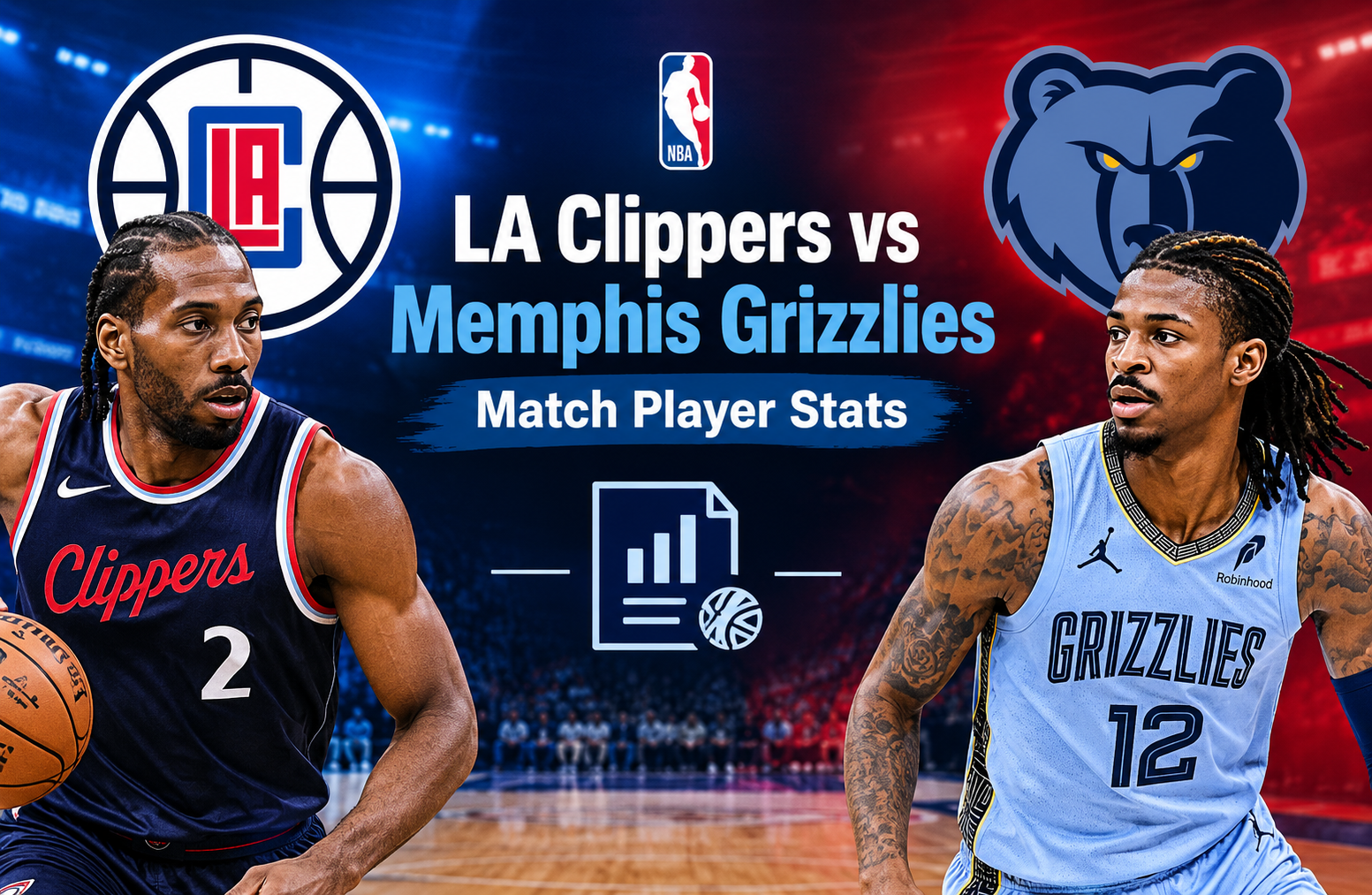
The LA Clippers vs Memphis Grizzlies match player stats from their December 2025 meeting tell a much deeper story than the 121-103 final score suggests. Memphis did not simply win because one player had a big scoring night. The Grizzlies combined efficient shooting, strong ball movement, timely three-point production, defensive activity, and a decisive second-half push to pull away from Los Angeles at Intuit Dome.
The game was played at Intuit Dome in Inglewood, California, with an announced attendance of 17,927. Memphis finished with 121 points while the Clippers scored 103. The quarter-by-quarter score was 25-27, 31-21, 34-28, and 31-27 from Memphis’ perspective. The result moved Memphis to 12-14 at the time, while Los Angeles fell to 6-20. The official NBA game record confirms the 121-103 result and identifies Jaren Jackson Jr. as the leading Memphis scorer with 31 points. Official NBA game box score and game details
What makes this matchup especially interesting is the way the game changed after halftime. The Clippers actually held a 27-25 advantage after the opening quarter, and they briefly led 64-63 in the third quarter. Memphis then changed the rhythm of the game, created separation, and finished with a 90-76 advantage entering the fourth quarter.
For readers researching LA Clippers vs Memphis Grizzlies match player stats, the most useful approach is therefore not to look only at points. Shooting efficiency, turnovers, rebounding, assists, plus/minus, three-point volume, and second-half execution explain why Memphis controlled the game.
LA Clippers vs Memphis Grizzlies Match Player Stats: Game Overview
| Category | Memphis Grizzlies | LA Clippers |
| Final Score | 121 | 103 |
| Field Goals | 45-86 | 37-80 |
| Field Goal % | 52% | 46% |
| Three-Pointers | 16-39 | 13-36 |
| Three-Point % | 41% | 36% |
| Free Throws | 15-17 | 16-22 |
| Free Throw % | 88% | 73% |
| Rebounds | 32 | 39 |
| Assists | 33 | 26 |
| Turnovers | 11 | 18 |
| Steals | 10 | 4 |
| Blocks | 7 | 2 |
The basic numbers immediately show why Memphis won.
The Clippers actually collected seven more rebounds, so rebounding alone cannot explain the result. Instead, Memphis created advantages in efficiency, ball security, passing, steals, blocks, and three-point shooting.
The most important statistical difference may have been turnovers. Los Angeles committed 18 turnovers compared with 11 by Memphis. That seven-turnover gap gave the Grizzlies additional possessions and helped them turn defensive pressure into offense.
Memphis also shot 52% from the field compared with 46% for Los Angeles. That six-percentage-point difference may appear modest, but across 86 Memphis attempts it represents a meaningful efficiency advantage.
The scoring leaders
Jaren Jackson Jr. led Memphis with 31 points. He was followed by Jaylen Wells with 16 points, while Cedric Coward and Ja Morant each scored 12.
For Los Angeles, Kawhi Leonard led the Clippers with 21 points. Kris Dunn scored 17, while James Harden finished with 13.
One important detail from the official box score is that Cam Spencer also produced a major performance for Memphis, scoring 27 points while making seven three-pointers. That contribution is essential when assessing the complete player performance from this game. (NBA.com)
Jaren Jackson Jr. Set the Tone for Memphis
The biggest individual storyline was Jaren Jackson Jr.
Jackson scored 31 points and shot 13-for-18 from the field, a remarkable 72.2% shooting night. He also made four of five attempts from three-point range.
His final line went beyond scoring. He added four rebounds, four assists, two steals, and five blocks.
That combination explains why his performance was so valuable.
A high-scoring performance can sometimes be misleading if the player needs a huge number of possessions to reach the total. Jackson did not have that problem here. He scored 31 points on only 18 field-goal attempts.
That efficiency allowed Memphis to receive high-level production without forcing its offense through one player on every possession.
The timing of Jackson’s scoring was equally important. According to the official game recap, he scored 21 of his 31 points in the first half. That gave Memphis a reliable offensive foundation while the game was still competitive. (NBA.com)
Jackson’s shooting efficiency
Jackson’s 13-for-18 shooting translates to 72.2% from the field.
He was also 4-for-5 from three-point range, or 80%.
Those numbers made it difficult for Los Angeles to find a comfortable defensive solution. If the Clippers gave him space, he could shoot. If they closed aggressively, Memphis had other scoring options available.
His five blocks also mattered on the defensive end.
This is a good example of why player statistics should be read together instead of separately. Thirty-one points explains the scoring output, but 13-for-18 shooting explains how efficiently those points were generated.
Cam Spencer’s 27 Points Changed the Game
Cam Spencer deserves major attention in any serious analysis of this matchup.
The supplied headline statistics identify Jackson as Memphis’ leading scorer, but Spencer finished with 27 points, making him the second-highest scorer on the team. His shooting from outside was particularly damaging.
Spencer made seven three-pointers on 10 attempts.
That means he shot 70% from three-point range.
Seven made threes are especially valuable because they provide 21 points before considering any other scoring. His perimeter shooting stretched the Clippers’ defense and created additional room for Memphis’ other offensive players.
The official NBA recap describes Spencer’s seven made three-pointers as a career high and notes that he made four threes in less than six minutes during the fourth quarter. (NBA.com)
That fourth-quarter burst was one of the clearest indicators that the game had moved beyond Los Angeles’ control.
Jaylen Wells Provided Valuable Secondary Scoring
Jaylen Wells scored 16 points for Memphis.
He shot 5-for-10 from the field and made five of five free throws.
While 16 points may look less dramatic next to Jackson’s 31 and Spencer’s 27, Wells’ contribution helped Memphis avoid depending entirely on its two biggest offensive performances.
That matters in a game where the opponent has high-level scorers such as Kawhi Leonard and James Harden.
A balanced scoring attack forces defenders to make difficult choices. If the defense focuses too heavily on Jackson, another Memphis player can attack. If the defense stretches toward perimeter shooters, Jackson can exploit interior or mid-range opportunities.
Ja Morant’s Return Added Another Layer
Ja Morant scored 12 points in the game.
His scoring total was not among Memphis’ biggest numbers, but his presence mattered because he was playing in only his second game after returning from a calf injury, according to the official recap. (NBA.com)
That context is important.
A player’s value cannot always be judged by points alone, particularly when he is returning from an injury and adjusting to game conditions.
Morant’s ability to participate in the offense gave Memphis another ball-handler and another player capable of creating pressure on the defense.
Even without producing a 25-point performance, his presence helped create a more versatile offensive structure.
Kawhi Leonard Led the Clippers in Scoring
Kawhi Leonard was the Clippers’ leading scorer with 21 points.
He shot 9-for-18 from the field, giving him a 50% shooting percentage.
Leonard also contributed four rebounds, three assists, and one steal.
The issue for Los Angeles was not that Leonard played poorly. A 21-point, 50% shooting performance is useful production.
The larger problem was that Memphis generated more efficient scoring around its own primary players.
That distinction is important.
Basketball games are not simply won by identifying which team had the best individual scorer. They are usually decided by how effectively each team converts possessions into points and how consistently the supporting cast contributes.
Kris Dunn Delivered a Strong Supporting Performance
Kris Dunn scored 17 points for Los Angeles.
He shot 6-for-10 from the field and 3-for-6 from three-point range.
He also recorded five assists.
Most importantly from a plus/minus perspective, Dunn finished at +3, which was the best plus/minus figure among Clippers players in the supplied data.
That is an interesting contrast with the final score.
Los Angeles lost by 18 points, yet Dunn finished with a positive plus/minus. This demonstrates why individual plus/minus needs context.
A player’s plus/minus reflects the team’s scoring margin while that player is on the court. It does not independently measure every aspect of that player’s performance.
James Harden’s Role in the Clippers’ Offense
James Harden scored 13 points and led the Clippers with six assists.
His six assists were tied to Los Angeles’ effort to create offense through playmaking rather than pure isolation scoring.
However, Harden also finished with three turnovers.
The Clippers as a team committed 18 turnovers, which was seven more than Memphis.
That difference became particularly costly because Memphis also recorded 10 steals.
When a team turns the ball over frequently against an opponent that is actively generating steals, the problem can compound quickly. Possessions disappear, while the opponent receives additional opportunities to score before the defense can establish itself.
Ivica Zubac Won the Rebounding Battle
Ivica Zubac was one of the Clippers’ most productive players in the rebounding department.
He collected 13 rebounds, including three offensive rebounds.
The Clippers finished with 39 total rebounds compared with 32 for Memphis.
That is one of the clearest statistical areas where Los Angeles had an advantage.
Yet the team still lost by 18 points.
This is an important lesson for interpreting LA Clippers vs Memphis Grizzlies match player stats. Winning a single statistical category does not guarantee victory.
Los Angeles controlled the glass, but Memphis controlled several more important efficiency indicators.
Jock Landale Had the Best Plus/Minus
Jock Landale finished with a team-best plus/minus of +30 for Memphis.
That figure deserves attention because it represents the largest positive on-court scoring margin among the players listed in the supplied data.
Landale also led Memphis in rebounding according to the supplied statistics, with seven rebounds.
His contribution was therefore not limited to one category.
A strong plus/minus does not automatically mean a player was the single most important performer, but a +30 figure in an 18-point team victory suggests that Memphis played particularly well during his minutes.
Kentavious Caldwell-Pope’s Playmaking Contribution
Kentavious Caldwell-Pope led Memphis with six assists according to the supplied data.
That is notable because Caldwell-Pope is often associated primarily with perimeter defense and shooting rather than being the team’s central playmaker.
Six assists indicate that Memphis was getting meaningful creation from multiple positions.
This fits the broader team statistics.
Memphis finished with 33 assists compared with 26 for Los Angeles.
That seven-assist advantage reflects a more connected offensive performance.
Why Memphis Won the Shooting Battle
The shooting numbers provide one of the clearest explanations for the result.
Memphis:
- 45-for-86 from the field
- 52% overall shooting
- 16-for-39 from three
- 41% from three
- 15-for-17 from the free-throw line
- 88% from the free-throw line
Los Angeles:
- 37-for-80 from the field
- 46% overall shooting
- 13-for-36 from three
- 36% from three
- 16-for-22 from the free-throw line
- 73% from the free-throw line
Memphis attempted six more field goals and made eight more.
The Grizzlies also made three more three-pointers.
That combination creates a significant scoring advantage.
Even though Los Angeles made one more free throw, the difference at the free-throw line was nowhere near enough to compensate for Memphis’ superiority from the field and beyond the arc.
Three-Point Shooting Was a Major Separator
Memphis made 16 three-pointers.
Los Angeles made 13.
That is only a three-shot difference in made threes, but the percentage difference is also important.
Memphis shot 41% from three while the Clippers shot 36%.
The biggest individual contributor was Cam Spencer, whose seven made threes accounted for nearly half of Memphis’ total three-point makes.
Jaren Jackson Jr. added four more.
Together, those two players accounted for 11 of Memphis’ 16 made threes.
That is a remarkable concentration of long-range production.
Turnovers Tell Another Part of the Story
The turnover margin was one of Memphis’ strongest advantages.
Memphis committed 11 turnovers.
Los Angeles committed 18.
That seven-turnover gap matters because every turnover represents a lost offensive opportunity.
Memphis also recorded 10 steals.
The Clippers had only four.
The relationship between these numbers is revealing.
Memphis was not simply taking care of the basketball better. The Grizzlies were also actively disrupting Los Angeles’ possessions.
That creates a double advantage.
One team keeps its possessions alive while simultaneously ending the opponent’s possessions.
Assists Show Memphis’ Offensive Balance
Memphis recorded 33 assists.
Los Angeles recorded 26.
The seven-assist difference mirrors the turnover difference, with Memphis winning both categories.
This is one reason the Grizzlies’ 121-point total was not dependent on one scorer.
Jackson scored 31.
Spencer scored 27.
Wells scored 16.
Coward scored 12.
Morant scored 12.
That distribution shows that Memphis had multiple players capable of converting offensive opportunities.
The Clippers had Leonard at 21 and Dunn at 17, but their overall offensive efficiency was lower.
The Second Quarter Changed the Momentum
The Clippers opened the game with a 27-25 advantage.
Memphis responded with a 31-point second quarter while limiting Los Angeles to 21 points.
That produced a 56-48 Memphis lead at halftime.
The second quarter was therefore the first major turning point.
A two-point deficit after one quarter became an eight-point halftime advantage.
That shift demonstrated Memphis’ ability to adjust without needing an overwhelming opening period.
The Third Quarter Put Memphis in Control
The third quarter was even more important.
Memphis scored 34 points.
Los Angeles scored 28.
The Grizzlies entered the fourth quarter with a 90-76 advantage.
According to the official recap, the Clippers briefly led 64-63 in the third quarter before Memphis responded with a 9-0 run that pushed the score to 72-64. (NBA.com)
That sequence captures the game perfectly.
Los Angeles had an opportunity to regain control.
Instead, Memphis responded immediately.
The Grizzlies did not allow a small lead to become a long-term momentum shift.
Fourth-Quarter Execution Sealed the Result
Memphis scored 31 points in the final quarter.
Los Angeles scored 27.
That meant the Clippers did not collapse completely offensively. They still produced 27 points.
The problem was that Memphis continued scoring at a high level.
This distinction matters.
A team does not always win because the opponent stops scoring. Sometimes it wins because it continues producing offense even when the opponent is still making shots.
Spencer’s fourth-quarter shooting was particularly damaging.
The official NBA report notes that he made four three-pointers in less than six minutes during the fourth quarter. (NBA.com)
That type of perimeter explosion can quickly turn a competitive game into a comfortable victory.
What the Player Stats Say About the Clippers
The Clippers’ numbers show a team that had several productive individual performances but struggled to turn those performances into a complete team result.
Leonard scored 21.
Dunn scored 17.
Harden scored 13 and produced six assists.
Zubac collected 13 rebounds.
Those are useful individual contributions.
The problem was the combination of:
- 18 turnovers
- 46% field-goal shooting
- 36% three-point shooting
- 26 assists
- Only four steals
- Only two blocks
Los Angeles also gave up 121 points.
That is a difficult combination to overcome.
What the Player Stats Say About Memphis
Memphis had a more complete statistical profile.
The Grizzlies:
- Shot 52% from the field
- Made 16 three-pointers
- Shot 41% from three
- Shot 88% at the free-throw line
- Recorded 33 assists
- Committed only 11 turnovers
- Recorded 10 steals
- Recorded seven blocks
The Grizzlies did not dominate the rebounding battle.
They did not need to.
Instead, they won through efficiency and possession quality.
That is arguably the biggest lesson from the game.
Advanced Reading of the Box Score
The raw statistics become even more useful when translated into possession-level thinking.
Memphis scored 121 points from 86 field-goal attempts, plus 17 free-throw attempts.
Los Angeles scored 103 points from 80 field-goal attempts, plus 22 free-throw attempts.
The Grizzlies were therefore more productive despite taking only six additional field-goal attempts.
Their 52% shooting compared with 46% for Los Angeles explains much of the difference.
The three-point advantage adds another layer.
Memphis made 16 threes compared with 13 for Los Angeles. The Grizzlies therefore gained nine points from made three-pointers alone.
Combined with better overall shooting and fewer turnovers, the statistical foundation of the victory becomes clear.
Why Rebounding Did Not Save Los Angeles
One of the most interesting parts of the game is the rebounding contradiction.
Los Angeles won the rebounding battle 39-32.
Usually, winning the glass helps a team control possessions.
But rebounding cannot compensate indefinitely for poor possession efficiency.
Memphis took better care of the ball.
Memphis shot better.
Memphis created more steals.
Memphis blocked more shots.
Memphis also passed the ball more effectively.
The Clippers therefore won one important category but lost several others.
Memphis’ Defensive Activity Was Underrated
Seven Memphis blocks and 10 steals are significant defensive numbers.
The Grizzlies’ defense was not perfect, but it created enough disruption to prevent Los Angeles from turning its rebounding advantage into sustained offensive pressure.
Jaren Jackson Jr.’s five blocks were especially important.
His defensive impact complemented his 31-point scoring performance.
That is why his game should be viewed as a two-way performance rather than simply a scoring explosion.
The Importance of Plus/Minus
Plus/minus is often misunderstood.
Jock Landale’s +30 was the best figure in the game among the supplied leaders.
Kris Dunn’s +3 was the best for the Clippers.
At first glance, the contrast is striking.
However, plus/minus should not be treated as an independent player rating.
It reflects what happened to the team during a player’s minutes.
Still, in this particular matchup, Landale’s +30 provides useful context because Memphis won by 18 and controlled the game during the stretches in which he was on the floor.
The Matchup’s Broader Season Context
At the time of this December matchup, Memphis had already beaten Los Angeles twice during the season.
The first listed meeting was a 112-107 Memphis victory on November 29, 2025.
The second was a 107-98 Memphis victory on December 6.
The December 16 game then ended 121-103 in Memphis’ favor.
That meant Memphis had a 3-0 advantage in the season series at that point.
The teams later met again on March 8, 2026, when the Clippers won 123-120. Therefore, the eventual season series finished 3-1 in Memphis’ favor rather than 3-0.
That distinction is important for anyone using historical statistics in a current article.
A Key Lesson for Fantasy Basketball Analysis
The LA Clippers vs Memphis Grizzlies match player stats also offer several useful lessons for fantasy basketball research.
Jaren Jackson Jr.’s performance was valuable because he contributed across several categories.
His line included:
- 31 points
- 4 rebounds
- 4 assists
- 2 steals
- 5 blocks
- 13-for-18 shooting
- 4-for-5 three-point shooting
That is the type of box-score profile that can have a strong fantasy impact without relying entirely on scoring.
Cam Spencer’s seven three-pointers also demonstrate how quickly shooting efficiency can change a game’s statistical profile.
On the Clippers side, Zubac’s 13 rebounds and Harden’s six assists show that fantasy value can come from specialized categories even when the team loses.
What This Game Reveals About Team Construction
The matchup also provides a useful team-building lesson.
Memphis had multiple ways to create offense.
Jackson could score efficiently.
Spencer could punish defensive rotations from outside.
Wells provided secondary scoring.
Morant supplied another ball-handler.
Caldwell-Pope contributed playmaking.
Landale contributed rebounding and strong on-court impact.
That variety made it difficult for Los Angeles to eliminate every threat.
The Clippers had strong individual talent as well, but their 18 turnovers limited the number of quality possessions they could generate.
Three Numbers That Best Explain the Game
If someone wanted to understand the game without reading the entire box score, three statistics would be enough to start.
1. Memphis shot 52%
That six-point shooting advantage over Los Angeles was substantial.
2. Memphis had 11 turnovers compared with 18
The seven-turnover advantage protected Memphis’ offense while creating additional opportunities.
3. Memphis made 16 threes
Los Angeles made 13.
The difference was not enormous in isolation, but combined with Memphis’ 41% three-point shooting and Spencer’s seven made threes, it became a major part of the victory.
Frequently Asked Questions
Who led the Memphis Grizzlies in scoring against the Clippers?
Jaren Jackson Jr. led Memphis with 31 points. Cam Spencer also had a major offensive game with 27 points and seven made three-pointers.
Who led the LA Clippers in scoring?
Kawhi Leonard led Los Angeles with 21 points. Kris Dunn followed with 17, while James Harden scored 13.
What was the final score between Memphis and the Clippers?
Memphis defeated the LA Clippers 121-103 at Intuit Dome.
Who had the most rebounds in the game?
Ivica Zubac led all listed players with 13 rebounds for Los Angeles. Jock Landale was Memphis’ top rebounder with seven.
Who led the game in assists?
James Harden led the Clippers with six assists, while Kentavious Caldwell-Pope led Memphis with six assists according to the supplied game data.
Why did Memphis beat the Clippers?
The biggest factors were Memphis’ 52% field-goal shooting, 41% three-point shooting, 33 assists, 11 turnovers, 10 steals, and seven blocks. Los Angeles shot 46% overall and committed 18 turnovers.
Conclusion
The LA Clippers vs Memphis Grizzlies match player stats show that Memphis’ 121-103 victory was built on much more than Jaren Jackson Jr.’s 31 points.
Jackson was the headline performer because of his scoring efficiency and two-way impact, but Cam Spencer’s 27 points and seven three-pointers were equally important to the game’s final shape. Jaylen Wells added 16 points, while Cedric Coward and Ja Morant each contributed 12.
For Los Angeles, Kawhi Leonard produced 21 points on 50% shooting, Kris Dunn added 17 points and five assists, and James Harden contributed 13 points with six assists. Ivica Zubac’s 13 rebounds gave the Clippers a clear advantage on the glass.
Yet Memphis won the categories that most directly shaped the result. The Grizzlies shot better, made more threes, moved the ball more effectively, committed fewer turnovers, and generated significantly more steals and blocks.
The turning point came after Los Angeles briefly moved ahead in the third quarter. Memphis responded with a decisive run, entered the fourth quarter up 90-76, and then used another strong offensive period to close out the victory.
For anyone studying LA Clippers vs Memphis Grizzlies match player stats, the main takeaway is simple: the final score was the result of superior possession quality and shooting efficiency as much as individual scoring. Memphis created more efficient offensive opportunities and did a better job converting defensive pressure into additional chances.