Phillies vs Chicago Cubs Match Player Stats
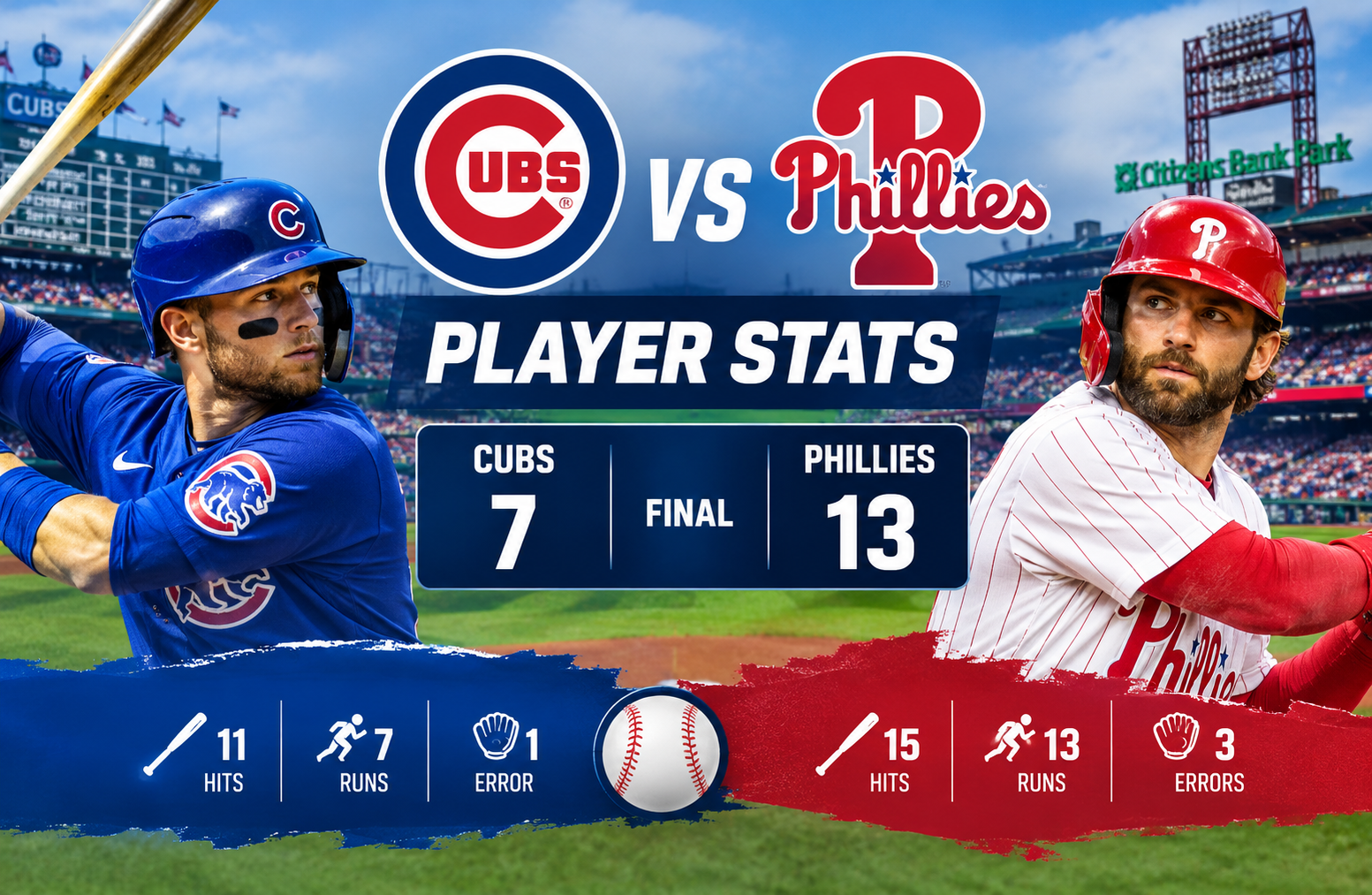
The phillies vs chicago cubs match player stats from April 14, 2026, highlight an explosive offensive performance by the Philadelphia Phillies, who defeated the Chicago Cubs 13-7 at Citizens Bank Park in Philadelphia. The Phillies collected 15 hits, drove in 12 runs, and hit two home runs, while the Cubs finished with 11 hits and seven runs. Kyle Schwarber provided the early power with two home runs, and J.T. Realmuto helped sustain Philadelphia’s scoring with timely hits and three RBIs. On the pitching side, Cristopher Sanchez delivered six innings of work, allowing two earned runs and striking out eight. Although Chicago produced a late scoring rally, Philadelphia’s productive middle innings established a lead that proved too large to overcome.
This game offers a useful example of how power hitting, runners in scoring position, starting-pitcher performance, and defensive execution can shape a baseball result. The box-score figures supplied for this matchup provide the foundation for examining the individual performances, inning-by-inning scoring, and statistical differences that explain the final result.
Data note: The analysis below uses the supplied ESPN box-score information for the April 14, 2026, game. Individual batting lines not included in that data are not estimated or invented.
Phillies vs Chicago Cubs Match Player Stats: Game Overview
The final score tells only part of the story. Philadelphia created its advantage through a combination of early home runs, a productive fifth inning, and continued scoring in the sixth and seventh. Chicago made contact throughout the game but struggled to convert enough opportunities into runs before the Phillies built their lead.
| Game detail | Result |
| Date | April 14, 2026 |
| Venue | Citizens Bank Park |
| Location | Philadelphia, Pennsylvania |
| Final score | Phillies 13, Cubs 7 |
| Phillies hits | 15 |
| Cubs hits | 11 |
| Phillies home runs | 2 |
| Cubs home runs | 1 |
| Winning pitcher | C. Sanchez (2-1) |
| Losing pitcher | J. Assad (1-1) |
| Attendance | 36,045 |
| Game duration | 2 hours, 49 minutes |
Philadelphia recorded four more hits than Chicago and scored six more runs. The difference was especially clear in the fifth and sixth innings, when the Phillies converted baserunners into a succession of runs rather than allowing scoring opportunities to pass without reward.
The Cubs also generated offense, including a two-run home run by Dansby Swanson and a five-run eighth inning. However, their late improvement came after Philadelphia had already established a commanding advantage.
How Philadelphia Built Its 13-Run Performance
Philadelphia’s offense was effective because it combined home-run power with run production from singles, doubles, and sacrifice flies. This balance made the lineup harder to contain than a team relying on home runs alone.
Kyle Schwarber established the early advantage
Schwarber opened the scoring with a solo home run to center field in the first inning. The reported distance was 414 feet, immediately giving Philadelphia a 1-0 lead.
He returned in the third inning with another home run, this time a two-run shot that also brought Trea Turner home. The second homer traveled a reported 417 feet and increased Philadelphia’s advantage to 4-0.
These two swings changed the context of the game. Instead of asking the Phillies to manufacture every run through multiple hits, Schwarber created three runs with two swings. His power also put pressure on Chicago starter Javier Assad, who needed to prevent the early deficit from growing.
J.T. Realmuto delivered important run production
Realmuto contributed at several critical points. In the second inning, his single to right field brought Brandon Marsh home. In the fifth, he singled again to score Bryson Stott. He added another RBI single in the sixth, scoring Adolis García.
The supplied scoring summary therefore credits Realmuto with three RBIs. His contribution demonstrates why a strong offensive performance cannot be judged only by home-run totals. A hitter who consistently moves runners across home plate can be just as important to the shape of a game.
Brandon Marsh helped turn baserunners into runs
Marsh played a central role in Philadelphia’s fifth inning. His double brought Schwarber and Bryce Harper home, producing two runs on one swing.
He also scored earlier in the game on Realmuto’s second-inning single and later crossed the plate himself during the fifth-inning rally. In the seventh, Marsh reached on an infield single that scored Edmundo Sosa.
The supplied data additionally records a stolen base by Marsh at second, taken off Assad and Miguel Amaya. That aggressive baserunning added another dimension to his contribution.
Alec Bohm and Bryson Stott extended the rally
Bohm produced two RBIs in the fifth and sixth innings. His sacrifice fly scored García in the fifth, and his groundout brought Harper home in the sixth.
Stott added an RBI single in the fifth, scoring Marsh. These plays were not as dramatic as Schwarber’s home runs, but they helped Philadelphia maintain pressure after its initial power display.
The key takeaway is that Philadelphia did not depend on one hitter to carry the entire offense. Schwarber created the early separation, while Realmuto, Marsh, Bohm, Stott, and García helped extend the lead.
Chicago Cubs Player Stats and Offensive Leaders
Chicago finished with seven runs on 11 hits, but its offensive output was uneven across the nine innings. The Cubs had moments of productive contact, particularly Swanson’s home run and their late rally, yet their overall numbers show why collecting hits does not always translate into winning baseball.
Dansby Swanson’s two-run home run
Swanson delivered Chicago’s most significant early scoring play with a two-run home run to right field in the fourth inning. The ball traveled a reported 359 feet and brought Carson Kelly home alongside Swanson.
The home run reduced Philadelphia’s lead from 4-0 to 4-2. At that stage, Chicago had created a potential route back into the game without needing to rely on a series of singles.
Swanson’s contribution was particularly valuable because the Cubs had been held scoreless through the first three innings. His home run supplied an immediate reward for getting a runner on base and showed that Chicago could punish a mistake even while struggling to control the overall game.
Seiya Suzuki contributed an RBI single
Suzuki recorded an RBI single in the eighth inning, scoring Pete Crow-Armstrong. That hit helped Chicago complete its late scoring surge.
The timing matters. Philadelphia’s relief pitching had allowed the Cubs to add several runs, and Suzuki’s single kept the inning moving. However, by that point, the Cubs were attempting to reduce a substantial deficit rather than protect a narrow lead.
Pete Crow-Armstrong helped fuel the comeback attempt
Crow-Armstrong was credited with an RBI single during the eighth inning. The supplied scoring summary indicates that two runs scored during the play amid a throwing error, so the full scoring sequence involved both offensive contact and a defensive mistake.
This distinction is important when reading a box score. An RBI records a batter’s credited contribution to a run, but the sequence of events can also involve errors that affect how many runners advance or score.
Matt Ballesteros brought home a run
Ballesteros singled to score Ian Happ during the eighth. His hit helped Chicago continue producing runs after the Phillies had built their 13-2 advantage.
Ballesteros also recorded a double earlier in the game, according to the supplied data. His extra-base hit and late RBI single represented two different forms of offensive contribution: creating scoring potential with a double and converting a runner into a run with a single.
Chicago’s offensive leaders at a glance
| Cubs player | Recorded contribution |
| Dansby Swanson | Two-run home run, 2 RBIs |
| Seiya Suzuki | RBI single in the eighth |
| Pete Crow-Armstrong | RBI single in the eighth |
| Matt Ballesteros | Double and RBI single |
| Ian Happ | Double; scored on Ballesteros’ single |
| Carson Kelly | Scored on Swanson’s home run |
The supplied data does not provide complete individual batting lines for every Cubs player. Therefore, individual at-bats, batting averages, strikeouts, and total bases should not be inferred from the team totals alone.
Complete Team Batting Comparison
The team batting totals provide a clear picture of how Philadelphia separated itself from Chicago. Both clubs recorded the same number of at-bats and walks, but the Phillies collected more hits, hit more home runs, drove in more runs, and struck out less frequently.
| Team batting statistic | Chicago Cubs | Philadelphia Phillies |
| At-bats | 38 | 38 |
| Runs | 7 | 13 |
| Hits | 11 | 15 |
| Runs batted in | 5 | 12 |
| Home runs | 1 | 2 |
| Walks | 5 | 5 |
| Strikeouts | 12 | 5 |
| Left on base | 10 | 8 |
| Hits with runners in scoring position | 4-for-16 | 8-for-14 |
| Errors | 1 | 3 |
The difference in hits and strikeouts
Philadelphia recorded four more hits than Chicago while striking out seven fewer times. This combination suggests that the Phillies made more productive contact and created more chances to advance runners.
The difference between five and 12 strikeouts is especially notable because every strikeout ends a plate appearance without putting the ball into play. Although strikeouts do not automatically prevent scoring, frequent strikeouts can make it harder to move runners when a team needs a productive ground ball, sacrifice fly, or base hit.
Chicago’s 11 hits show that the offense was not completely shut down. The Cubs were able to reach base and create opportunities, but their production was not as consistent as Philadelphia’s.
Why the RBI totals deserve attention
The Phillies recorded 12 RBIs, compared with five for the Cubs. Philadelphia’s RBI total reflects how often its hitters converted opportunities into runs credited to the batter.
The final score was 13-7, but the RBI totals were not identical to the runs scored. This is normal in baseball because runs can score on errors or other plays where the batter is not credited with an RBI.
The difference between 13 team runs and 12 RBIs for Philadelphia is consistent with the supplied scoring information, which includes defensive errors during the game.
Philadelphia’s advantage with runners in scoring position
The most revealing comparison is the performance with runners in scoring position.
- Phillies: 8 hits in 14 at-bats, approximately .571.
- Cubs: 4 hits in 16 at-bats, .250.
Philadelphia collected twice as many hits in these situations despite having fewer opportunities. Its rate was also substantially higher, showing that the Phillies did more than accumulate hits with the bases empty.
These figures are situational statistics for this game, not season-long batting averages. They should be interpreted as evidence of what happened in this matchup rather than proof that one lineup will always outperform the other.
Pitching Analysis: Cristopher Sanchez vs. Javier Assad
Starting pitching helped establish the game’s direction. Sanchez gave Philadelphia six innings of relatively controlled work, while Assad allowed nine earned runs before leaving in the fifth.
The difference was not simply that one pitcher won and the other lost. It was also about how long each starter kept his team competitive and how much work each bullpen had to absorb.
Cristopher Sanchez’s winning performance
Sanchez earned the win after allowing six hits and two earned runs across six innings. He struck out eight batters and issued three walks, while allowing one home run.
| Sanchez pitching statistic | Result |
| Innings pitched | 6.0 |
| Hits allowed | 6 |
| Runs allowed | 2 |
| Earned runs | 2 |
| Strikeouts | 8 |
| Walks | 3 |
| Home runs allowed | 1 |
| Decision | Win, 2-1 |
Sanchez’s performance was strongest in terms of run prevention. Chicago recorded six hits against him, but only two runs scored during his six innings. His eight strikeouts also helped him finish plate appearances without depending entirely on his fielders.
The three walks are worth noting because free baserunners can make even a good outing more difficult. Still, Sanchez limited the damage and gave Philadelphia six innings before the bullpen took over.
His line suggests a pitcher who was not unhittable but was effective at controlling the consequences of the contact he allowed.
Javier Assad’s difficult outing
Assad took the loss after giving up 11 hits and nine earned runs in 4.1 innings. He struck out three batters, walked two, and surrendered two home runs.
| Assad pitching statistic | Result |
| Innings pitched | 4.1 |
| Hits allowed | 11 |
| Runs allowed | 9 |
| Earned runs | 9 |
| Strikeouts | 3 |
| Walks | 2 |
| Home runs allowed | 2 |
| Decision | Loss, 1-1 |
The key issue was the combination of contact and damage. Assad allowed 11 hits before completing five innings, and Philadelphia repeatedly converted those baserunners into runs.
His two walks were fewer than Sanchez’s three, which shows why walks alone cannot explain a pitcher’s effectiveness. Assad allowed more hits and substantially more scoring, while Sanchez generated more strikeouts and kept the damage limited.
Philadelphia’s fifth inning was particularly costly for Assad. The Phillies entered the inning leading 4-2 and finished it ahead 9-2. That five-run increase transformed a competitive game into one in which Chicago needed a major comeback.
Chicago’s relief pitchers
The Cubs used two additional pitchers after Assad.
| Cubs pitcher | Innings | Hits allowed | Runs allowed | Earned runs | Strikeouts | Walks |
| Javier Assad | 4.1 | 11 | 9 | 9 | 3 | 2 |
| J. Webb | 0.2 | 0 | 0 | 0 | 1 | 0 |
| C. Barnes | 3.0 | 4 | 4 | 3 | 1 | 3 |
Webb provided a brief, scoreless appearance, allowing no hits and striking out one batter in two-thirds of an inning. Barnes covered the final three innings of the Cubs’ pitching line but gave up four runs, three earned, on four hits and three walks.
Barnes’ outing illustrates the difficulty of pitching from behind. Once a team trails by several runs, a reliever still needs to prevent further scoring, even if the offense has limited opportunities to close the gap. The three walks also gave Philadelphia additional baserunners.
Philadelphia’s bullpen
Philadelphia used S. Johnson and O. Kerkering after Sanchez completed six innings.
| Phillies pitcher | Innings | Hits allowed | Runs allowed | Earned runs | Strikeouts | Walks |
| Cristopher Sanchez | 6.0 | 6 | 2 | 2 | 8 | 3 |
| S. Johnson | 1.2 | 4 | 5 | 3 | 1 | 2 |
| O. Kerkering | 1.1 | 1 | 0 | 0 | 3 | 0 |
Johnson’s appearance was the most difficult portion of Philadelphia’s pitching performance. He allowed four hits, two walks, and five runs, although three were earned.
Kerkering then stopped the scoring. In 1.1 innings, he allowed one hit, walked no batters, and struck out three. His scoreless work prevented the Cubs from extending their eighth-inning rally into a more threatening finish.
The bullpen numbers add an important qualification to the final result. Philadelphia won comfortably, but its relief work was not uniformly dominant. The starting pitcher’s six strong innings and Kerkering’s scoreless finish helped offset Johnson’s difficult outing.
Inning-by-Inning Scoring Summary
The game’s progression explains why Chicago’s five-run eighth inning did not change the result. Philadelphia scored early, broke the game open in the middle innings, and then added another run before the Cubs’ late response.
| Inning | Cubs | Phillies | Key event |
| 1st | 0 | 1 | Schwarber hit a 414-foot solo homer |
| 2nd | 0 | 1 | Realmuto singled home Marsh |
| 3rd | 0 | 2 | Schwarber hit a two-run homer |
| 4th | 2 | 0 | Swanson hit a two-run homer |
| 5th | 0 | 5 | Philadelphia produced a multi-hit scoring rally |
| 6th | 0 | 3 | García doubled and Philadelphia continued scoring |
| 7th | 0 | 1 | Marsh’s infield single scored Sosa |
| 8th | 5 | 0 | Chicago rallied with hits and benefited from errors |
| 9th | 0 | 0 | No additional runs recorded |
| Final | 7 | 13 | Philadelphia won by six runs |
First and second innings: Philadelphia takes control
Schwarber’s first-inning home run gave the Phillies the lead, and Realmuto’s second-inning single doubled their advantage.
These early runs mattered because they forced Chicago to play from behind before its offense had established a rhythm. The Cubs were still within reach, but Philadelphia had already shown that a single mistake could become a run.
Third and fourth innings: Both teams display power
Schwarber’s second home run made the score 4-0. Swanson answered in the fourth with a two-run homer that cut the gap to 4-2.
For a short period, the game had the feel of a contest that could turn on the next scoring opportunity. Chicago had shown that it could hit for power, and the deficit was manageable.
The fifth inning changed that picture.
Fifth inning: The decisive offensive surge
Philadelphia scored five runs in the fifth inning, moving from a two-run lead to a 9-2 advantage.
Marsh’s double scored Schwarber and Harper. Bohm followed with a sacrifice fly that brought García home, and Stott singled to score Marsh. Realmuto then singled to bring Stott across the plate.
The sequence is important because the runs came from several hitters rather than a single home run. Philadelphia repeatedly put the ball in play and moved runners around the bases.
This was the decisive inning for three reasons:
- It increased the lead from two runs to seven.
- It placed significant pressure on the Cubs’ bullpen before the middle innings were complete.
- It demonstrated that Philadelphia could produce runs even after Schwarber’s early home runs.
Sixth and seventh innings: Philadelphia adds insurance
The Phillies scored three more runs in the sixth. García doubled to score Schwarber, Bohm’s groundout brought Harper home, and Realmuto singled to score García.
Marsh then produced another RBI in the seventh, reaching on an infield single that scored Sosa. By the end of that inning, Philadelphia led 13-2.
The team had scored nine runs across the fifth, sixth, and seventh innings. That stretch turned a game that had been relatively close after four innings into a large deficit for Chicago.
Eighth inning: Chicago’s late rally
The Cubs scored five runs in the eighth inning. Ballesteros singled home Happ, Crow-Armstrong followed with a scoring hit during a play involving a throwing error, Amaya scored on a fielding error, and Suzuki singled home Crow-Armstrong.
The rally was meaningful because it showed that Chicago continued competing rather than simply accepting the result. However, five runs were not enough to overcome an 11-run deficit entering the inning.
Philadelphia’s lead fell from 13-2 to 13-7, but the Cubs could not complete the comeback.
Advanced Statistical Takeaways From the Game
A useful game analysis looks beyond the final score and identifies the statistics that explain how the result developed. The numbers in this matchup point to three major factors: Philadelphia’s success with runners in scoring position, the difference in strikeout totals, and the timing of each team’s scoring.
1. Philadelphia converted scoring chances more efficiently
The Phillies went 8-for-14 with runners in scoring position, while Chicago went 4-for-16.
Runners in scoring position are generally on second or third base, where a single can be enough to score a run. Philadelphia’s eight hits in these situations indicate that the lineup repeatedly delivered when a runner was close to home plate.
The difference can be expressed as follows:
| Situational measure | Phillies | Cubs |
| Hits with runners in scoring position | 8 | 4 |
| At-bats in those situations | 14 | 16 |
| Hit rate in those situations | 57.1% | 25.0% |
| Difference in hits | +4 | -4 |
Philadelphia’s rate was more than twice Chicago’s. That does not mean the Phillies will always perform better in these situations, because a single game is a small sample. It does, however, help explain the six-run difference in this particular contest.
2. The Phillies struck out less frequently
Chicago recorded 12 strikeouts, compared with five for Philadelphia. Both teams had 38 at-bats, making the contrast especially straightforward.
The Cubs struck out in approximately 31.6% of their at-bats, while the Phillies struck out in approximately 13.2%. These percentages are calculated using team at-bats as the denominator, not total plate appearances.
A lower strikeout total can give an offense more opportunities to put the ball in play. Balls in play may advance runners, produce singles or doubles, or force defensive plays. They can also become outs, so avoiding strikeouts does not automatically guarantee runs.
In this matchup, however, Philadelphia combined its lower strikeout count with more hits and a much higher rate of success with runners in scoring position. The three statistics reinforce the same conclusion: the Phillies produced more consistent offense.
3. The Cubs left too many runners on base
Chicago left 10 runners on base, compared with eight for Philadelphia. The Cubs also had 16 at-bats with runners in scoring position but recorded just four hits.
Left-on-base totals should not be treated as a direct measure of failure. A team can leave runners on base because it generated several opportunities, even if it also scored heavily. The number becomes more revealing when read alongside the team’s runs and situational hitting.
Chicago scored seven runs, which is a meaningful offensive output, but its 10 stranded runners suggest that additional opportunities did not become runs. Philadelphia’s smaller total, paired with 13 runs, reflects a more productive scoring performance.
4. Home runs created separation, but singles and doubles sustained it
Philadelphia hit two home runs, while Chicago hit one. Schwarber’s two home runs accounted for three RBIs, and Swanson’s homer accounted for two.
Yet the Phillies’ five-run fifth inning did not depend on another home run. Instead, a double, a sacrifice fly, and multiple singles produced the scoring surge.
That distinction matters when evaluating a team’s offensive depth. Home runs can change a score quickly, but a lineup that also hits with runners aboard can continue scoring when the ball does not leave the park.
For readers comparing offensive performances, the official MLB explanation of the slugging percentage statistic is useful because it explains how singles, doubles, triples, and home runs contribute different amounts toward total bases.
5. Philadelphia’s lead changed the strategic demands of the game
A team trailing by two runs can still approach an inning with several realistic paths to take the lead. A team trailing by 11 runs must first focus on extending the inning and putting multiple runners on base.
After Philadelphia scored nine runs across the fifth, sixth, and seventh innings, Chicago’s task became much more difficult. The Cubs’ eighth-inning rally reduced the margin, but the size of the deficit limited its impact on the final result.
This is why game context matters. Five runs in a close game can transform the outcome. Five runs when a team is already down by 11 can make the final score more respectable without changing the likely winner.
Defensive Performance and Errors
Although Philadelphia won by six runs, the defensive statistics were not entirely in its favor.
The Cubs committed one error, attributed to Swanson’s throwing error. The Phillies committed three, involving Turner in the field, Marsh on a throw, and Bohm in the field.
| Defensive statistic | Cubs | Phillies |
| Errors | 1 | 3 |
| Double plays recorded | Not specified in supplied data | 2 |
| Runs allowed | 13 | 7 |
The supplied data records two double plays by Philadelphia, with Turner, Stott, and Harper involved in the listed sequence. Double plays can be especially valuable when runners are aboard because they can end a threat quickly and reduce the number of outs required to escape an inning.
Why errors do not tell the whole defensive story
An error is a specific scoring judgment, not a complete measurement of defensive ability. A team may make a difficult play that prevents a run without receiving any special credit in the basic error column. Conversely, an error can allow a runner to advance or score when a routine play would normally end the threat.
The Phillies’ three errors did not prevent them from winning, but they contributed to a less clean defensive performance than the final score alone might suggest. The Cubs’ eighth-inning scoring sequence included plays affected by defensive mistakes, illustrating how errors can change the number of runs scored in a single inning.
A more complete defensive assessment would require additional details such as individual fielding opportunities, outs above average, and the quality of balls put in play. Those figures are not included in the supplied box-score data, so they should not be estimated.
What These Player Statistics Reveal About Each Team
The numbers offer several practical lessons for anyone studying baseball performance, writing a game recap, or comparing team results across a season.
What Philadelphia did well
Philadelphia’s main strengths in this game were:
- Power hitting: Schwarber hit two home runs, giving the Phillies an early scoring advantage.
- Situational hitting: The club went 8-for-14 with runners in scoring position.
- Offensive depth: Realmuto, Marsh, Bohm, Stott, and García all contributed to the scoring sequence.
- Starting pitching: Sanchez limited Chicago to two earned runs over six innings.
- Late-inning control: Kerkering prevented the Cubs from scoring again after their eighth-inning surge.
The Phillies were not flawless. Their three errors and Johnson’s difficult relief appearance exposed weaknesses in the defensive and bullpen portions of the game. However, their offensive output provided enough separation to absorb those problems.
What Chicago could have improved
The Cubs’ performance points to different areas of concern:
- Limiting early damage: Assad allowed nine earned runs before completing five innings.
- Converting opportunities: Chicago hit .250 in its at-bats with runners in scoring position.
- Avoiding strikeouts: The team’s 12 strikeouts exceeded Philadelphia’s total by seven.
- Maintaining defensive consistency: The throwing error and later defensive mistakes complicated the game’s scoring sequences.
- Producing earlier: The Cubs’ five-run eighth inning came after the Phillies had already scored 13 runs.
Chicago’s 11 hits and seven runs show that its offense was capable of producing. The central problem was the timing and distribution of that production, along with the number of runs surrendered by its pitching staff.
How to Read a Baseball Box Score Correctly
For readers searching for player statistics, understanding the main abbreviations makes a box score more useful. It also prevents common mistakes when comparing two players or evaluating a team’s performance.
| Abbreviation | Meaning | Why it matters |
| AB | At-bats | Shows official batting opportunities |
| R | Runs | Counts times a player crosses home plate |
| H | Hits | Measures successful hits |
| RBI | Runs batted in | Credits a hitter for qualifying run-producing plays |
| HR | Home runs | Measures balls hit out of the playing field for home runs |
| BB | Walks | Counts bases awarded after four balls |
| SO | Strikeouts | Counts plate appearances ending in strikeouts |
| IP | Innings pitched | Shows how much work a pitcher completed |
| ER | Earned runs | Runs charged to the pitcher, excluding runs resulting from certain defensive mistakes |
| ERA | Earned run average | Measures earned runs allowed per nine innings |
| WHIP | Walks plus hits per inning pitched | Measures how often a pitcher allows baserunners through hits and walks |
For example, Sanchez’s six innings, eight strikeouts, and two earned runs provide a quick summary of his effectiveness. His three walks and six hits add important context, showing that he allowed baserunners but limited the number who scored.
Similarly, Schwarber’s two home runs are a clear measure of power, while Realmuto’s three RBIs show his contribution to run production. Neither statistic alone captures every aspect of a player’s game, but together they help explain why the Phillies’ offense was successful.
Why individual batting averages cannot be calculated from the team total
The supplied data lists 38 at-bats and 11 hits for the Cubs, and 38 at-bats and 15 hits for the Phillies. Those figures allow a team batting average to be calculated:
- Cubs: 11 divided by 38, or approximately .289.
- Phillies: 15 divided by 38, or approximately .395.
These are team batting averages derived from the supplied totals. They are not the batting averages of any individual player.
Calculating an individual player’s batting average requires that player’s own hits and at-bats. The same principle applies to on-base percentage and slugging percentage, which require additional information about walks, hit-by-pitches, sacrifice flies, and the types of hits recorded.
A responsible statistical recap should distinguish between supplied figures, calculations derived from those figures, and information that is not available. That approach makes the analysis more useful and avoids presenting unsupported numbers as official statistics.
Frequently Asked Questions
1. What was the final score of the Phillies vs Chicago Cubs game on April 14, 2026?
The Philadelphia Phillies defeated the Chicago Cubs 13-7 at Citizens Bank Park. Philadelphia recorded 15 hits and two home runs, while Chicago finished with 11 hits and one home run.
2. Who were the standout players in the matchup?
Kyle Schwarber was a major offensive contributor for Philadelphia, hitting two home runs and recording three RBIs. J.T. Realmuto also recorded three RBIs. For Chicago, Dansby Swanson hit a two-run home run and finished with two RBIs.
3. How did Cristopher Sanchez perform against the Cubs?
Sanchez pitched six innings, allowing six hits and two earned runs. He struck out eight batters and walked three, earning the win to improve his listed record to 2-1.
4. Why did the Phillies win despite committing three errors?
Philadelphia compensated for its defensive mistakes with stronger offense and better run prevention from its starting pitcher. The Phillies collected 15 hits, went 8-for-14 with runners in scoring position, and built a large lead during the fifth, sixth, and seventh innings.
5. How many home runs were hit in the game?
Three home runs were recorded in the supplied scoring summary. Kyle Schwarber hit two for Philadelphia, while Dansby Swanson hit one for Chicago.
6. What was the most important inning of the game?
The fifth inning was the turning point. Philadelphia scored five runs to increase its lead from 4-2 to 9-2. The Phillies added four more runs over the next two innings, making Chicago’s late comeback attempt insufficient.
Conclusion
The phillies vs chicago cubs match player stats reveal a game shaped by Philadelphia’s offensive consistency, Schwarber’s power hitting, Realmuto’s run production, and Sanchez’s effective start. The Phillies finished with 15 hits and 13 runs, while the Cubs recorded 11 hits and seven runs.
The decisive difference came in the middle innings. Philadelphia scored five times in the fifth, three times in the sixth, and once in the seventh. Its 8-for-14 performance with runners in scoring position contrasted with Chicago’s 4-for-16 mark, demonstrating how important timely hitting was to the final result.
Schwarber’s two home runs supplied the early advantage, while contributions from Marsh, Realmuto, Bohm, Stott, and García helped turn that advantage into a commanding lead. Sanchez limited the Cubs to two earned runs through six innings, although Philadelphia’s bullpen and defense experienced difficulties later in the contest.
Chicago showed resilience with a five-run eighth inning, led by contributions from Ballesteros, Crow-Armstrong, Suzuki, and other hitters. However, the rally came too late to erase the deficit.
Ultimately, this matchup illustrates why a complete baseball analysis should examine more than runs and hits. Pitching efficiency, situational hitting, strikeouts, defensive mistakes, and inning-by-inning momentum all help explain the outcome. Together, these statistics provide a clearer understanding of how Philadelphia secured its 13-7 victory.