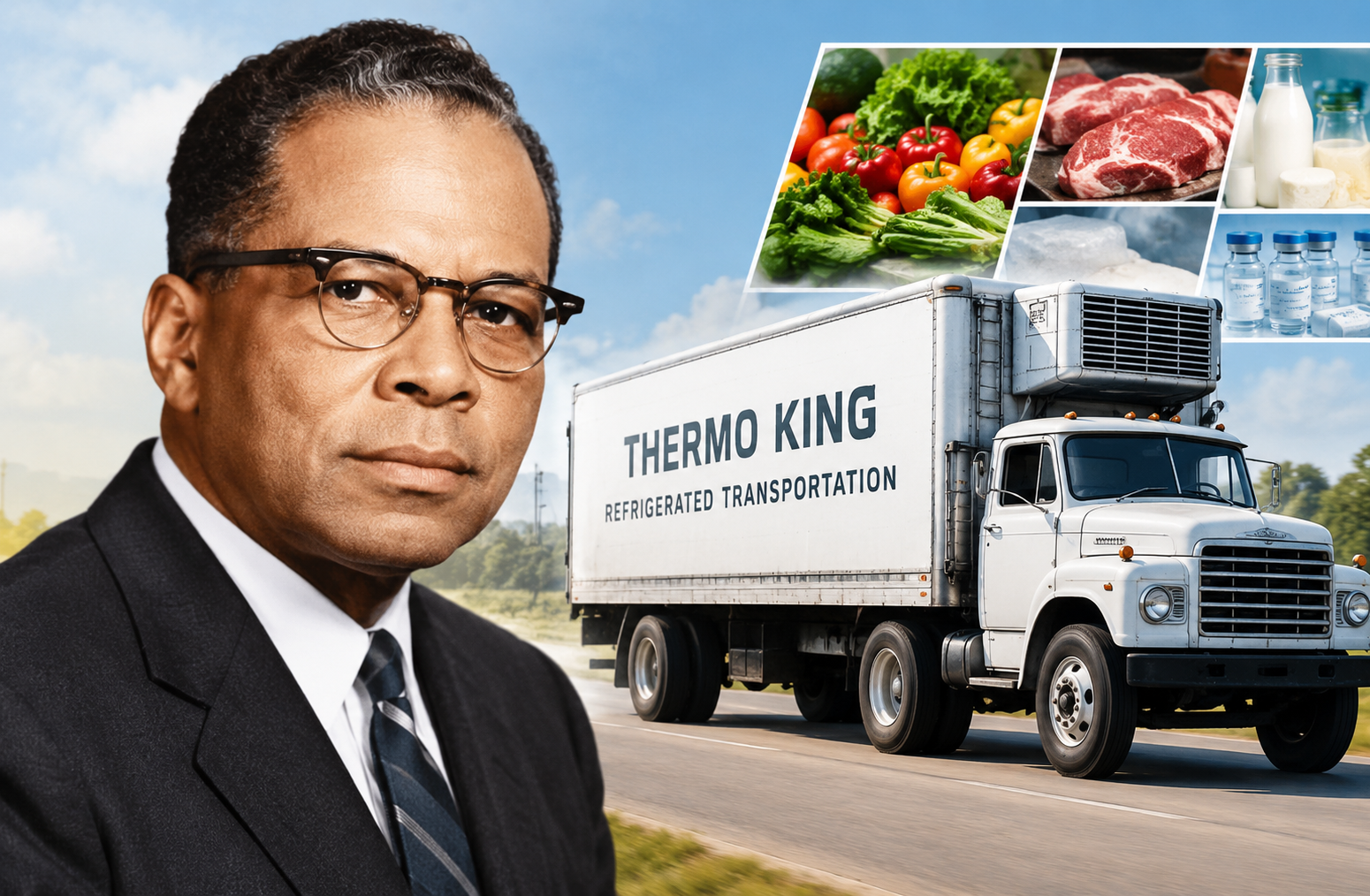
Frederick McKinley Jones: The Inventor Who Changed Food Transportation
Frederick McKinley Jones was an American inventor, engineer, and entrepreneur whose innovations transformed how food, medicine, and other temperature-sensitive products travel over long distances. Best known for developing a practical mobile refrigeration system for trucks, Frederick McKinley Jones helped solve a problem that had challenged transportation businesses for years: how to keep perishable goods cold while moving them across hundreds of miles. His work laid the foundation for modern refrigerated transportation and made a lasting difference to food distribution, military logistics, and public health.
Born on May 17, 1893, in Cincinnati, Ohio, Jones built an extraordinary career despite facing significant obstacles during his childhood and having limited formal education. Rather than following a traditional engineering path, he developed his technical abilities through hands-on work, independent study, experimentation, and an exceptional understanding of mechanical systems. Over his lifetime, he received more than 60 patents for inventions involving refrigeration, sound equipment, engines, and other technologies.
His most influential achievement was the development of a reliable refrigeration unit that could operate while a truck was moving. Before this breakthrough, transportation companies often depended on ice to keep food cold, a method that limited travel distances and made temperature control difficult. Jones helped turn refrigeration into a practical part of long-distance transportation.
His story is important not only because of what he invented, but also because it demonstrates how technical knowledge, persistence, and practical problem-solving can create industries that affect millions of people.
Who Was Frederick McKinley Jones?
Quick facts about his life and achievements
| Detail | Information |
| Full name | Frederick McKinley Jones |
| Date of birth | May 17, 1893 |
| Birthplace | Cincinnati, Ohio, United States |
| Date of death | February 21, 1961 |
| Profession | Inventor, engineer, entrepreneur |
| Main invention | Automatic mobile refrigeration system |
| Business partner | Joseph A. Numero |
| Company associated with his work | Thermo King |
| Patents | More than 60 |
| Major recognition | National Medal of Technology, awarded posthumously in 1991 |
| Hall of Fame recognition | National Inventors Hall of Fame, 2007 |
Jones was a pioneering Black American inventor whose work helped establish refrigerated transportation as a practical commercial industry. His portable cooling technology allowed trucks to carry perishable products without depending entirely on ice or stopping at fixed refrigeration facilities.
The importance of his work extended far beyond the trucking industry. His inventions supported the transportation of fresh produce, meat, dairy products, and other goods that require careful temperature management. During World War II, mobile refrigeration technology also supported military operations involving food, medical supplies, and blood products.
Jones was a technically gifted inventor who understood that a useful invention must work under real conditions. A refrigeration system designed for a stationary building would not automatically function well on a truck exposed to vibration, changing weather, and long hours on the road. He helped overcome those challenges through practical engineering.
The National Inventors Hall of Fame recognized his contributions by inducting him in 2007. His achievements also earned him the National Medal of Technology in 1991, a major honor that highlighted the national importance of his innovations.
Frederick McKinley Jones and the Invention That Changed Transportation
The central achievement associated with Jones was the development of a practical mechanical refrigeration unit that could travel with a vehicle.
To understand why this mattered, consider the challenges faced by food distributors before reliable mobile refrigeration became available.
Fresh meat, dairy products, and many other foods can spoil when exposed to unsuitable temperatures for extended periods. In the early twentieth century, businesses transporting these products often relied on ice-packed containers or insulated railcars. Ice could slow warming, but it gradually melted and required careful planning, replacement, and maintenance.
These limitations affected delivery distances, scheduling, product quality, and the range of goods that merchants could transport.
Jones approached the problem as an engineering challenge. Instead of relying only on stored ice, he developed a mechanical system capable of producing cooling during transportation.
His design had to meet several demanding requirements:
- It needed to provide consistent cooling during a journey.
- It had to withstand vibration and movement on ordinary roads.
- Its components needed to fit within the practical limits of a truck.
- It had to operate without depending on a permanent external power supply.
- It needed to be reliable enough for commercial use.
These requirements made the invention more complex than simply placing a refrigerator inside a vehicle.
A successful mobile refrigeration unit needed a suitable compressor, a power source, a cooling system, and a practical installation that could survive daily transportation. Jones’s engineering work helped bring those elements together in a commercially useful form.
The resulting technology changed how companies thought about moving perishable products. Refrigeration was no longer limited to warehouses, factories, and stationary storage facilities. It could accompany goods throughout the delivery journey.
This principle remains central to the modern cold chain, the network of equipment and procedures used to keep temperature-sensitive products within suitable conditions from production to final delivery.
Early Life and Childhood
Frederick McKinley Jones was born in Cincinnati, Ohio, on May 17, 1893. His childhood was marked by hardship, and he had to become independent at an unusually young age.
His mother died when he was nine years old. He subsequently lived at St. Ann Catholic Church in Covington, Kentucky, where a priest helped raise him. His responsibilities included cleaning, cooking, groundskeeping, and general maintenance.
These experiences exposed him to practical tasks and the importance of working with his hands. However, Jones was restless and eager to explore interests beyond his assigned duties. At age 11, he left the church and returned to Cincinnati, where he found work at an automobile garage.
That decision proved important for his future.
His First Experiences as a Mechanic
Jones began working at the garage by performing basic tasks. He gradually developed a strong understanding of engines, tools, and mechanical systems.
His ability to learn quickly helped him progress from an entry-level worker to a skilled mechanic. By age 14, he was working as a full-time mechanic, and by 15, he had become the garage’s mechanic foreman.
This achievement was remarkable for someone so young, particularly because his formal educational opportunities had been limited.
Working in a garage provided a practical education. Jones could observe how machines operated, identify faults, dismantle components, and determine how to repair them. These activities required patience, careful observation, and the ability to connect theoretical principles with physical results.
A person might learn that an engine requires a sequence of mechanical events to function. A mechanic must also recognize what happens when one component fails, how that failure affects other parts, and which repair is likely to restore performance.
Jones gained this kind of practical understanding early in life.
His experience also illustrates an important distinction between knowing technical information and being able to apply it. Engineering involves both. A design must work under real conditions, not simply appear convincing on paper.
Learning Beyond the Classroom
Jones did not follow the conventional path of attending a university engineering program before beginning his career. Instead, he learned through work, observation, reading, and experimentation.
This does not mean formal education is unimportant. Rather, his life demonstrates that people can develop valuable technical knowledge through different routes when they have access to learning opportunities and the determination to use them.
His early career included work on automobiles, agricultural machinery, furnaces, and other equipment. These jobs exposed him to a wide variety of mechanical systems.
Such variety likely helped him develop a broad engineering perspective. Someone who understands only one type of machine may approach a problem from a narrow viewpoint. Someone who has worked with many systems can recognize useful similarities between them.
That ability would later prove valuable when Jones began working on refrigeration technology.
Military Service During World War I
Jones enlisted in the United States Army during World War I. His mechanical experience made him useful in a setting where reliable equipment was essential.
Military operations depended on communication systems, vehicles, electrical equipment, and other machinery. When these systems failed, trained personnel were needed to diagnose problems and restore them quickly.
Jones worked on communications equipment, military vehicles, X-ray machines, and electrical wiring. He also shared his technical knowledge with fellow soldiers by teaching classes in electrical circuitry.
His military service broadened his practical experience and exposed him to situations where equipment reliability could affect the success of an entire operation.
How Military Work Strengthened His Technical Skills
Military engineering and maintenance work often requires people to solve problems under difficult conditions. Equipment may be exposed to weather, rough handling, limited supplies, and demanding operating schedules.
Although the precise influence of every military assignment on his later inventions is difficult to measure, the experience fits an important pattern in his career: he learned by working directly with complex systems.
His ability to repair different types of equipment also demonstrates the value of transferable knowledge. Electrical systems, mechanical assemblies, and refrigeration equipment may serve different purposes, but they share basic engineering principles.
These include energy transfer, component reliability, fault diagnosis, and the need to match a design to its operating environment.
Jones returned to civilian life with a stronger technical background and additional experience solving practical problems.
From Movie Projectionist to Inventor
After the war, Jones continued developing his skills through a series of jobs. He eventually worked in Hallock, Minnesota, as a movie projectionist.
At first glance, operating movie equipment might appear unrelated to refrigerated transportation. In reality, it provided another opportunity to work with machinery, sound systems, and electrical technology.
During this period, Jones developed innovations in movie sound equipment and built a radio transmitter for the town. His work demonstrated that his interests extended beyond automotive mechanics.
His Contributions to Cinema Technology
The early film industry was changing rapidly as motion pictures incorporated recorded sound. This transition created technical challenges because projection equipment had to work with the new demands of synchronized audio and moving images.
Jones helped develop sound technology for movie projection systems. His experience with electrical and mechanical equipment made him well suited to this work.
He also developed a ticket-dispensing device for movie box offices that could distribute tickets and return change. This type of invention addressed a different practical problem: improving the efficiency of a routine business process.
These projects show that Jones did not limit himself to a single field. He approached invention as a way to solve problems wherever he encountered them.
His work in cinema technology also brought him into contact with businessman Joseph A. Numero, who operated a company involved in sound equipment.
That professional relationship became a turning point in Jones’s life.
Joseph A. Numero and the Beginning of Thermo King
Joseph A. Numero was a businessman who recognized Jones’s technical ability and hired him to improve sound equipment. The two men eventually became partners in developing mobile refrigeration technology.
Their collaboration combined different strengths. Numero contributed business experience and commercial connections, while Jones provided the engineering skill needed to turn an idea into a working machine.
This partnership is important because successful inventions often require more than technical creativity. A useful device must also be manufactured, marketed, maintained, and adapted to the needs of customers.
The Transportation Problem That Inspired the Invention
In 1938, a business associate of Numero named Harry Werner faced problems transporting food without spoilage. The story is commonly told as a conversation about the need for a refrigerator inside a truck.
Werner obtained an aluminum truck and challenged Numero and Jones to make refrigerated transportation possible.
The proposal presented a substantial engineering challenge. Existing refrigeration systems were not necessarily designed to operate while being carried over uneven roads for long periods.
A truck-mounted unit had to be compact enough for installation and durable enough to withstand movement. It also needed a dependable source of power and a way to regulate temperature throughout a journey.
Numero initially had doubts about whether the idea could be achieved. Jones, however, began examining the problem and working toward a solution.
His response reflected the approach that had shaped his career: investigate the problem, understand the constraints, and build a practical answer.
How Jones Developed the Refrigeration Unit
Jones experimented with a mechanical cooling system designed to operate independently with the vehicle. The resulting unit was compact, durable, and resistant to the shocks and vibrations associated with transportation.
The system used a compressor and a four-cylinder engine as its power source. Its design made it possible to produce cooling during a journey rather than depending entirely on a supply of ice loaded before departure.
The engineering achievement was not simply producing cold air. It was making the equipment reliable enough for commercial transportation.
A refrigeration unit that worked in a stationary workshop but failed on a rough road would have limited value. Jones’s solution addressed the conditions in which the equipment actually needed to operate.
On July 12, 1940, he received a patent for the invention, identified as U.S. Patent No. 2,303,857 in the National Inventors Hall of Fame’s profile.
Jones and Numero then established a company that became known as Thermo King.
The partnership transformed the invention from an engineering project into a commercial technology with far-reaching consequences.
How Mobile Refrigeration Worked
Understanding the basic principles of refrigeration helps explain why Jones’s invention was so important.
Refrigeration does not simply create coldness. It removes heat from a space or product and transfers that heat elsewhere.
A mechanical refrigeration system typically uses a refrigerant that circulates through components designed to absorb and release heat. The compressor helps maintain the pressure differences needed for the process.
In a simplified refrigeration cycle, four main stages are involved:
- Evaporation: The refrigerant absorbs heat as it evaporates inside the cooling section.
- Compression: The compressor raises the refrigerant’s pressure and temperature.
- Condensation: The refrigerant releases heat to the surrounding environment and becomes liquid.
- Expansion: The refrigerant’s pressure falls before it returns to the evaporator to absorb more heat.
The exact design varies by system, but the underlying principle remains central to modern mechanical refrigeration.
Why Putting Refrigeration on a Truck Was Difficult
A stationary refrigerator operates in a relatively stable environment. A transportation refrigeration unit must deal with changing outside temperatures, road vibration, variable cargo loads, and frequent opening of doors.
These conditions create several engineering challenges.
Power supply: The unit needs energy to operate while the truck is away from fixed electrical sources.
Mechanical durability: Components must withstand continuous vibration and movement.
Heat removal: The equipment must release heat effectively, even when the surrounding air is hot.
Temperature stability: The system must keep cargo within suitable temperature limits during long journeys.
Maintenance: The equipment must remain practical for commercial operators who need reliable delivery schedules.
Jones’s achievement was to make mobile refrigeration sufficiently practical for real transportation work. His design helped establish a model for equipment that could maintain cooling while goods moved between locations.
Modern refrigerated vehicles use more advanced controls, refrigerants, and equipment designs. They should not be confused with Jones’s original system. Nevertheless, his work helped establish the essential principle that refrigeration could travel with the cargo.
The Role of Thermo King in His Legacy
Thermo King became the business vehicle through which Jones’s refrigeration inventions reached a wider market. The company developed equipment for transporting goods that required temperature control, helping turn mobile refrigeration into a major part of commercial logistics.
The company was established in the late 1930s as U.S. Thermo Control Company and later became known as Thermo King. Jones served as its chief engineer and vice president of engineering, while Numero helped develop the business side of their partnership.
Their work demonstrates how technical innovation and commercial development can support each other. An inventor may develop a successful prototype, but a commercial product also needs production systems, customers, service support, and continued engineering improvements.
Why Their Partnership Worked
Jones and Numero brought complementary skills to the project.
Jones understood the technical requirements. He could design equipment, test components, and work through mechanical problems. Numero understood the commercial environment and helped create the conditions needed to bring the invention to market.
Their partnership addressed three essential stages of innovation:
- Problem identification: Recognizing that existing methods of keeping food cold were inadequate for certain transportation needs.
- Technical development: Creating a practical refrigeration system that could operate on a moving vehicle.
- Commercial adoption: Building a company capable of supplying equipment to customers who needed reliable temperature-controlled transportation.
This process is relevant to modern entrepreneurs as well. An invention’s usefulness does not automatically guarantee commercial success. It must solve a genuine problem, perform reliably, and reach people who can benefit from it.
Jones’s experience is particularly valuable because his work began with a practical transportation challenge rather than an abstract attempt to create a new technology.
Growth Beyond the Original Truck Design
As demand for refrigerated transportation expanded, the underlying technology was adapted for different types of vehicles and transport systems.
Refrigeration equipment became useful in railroad cars, ships, and aircraft, allowing temperature-sensitive goods to travel through multiple stages of a supply chain.
This development helped establish the broader cold-chain industry. Products could be moved from production facilities to storage centers, distribution hubs, shops, hospitals, and other destinations while receiving temperature control during transportation.
Thermo King’s growth also illustrates how a focused engineering solution can support an entire commercial sector. A reliable refrigeration unit made new transportation arrangements possible, which created further demand for equipment, maintenance, logistics planning, and temperature management.
Jones’s legacy therefore includes more than one patented device. It includes the development of a practical approach to transporting goods that would otherwise be difficult to move over long distances.
How Frederick McKinley Jones Changed the Food Industry
One of the most important effects of Jones’s work was its influence on food distribution.
Before dependable mobile refrigeration became widely available, transporting perishable food over long distances was more difficult and risky. Ice-based methods could help preserve products, but they were limited by melting, handling requirements, and the need to maintain suitable conditions throughout a journey.
Mechanical refrigeration provided a more controlled alternative.
Greater Access to Fresh Food
Mobile refrigeration allowed distributors to transport products across greater distances without relying solely on ice.
This helped expand the geographic reach of food producers. A farm or processing facility no longer needed to serve only nearby customers when a suitable refrigerated transportation network was available.
The benefits included:
- More practical transportation of meat and dairy products.
- Wider distribution of fresh fruits and vegetables.
- Better opportunities to move frozen products between regions.
- Greater flexibility in planning deliveries.
- Improved access to foods produced in different climates and seasons.
The technology did not eliminate food spoilage, and it did not make every product safe under every condition. Refrigeration works only when the equipment is suitable, the temperature is controlled correctly, and the food is handled properly.
Nevertheless, it significantly improved the practical options available to food distributors.
The Connection Between Refrigeration and Seasonal Eating
Before modern transportation and storage systems, consumers were more dependent on foods that could be produced locally or preserved for later use.
Mechanical refrigeration helped change that pattern by making it easier to move perishable products from one region to another.
For example, produce grown in a warmer climate could be transported to consumers in cooler regions. Meat and dairy products could reach markets farther from their points of origin, provided the supply chain maintained suitable conditions.
This development contributed to greater variety in grocery stores and helped make some foods available throughout more of the year.
It is important not to credit Jones alone with all changes in food availability. Refrigerated warehouses, improved packaging, highways, rail networks, agricultural development, and later advances in logistics also played important roles.
His contribution was foundational because reliable mobile cooling helped connect these parts of the distribution system.
Reduced Dependence on Ice
Ice-based transportation required businesses to account for melting and replacement. It also made temperature management less flexible during long journeys.
Mechanical refrigeration changed the equation by allowing the cooling process to continue while a vehicle was moving.
This was particularly useful for businesses operating over longer routes or transporting products that needed more dependable temperature control.
It also encouraged a shift in how companies planned transportation. Instead of treating cooling as something that had to be loaded before departure, operators could treat refrigeration as an active part of the vehicle’s equipment.
That distinction remains important in modern logistics.
Frederick McKinley Jones and World War II
The importance of mobile refrigeration became especially clear during World War II.
Military forces operated across large distances and in a wide range of climates. They needed dependable methods of transporting food, medical supplies, and other materials that could deteriorate in heat.
Jones’s refrigeration technology helped address these needs.
Thermo King supplied refrigerated equipment for military transportation, and mobile cooling technology supported the movement of supplies to locations where conventional storage facilities were limited.
Supporting Food and Medical Logistics
Food preservation was a significant military requirement. Soldiers needed reliable supplies, and transporting perishable provisions over long distances presented logistical challenges.
Refrigeration helped keep certain foods within suitable conditions during transportation, making it easier to distribute supplies to military personnel.
The broader applications of mobile cooling also extended to medical logistics. Temperature-sensitive medical products require careful handling because exposure to unsuitable conditions can affect their quality.
Historical accounts associate Jones’s refrigeration work with the preservation and transportation of blood products and other medical supplies during the war. His wider military-related engineering work also included portable cooling equipment for field environments.
These applications demonstrate how an invention developed to solve a commercial transportation problem can become valuable in public service.
Why Reliability Mattered in Military Settings
Military supply chains often operate under conditions that are very different from ordinary commercial delivery.
Routes may be difficult, weather may be extreme, and replacement equipment may not be readily available. A cooling system that fails can compromise the supplies it was intended to protect.
Jones’s emphasis on a compact, durable, and shock-resistant design was therefore particularly relevant.
The value of the technology was not simply that it could make a compartment cold. It was that it could help maintain useful operating conditions in places where dependable refrigeration was difficult to obtain.
His work illustrates a wider principle of engineering: a device’s true value depends on how well it performs in the environment where it is needed.
Other Inventions by Frederick McKinley Jones
Although mobile refrigeration is his best-known achievement, Jones developed many other inventions during his career.
He received more than 60 patents across several technical fields. Many concerned refrigeration, while others involved engines, sound equipment, electrical systems, and devices designed to improve everyday business operations.
This range of work helps explain why he should be remembered as a versatile inventor rather than someone who developed only one successful product.
Movie Sound Equipment
Jones worked on sound technology for movie projection systems during a period when the film industry was adapting to talking pictures.
The transition from silent films to movies with synchronized sound created a range of technical challenges. Projection systems had to handle new forms of recorded audio while maintaining a reliable presentation.
Jones’s experience with mechanical and electrical systems helped him develop equipment for this changing industry.
His work in cinema technology also demonstrates how his early career gave him opportunities to learn about systems that later informed his broader engineering practice.
Automatic Ticket-Dispensing Equipment
Jones developed a device that could dispense movie tickets and return change to customers.
The invention addressed a practical operational problem. Box offices needed ways to handle routine transactions, and automation could help simplify the process.
Although this device did not have the same long-term influence as mobile refrigeration, it shows that Jones was interested in making everyday systems more efficient.
Engines and Mechanical Systems
Jones also worked on engines and other mechanical equipment. His early experience as a mechanic provided a foundation for understanding how moving components interact and how machines can be improved.
That experience was especially relevant to mobile refrigeration because the cooling equipment needed a reliable power source and a design suitable for vehicle use.
His work across different fields reveals a consistent approach: observe how a system operates, identify what limits its performance, and develop a practical improvement.
Major Patents and Recognition
Patents provide a formal record of an inventor’s protected inventions. They also help researchers understand how a technical idea developed and what specific features were claimed in a particular design.
Jones received more than 60 patents over his career, reflecting his broad range of technical interests.
One of his most significant achievements was U.S. Patent No. 2,303,857, associated with his mobile refrigeration system. The patent is an important reference point for understanding his role in the development of refrigerated transportation.
For readers who want to explore the historical record, the National Inventors Hall of Fame profile of Frederick McKinley Jones provides a useful overview of his life, invention, and major honors.
Becoming the First Black Member of a Refrigeration Engineering Society
In 1944, Jones became the first Black member of the American Society of Refrigeration Engineers.
This milestone reflected professional recognition of his technical contributions at a time when racial barriers limited opportunities for many Black Americans.
His achievement is significant for two reasons. It recognizes his engineering expertise, and it highlights the obstacles that talented people could face even when their work had clear practical value.
Jones’s career shows how technical accomplishment can challenge narrow assumptions about who belongs in scientific and engineering professions.
Receiving the National Medal of Technology
In 1991, Jones was posthumously awarded the National Medal of Technology, making him the first Black American to receive the honor.
The award recognized his contributions to refrigeration technology and the transportation of perishable products.
Because the medal was awarded after his death, it also served as a formal acknowledgment of the long-term significance of his work.
Induction Into the National Inventors Hall of Fame
In 2007, Jones was inducted into the National Inventors Hall of Fame.
The recognition placed his work among inventions and inventors considered important to technological progress in the United States.
Together, these honors show that his influence extended beyond the commercial success of the company associated with his inventions. His engineering work became part of the wider history of American innovation.
Challenges Frederick McKinley Jones Faced
The achievements of Jones become more meaningful when considered alongside the challenges he encountered.
His career developed during a period when access to education, professional networks, and technical opportunities was not equal for all Americans. He also faced the practical difficulties involved in developing new machinery before modern computer-aided design and testing tools were available.
Limited Formal Education
Jones’s early education was limited, yet he became a successful inventor through practical experience and independent learning.
His example challenges the assumption that a person’s educational background alone determines their technical ability. It also demonstrates the importance of giving people opportunities to develop their skills outside conventional academic settings.
However, his experience should not be used to dismiss formal engineering education. Modern refrigeration systems involve complex principles, safety requirements, environmental considerations, and technical standards. Formal study can provide essential knowledge for people working in these fields.
The more useful lesson is that education can take different forms, and continued learning matters throughout a technical career.
Racial Discrimination
Jones lived and worked during an era when racial discrimination restricted opportunities for Black Americans in many professions.
His professional recognition in 1944 was a significant achievement, but it also reflected the barriers he had to overcome to gain acceptance within an established engineering community.
His career illustrates why recognizing inventors from underrepresented backgrounds is important. Historical accounts can overlook individuals whose contributions were substantial but whose opportunities for public recognition were limited.
Understanding these barriers provides a fuller picture of his accomplishments.
The Difficulty of Commercial Engineering
Developing an invention is only one part of bringing a product into everyday use.
Jones had to help create equipment that could withstand real transportation conditions. The unit needed to operate reliably, fit into a practical vehicle configuration, and serve customers who depended on deliveries.
The process required experimentation and technical judgment. A design that worked under one set of conditions might fail under another.
His work highlights the difference between an interesting concept and a dependable commercial product.
The Need for Recognition
Jones received major professional recognition during his life and additional honors after his death. Nevertheless, his name is less familiar to many people than those of other celebrated American inventors.
This makes accurate historical education especially valuable. His work offers a clear example of how an invention can change everyday life without its creator becoming widely known to the public.
Remembering Jones helps connect the history of engineering with the ordinary experiences of buying food, receiving medical supplies, and relying on modern transportation.
The Lasting Impact of His Invention on Modern Life
The modern cold chain is a complex system involving refrigeration equipment, insulated storage, transportation networks, temperature monitoring, and careful handling procedures.
Jones did not create every part of this system. However, his mobile refrigeration work helped establish a practical foundation for transporting perishable goods under controlled conditions.
Refrigerated Trucks and Distribution Centers
Modern refrigerated trucks move food between farms, factories, warehouses, supermarkets, restaurants, and other destinations.
Their cooling systems help maintain appropriate cargo temperatures during transportation. Insulated bodies reduce unwanted heat transfer, while monitoring systems help operators identify conditions that may threaten product quality.
Jones’s work helped establish the principle that refrigeration equipment could operate as part of a moving vehicle rather than remaining tied to a fixed building.
That principle remains essential to refrigerated transportation today.
Medicine and Temperature-Sensitive Products
Some medicines, vaccines, biological materials, and medical products require specific storage and transportation conditions.
Temperature excursions can reduce the quality of certain products, so their distribution requires appropriate packaging, equipment, monitoring, and handling procedures.
Mobile refrigeration contributes to the broader infrastructure that makes this distribution possible.
It is important to distinguish Jones’s historical contribution from modern medical logistics. Current systems rely on technologies and standards developed long after his original invention. His work was one part of the larger progression toward dependable mobile temperature control.
International Food Distribution
Refrigerated transportation supports trade between regions with different climates and growing seasons.
For example, a product harvested in one country may travel through refrigerated storage and transport facilities before reaching a supermarket thousands of miles away.
Such supply chains require coordination among producers, shippers, warehouse operators, retailers, and regulators. Refrigeration is essential, but it must work alongside proper packaging, sanitation, and temperature management.
The industry has evolved considerably since Jones’s early designs. Even so, his contribution helped make it practical to move temperature-sensitive goods over long distances.
Reducing Waste Through Better Temperature Control
Food waste can occur at multiple stages, including harvesting, storage, transportation, retail, and household use.
Reliable refrigeration can reduce some losses by slowing the deterioration of products that require cold storage. It cannot eliminate waste entirely, and its benefits depend on appropriate handling and operating conditions.
Modern refrigerated transportation therefore builds on a basic idea that Jones helped advance: protecting a product during transit is an essential part of delivering it successfully.
What His Story Teaches Modern Inventors and Entrepreneurs
The career of Jones offers several lessons that apply to engineering, business, and problem-solving today.
1. Begin With a Real Problem
Jones’s best-known invention emerged from a practical challenge involving food transportation.
The underlying problem was easy to understand: products were spoiling before they reached their destination. The difficult part was creating equipment that could reliably prevent this from happening.
Modern inventors can learn from this approach. A useful starting point is to identify a clear problem, understand who experiences it, and determine why existing solutions are inadequate.
2. Learn by Testing Ideas
Jones relied on practical experience and experimentation throughout his career.
Engineering projects rarely succeed through assumptions alone. Prototypes, observations, testing, and improvements help identify weaknesses that may not be obvious during initial design.
This lesson applies to many fields, from manufacturing to software development. Testing an idea under realistic conditions is often the best way to determine whether it solves the intended problem.
3. Build Knowledge Across Different Fields
Jones worked with engines, electrical systems, movie equipment, and refrigeration machinery.
His varied experience helped him approach problems with a broad technical perspective. Skills developed in one field can sometimes provide useful insights in another.
For students and early-career professionals, this highlights the value of learning basic principles rather than focusing exclusively on a narrow set of tasks.
4. Combine Technical Ability With Practical Use
An invention must serve a real need to achieve lasting commercial value.
Jones’s refrigeration unit mattered because it could operate in the environment where businesses needed it. Its durability and practical usefulness were central to its success.
Entrepreneurs can apply the same principle by considering reliability, maintenance, cost, and user needs alongside technical performance.
5. Understand the Importance of Collaboration
Jones’s partnership with Numero helped turn his technical achievement into a commercial enterprise.
The relationship demonstrates how different skills can support a shared objective. Engineers, designers, business managers, manufacturers, and customers each contribute different perspectives to the development of a successful product.
6. Keep Learning Throughout Your Career
Jones continued to develop his technical skills across different jobs and industries.
His life demonstrates that learning does not have to stop when formal schooling ends. Reading, observation, experimentation, and work experience can all contribute to professional growth.
For anyone interested in invention, the central lesson is to remain curious and treat problems as opportunities to understand how things work.
Frederick McKinley Jones: Historical Importance and Public Recognition
The historical importance of Jones rests on the practical consequences of his engineering work.
He helped transform refrigeration from a technology primarily associated with stationary facilities into equipment that could travel with goods. This development made long-distance distribution of perishable products more practical and supported changes in food commerce and military logistics.
His career also has significance in the history of Black American inventors. He demonstrated exceptional technical ability in an environment where racial discrimination created additional obstacles to professional advancement.
Recognition through the National Medal of Technology and induction into the National Inventors Hall of Fame helped establish his place in the history of American innovation.
Yet his legacy should not be reduced to awards or patent totals alone. The deeper measure of his work is the practical problem it helped solve.
When a refrigerated truck carries food across a long route, it represents a modern application of the broader engineering principle that Jones helped establish. When temperature-sensitive products can be moved more reliably between facilities, the value of mobile cooling becomes clear.
His life also challenges a common misconception about invention: that innovation always begins in a university laboratory or a large research department. Jones’s career grew from practical work, self-directed learning, collaboration, and the determination to solve problems.
That does not make formal scientific research less important. It shows that valuable innovation can emerge through different pathways when technical knowledge is applied with care and persistence.
Frequently Asked Questions
1. Who was Frederick McKinley Jones?
Frederick McKinley Jones was an American inventor and engineer best known for developing a practical mobile refrigeration system for trucks. His inventions helped transform refrigerated transportation and supported the distribution of food and other perishable products.
2. What did Frederick McKinley Jones invent?
He developed a successful mechanical refrigeration system designed to operate on moving vehicles. He also patented inventions involving movie sound equipment, engines, and automatic ticket-dispensing technology.
3. Why was his refrigeration invention important?
His invention made it more practical to transport perishable goods over long distances without depending entirely on ice. It helped expand food distribution and contributed to the development of the modern refrigerated transportation industry.
4. Did Frederick McKinley Jones found Thermo King?
Yes. Jones and businessman Joseph A. Numero established the company that became Thermo King after developing mobile refrigeration technology. Jones contributed engineering expertise, while Numero helped develop the commercial business.
5. How many patents did Frederick McKinley Jones receive?
Jones received more than 60 patents during his career. His inventions covered refrigeration and several other technical fields, including engines and sound equipment.
6. What awards did Frederick McKinley Jones receive?
He was awarded the National Medal of Technology posthumously in 1991 and inducted into the National Inventors Hall of Fame in 2007. In 1944, he also became the first Black member of the American Society of Refrigeration Engineers.
Conclusion
Frederick McKinley Jones was a pioneering inventor whose work changed the way perishable products could be transported. Through his development of practical mobile refrigeration, he helped solve a major problem facing food distributors and laid an important foundation for modern temperature-controlled logistics.
His journey from a difficult childhood to an influential engineering career demonstrates the value of curiosity, practical experience, persistence, and independent learning. Despite limited formal education and the racial barriers of his era, he developed more than 60 patented inventions and earned recognition for his technical achievements.
His partnership with Joseph A. Numero helped bring his refrigeration technology into commercial use through Thermo King. The resulting innovations supported the transportation of food and medical supplies and contributed to the growth of a global industry.
The broader significance of his work lies in its everyday impact. Reliable refrigerated transportation helps connect producers with consumers, supports the movement of temperature-sensitive products, and makes modern distribution networks possible.
His achievements also deserve recognition as part of the history of Black American innovation. By examining his life and work, readers can better understand how practical engineering can address real problems and create benefits that extend far beyond the original invention.