Who Are the Inventors of Electricity? A Complete History
Electricity is one of the most important discoveries in human history, but who are the inventors of electricity? The answer is not one person. Electricity is a natural phenomenon that existed long before humans understood it. Over many centuries, scientists, philosophers, and inventors discovered its properties, developed ways to generate and control it, and created the electrical systems that power modern life.
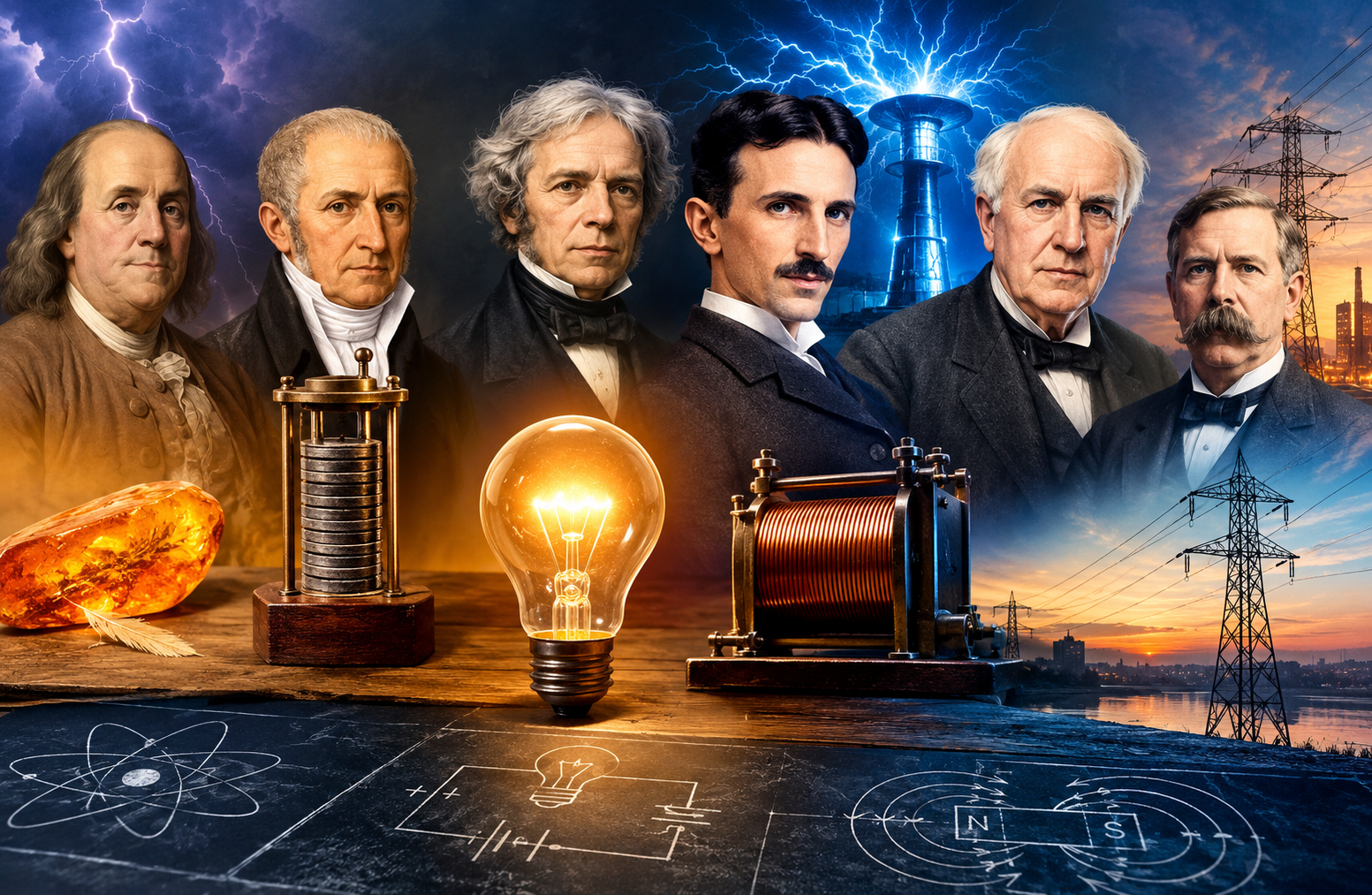
From ancient observations of static electricity to Benjamin Franklin’s experiments, Alessandro Volta’s first practical battery, Michael Faraday’s discoveries about electromagnetic induction, and Thomas Edison’s electrical lighting systems, many individuals contributed to the development of electrical science. Nikola Tesla, George Westinghouse, and other engineers later helped make electricity practical on a large scale.
Understanding this history means separating three different achievements: discovering how electricity behaves, inventing devices that produce or use electrical energy, and building the networks that deliver power to homes, schools, hospitals, factories, and businesses.
This article explores the major contributors, their discoveries, how electricity works, and why no single inventor can claim credit for creating it.
Who Are the Inventors of Electricity? The Short Answer
There is no single inventor of electricity. It is a natural force, not a human-made invention. However, several historical figures played major roles in helping people understand, generate, and use it.
The following scientists and inventors are among the most important contributors:
- Thales of Miletus: An early observer of static electricity around 600 BCE.
- William Gilbert: A pioneer of systematic studies of electricity and magnetism in the late 16th century.
- Benjamin Franklin: Helped establish the connection between lightning and electrical phenomena in the 18th century.
- Alessandro Volta: Invented the voltaic pile, an early practical electric battery, around 1800.
- Michael Faraday: Discovered electromagnetic induction, a foundation of modern electric generators.
- James Clerk Maxwell: Developed mathematical theories that unified electricity and magnetism.
- Thomas Edison: Developed and commercialized practical electric lighting and power-distribution systems.
- Nikola Tesla: Made major contributions to alternating-current motors and electrical power systems.
- George Westinghouse: Helped bring alternating-current technology into widespread commercial use.
Each contributed something different. Some established scientific principles, others created working devices, and still others turned laboratory discoveries into technology that could serve millions of people.
To understand why their achievements matter, it helps to examine the story in chronological order.
What Is Electricity?
Electricity is a set of physical phenomena associated with electric charge. It includes the forces between charged particles, the movement of electric charges, and the effects those charges produce.
Atoms contain positively charged protons and negatively charged electrons. When electric charges interact, they create electric forces. Under suitable conditions, charges can move through a material, producing an electric current.
Electricity takes several forms, including:
- Static electricity: An accumulation of electric charge on an object’s surface.
- Electric current: The movement of electric charge through a conductor or another suitable medium.
- Electrical potential difference: A voltage that can drive charge through a circuit.
- Electromagnetic effects: Interactions between electric charges, currents, and magnetic fields.
These ideas explain why electricity can make a light bulb glow, operate an electric motor, transmit information, or deliver energy to medical equipment.
Is Electricity an Invention or a Discovery?
Electricity is a natural phenomenon that humans discovered and learned to control. It existed before life appeared on Earth and before human beings developed scientific tools.
Lightning, for example, is a natural electrical discharge. Static electricity can occur when materials rub against one another. Electric activity also plays a role in nerve signals and muscle contractions in living organisms.
The inventions came later. Batteries, generators, electric motors, light bulbs, transformers, and power grids are human-made technologies designed to produce, manage, or use electrical energy.
This distinction is essential when answering the question of who invented electricity. No individual created the phenomenon itself. Instead, generations of researchers discovered its properties and developed increasingly useful ways to harness it.
1. Thales of Miletus: One of the Earliest Observers of Electricity
Ancient Greek philosophy and early observations of natural phenomena.
Thales of Miletus lived around the sixth century BCE and is often credited with one of the earliest recorded observations of static electricity.
He reportedly noticed that amber, when rubbed with cloth or fur, could attract light objects such as feathers or small pieces of straw. This effect occurs because rubbing certain materials can transfer electric charge, allowing them to attract other objects.
The ancient Greeks did not have the scientific tools needed to explain this process. Nevertheless, the observation was important because it showed that ordinary materials could develop an unusual force after being rubbed.
What Was Thales’s Contribution?
Thales did not invent electricity, build an electric generator, or explain electricity using modern physics. His importance lies in the early recognition of an electrical effect.
His observation established a starting point for questions that later researchers would investigate:
- Why does rubbed amber attract lightweight objects?
- Can other materials produce the same effect?
- Does the effect depend on the material?
- Can electrical attraction be measured or controlled?
These questions eventually became part of the scientific study of electricity.
The Greek word for amber, elektron, also contributed to the terminology that developed around electrical phenomena.
Thales’s work illustrates a basic principle of scientific progress: a discovery often begins with a simple observation, followed by repeated experiments and increasingly accurate explanations.
2. William Gilbert: The Pioneer of Electrical Science
William Gilbert was an English physician and natural philosopher whose work helped transform scattered observations into a more systematic study of electricity and magnetism.
In 1600, he published De Magnete, a major work about magnets, magnetic forces, and related phenomena. He also investigated how rubbing different materials could make them attract small objects.
Gilbert used the term electricus to describe materials that behaved like amber after rubbing. His work helped establish the language and experimental approach that later researchers developed.
Why William Gilbert Matters
Before Gilbert, electrical observations were often treated as curious or mysterious effects. His approach was more systematic.
He investigated different materials, compared their behavior, and distinguished electrical attraction from magnetism. He also studied Earth’s magnetic properties, contributing to the scientific understanding of compasses and navigation.
His influence can be understood through three major contributions:
- Systematic experiments: He investigated electrical effects rather than relying only on traditional explanations.
- Scientific terminology: His use of electricus helped shape the later language of electricity.
- The study of magnetism: His research laid important foundations for later work on magnetic fields and their relationship with electric currents.
Gilbert did not produce the electrical power used in homes today. Instead, he helped create the scientific foundation on which future inventors could build.
3. Otto von Guericke: An Early Electrical Generator
In the 17th century, German scientist Otto von Guericke developed a machine capable of producing static electrical charge through friction.
His early device used a rotating ball of sulfur. When the ball was rubbed, it could produce electrical effects that researchers could observe and investigate.
This was a major step forward because scientists no longer had to depend entirely on naturally charged objects. They could create electrical effects using an experimental apparatus.
Why His Machine Was Important
Von Guericke’s work helped establish a practical approach to studying electricity.
An experimental machine allowed researchers to produce charge repeatedly, test different materials, and investigate attraction and repulsion under controlled conditions.
His device was not a modern power generator. It produced static electricity rather than the continuous current needed to run ordinary electrical appliances. However, it represented an early move toward deliberately generating electrical charge.
This distinction is important: producing a spark is not the same as generating a steady electrical supply.
4. Stephen Gray: Understanding Conductors and Insulators
English scientist Stephen Gray made important discoveries about how electrical charge could move between objects.
During the early 18th century, Gray conducted experiments showing that electrical effects could be transmitted along certain materials. He helped distinguish materials that allow charge to move more readily from those that resist its movement.
These two categories are now known as conductors and insulators.
Conductors and Insulators Explained
A conductor allows electric charge to move relatively easily. Copper and aluminum are common examples used in electrical wiring.
An insulator resists the movement of charge. Rubber, glass, and many plastics are used to provide electrical insulation under suitable conditions.
Gray’s research helped scientists understand that electricity was not limited to the object on which a charge was initially produced. Electrical effects could be transferred over a distance through suitable materials.
This discovery became important for later electrical technology because power systems depend on conducting paths, insulating barriers, and controlled movement of charge.
Without the distinction between conductors and insulators, modern electrical wiring would be far more difficult to design safely.
5. Benjamin Franklin: Connecting Lightning With Electricity
Benjamin Franklin is one of the most famous figures in the history of electricity. He was an American scientist, writer, inventor, and statesman who conducted important electrical experiments during the 1740s and 1750s.
Franklin investigated charged objects, electrical discharges, and the behavior of electrical charge. He helped popularize the concepts of positive and negative charge and argued that lightning was an electrical phenomenon.
His work helped move electricity from an area of curiosity toward a subject that could be studied through experiment and theory.
The Famous Kite Experiment
Franklin is widely associated with an experiment involving a kite, a metal key, and a thunderstorm in 1752.
The experiment was intended to investigate whether storm clouds could produce electrical effects similar to those observed in laboratory experiments. The historical details of the experiment are less certain than many popular retellings suggest, and Franklin was not the first person to demonstrate the electrical nature of lightning.
French researcher Thomas-François Dalibard conducted a successful lightning-related electrical experiment in May 1752 using an elevated metal rod, before Franklin’s reported kite experiment.
Franklin’s own work nevertheless became a landmark in the history of electricity.
An important safety lesson: Reproducing the kite experiment during a thunderstorm is extremely dangerous. Lightning can travel through wet strings, wires, and other conducting paths, causing fatal injuries. The historical experiment should never be attempted.
Franklin’s Lightning Rod
One of Franklin’s most useful contributions was the promotion of the lightning rod.
A properly designed lightning protection system provides a preferred conductive path for lightning current toward the ground. It helps protect buildings by reducing the chance that lightning will travel through vulnerable structural materials.
Franklin’s work demonstrated that understanding electrical phenomena could provide practical benefits, not merely scientific knowledge.
Did Benjamin Franklin Invent Electricity?
No. Franklin did not create electricity or discover every electrical effect.
His contribution was to investigate electricity systematically, advance important ideas about electrical charge, demonstrate the relationship between lightning and electrical phenomena, and promote practical lightning protection.
His work became part of the foundation for later discoveries in electrical science.
6. Alessandro Volta: The Inventor of the Electric Battery
Alessandro Volta, an Italian physicist, made one of the most important advances in the history of electrical technology when he developed the voltaic pile around 1800.
Before Volta’s invention, many electrical experiments relied on static electricity machines or devices that could store charge temporarily. These methods were useful for research but did not provide a convenient, sustained source of electric current.
Volta’s battery changed that.
How the Voltaic Pile Worked
The voltaic pile consisted of alternating layers of different metals, commonly zinc and copper, separated by material soaked in an electrolyte.
Chemical reactions between the materials created an electrical potential difference. When the pile was connected to a suitable conducting circuit, it could produce a continuous electric current for a period of time.
This was a significant improvement over the brief discharges produced by many earlier electrical devices.
Volta’s invention allowed researchers to perform experiments involving steady current. It helped advance the study of electrochemistry, electromagnetism, and electrical circuits.
Why the Battery Was a Turning Point
The battery made it easier to study how electricity interacts with other materials and forces.
Researchers could now investigate:
- How electric current affects magnetic needles.
- How electricity causes chemical changes.
- How different materials respond to electrical current.
- How electrical circuits behave under sustained conditions.
Volta’s invention also established a lasting connection between electrical science and portable power.
Today, batteries are used in phones, laptops, vehicles, medical devices, flashlights, and backup systems. Modern batteries differ greatly from the original voltaic pile, but the underlying principle of converting chemical energy into electrical energy remains central to their operation.
The unit of electrical potential, the volt, honors Volta’s contribution.
7. Hans Christian Ørsted and André-Marie Ampère: Electricity and Magnetism
The next major advance came when scientists established a clear relationship between electric current and magnetism.
In 1820, Danish physicist Hans Christian Ørsted observed that an electric current flowing through a wire could deflect a nearby compass needle.
This showed that electricity could produce a magnetic effect.
French physicist André-Marie Ampère then investigated the relationship in greater detail. His work helped establish the mathematical study of forces between electric currents.
Why Their Discoveries Changed Electrical Science
Before these experiments, electricity and magnetism were often studied as separate subjects.
Ørsted’s observation revealed a direct connection between them. Ampère helped explain and quantify that connection.
This opened the door to technologies that rely on electromagnetism, including:
- Electric motors.
- Electromagnets.
- Relays and switching devices.
- Electrical measuring instruments.
- Many types of generators and transformers.
These discoveries were essential because modern electrical technology depends on controlling both electric currents and magnetic fields.
8. Michael Faraday: The Discoverer of Electromagnetic Induction
Michael Faraday was an English scientist whose experiments transformed the practical possibilities of electricity.
In 1831, Faraday demonstrated electromagnetic induction: a changing magnetic environment can induce an electric current in a conductor.
This principle is central to the operation of most conventional electric generators.
What Is Electromagnetic Induction?
Imagine a coil of wire placed near a magnet. When the magnetic field through the coil changes, an electrical voltage can be induced across it.
The change may result from moving the magnet, moving the coil, or changing the magnetic field.
If the circuit is closed, the induced voltage can drive current through it.
This principle allows mechanical motion to be converted into electrical energy.
Faraday’s Contribution to Electric Generators
Faraday’s experiments helped establish how motion and magnetism could produce electricity. Engineers later developed practical generators based on these principles.
In a power station, a turbine can rotate a generator. The turbine may be driven by steam, flowing water, wind, or another source of mechanical energy. Inside the generator, electromagnetic induction converts the mechanical input into electrical output.
The exact design differs across technologies, but the principle remains fundamental.
Faraday and the Electric Motor
Faraday also contributed to the development of electric motors. In 1821, he demonstrated electromagnetic rotation, an important step toward converting electrical energy into continuous mechanical motion.
An electric motor performs the reverse of a generator in energy terms: it uses electrical energy to produce motion.
Motors power pumps, fans, refrigerators, industrial machines, elevators, and electric vehicles.
Why Faraday’s Work Was So Important
Faraday helped connect scientific understanding with practical engineering.
His discoveries made it possible to develop devices that could generate electricity at useful scales. They also helped scientists understand how electric and magnetic phenomena interact.
Faraday did not single-handedly invent the modern power station. Rather, his experiments supplied a crucial scientific foundation that generations of engineers developed into practical equipment.
9. James Clerk Maxwell: Explaining Electricity and Magnetism Mathematically
James Clerk Maxwell, a Scottish physicist, made a major contribution by bringing together earlier discoveries about electricity and magnetism into a unified mathematical framework.
During the 19th century, researchers had learned a great deal about electric charge, current, magnetic fields, and electromagnetic induction. However, they needed a broader theory to explain how these phenomena were related.
Maxwell developed that theory through a set of equations describing electric and magnetic fields.
Maxwell’s Electromagnetic Theory
Maxwell’s work explained how changing electric and magnetic fields interact. His theory also predicted electromagnetic waves traveling through space.
Light was eventually understood as an electromagnetic wave, linking optics with electricity and magnetism.
This was one of the most important unifications in physics.
Maxwell’s theory later supported the development of technologies involving radio waves, wireless communication, radar, antennas, and many electronic systems.
Why Maxwell Matters Today
Maxwell was not primarily known for inventing a household electrical appliance. His importance lies in explaining the physical principles behind technologies that came later.
Modern electrical engineers rely on electromagnetic theory when designing motors, transformers, communication equipment, power lines, and electronic devices.
His work demonstrates that scientific theory and practical invention often advance together. A strong theoretical foundation can help engineers predict how a device will behave before building it.
10. Thomas Edison: Making Electric Lighting Practical
Thomas Edison was an American inventor and businessman who helped commercialize electric lighting and develop systems for delivering electricity to customers.
Edison did not invent electricity, and he was not the first person to create an electric lamp. Earlier inventors, including Humphry Davy and Joseph Swan, contributed to the development of electric lighting.
Edison’s major achievement was improving the practicality of incandescent lighting and developing a broader commercial system around it.
Edison’s Work on the Light Bulb
An incandescent lamp produces light by heating a filament until it glows. The filament must withstand high temperatures, and the bulb’s construction must limit conditions that would cause it to fail too quickly.
Edison and his team tested numerous materials and designs while working toward a lamp that could operate reliably and economically.
Their work contributed to practical lighting systems that could serve homes and businesses.
The invention of a useful lamp was only one part of the challenge. Customers also needed a dependable electrical supply, suitable wiring, meters, switches, and generating equipment.
The Importance of an Electrical Distribution System
Edison helped develop an early commercial direct-current power system in New York City. In 1882, his Pearl Street Station began supplying electricity to customers in lower Manhattan.
This was a significant milestone in the commercial use of electric power.
It demonstrated that electricity could be delivered as a service rather than being limited to individual laboratories, isolated generators, or specialized installations.
However, early direct-current systems had limitations, particularly over long distances. These challenges helped drive competition and innovation in electrical distribution.
Was Edison the Inventor of Electricity?
No. Edison’s contribution was to practical electric lighting and the commercial infrastructure that supported it.
His work was part of a much larger process involving scientists, engineers, technicians, investors, and other inventors. The modern electrical industry emerged through collaboration and competition, not from one individual working alone.
11. Nikola Tesla: Advancing Alternating-Current Technology
Nikola Tesla was a Serbian-American inventor and electrical engineer whose work made major contributions to alternating-current electrical systems.
Electricity can be supplied as direct current or alternating current. These terms describe how electric current behaves over time.
- Direct current (DC): Current flows in one direction through the circuit.
- Alternating current (AC): Current periodically reverses direction.
Both types are useful. Their advantages depend on the application, equipment, and design of the electrical system.
Why Alternating Current Became Important
A major challenge in the early electricity industry was delivering power over long distances.
Voltage affects how electricity can be transmitted efficiently. For a given amount of power, increasing transmission voltage can reduce current, which in turn reduces resistive losses in power lines.
Transformers make it practical to raise voltage for transmission and lower it for distribution and use. Traditional transformers work with alternating current.
Tesla’s work on polyphase alternating-current systems and induction motors helped make AC technology more practical for industry and power distribution.
Tesla’s Induction Motor
An induction motor converts electrical energy into mechanical motion through electromagnetic effects. Tesla’s work helped establish a practical motor design that became important in industrial applications.
Such motors can operate machinery without requiring the same kind of electrical contact with a rotating rotor that some other motor designs use.
They became widely useful in factories, pumps, fans, and other equipment.
Tesla and the War of the Currents
During the late 19th century, electrical companies and inventors debated which distribution approach should become dominant.
Edison’s systems emphasized direct current, while Tesla’s work supported alternating-current technology. George Westinghouse helped finance and commercialize AC systems, and many other engineers contributed to their development.
The conflict is often called the War of the Currents.
It was not simply a contest between two inventors. It involved engineering trade-offs, business decisions, safety concerns, infrastructure costs, and competing technologies.
Alternating current became the dominant form for conventional electricity transmission and distribution in many parts of the world because it could be transformed efficiently to different voltage levels. Direct current remains important in batteries, electronics, solar systems, and modern high-voltage transmission links.
Did Tesla Invent Electricity?
No. Tesla made major advances in electrical engineering, especially in AC motors and polyphase power systems. His work helped make electrical energy more useful for modern industry and large-scale power networks.
12. George Westinghouse: Bringing Electrical Systems to Market
George Westinghouse was an American industrialist and engineer who helped develop and commercialize alternating-current power technology.
Although Tesla is often the best-known name associated with AC, Westinghouse played an important role in turning the technology into an operating commercial system.
His company invested in electrical equipment, power distribution, and related engineering work.
The Partnership Between Tesla and Westinghouse
Tesla’s patents and engineering ideas supported the development of practical AC systems. Westinghouse provided industrial resources and helped bring those systems into wider use.
This partnership illustrates an important point: a scientific discovery or invention does not automatically become a successful technology.
Commercial success often requires:
- Reliable engineering.
- Manufacturing capacity.
- Financial investment.
- Standards and safety practices.
- Installation and maintenance.
- A workable business model.
Westinghouse’s role was part of the transition from electrical experiments to large-scale power infrastructure.
The Broader Impact
AC systems helped make it practical to transmit electrical power from generating stations to distant users. Over time, electrical networks expanded to connect cities, industries, and rural communities.
Modern power systems are far more advanced than those of the 19th century, but they still depend on many of the same basic engineering principles.
13. Other Important Inventors and Scientists Who Shaped Electricity
The history of electricity includes many contributors whose work is sometimes overlooked in short accounts of Franklin, Edison, and Tesla.
Their discoveries helped transform electricity from a collection of curious effects into a measurable, controllable, and widely useful form of energy.
Luigi Galvani: The Study of Bioelectricity
Italian physician Luigi Galvani investigated the relationship between electricity and living tissue during the late 18th century.
His experiments involving frog muscles showed that electrical effects could trigger muscle contractions. These observations encouraged further investigation into the role of electricity in biological systems.
Galvani’s work influenced Volta and contributed to the development of bioelectricity as a field of study.
Today, electrical activity is central to understanding nerve signals, muscle movement, heart rhythms, and the operation of medical devices such as electrocardiographs.
Charles-Augustin de Coulomb: Measuring Electrical Forces
French physicist Charles-Augustin de Coulomb investigated the forces between electrically charged objects.
His work led to Coulomb’s law, which describes how the electric force between two point charges depends on their charges and separation.
The law provides a mathematical foundation for understanding electrostatic interactions.
Coulomb’s contribution was important because it helped make electricity a quantitative science. Instead of merely observing attraction and repulsion, scientists could calculate and compare the forces involved.
Georg Simon Ohm: Understanding Electrical Circuits
German physicist Georg Simon Ohm established a relationship between voltage, current, and resistance.
His well-known law is written as:
V=IR
Here:
- V represents voltage, measured in volts.
- I represents current, measured in amperes.
- R represents resistance, measured in ohms.
For a simple circuit with a resistance of 10 ohms and a voltage of 20 volts, Ohm’s law gives a current of 2 amperes.
This relationship is a basic tool in electrical engineering. It helps engineers analyze circuits, select suitable components, and estimate current under specified conditions.
Ohm’s law applies directly to ohmic conductors under suitable conditions. Not every electrical component maintains a constant resistance, so more complex devices may require additional models.
Joseph Henry: Electromagnets and Induction
American scientist Joseph Henry made important contributions to electromagnetism and electrical technology.
He developed powerful electromagnets and investigated electromagnetic induction independently of Faraday. He also worked on electromagnetic signaling, helping establish foundations for electrical communication.
His research contributed to the development of devices that could use electrical signals to control mechanisms at a distance.
Humphry Davy: Early Electric Lighting
British chemist Humphry Davy demonstrated an electric arc lamp in the early 19th century.
His lamp used an electric current to produce an intense arc of light between carbon electrodes. It showed that electricity could provide illumination, although early arc lamps were not suitable for every household application.
Davy’s work helped establish electric lighting as a practical possibility before later inventors developed more convenient lighting systems.
Joseph Swan: Another Key Contributor to the Light Bulb
British physicist and chemist Joseph Swan developed an incandescent electric lamp independently of Edison’s work.
Swan’s experiments contributed to the development of electric lighting in Britain. Edison and Swan later became associated through commercial arrangements involving their lighting patents and businesses.
This history shows why it is misleading to credit a single person with inventing every form of electric lighting. Different inventors solved related engineering problems, and their work sometimes overlapped.
Heinrich Hertz: Demonstrating Electromagnetic Waves
German physicist Heinrich Hertz experimentally demonstrated electromagnetic waves in the late 19th century.
His experiments supported Maxwell’s theory and helped establish the scientific basis for radio communication.
The unit of frequency, the hertz, honors his contribution.
His work helped connect electrical theory with technologies that transmit information through space, including radio and other wireless communication systems.
14. Timeline of the Major Discoveries in Electricity
The development of electrical science took place over thousands of years. The following timeline highlights important milestones and explains how each contributed to modern technology.
| Date or period | Scientist or inventor | Major contribution |
| Around 600 BCE | Thales of Miletus | Early recorded observation of static electricity |
| 1600 | William Gilbert | Systematic studies of electricity and magnetism |
| 1660s | Otto von Guericke | Early machine for generating static electricity |
| Early 1700s | Stephen Gray | Experiments on electrical conduction |
| 1750s | Benjamin Franklin | Research connecting lightning and electricity |
| 1780s | Charles-Augustin de Coulomb | Quantitative law of electrical force |
| 1780s to 1790s | Luigi Galvani | Research on electrical effects in living tissue |
| Around 1800 | Alessandro Volta | Voltaic pile, an early practical battery |
| 1820 | Hans Christian Ørsted | Demonstrated the magnetic effect of electric current |
| 1820s | André-Marie Ampère | Mathematical study of electrodynamic forces |
| 1820s | Georg Simon Ohm | Relationship between voltage, current, and resistance |
| 1831 | Michael Faraday | Electromagnetic induction |
| 1860s | James Clerk Maxwell | Mathematical theory of electromagnetism |
| 1880s | Thomas Edison and Joseph Swan | Contributions to practical incandescent lighting |
| Late 19th century | Nikola Tesla | AC motors and polyphase power systems |
| Late 19th century | George Westinghouse | Commercial development of AC power systems |
| Late 19th century | Heinrich Hertz | Experimental demonstration of electromagnetic waves |
These dates are useful milestones, not a complete record of every discovery. Some advances were made independently by several researchers, and the development of many technologies took place over years rather than in a single moment.
For a concise historical reference, the U.S. Energy Information Administration’s electricity timeline provides an accessible overview of major developments.
15. How Electricity Is Generated Today
Understanding the inventors of electricity becomes more meaningful when we connect their discoveries to the way electrical power is produced today.
Most large power systems use generators to convert mechanical energy into electrical energy. The source of that mechanical energy varies.
Power Stations and Turbines
At many conventional power stations, a turbine rotates a generator.
Depending on the facility, the turbine may be driven by steam, flowing water, or wind. In a thermal power station, heat is used to produce steam that drives the turbine. In a hydroelectric station, moving water supplies the mechanical force directly.
The generator uses electromagnetic induction, the principle associated with Faraday’s work, to produce electricity.
Solar Panels
Solar photovoltaic panels operate differently. They convert sunlight directly into electrical energy through the photovoltaic effect in semiconductor materials.
Solar panels do not need a rotating turbine to generate electricity. Their operation depends on the interaction between light and semiconductor materials.
This technology draws on later developments in physics and materials science beyond the early history of electrical generators.
Batteries
Batteries convert stored chemical energy into electrical energy through electrochemical reactions.
They can supply electricity when a generator is unavailable or when a portable power source is required. Rechargeable batteries can store energy again when supplied with electrical power under suitable charging conditions.
Batteries are essential in mobile electronics, electric vehicles, backup power systems, and many renewable-energy installations.
How Electricity Reaches Homes
In a conventional grid, electricity generally passes through several stages:
- Generation: A power station, solar installation, wind farm, or other source produces electrical energy.
- Voltage transformation: Transformers adjust voltage to levels suitable for transmission.
- Transmission: High-voltage lines carry large amounts of power over long distances.
- Distribution: Local substations and distribution lines deliver electricity closer to consumers.
- End use: Electrical equipment converts the energy into light, heat, sound, motion, or other useful forms.
Actual grid designs vary by region and power source. Some systems include battery storage, distributed solar generation, and high-voltage direct-current links.
The modern electricity supply is therefore the result of many connected inventions rather than one isolated device.
16. The Benefits of Electricity in Everyday Life
Electricity has transformed how people live, work, communicate, and access essential services.
Its importance comes not only from its ability to provide energy but also from how easily electrical systems can be adapted to different tasks.
Homes and Daily Activities
Electricity powers lighting, refrigerators, washing machines, cooking equipment, heating and cooling systems, and personal devices.
Reliable electrical service can make homes safer and more comfortable. Refrigeration helps preserve food, while lighting supports activities after sunset.
The benefits depend on safe wiring, reliable supply, suitable appliances, and access to affordable energy.
Healthcare
Hospitals rely on electricity for diagnostic equipment, patient monitoring, medical imaging, refrigeration of certain medicines, and many treatment systems.
An interruption can create serious risks when equipment depends on continuous power. For this reason, hospitals often require backup generators, batteries, emergency lighting, and carefully managed electrical systems.
Education and Communication
Electricity supports computers, internet equipment, classroom lighting, digital learning platforms, and communication networks.
In areas with limited infrastructure, reliable power can improve access to educational resources and remote services.
However, electricity alone does not guarantee these benefits. People also need suitable devices, connectivity, training, and affordable access.
Industry and Employment
Factories use electric motors, automated production lines, machine tools, pumps, and control systems.
Electricity allows manufacturers to operate equipment with precision and repeatability. It also supports data centers, transportation systems, water treatment plants, and commercial services.
The growth of electrical infrastructure has therefore influenced economic development across many countries.
17. Challenges and Risks Associated With Electricity
Although electricity offers major benefits, it must be managed carefully. Its usefulness depends on reliable infrastructure, sound engineering, and safe operating practices.
Electrical Shock and Fire
Electric current passing through the human body can cause severe injury or death. Faulty wiring, damaged insulation, overloaded circuits, and improper equipment use can also lead to fires.
Basic precautions include:
- Using qualified electricians for electrical installation and repairs.
- Avoiding damaged cords, exposed wires, and broken outlets.
- Keeping electrical equipment away from water unless it is designed for the conditions.
- Using appropriate circuit breakers and residual-current protection where required.
- Following manufacturer instructions and local electrical codes.
Never attempt to repair live electrical equipment unless you are properly qualified and equipped to do so.
Power Outages
Power outages can interrupt healthcare, communications, manufacturing, water supply, and household activities.
Their causes may include equipment failure, severe weather, fuel shortages, transmission problems, or high demand.
Backup batteries and generators can provide resilience, but they must be installed and used safely. Fuel-powered generators must never be operated indoors or in enclosed spaces because of the risk of carbon monoxide poisoning.
Environmental Effects
Electricity generation can affect the environment, depending on the energy source.
Fossil-fuel power stations release greenhouse gases and air pollutants. Hydroelectric projects can alter river ecosystems, while wind and solar projects have land-use, material, and manufacturing considerations.
No energy source is entirely free of environmental impact. The overall effect depends on the technology, location, construction, operation, and disposal of equipment.
Access and Affordability
Not everyone has access to reliable and affordable electricity. Some communities experience frequent outages, limited grid coverage, or high energy costs.
Addressing these challenges requires investment in generation, transmission, distribution, maintenance, and suitable alternatives such as mini-grids and solar systems where appropriate.
The history of electricity is not only a story of invention. It is also a story of how societies make essential technology available and dependable.
18. How to Learn More About Electricity: A Practical Guide
You do not need to be an electrical engineer to understand the basic principles of electricity. A few simple concepts can help you understand household devices, energy use, and the discoveries made by historical scientists.
Step 1: Learn the Basic Electrical Terms
Start with four essential concepts:
- Voltage: The electrical potential difference that can drive current through a circuit.
- Current: The rate at which electric charge flows.
- Resistance: The opposition to current flow.
- Power: The rate at which electrical energy is transferred or converted.
Electrical power in a simple DC circuit can be calculated using:
P=VI
Here, P is power in watts, V is voltage in volts, and I is current in amperes.
For example, a device operating at 12 volts and drawing 2 amperes uses 24 watts of electrical power.
This calculation is useful when learning about batteries and low-voltage equipment. AC circuits may require additional calculations involving power factor and the distinction between real and apparent power.
Step 2: Understand a Simple Circuit
A basic electrical circuit contains a source, a conducting path, and a load.
A battery can supply electrical energy, wires provide a conducting path, and a lamp converts electrical energy into light and heat.
When the circuit is closed, current can flow. When the circuit is opened, the conducting path is interrupted.
This simple model helps explain switches, fuses, and many everyday electrical devices.
For learning, use a purpose-built educational circuit kit or a low-voltage battery project. Do not experiment with household mains electricity.
Step 3: Connect Historical Discoveries to Modern Devices
The history of electricity becomes easier to remember when each discovery is linked to a familiar technology.
| Historical contribution | Modern connection |
| Franklin’s electrical research | Lightning protection |
| Volta’s battery | Portable electronic devices |
| Ørsted’s discovery | Electromagnets and electrical machinery |
| Faraday’s induction | Generators and transformers |
| Ohm’s law | Circuit design and troubleshooting |
| Maxwell’s theory | Radio and wireless communication |
| Tesla’s AC motor work | Industrial motors and power systems |
| Edison’s lighting systems | Commercial electric lighting |
This approach helps explain why the history matters. The scientists were not all working toward the same invention, but their discoveries gradually formed a connected body of knowledge.
Step 4: Study Electrical Safety
Electrical knowledge is useful only when paired with safe practices.
Learn how circuit breakers, fuses, grounding, insulation, and protective devices reduce risk. For household problems involving exposed wiring, burning smells, sparks, or damaged electrical equipment, stop using the affected equipment and seek qualified assistance.
The safest way to learn practical electrical principles is through supervised demonstrations, educational kits, and established technical resources.
19. Why No Single Person Deserves All the Credit
It is tempting to identify one famous inventor and treat the history of electricity as a story about individual genius. The reality is more interesting.
Thales observed an electrical effect. Gilbert established a more systematic experimental approach. Franklin advanced the study of electrical charge and lightning. Volta created a practical source of sustained current. Faraday demonstrated electromagnetic induction, and Maxwell developed a theory explaining the relationship between electric and magnetic fields.
Later inventors and engineers applied those discoveries to motors, lighting, generators, communication equipment, and power networks.
Each generation built on earlier work. In many cases, different people investigated similar questions independently, while manufacturers, technicians, and engineers helped turn scientific knowledge into dependable technology.
This is also why historical credit should be precise. Discovering a principle, inventing a device, improving its reliability, and commercializing it are different achievements.
Recognizing those differences provides a more accurate understanding of scientific progress than simply naming one person as the inventor of everything.
Frequently Asked Questions
1. Who invented electricity first?
No single person invented electricity because it is a natural phenomenon. Thales of Miletus is often credited with one of the earliest recorded observations of static electricity around 600 BCE. Many scientists and inventors later developed the knowledge and technology used to generate and control electrical power.
2. Did Benjamin Franklin invent electricity?
No. Benjamin Franklin investigated electrical charge and helped establish the connection between lightning and electricity. His research contributed to the development of electrical science and practical lightning protection.
3. Who invented the electric battery?
Alessandro Volta developed the voltaic pile around 1800. It was an early practical battery that provided a sustained electric current and enabled important advances in electrical and chemical research.
4. Who discovered how to generate electricity using magnets?
Michael Faraday demonstrated electromagnetic induction in 1831. This principle allows a changing magnetic field to induce voltage in a conductor and forms the foundation of most conventional electric generators.
5. Did Thomas Edison or Nikola Tesla invent electricity?
Neither invented electricity itself. Edison helped commercialize practical electric lighting and electrical distribution, while Tesla made major contributions to alternating-current motors and polyphase power systems. Their work helped make electricity more useful in everyday life.
6. Who is the father of electricity?
There is no universally accepted single father of electricity. William Gilbert is often described as a pioneer of electrical science because of his systematic research. Benjamin Franklin, Alessandro Volta, and Michael Faraday are also major figures, each associated with different stages in the development of electrical knowledge.
Conclusion
The answer to who are the inventors of electricity is a story of many discoveries rather than a single invention. Electricity existed naturally long before humans began to study it, and its development into a practical source of power required centuries of scientific investigation and engineering.
Thales of Miletus made an early observation of static electricity. William Gilbert helped establish systematic electrical research. Benjamin Franklin advanced the understanding of electrical charge and lightning, while Alessandro Volta developed an early practical battery. Michael Faraday discovered electromagnetic induction, and James Clerk Maxwell unified electricity and magnetism mathematically.
Thomas Edison helped make electric lighting commercially practical, Nikola Tesla advanced alternating-current technology, and George Westinghouse helped bring AC power systems into widespread use.
Together, these contributions transformed electricity from a natural phenomenon into one of the foundations of modern civilization. Its influence can be seen in homes, hospitals, factories, transportation, computers, and communication networks.
The most accurate way to understand its history is to recognize that no single individual created electricity. Generations of scientists, inventors, and engineers gradually learned how to understand it, produce it, and put it to work.