Memphis Grizzlies vs Sacramento Kings Match Player Stats
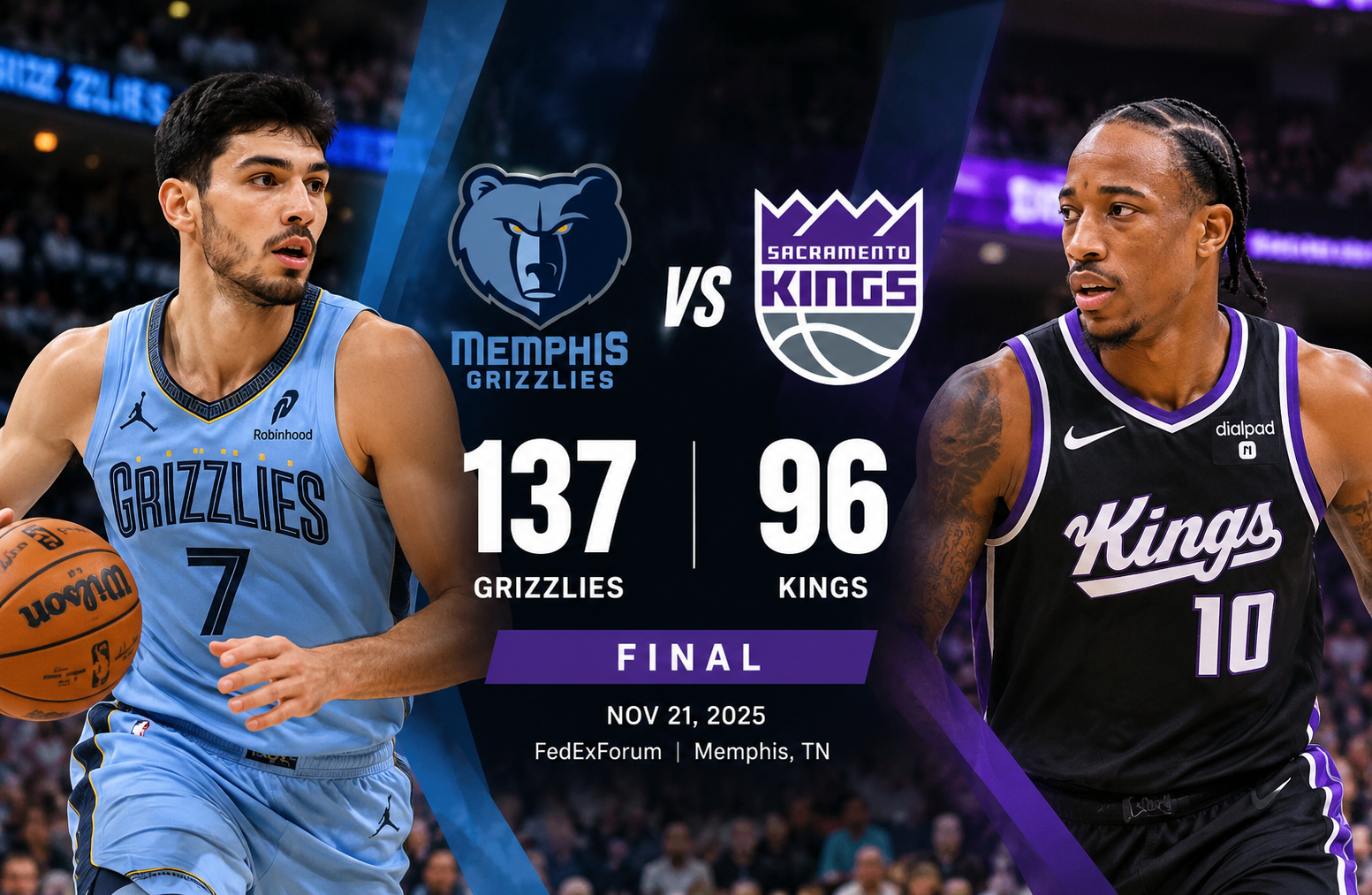
The memphis grizzlies vs sacramento kings match player stats from November 21, 2025, reveal a dominant performance by Memphis, which defeated Sacramento 137-96 at FedExForum in Memphis, Tennessee. The Grizzlies won by 41 points, powered by Santi Aldama’s 29 points, Vince Williams Jr.’s 15 assists, and a team performance that combined efficient scoring, strong rebounding, and excellent ball movement. Sacramento’s Zach LaVine led all Kings scorers with 26 points, but the team struggled to match Memphis’s pace and defensive pressure.
The final score tells only part of the story. Memphis scored 35 points in the first quarter and added 40 in the second, creating a substantial halftime advantage. The Grizzlies continued their offensive success after the break, scoring 38 points in the third quarter. Sacramento had individual scoring contributions from LaVine, Maxime Raynaud, and Russell Westbrook, but those efforts could not overcome Memphis’s 42 assists, 49 rebounds, and seven turnovers.
This breakdown examines the final score, individual player performances, team statistics, quarter-by-quarter scoring, and the main reasons behind the result. It also explains how to interpret the numbers when comparing players and evaluating the performance of both teams.
Game details: November 21, 2025 | FedExForum, Memphis, Tennessee | Attendance: 14,704 | Final score: Memphis 137, Sacramento 96 | Statistical source: ESPN
Memphis Grizzlies vs Sacramento Kings Match Player Stats: Complete Game Overview
The game was a clear example of how efficient team offense can create separation even when the opposing team has capable individual scorers. Memphis finished with 137 points, while Sacramento managed 96. The 41-point margin reflected the difference in passing, rebounding, possession management, and overall offensive production.
Memphis entered the contest with a 5-11 record, including a 4-5 home record. Sacramento arrived at 3-13 overall and 1-8 on the road. Those records provide context for the matchup, but the game statistics show more directly how the Grizzlies secured the win.
Final Score and Match Details
| Match detail | Result |
| Home team | Memphis Grizzlies |
| Away team | Sacramento Kings |
| Game date | November 21, 2025 |
| Venue | FedExForum |
| Final score | Memphis 137, Sacramento 96 |
| Winning margin | 41 points |
| Attendance | 14,704 |
| Memphis record entering game | 5-11 |
| Sacramento record entering game | 3-13 |
| Memphis field-goal percentage | 50.5% |
| Sacramento field-goal percentage | 46.3% |
| Memphis total assists | 42 |
| Sacramento total assists | 24 |
Memphis made 50 of its 99 field-goal attempts, while Sacramento converted 37 of 80. Although the Kings attempted fewer shots and recorded a slightly better three-point percentage, Memphis created substantially more offensive opportunities through its passing and work on the offensive glass.
The most revealing difference was the assist total. Memphis recorded 18 more assists than Sacramento, suggesting that the Grizzlies consistently created scoring opportunities for teammates rather than depending on isolated individual plays.
Why the Result Matters
A 41-point victory is significant because the winning team controlled several major statistical categories simultaneously. Memphis did not rely solely on one player scoring a large number of points. Aldama led the scoring, Landale provided another major contribution, and Williams organized the offense with 15 assists.
The Grizzlies also recorded 49 rebounds compared with Sacramento’s 32. That 17-rebound advantage helped Memphis maintain possession, limit second chances for the Kings, and create additional scoring opportunities.
For readers evaluating basketball performance, this game illustrates why the final score should be studied alongside the underlying statistics. Points explain the outcome, but rebounds, assists, turnovers, and shooting percentages help explain how it happened.
Quarter-by-Quarter Scoring Breakdown
The scoring progression explains why Sacramento found itself chasing the game for almost the entire night. Memphis established control immediately, delivered its strongest offensive quarter in the second, and entered the final period with a lead too large for the Kings to realistically overcome.
| Quarter | Sacramento Kings | Memphis Grizzlies | Memphis lead |
| First quarter | 22 | 35 | 13 |
| Second quarter | 25 | 40 | 28 |
| Third quarter | 29 | 38 | 37 |
| Fourth quarter | 20 | 24 | 41 |
| Final score | 96 | 137 | 41 |
First Quarter: Memphis Establishes Control
Memphis opened with 35 points, while Sacramento scored 22. The 13-point difference gave the home team an early advantage and forced the Kings to play from behind.
A strong opening quarter matters because it influences the decisions teams make for the remainder of the game. A team trailing early may need to take more three-point attempts, increase its offensive pace, or rely more heavily on individual shot creation.
Sacramento eventually scored 29 points in the third quarter, its highest-scoring period of the game. However, its opening production was not enough to keep pace with Memphis.
The Grizzlies’ early lead also allowed them to attack without needing to take unnecessary risks. They could continue creating high-quality opportunities through passing and interior scoring instead of relying on difficult shots late in possessions.
Second Quarter: The Decisive Offensive Surge
Memphis scored 40 points in the second quarter, extending its advantage from 13 points to 28.
The halftime score was Memphis 75, Sacramento 47. That means the Grizzlies scored 75 points in the first half alone, compared with 47 for the Kings.
The second quarter was particularly important because Memphis did not simply maintain its lead. It increased it by another 15 points in a single period.
According to the game recap, Memphis shot approximately 54% in the first half. Zach Edey and Jock Landale were especially effective around the basket, combining to miss only one of their 13 first-half shots. Edey scored 16 points in the game, while Landale finished with 21.
ESPN
Sacramento’s defensive challenge was therefore twofold. The Kings had to contest Memphis’s interior scoring while also accounting for perimeter shooters and cutters. When a team must protect against several scoring threats at once, defensive rotations become more difficult.
Third Quarter: The Grizzlies Extend the Margin
Sacramento produced its best quarter offensively, scoring 29 points after halftime. However, Memphis responded with 38 points of its own.
The Grizzlies entered the fourth quarter leading 113-76, a 37-point advantage.
This period demonstrates an important distinction between scoring well and successfully reducing a deficit. Sacramento improved its own production, but it did not generate enough stops to change the game’s direction.
For the Kings to make a serious comeback, they needed consecutive defensive stops, quick scores, and a way to reduce Memphis’s control of the rebound battle. Instead, the Grizzlies continued to create offense.
Fourth Quarter: Memphis Completes the Victory
Memphis scored 24 points in the final quarter, compared with Sacramento’s 20. The scoring pace slowed, but the Grizzlies maintained their advantage and finished with a 137-96 win.
The fourth quarter was not the source of the decisive separation. That work had already been done during the opening three periods.
Memphis outscored Sacramento by 37 points across the first three quarters. The final period added another four points to the margin.
The larger lesson is that strong starts can make a basketball game much easier to manage. Once Memphis built a substantial lead, it no longer needed to win every remaining possession by a large margin.
Memphis Grizzlies Player Stats and Top Performers
The Memphis performance was built around multiple contributors. Santi Aldama led the team in scoring, while Vince Williams Jr. directed the offense. Jock Landale, Cedric Coward, and Zach Edey provided additional scoring that prevented Sacramento from concentrating its defensive attention on one player.
The following table lists the individual player figures available in the supplied game data. It is not a complete box score for every player.
| Memphis player | Points | Rebounds | Assists | Key contribution |
| Santi Aldama | 29 | 5 | 3 | Team-high scorer |
| Jock Landale | 21 | 6 | Not supplied | Interior scoring |
| Cedric Coward | 19 | 4 | 4 | Balanced scoring and playmaking |
| Zach Edey | 16 | Not fully supplied | Not supplied | Interior presence and 2 steals |
| Vince Williams Jr. | 4 | 5 | 15 | Primary playmaker |
| Jaylen Wells | 13 | 1 | 2 | Supporting scoring |
| Olivier-Maxence Prosper | 11 | Not supplied | Not supplied | Bench scoring |
| GG Jackson | 6 | 9 | Not supplied | Rebounding support |
Santi Aldama: Memphis’s Leading Scorer
Aldama finished with 29 points, five rebounds, and three assists. His scoring total was the highest for either team, making him the leading individual scorer of the contest.
His performance was important because Memphis needed more than one source of offense to sustain such a high score. Aldama’s 29 points gave the Grizzlies a dependable scoring option while other players contributed through interior finishes, perimeter attempts, and passing.
A high point total is most meaningful when considered alongside team production. Memphis scored 137 points overall, so Aldama accounted for approximately 21.2% of the team’s total.
That contribution was substantial without requiring him to account for most of the offense. The Grizzlies’ ability to distribute scoring across several players made their attack more difficult to contain.
For anyone reviewing the memphis grizzlies vs sacramento kings match player stats, Aldama’s performance is the clearest individual scoring highlight.
Vince Williams Jr.: The Playmaking Difference
Williams recorded 15 assists, five rebounds, and four points. His assist total was one of the most important numbers in the entire game.
An assist is credited when a pass directly leads to a made basket under the official statistical rules. Fifteen assists therefore indicate that Williams repeatedly helped teammates finish scoring opportunities.
Memphis recorded 42 assists as a team, setting a franchise record according to the game recap. Williams was responsible for more than one-third of those assists.
This figure helps explain how Memphis generated so many points without relying exclusively on isolation scoring. A successful possession can begin with a drive, a pass to the perimeter, another pass into the paint, and a final shot by an open teammate. The player credited with the assist often completes only the final part of a larger sequence of ball movement.
Williams’s performance also shows why points alone are an incomplete measure of a guard’s contribution. His four points might appear modest in isolation, but his 15 assists reveal a much larger role in the team’s offense.
Jock Landale: Efficient Interior Scoring
Landale contributed 21 points and six rebounds. His scoring gave Memphis another major threat close to the basket.
The Grizzlies benefited from having multiple players capable of finishing interior possessions. This was especially relevant because Sacramento entered the game without starting center Domantas Sabonis, who had a partial meniscus tear in his left knee, according to the game recap.
With Sabonis unavailable, Memphis could attack the interior through Edey and Landale. Their combined first-half efficiency helped the Grizzlies build their substantial halftime advantage.
ESPN
Landale’s 21 points were the second-highest total on the Memphis roster. That contribution reduced the pressure on Aldama to carry the scoring load alone.
Cedric Coward: A Balanced Contribution
Coward finished with 19 points, four rebounds, and four assists.
His performance stands out because it combined three useful aspects of basketball production. He scored at a high level, helped secure possessions with rebounds, and contributed to teammates’ scoring through assists.
Players who contribute across several categories can help a team maintain its performance even when one particular part of the offense slows down. If a player is not scoring on every possession, passing and rebounding can still provide value.
Coward’s 19 points also meant that Memphis had four players reach at least 19 points: Aldama, Landale, Coward, and, just below that group, no, Edey with 16. That distribution made Memphis less predictable.
Zach Edey: Interior Presence
Edey scored 16 points and recorded two steals. His scoring contribution was particularly useful alongside Landale’s production.
The Grizzlies’ interior attack helped them take advantage of Sacramento’s available personnel. Edey’s size and presence near the basket gave Memphis another way to finish possessions without depending on three-point shooting.
Memphis attempted 54 three-pointers and made 17, shooting approximately 31.5%. Its outside shooting was not exceptionally accurate, but the team still reached 137 points.
That contrast matters. A team can score heavily through a combination of interior finishing, offensive rebounds, free throws, and assists even when its three-point percentage is relatively modest.
Edey’s 16 points contributed to that balance.
Jaylen Wells and the Supporting Cast
Wells added 13 points, one rebound, and two assists. Prosper scored 11 points off the bench, while GG Jackson contributed six points and nine rebounds.
Jackson’s nine rebounds are worth noting because they show that rebounding value is not limited to a team’s highest scorer. Players can influence possession outcomes without taking many shots.
Prosper’s 11 points also helped Memphis maintain its scoring depth. When several players can contribute meaningful points, opponents have fewer opportunities to focus their defensive resources on the primary scorer.
The available data identifies these contributions, but it does not provide complete shooting, minutes, and plus/minus figures for every Memphis player. Those details should be checked against the official box score before making a complete player-by-player statistical comparison.
Sacramento Kings Player Stats and Top Performers
Sacramento’s offense had a clear leading scorer, but the team did not receive enough combined production to challenge Memphis. Zach LaVine led the Kings with 26 points, while Maxime Raynaud scored 12 and Russell Westbrook added 11 points, seven rebounds, and four assists.
The Kings shot 46% from the field and made 11 three-pointers. Those numbers show that Sacramento was capable of producing offense. The larger issue was the gap between its scoring and Memphis’s overall efficiency as a team.
| Sacramento player | Points | Rebounds | Assists | Key contribution |
| Zach LaVine | 26 | Not supplied | Not supplied | Team-high scorer |
| Maxime Raynaud | 12 | 3 | Not supplied | Bench scoring |
| Russell Westbrook | 11 | 7 | 4 | Rebounding and playmaking |
| Keegan Murray | 11 | Not supplied | Not supplied | Scoring in his season debut |
| Other players | Not fully supplied | Not fully supplied | Not fully supplied | Full individual lines require the box score |
The figures above include the main individual performances available in the supplied data and game recap. Missing figures have not been estimated.
Zach LaVine: Sacramento’s Leading Scorer
LaVine finished with 26 points, making him the leading scorer for Sacramento and the second-highest scorer in the game behind Aldama.
He made 10 of 17 field-goal attempts, an impressive conversion rate of approximately 58.8%. This is important context because it shows that LaVine was not simply accumulating points through a large number of missed shots.
His scoring was efficient, but individual efficiency cannot fully compensate for a large team-level disadvantage. Memphis received several major scoring contributions, while Sacramento’s overall production remained limited to 96 points.
LaVine’s performance also highlights a common challenge in basketball analysis: a player can perform well individually even when his team loses heavily. The final score reflects the combined performance of both teams, not the quality of every individual contribution.
When assessing LaVine’s night, his scoring efficiency should be separated from Sacramento’s broader problems with turnovers, rebounding, and defensive stops.
Russell Westbrook: Contributions Beyond Scoring
Westbrook finished with 11 points, seven rebounds, and four assists.
His seven rebounds were a useful contribution for a guard, particularly in a game where Sacramento lost the overall rebounding battle by 17. His four assists also indicate that he helped create scoring opportunities for teammates.
However, Westbrook’s individual production did not translate into enough collective offensive output. Sacramento recorded 24 assists, well below Memphis’s 42.
That difference does not mean Westbrook was solely responsible for Sacramento’s playmaking. Assists depend on the actions of the entire team, including off-ball movement, screening, shot selection, and successful finishing.
His line is best understood as a solid individual contribution within a difficult team performance.
Maxime Raynaud: A Useful Bench Contribution
Raynaud scored 12 points and grabbed three rebounds.
His scoring provided support beyond Sacramento’s starting lineup. Bench production matters because starters cannot play every minute, and teams need reserves who can maintain offensive pressure when rotations change.
However, a 12-point contribution was not enough to bridge the gap. Memphis had multiple players scoring in double figures, including Landale, Coward, Edey, Wells, and Prosper, alongside Aldama.
The comparison shows how depth can influence a game’s outcome. One reserve scoring in double figures is useful, but several contributors working together can produce a much larger cumulative effect.
Keegan Murray’s Season Debut
Murray scored 11 points in his season debut after being sidelined by a left thumb injury suffered during the preseason, according to the game recap.
His return was a notable personnel development for Sacramento. Even so, the team still struggled to contain Memphis’s offense.
It is important not to judge a player’s return from injury solely by the final result. Eleven points provide a straightforward measure of his scoring, but a complete assessment would require his shooting efficiency, playing time, defensive assignments, and overall role in the rotation.
For Sacramento, Murray’s return offered an additional scoring option, but the team needed a stronger collective response to Memphis’s offensive execution.
Team Statistics Comparison: Memphis vs Sacramento
The team statistics provide the clearest explanation for the 41-point result. Memphis led in field-goal percentage, rebounds, assists, steals, and turnovers. Sacramento’s three-point percentage was slightly higher, but that small advantage did not offset Memphis’s superiority in other categories.
| Statistical category | Memphis Grizzlies | Sacramento Kings |
| Total points | 137 | 96 |
| Field goals made | 50 | 37 |
| Field-goal attempts | 99 | 80 |
| Field-goal percentage | 50% | 46% |
| Three-pointers made | 17 | 11 |
| Three-point attempts | 54 | 33 |
| Three-point percentage | 31% | 33% |
| Free throws made | 20 | 11 |
| Free-throw attempts | 26 | 15 |
| Free-throw percentage | 77% | 73% |
| Total rebounds | 49 | 32 |
| Offensive rebounds | 11 | 4 |
| Defensive rebounds | 38 | 28 |
| Assists | 42 | 24 |
| Turnovers | 7 | 16 |
| Steals | 11 | 5 |
| Blocks | 3 | 5 |
| Personal fouls | 11 | 22 |
Field-Goal Efficiency
Memphis made 50 of 99 field-goal attempts, giving it a shooting percentage of approximately 50.5%. Sacramento made 37 of 80 attempts, or approximately 46.3%.
The difference was about 4.3 percentage points.
That gap matters, but it does not explain the entire 41-point margin. Memphis also attempted 19 more field goals, which helped it convert more shots overall.
Field-goal percentage measures how often a team makes its field-goal attempts. It does not account for the value of each shot, free throws, or possession volume. To understand a complete offensive performance, those figures must be considered together.
Three-Point Shooting
Sacramento made 11 of 33 three-point attempts, shooting approximately 33.3%. Memphis made 17 of 54, shooting approximately 31.5%.
The Kings therefore held a small advantage in three-point accuracy.
However, Memphis made six more three-pointers because it attempted substantially more shots from beyond the arc. The Grizzlies also scored more frequently from inside the three-point line and converted more free throws.
This is a useful reminder that a better percentage in one category does not automatically mean a better overall offense. Shot volume, shot value, and performance in other areas all affect the final score.
Rebounding: A 17-Rebound Advantage
Memphis recorded 49 total rebounds, compared with Sacramento’s 32.
The Grizzlies collected 11 offensive rebounds and 38 defensive rebounds. Sacramento recorded four offensive rebounds and 28 defensive rebounds.
The seven-rebound difference on the offensive glass is especially important. An offensive rebound gives a team another chance to score after an initial missed shot. These additional possessions can increase scoring opportunities and place further pressure on the opposing defense.
Memphis’s total rebounding advantage was 17, meaning it finished with substantially more rebounds than Sacramento.
That advantage was not simply about height or strength. Rebounding also depends on positioning, timing, effort, and how well players identify opponents when a shot goes up.
Assists: Memphis’s Defining Advantage
Memphis recorded 42 assists, compared with Sacramento’s 24. The 18-assist gap was one of the most striking statistical differences of the game.
The Grizzlies’ assist total was a franchise record, according to the game recap.
Assists help illustrate how teams generate scoring opportunities. A pass that creates an open shot can be more effective than a difficult attempt taken under pressure. Repeated ball movement can also force defenders to rotate, opening space elsewhere on the court.
Memphis’s 42 assists suggest that its offense was functioning collectively. Williams’s 15 assists were the most prominent individual example, but the team total reflects contributions from multiple players.
Sacramento’s 24 assists were not insignificant. However, the Kings could not match the volume of successful team-created scoring opportunities generated by Memphis.
Turnovers: Protecting Possessions
Memphis committed seven turnovers, while Sacramento committed 16.
That gave the Grizzlies a nine-turnover advantage.
A turnover ends a team’s possession without a field goal or free throw being recorded from that possession. It can also create transition opportunities for the opposing team before its defense is organized.
Memphis’s seven turnovers indicate strong possession management in this game. Sacramento’s 16 turnovers created more opportunities for the Grizzlies to regain possession and attack.
Turnovers are especially damaging when a team is already trailing. A team needs successful offensive possessions to reduce a deficit, so giving the ball away makes a comeback more difficult.
Steals, Blocks, and Fouls
Memphis recorded 11 steals, compared with Sacramento’s five. The Grizzlies also committed 11 personal fouls, half Sacramento’s total of 22.
Sacramento recorded five blocks, two more than Memphis’s three. This was one defensive category in which the Kings had the numerical advantage.
However, blocks alone do not determine defensive success. A team can block shots and still struggle to prevent points through open perimeter attempts, offensive rebounds, turnovers, or successful passing sequences.
Memphis’s combination of 11 steals and seven turnovers suggests it was effective at creating defensive events while protecting the ball on offense.
The Kings’ 22 fouls also contributed to the overall difference in free-throw opportunities. Memphis attempted 26 free throws, while Sacramento attempted 15.
Five Key Reasons Memphis Won by 41 Points
The statistical comparison identifies several connected reasons for Memphis’s victory. No single number fully explains the outcome, but the combination provides a strong picture of how the game developed.
1. Memphis Built a Large Halftime Lead
Memphis scored 75 first-half points and limited Sacramento to 47. The resulting 28-point advantage placed the Kings in a difficult position before the second half began.
A large halftime deficit can force a team to change its approach. Players may take more difficult shots, increase their pace, or try to create turnovers in search of quick scoring opportunities.
Those adjustments can sometimes lead to a comeback, but they can also create additional mistakes if they are not executed carefully.
Memphis avoided allowing Sacramento to build momentum after the break. The Grizzlies scored 38 points in the third quarter, increasing their lead further.
2. The Grizzlies Shared the Offensive Workload
Aldama led Memphis with 29 points, but he was not the team’s only major scoring option. Landale scored 21, Coward added 19, and Edey contributed 16.
This distribution gave Memphis several ways to produce points.
If Sacramento concentrated its defensive attention on Aldama, other players could take advantage of the resulting space. If the Kings protected the paint, Memphis could look for perimeter opportunities.
A balanced attack does not guarantee victory, but it reduces the risk of an offense becoming dependent on one player having an exceptional night.
3. Ball Movement Created Scoring Opportunities
The 42-24 assist difference highlights Memphis’s advantage in team playmaking.
The Grizzlies moved the ball effectively enough to record 42 assists while committing only seven turnovers. That combination is especially valuable because it indicates that the team created numerous assisted baskets without frequently surrendering possession.
A high assist total should not be treated as a perfect measure of offensive quality. Some successful plays do not result in assists, and some baskets are made after individual actions. Nevertheless, the scale of Memphis’s advantage is a strong indicator of how effectively its players worked together.
4. Rebounding Increased Memphis’s Possession Opportunities
Memphis finished with 49 rebounds, while Sacramento had 32.
The difference included seven additional offensive rebounds for the Grizzlies. Those extra offensive boards gave Memphis more opportunities to recover missed shots and continue possessions.
The Kings’ four offensive rebounds limited their chances to generate second-shot opportunities. Against a team already scoring efficiently, that shortage made it harder to keep pace.
Rebounding also supports defense. Securing a defensive rebound prevents the opposing team from extending its possession and allows the rebounder’s team to begin its own attack.
5. Sacramento Could Not Turn Individual Scoring Into a Team Comeback
LaVine scored 26 points, Raynaud added 12, and Westbrook and Murray each scored 11.
These contributions show that Sacramento had several players capable of producing points. However, the team finished with 96, which was 41 fewer than Memphis.
The problem was not simply that Sacramento lacked a high scorer. It also faced disadvantages in assists, rebounds, turnovers, and free-throw attempts.
A comeback requires more than one player scoring efficiently. The team must also secure defensive stops, protect the ball, rebound missed shots, and string together successful possessions. Sacramento did not close the gap in those areas.
How to Interpret Plus/Minus and Other Player Statistics
Beyond points and assists, basketball box scores include measurements that help readers understand what happens while a player is on the court.
What Plus/Minus Measures
Plus/minus represents the net point differential for a player’s team while that player is on the court.
For example, if a player is on the floor while his team scores 30 points and allows 20, his plus/minus for that period would be +10. This does not mean the player personally scored 10 points. It means his team outscored its opponent by 10 during those minutes.
Plus/minus can provide useful context, but it has limitations. It is affected by teammates, opponents, substitutions, and the timing of a player’s minutes. A strong player can finish with a negative figure if the team performs poorly during his time on the court.
The supplied statistics do not include every player’s plus/minus figure from this game, so individual values should not be inferred from the final score.
Why Points Per Game Do Not Tell the Whole Story
Points are an important measure of scoring, but they do not capture everything a player contributes.
Consider Williams, who scored four points but recorded 15 assists. His scoring total was modest, yet his passing played a major role in Memphis’s offensive performance.
Similarly, Jackson’s nine rebounds offered value even though he scored six points.
A well-rounded player evaluation should consider:
- Scoring: Points, shooting percentage, and shot selection.
- Playmaking: Assists and the ability to create opportunities.
- Rebounding: Offensive and defensive rebounds.
- Defense: Steals, blocks, positioning, and defensive pressure.
- Possession management: Turnovers and the ability to maintain control of the ball.
- Context: Playing time, role, teammates, opponents, and game situation.
These categories provide a more complete picture than scoring totals alone.
What This Game Reveals About Both Teams
The November 21 matchup offers several useful lessons for understanding the performances of Memphis and Sacramento.
Memphis: A Model of Collective Offensive Production
Memphis demonstrated how multiple scoring options and effective passing can combine to produce a high-scoring performance.
The team finished with 137 points, 42 assists, 49 rebounds, and only seven turnovers. Aldama’s scoring led the way, but the Grizzlies also received major contributions from Landale, Coward, Edey, and Williams.
The numbers suggest that Memphis’s success came from the combined effect of several strengths rather than one isolated factor.
Its interior scoring helped establish the offense, its passing created additional opportunities, and its rebounding supported possession control. The team also converted 20 of 26 free throws, adding another source of points.
However, one dominant result should not be treated as proof that every underlying issue has been resolved. The game took place when Memphis had a 5-11 record, and a single performance cannot establish how consistently the team would maintain the same level over an entire season.
Sacramento: Individual Scoring Was Not Enough
Sacramento’s 96 points included a strong scoring performance from LaVine, along with contributions from Westbrook, Raynaud, and Murray.
The Kings also shot a slightly better percentage from three-point range than Memphis. That is evidence that the game was not a complete failure in every offensive category.
The broader problem was the combination of defensive and possession disadvantages. Sacramento gave up 137 points, recorded only 32 rebounds, and committed 16 turnovers.
The absence of Sabonis was an important piece of context because the game recap identified the injury as a factor in Memphis’s interior advantage. However, it would be too simplistic to attribute the entire loss to one absent player. Memphis still needed to execute, create scoring opportunities, and capitalize on the available matchup, which it did.
What Analysts Should Watch in Future Matchups
When evaluating another meeting between these teams, the most useful indicators would include:
- Interior scoring: Whether Memphis can again create efficient opportunities around the basket.
- Rebounding margin: Whether Sacramento can reduce the difference in total and offensive rebounds.
- Assist-to-turnover balance: Whether the Kings can improve ball movement while protecting possession.
- Three-point volume and accuracy: Whether either team can create a meaningful advantage from the perimeter.
- Player availability: Whether key players are healthy and available, changing the matchup and rotation.
- First-half performance: Whether Sacramento can avoid allowing Memphis to build another substantial early lead.
These factors would help distinguish a repeatable tactical advantage from a result influenced by specific circumstances on one night.
Frequently Asked Questions
1. Who won the Memphis Grizzlies vs Sacramento Kings game on November 21, 2025?
The Memphis Grizzlies defeated the Sacramento Kings 137-96 at FedExForum in Memphis, Tennessee. Memphis won by 41 points after building a 75-47 halftime lead.
2. Who was the leading scorer in the game?
Santi Aldama led all players with 29 points for Memphis. Zach LaVine was Sacramento’s leading scorer with 26 points, making 10 of 17 field-goal attempts.
3. How many assists did Vince Williams Jr. record?
Vince Williams Jr. recorded 15 assists, five rebounds, and four points. His assist total contributed to Memphis’s franchise-record 42 team assists.
4. Which team had more rebounds and assists?
Memphis led both categories. The Grizzlies recorded 49 rebounds and 42 assists, compared with Sacramento’s 32 rebounds and 24 assists.
5. What was the halftime score?
Memphis led Sacramento 75-47 at halftime. The Grizzlies scored 35 points in the first quarter and 40 in the second, creating a 28-point advantage.
6. Where can readers verify the complete player statistics?
The complete box score, including individual shooting figures, rebounds, assists, turnovers, minutes, and plus/minus, can be checked in the ESPN game box score.
Conclusion
The Memphis Grizzlies‘ 137-96 victory over the Sacramento Kings on November 21, 2025, was defined by a combination of scoring depth, effective passing, rebounding, and possession control. Memphis built a 28-point halftime lead and continued to increase its advantage in the third quarter before completing a 41-point win.
Aldama led the game with 29 points, Landale added 21, and Coward contributed 19. Williams’s 15 assists helped Memphis set a franchise record with 42 team assists. The Grizzlies also won the rebounding battle 49-32 and committed nine fewer turnovers than Sacramento.
LaVine’s 26 points highlighted Sacramento’s individual scoring potential, while Raynaud, Westbrook, and Murray also made useful contributions. However, the Kings could not overcome the combined disadvantages in playmaking, rebounding, turnovers, and defensive execution.
The central lesson from this matchup is that individual scoring and team success are not the same thing. A leading scorer can produce an efficient performance, but winning also requires coordinated offense, reliable defense, control of possessions, and contributions throughout the lineup. Those differences explain why Memphis secured such a convincing result.