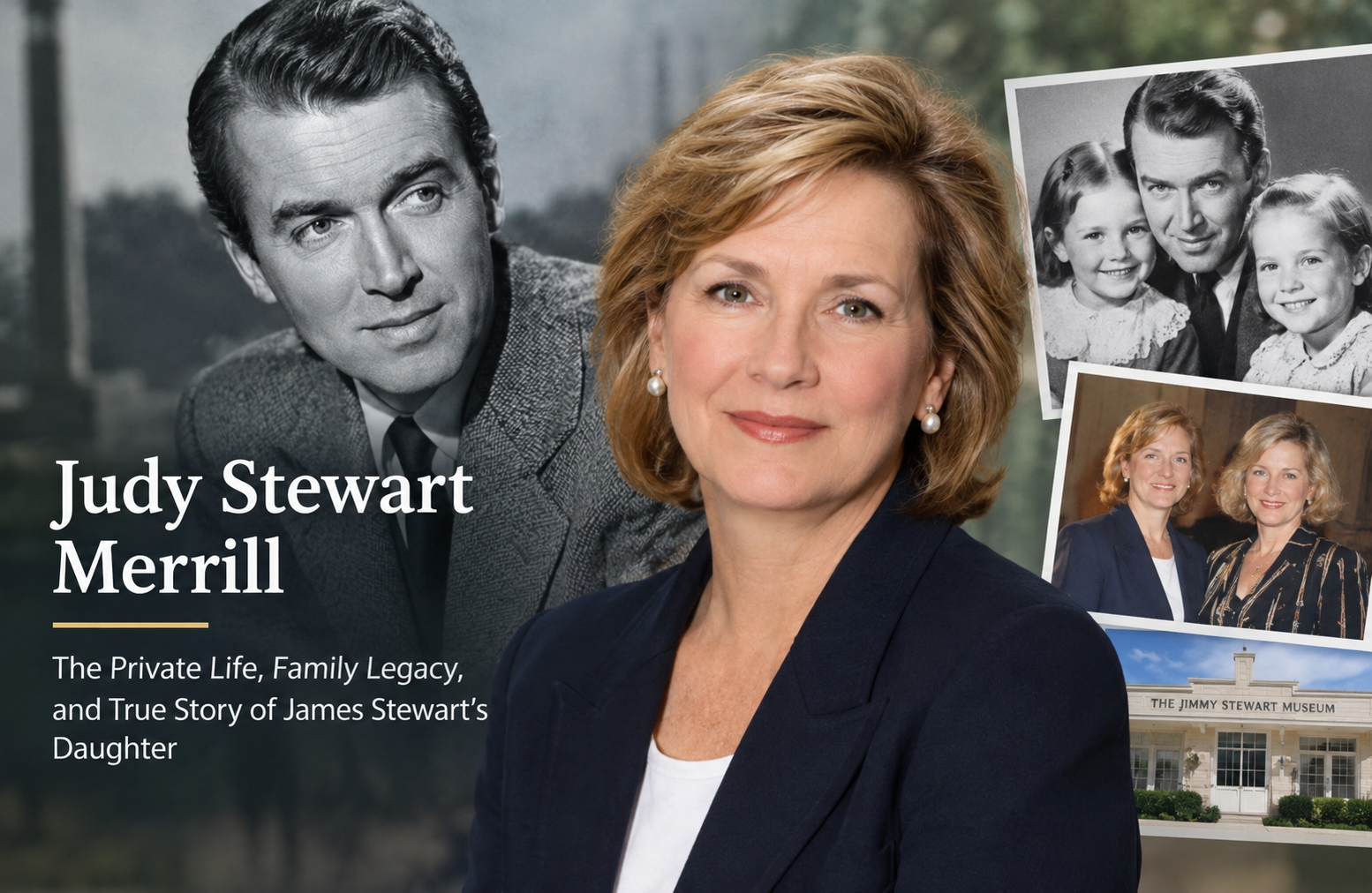
Judy Stewart Merrill: The Private Life and Family Legacy
Judy Stewart Merrill is best known as the daughter of legendary Hollywood actor James Stewart and his wife, Gloria Hatrick McLean Stewart. Although her father became one of the most respected figures in American cinema, Judy Stewart Merrill has maintained a comparatively private life, appearing publicly on select occasions connected to her family’s history and charitable work. Her story offers a different perspective on celebrity, one shaped by family heritage, personal privacy, and the responsibility of preserving a well-known name.
Interest in her life often begins with a simple question: Who is James Stewart’s daughter, and what has she done beyond her connection to Hollywood? The available information points to a woman whose public identity is closely tied to her family rather than an established entertainment career. Her participation in commemorative events and her reported trusteeship with the Stewart Foundation provide useful insight into how the Stewart family’s legacy has continued beyond the lifetime of its most famous member.
Understanding her biography requires care. Celebrity websites frequently repeat personal details without showing where those details originated. A reliable account should distinguish information supported by historical records and contemporary reporting from claims that remain uncertain. This distinction matters particularly when discussing private individuals whose lives have not been extensively documented in public.
This article examines Judy’s family background, childhood within a blended family, connection to her father’s Hollywood legacy, involvement in charitable stewardship, and limited public appearances. It also addresses common questions about her personal life, including her reported birth date, professional background, and an often-repeated claim connecting her to a former New Hampshire governor.
Who Is Judy Stewart Merrill?
Judy Stewart Merrill is one of the twin daughters of James Stewart, the acclaimed American actor known for his distinctive voice, understated screen presence, and memorable performances in classic films. She was born in 1951, according to secondary biographical accounts, and grew up in a family that combined Hollywood fame with a preference for keeping personal matters away from public attention.
Unlike her father, Judy has no widely established professional acting career documented in the available biographical information. Her public profile is associated primarily with her family background, selected commemorative appearances, and reported involvement in the Stewart Foundation.
Her life illustrates an important distinction between being related to a famous person and building a public career of one’s own. A recognizable surname can attract attention, but it does not automatically make every aspect of a family member’s life public knowledge.
Quick Facts About Judy Stewart Merrill
| Detail | Information |
| Full name | Judy Stewart Merrill |
| Reported birth date | May 7, 1951 |
| Birth year | 1951 |
| Father | James Maitland Stewart, known professionally as James Stewart |
| Mother | Gloria Hatrick McLean Stewart |
| Twin sister | Kelly Stewart Harcourt |
| Half-brothers | Michael McLean and Ronald McLean |
| Known for | Being James Stewart’s daughter and participating in preserving the family legacy |
| Documented public connection | Jimmy Stewart Museum dedication in 1995 |
| Other notable event | Academy of Motion Picture Arts and Sciences tribute in 2008 |
| Charitable connection | Reported trustee of the Stewart Foundation |
| Public profile | Comparatively private |
| Established acting career | No significant professional acting career documented in the available information |
The table summarizes the information available for this biography. The reported birth date comes from secondary sources and should not be treated as independently confirmed without a reliable primary record. Similarly, the exact scope of Judy’s professional and charitable activities should not be expanded beyond what documentary evidence supports.
Judy Stewart Merrill Biography: Birth, Childhood, and Family Background
Judy’s early life was shaped by a family that brought together two households before establishing a shared identity. Her father was already developing a major Hollywood career when he married Gloria Hatrick McLean in 1949. Gloria had two sons from an earlier marriage, Michael and Ronald McLean, who became Judy’s half-brothers.
Judy and her twin sister, Kelly, were born in 1951. Their arrival expanded the family and created a household in which biological relationships, stepfamily connections, and the demands of a famous father’s career existed alongside one another.
The available information does not establish a detailed public record of Judy’s schooling, childhood activities, or private experiences. It would therefore be misleading to invent stories about her upbringing or claim to know exactly how she felt about growing up in a celebrated household.
What can be understood is the broader setting. James Stewart’s professional life involved film productions, public appearances, and a level of recognition that few families experience. At the same time, the family was not simply a public extension of his screen persona. His children had their own lives, and Judy’s limited public profile suggests that her adult identity did not depend on constant media exposure.
Her Birth and Twin Sister
Secondary sources identify May 7, 1951, as Judy’s birth date. Her twin sister, Kelly Stewart Harcourt, is another important part of the family’s public history.
The sisters occasionally appeared together in connection with their father’s legacy. One documented example is their participation in the opening dedication of the Jimmy Stewart Museum in Indiana, Pennsylvania, in May 1995.
Their joint appearance is significant because it demonstrates a direct family connection to an institution dedicated to preserving their father’s life and career. It does not, however, establish that either sister sought a career in entertainment or regularly participated in public celebrity events.
Growing Up in a Blended Family
The Stewart household included four children: Michael and Ronald from Gloria’s earlier marriage, followed by Judy and Kelly. This blended family structure is an important part of the family’s history and should not be overlooked in a biography that focuses on James Stewart’s daughters.
Blended families can involve multiple relationships and different stages of childhood. However, without detailed firsthand accounts, it would be inappropriate to draw conclusions about private family dynamics or claim that the household followed a particular pattern.
The available facts establish the family structure, not every personal experience within it.
For readers researching Judy, this distinction offers a useful lesson: family relationships are part of a biography, but assumptions about those relationships are not substitutes for evidence.
Who Was James Stewart, Judy’s Father?
To understand why Judy attracts continuing interest, it helps to understand the public legacy of her father.
James Maitland Stewart was born in 1908 and became one of the defining actors of classic American cinema. Audiences recognized him for his conversational delivery, expressive face, and ability to portray ordinary people facing extraordinary moral or personal challenges.
His filmography covered comedy, drama, romance, suspense, and Westerns. Rather than relying on a single screen persona, he worked with major directors and appeared in films that remain central to discussions of Hollywood history.
Among his best-known movies are It’s a Wonderful Life, Rear Window, Vertigo, Harvey, The Philadelphia Story, Mr. Smith Goes to Washington, and Anatomy of a Murder.
His performance in The Philadelphia Story earned him the Academy Award for Best Actor. His career also included a major interruption during World War II, when he served in the United States military and later remained associated with the Air Force Reserve.
These achievements explain why his family name continues to draw interest decades after his death. They also explain the importance of institutions, film archives, museums, and family members who help maintain accurate records of his life.
From Architecture Student to Hollywood Star
Before becoming an actor, Stewart studied architecture at Princeton University. His education reflects a path that was not originally limited to the entertainment industry.
His later career brought him widespread recognition, but the significance of his work extends beyond awards and box-office success. Many of his performances explored responsibility, civic duty, integrity, and the pressure individuals face when confronting powerful institutions or difficult choices.
For example, Mr. Smith Goes to Washington examines political idealism, while It’s a Wonderful Life explores community, sacrifice, and the importance of ordinary lives. Rear Window and Vertigo, both directed by Alfred Hitchcock, demonstrate his ability to work within psychologically complex suspense stories.
These films help explain why interest in his family has continued. Audiences often want to understand the personal background of performers whose work has become part of cultural history.
Still, the public importance of James Stewart’s career should not be confused with permission to speculate about his children’s private experiences.
His Military Service and Personal Values
Stewart’s military service was an important part of his biography. During World War II, he served in the United States Army Air Forces, later associated with the Air Force, and continued his involvement in the Air Force Reserve after the war.
His service gave his public identity a dimension beyond acting. He was not only a screen performer but also a veteran whose life intersected with a significant period in American history.
Family recollections also provide glimpses of the values associated with his role as a father. Judy’s twin sister, Kelly, reportedly recalled advice from their father before college: “Always remember, be nice to people.”
This brief statement is meaningful because it emphasizes everyday conduct rather than celebrity status. Its value lies in the family recollection itself, not in treating one quotation as a complete explanation of James Stewart’s personality or parenting.
For Judy and her siblings, their father’s legacy included both his public achievements and the private lessons remembered by family members.
Judy Stewart Merrill and Her Mother’s Influence
Judy’s mother, Gloria Hatrick McLean Stewart, played a central role in the family story. She married James Stewart in 1949, bringing her two sons into the household before the birth of Judy and Kelly.
Although James Stewart’s career naturally receives much of the public attention, the family history cannot be understood through his achievements alone. Gloria’s role as a parent within a blended family was an essential part of the household’s structure.
The available information does not provide enough verified detail to construct a complete account of Judy’s relationship with her mother, including private conversations, household routines, or specific parenting decisions. Such details should not be supplied simply to make a biography appear more personal.
What is documented is the family’s composition and the lasting connection between the Stewart name and its children. Gloria’s marriage brought together different branches of the family, while Judy and Kelly grew up alongside their older half-brothers.
This background helps explain why references to the Stewart family should include more than the father-daughter relationship. The family legacy developed across several relationships and generations.
The Importance of Family History
Family history can be preserved in different ways. Some relatives write memoirs, give interviews, or pursue public careers. Others contribute through occasional appearances, institutional relationships, charitable responsibilities, or the preservation of family records.
Judy’s public profile appears closer to the latter pattern. Her known appearances connected to her father and her reported foundation trusteeship offer evidence of involvement without establishing a broad public career.
That distinction is especially important in celebrity biographies. A person can have a meaningful role in preserving a family legacy without becoming a celebrity in their own right.
Judy Stewart Merrill’s Public Appearances and Connection to Her Father’s Legacy
Judy has not maintained a constant public presence. The available information instead identifies selected occasions when she participated in events connected to James Stewart’s memory.
Two events stand out: the opening dedication of the Jimmy Stewart Museum in 1995 and an Academy of Motion Picture Arts and Sciences tribute in 2008.
These appearances are useful points of reference because they are tied to recognizable institutions and specific dates. They provide a firmer foundation for understanding her public role than anonymous claims about her lifestyle or personal relationships.
The Jimmy Stewart Museum Opening in 1995
In May 1995, Judy and her twin sister, Kelly Stewart Harcourt, reportedly represented their father at the opening dedication of the Jimmy Stewart Museum in Indiana, Pennsylvania.
The museum is closely associated with preserving the actor’s history and presenting his connection to the community where he was born. Its purpose gives family participation a broader cultural context.
A museum dedicated to a major performer does more than display photographs and memorabilia. It can preserve documents, communicate historical context, and help visitors understand how an individual’s career developed over time.
For family members, involvement in a dedication can also represent a connection between personal history and public remembrance. Judy’s reported participation is therefore one of the clearest examples of her association with her father’s continuing legacy.
However, attendance at an event should not automatically be interpreted as proof of a formal museum management position. Unless institutional records establish a specific title or ongoing responsibility, the accurate description is that she participated in the dedication.
The Academy’s 2008 Centennial Tribute
Judy also reportedly participated in the Academy of Motion Picture Arts and Sciences’ centennial tribute to James Stewart in June 2008.
Such commemorations help connect an actor’s body of work with the institutions that document and celebrate film history. The Academy’s involvement also places the event within a broader effort to recognize Stewart’s contribution to American cinema.
For family members, participating in a tribute can be a way to honor a relative whose professional achievements remain familiar to later generations. It also provides an opportunity for audiences to encounter the human connections behind a famous public figure.
The available information does not establish every detail of Judy’s role at the event. It is therefore more accurate to describe her as a reported participant than to assign her an unverified speaking role, organizing position, or formal title.
Why These Appearances Matter
Judy’s public appearances are limited, but they reveal a consistent theme. Her documented public connections are related to remembrance and family heritage rather than an independent entertainment career.
That pattern should not be exaggerated into a claim that she deliberately rejected fame or consciously designed her life around privacy. Those interpretations would require direct evidence of her intentions.
The more defensible conclusion is that her publicly documented life has remained comparatively private, with occasional participation in events that preserve her father’s legacy.
Judy Stewart Merrill’s Professional Life and Career
One of the most common questions about Judy concerns her occupation. Because she is the daughter of a famous actor, readers may expect to find a filmography, television credits, interviews, or a substantial entertainment career.
The available information does not establish a significant professional acting career for her. No reliable basis has been provided for presenting her as a film or television performer with an extensive body of work.
This does not mean that she has never worked professionally. It means that her occupation and career history have not been documented in enough detail to support a specific public career narrative.
Did She Follow Her Father Into Acting?
There is no established record in the supplied biographical information showing that Judy followed her father into professional acting.
Her father’s career involved decades of performances and collaborations with prominent directors. Judy’s public identity, by contrast, is primarily connected to her family relationship and legacy-related activities.
It would be inaccurate to invent film credits or suggest that she appeared in particular productions without supporting evidence.
It is equally important not to treat a lack of public acting credits as evidence that she lacked professional interests or accomplishments outside Hollywood. Many people work in fields that do not generate extensive online biographies.
Family Stewardship as a Public Role
Judy’s reported connection to the Stewart Foundation offers a more concrete indication of her public involvement beyond family appearances.
Charitable governance can involve responsibilities such as oversight, fiduciary duties, reviewing organizational activities, and helping ensure that resources are used in accordance with a foundation’s purposes. These are general responsibilities associated with trusteeship, not a verified list of Judy’s individual duties.
The foundation’s nonprofit filings are described as identifying her as a trustee. If confirmed against the relevant filings, that record provides a documentary basis for discussing her involvement in family charitable stewardship.
A trustee position is not equivalent to an entertainment career, nor does it establish that the individual personally manages every grant or charitable activity. It does, however, represent a formal connection to an organization.
This distinction makes charitable records particularly useful when researching people whose lives are not extensively covered in entertainment journalism.
The Stewart Foundation and Charitable Stewardship
The Stewart Foundation is an important part of the available account of Judy’s adult public life. According to the supplied article information, nonprofit records identify her as a trustee, and the foundation’s fiscal-year 2024 filing reportedly showed millions of dollars in net assets and substantial charitable disbursements.
The exact figures were not supplied, so they should not be repeated as specific dollar amounts. Readers seeking financial details should consult the original filing rather than relying on summaries that omit figures, reporting periods, or accounting definitions.
What Does a Foundation Trustee Do?
A trustee generally participates in the governance of an organization. Depending on its governing documents and applicable law, the role may include:
- Overseeing the organization’s mission and long-term direction.
- Reviewing financial statements and organizational performance.
- Ensuring that charitable resources are used appropriately.
- Participating in governance decisions and policy reviews.
- Supporting compliance with applicable legal and reporting requirements.
These points describe common governance functions. They should not be taken as confirmation that Judy personally performed every task listed above.
A trustee’s actual responsibilities depend on the foundation’s structure, bylaws, applicable regulations, and division of duties among its governing members.
Why Nonprofit Records Matter
Nonprofit filings can help researchers distinguish a documented institutional relationship from a claim repeated across celebrity websites.
An official filing may establish a person’s listed position during a particular reporting period. It can also provide information about revenue, expenses, assets, grants, and other organizational activities.
However, a filing must be interpreted carefully. Financial figures relate to a specified period and accounting framework. A foundation’s assets are not the same as a trustee’s personal wealth, and the value of the organization’s holdings should never be presented as an individual’s net worth.
For Judy, this distinction is especially important because her own financial circumstances are not established by the foundation information provided.
Family Legacy and Philanthropy
Philanthropy can preserve a family legacy in a different way from films, museums, or public ceremonies. A foundation can support causes over time, maintain an institutional purpose, and operate beyond the lifetime of the person whose name or history it may be associated with.
Judy’s reported trusteeship suggests a connection to this form of stewardship. Yet the nature and scale of her personal contribution should not be overstated without minutes, official statements, or other documentation describing her work.
A careful biography recognizes the significance of the role while respecting the limits of what public records actually establish.
Where Did Judy Stewart Merrill Live?
The supplied biographical information connects Judy to Northern California, particularly the San Francisco Bay Area. Contemporary reporting from 1997 reportedly placed her in Atherton, California, and described James Stewart visiting her home or meeting in connection with the Burlingame Club.
These references provide a historical regional connection, but they do not establish her current residence.
A report from 1997 is evidence about a period in the past. It should not be used to publish a present-day address or to imply that someone continues to live in the same place nearly three decades later.
For a private individual, this distinction is both factual and respectful. Public interest in a famous family does not make private residential details necessary to understand the person’s biography.
Her Connection to Northern California
The Bay Area reference is relevant because it places Judy within the geographic context of her father’s family visits. It also illustrates how local reporting can preserve small but useful details about the lives of people connected to major public figures.
Still, the available information does not provide a complete residential history. It would be speculative to list additional cities, properties, or moves without reliable documentation.
The most accurate summary is that historical reporting linked her to Atherton and the wider Northern California region during the 1990s. Her current location has not been established by the information available for this article.
Judy Stewart Merrill’s Relationship With Her Father
The relationship between Judy and James Stewart is a central reason for public interest in her life. However, the quality of that relationship should be discussed through documented events and attributable family recollections rather than assumptions.
The reported museum dedication, the Academy tribute, and the 1997 references to family visits help establish a connection that continued into her father’s later years.
James Stewart died on July 2, 1997. His death marked the end of a long career and the beginning of a different stage in the public preservation of his legacy.
Family Memories Beyond the Screen
For audiences, James Stewart is often remembered through performances. For his children, his identity necessarily extended beyond the characters he played.
The recollection attributed to Kelly Stewart Harcourt about her father’s advice before college offers one example of a family memory that has entered the public record. Its emphasis on kindness provides a personal dimension to the broader story of an actor associated with sincerity and decency on screen.
It would be unwise, however, to use this anecdote as proof of every aspect of his private character or his relationship with each child. A single recollection can be meaningful without being comprehensive.
Judy’s own private memories have not been extensively documented in the supplied material. Her story should therefore leave room for experiences that may never have been publicly shared.
After James Stewart’s Death
Following her father’s death, Judy remained connected to the family legacy through the public appearances and charitable association described in available information.
Family legacies often continue through a combination of institutional preservation, archival records, charitable activities, and relatives who participate in commemorations. Judy’s public profile fits within that broader pattern.
There is not enough verified information to describe her private grieving process, personal statements after his death, or specific decisions regarding his estate. Such claims would require direct sources.
The responsible conclusion is narrower but still meaningful: her documented involvement reflects a continuing connection to her father’s memory without establishing that she sought public attention for herself.
Is Judy Stewart Merrill Married to Former Governor Stephen Merrill?
A recurring claim connects Judy Stewart Merrill with Stephen Merrill, the former governor of New Hampshire. The supplied source information specifically warns that this identification is unreliable and should not be presented as established fact.
The information also states that Stephen Merrill’s wife was Heather Merrill, not Judy Stewart Merrill.
This is an important example of why celebrity biographies need careful identity verification. Two people may share a surname, and a claim can be copied across multiple websites until it appears authoritative. Repetition, however, does not establish a relationship.
How the Confusion Can Be Evaluated
When checking a claim about a marriage, researchers should look for reliable evidence such as:
- A direct statement from the people involved.
- A reputable newspaper report with clear identification.
- An official biography or institutional record.
- A trustworthy historical record that establishes the relationship.
The absence of such evidence does not justify inventing an alternative story. It means the claim should remain unconfirmed unless stronger documentation becomes available.
In this case, the supplied information explicitly cautions against identifying Judy as Stephen Merrill’s wife. A responsible biography should therefore avoid repeating the marriage claim as fact.
What Is Known About Her Marital Status?
The available information does not establish a sufficiently reliable account of Judy’s current marital status or spouse. It is best to leave those details unconfirmed rather than attach her to a person based on a questionable online claim.
This approach may appear less detailed than some celebrity biographies, but it protects readers from misinformation and respects the distinction between public history and private life.
Government Records and the Importance of Verification
The supplied data also refers to archival documents from the U.S. Securities and Exchange Commission and government records concerning mineral interests in Nevada and Utah. These documents reportedly mention a royalty deed involving Judy Stewart Merrill in 1997.
Such references can be useful research leads, but they require careful interpretation.
A person’s name appearing in a financial or legal document does not automatically reveal the size of an asset, its current ownership status, or the person’s wider financial circumstances. Those conclusions depend on the complete document, its legal context, and any subsequent transactions.
What a Record Can and Cannot Prove
A properly authenticated document may establish that a named person was referenced in a transaction or held a particular interest at a particular time.
It may not establish:
- The current value of that interest.
- Whether the interest was later transferred or sold.
- The person’s total wealth.
- The full details of the underlying family or business relationship.
- The current status of the property or royalty arrangement.
For Judy, the reported reference to a royalty deed should be treated as a specific archival lead rather than a basis for calculating net worth.
The relevant records would need to be examined directly before any more detailed claim could be made.
Why Celebrity Websites Often Get Personal Details Wrong
Biographical websites sometimes reproduce the same claims without identifying the original source. Over time, a single unverified statement can appear on many pages, creating the impression of independent confirmation.
This is especially common with birth dates, spouses, children, education, occupations, and net worth.
A stronger research process asks three questions:
- What is the original source of the claim?
- Does that source actually support the wording being used?
- Has an independent, reliable source confirmed the same detail?
If these questions cannot be answered, the detail should be qualified or omitted.
This method is particularly valuable for Judy’s biography because the public record is limited and several aspects of her private life remain uncertain.
Judy Stewart Merrill’s Net Worth and Financial Background
There is no sufficiently verified figure in the supplied information for Judy Stewart Merrill’s personal net worth. Any precise estimate would require reliable evidence about her personal assets, liabilities, income, and relevant financial interests.
Her father’s success does not establish her personal wealth. Nor can the assets of the Stewart Foundation be treated as her own property.
Why Net Worth Estimates Can Be Misleading
Online net worth estimates often rely on assumptions rather than documented financial information. They may confuse family wealth, inheritance, property interests, and organizational assets.
A trustworthy assessment would need to distinguish between:
- Personal assets legally owned by Judy.
- Any documented inheritance or estate distribution.
- Financial interests confirmed by original records.
- Foundation assets that belong to the organization.
- Historical transactions that may no longer reflect current holdings.
The supplied information does not provide enough evidence to calculate these categories.
What Can Be Said With Confidence?
The available material identifies a reported trusteeship and refers to historical records involving a royalty interest. These details may be relevant to her financial and charitable history, but they do not establish a reliable current net worth.
For that reason, a precise dollar figure should not be published as fact. A careful biography is more useful when it explains what the evidence establishes than when it supplies an attractive but unsupported number.
Judy Stewart Merrill and the Preservation of Hollywood History
Judy’s connection to her father’s legacy is part of a wider effort to preserve the history of classic Hollywood. That work involves more than remembering famous performances. It includes maintaining records, contextualizing careers, preserving artifacts, and distinguishing documented history from stories that become distorted over time.
The Role of Museums and Archives
Museums and archives provide a structured way to preserve the past. They can maintain photographs, correspondence, production materials, personal artifacts, and records that help researchers understand an individual’s life and career.
The Jimmy Stewart Museum is particularly relevant because it connects Stewart’s public achievements with his personal and regional history.
Family participation in such institutions can help maintain continuity between a person’s private history and the public record. However, the existence of a family connection does not mean that every relative has a formal curatorial or management role.
Judy’s reported participation in the 1995 dedication provides a concrete point of connection without requiring broader assumptions.
Why Accurate Family Biographies Matter
A biography of a celebrity’s child can easily become dominated by speculation. Readers may encounter unsupported stories about relationships, wealth, residences, or careers because those topics generate interest.
Yet the most meaningful account may be less sensational. It can explain the person’s known family background, identify public appearances, describe documented institutional connections, and openly acknowledge what remains unknown.
That is particularly important for individuals such as Judy, whose life has not been extensively covered through interviews or independent reporting.
Her story demonstrates that an accurate biography does not need to manufacture drama. A measured account of family history, privacy, and charitable stewardship can provide a more reliable understanding of a person’s public identity.
Challenges of Researching Judy Stewart Merrill’s Life
Researching Judy presents several challenges that are common when writing about relatives of well-known public figures.
Limited Firsthand Interviews
The supplied information does not include an extensive set of interviews in which Judy discusses her life, work, or personal views. Without such material, a writer cannot reliably reconstruct her thoughts or motivations.
Family recollections attributed to another person can provide context, but they should not be presented as Judy’s own words.
Repeated Claims With Unclear Origins
Secondary websites may repeat details such as a birth date, marriage, occupation, or net worth without showing primary documentation.
The correct response is to trace those claims to their original sources. If a source cannot be found, the detail should be qualified rather than repeated as a certainty.
Historical Records Require Context
Newspaper reports, government filings, and nonprofit records each serve different purposes. A newspaper may describe an event, a filing may identify an organizational role, and a government document may record a transaction. None necessarily provides a complete biography.
Researchers should use each source only for the conclusions it supports.
Privacy and Public Interest
Being the child of a famous actor creates public curiosity, but it does not eliminate the right to a private life.
A responsible article should focus on relevant, documented information rather than expose unnecessary personal details. This makes the resulting biography more accurate and more respectful.
How to Verify Information About Judy Stewart Merrill
Readers who want to investigate her history further can follow a practical source-checking process.
Step 1: Start With Institutional Sources
For information about James Stewart’s career and the museum dedicated to him, begin with recognized cultural institutions and archival collections.
Institutional sources are often more useful than unsourced celebrity pages because they have a defined responsibility to preserve or document historical information.
Step 2: Check Contemporary Reporting
Newspaper reports published around the time of an event can help establish dates, attendance, and regional context. A report from 1995 is generally more useful for verifying a 1995 museum dedication than a modern page that does not cite its source.
The original article should be checked whenever possible, rather than relying solely on a search-result snippet or another website’s summary.
Step 3: Examine Nonprofit Filings
To verify the Stewart Foundation connection, consult the relevant nonprofit records and confirm the reporting period in which Judy is listed.
Check the organization’s legal name and distinguish trustees from employees, beneficiaries, donors, and other associated individuals. Those roles are not interchangeable.
Step 4: Read Government Documents in Full
If an archival document mentions a royalty deed or mineral interest, read the surrounding text and identify the nature of the record.
A name appearing in a document should not be used to infer a person’s total assets or current financial position without further evidence.
Step 5: Label Uncertainty Clearly
When a detail remains unresolved, state that it has not been independently confirmed. This is not a weakness in the article. It is an important part of accurate reporting.
A reader is better served by an honest explanation of the evidence than by a confident statement that cannot be supported.
Frequently Asked Questions About Judy Stewart Merrill
1. Who is Judy Stewart Merrill?
Judy Stewart Merrill is the daughter of classic Hollywood actor James Stewart and Gloria Hatrick McLean Stewart. She is known primarily for her family connection, selected appearances honoring her father, and reported involvement with the Stewart Foundation.
2. When was Judy Stewart Merrill born?
Secondary biographical sources identify May 7, 1951, as her birth date. The date should be treated as reported information unless it can be confirmed through a reliable primary record.
3. Who is Judy Stewart Merrill’s twin sister?
Her twin sister is Kelly Stewart Harcourt. The sisters reportedly participated together in the opening dedication of the Jimmy Stewart Museum in Indiana, Pennsylvania, in May 1995.
4. Did Judy Stewart Merrill become an actress?
No significant professional acting career is established in the available biographical information. Her public profile is associated more closely with her family background and her father’s legacy than with a documented film or television career.
5. Is Judy Stewart Merrill married to Stephen Merrill?
That claim is not supported by the supplied information and should not be treated as fact. The material identifies Heather Merrill as the former New Hampshire governor’s wife and warns against confusing her with Judy Stewart Merrill.
6. What is Judy Stewart Merrill’s net worth?
Her personal net worth has not been reliably established in the supplied information. Foundation assets and historical references to a royalty interest cannot be used on their own to calculate her personal wealth.
Conclusion
Judy Stewart Merrill’s biography is best understood through the relationship between family history, personal privacy, and the preservation of a celebrated Hollywood legacy. As the daughter of James Stewart and Gloria Hatrick McLean Stewart, she belongs to a family whose story extends beyond the films that made her father famous.
Her reported participation in the 1995 Jimmy Stewart Museum dedication and the 2008 Academy tribute provides a documented framework for understanding her public connection to his memory. Her reported trusteeship with the Stewart Foundation adds a charitable dimension, although the precise scope of her responsibilities should be confirmed through original records.
Important details about her life remain uncertain, including a fully documented career history, current marital status, present residence, and personal net worth. Rather than filling these gaps with speculation, a trustworthy biography distinguishes historical evidence from claims that have not been independently verified.
Ultimately, Judy’s story is not one of a public celebrity seeking the spotlight. It is a more restrained account of a family member connected to a lasting cultural legacy. James Stewart’s films continue to reach audiences, while museums, archives, family participation, and charitable stewardship help keep his history accessible to future generations.