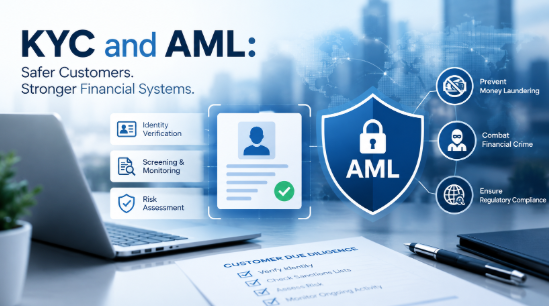
KYC and AML: Building Stronger Financial Relationships
A business may appear legitimate on paper, have registered documents, and maintain an active bank account. However, these details do not always reveal the risks behind its ownership, financial activities, or business connections. For banks, fintech companies, and payment providers, understanding customers requires more than collecting identification documents. They need to know who they are doing business with and whether the relationship presents financial crime risks. This is where KYC and AML processes work together. Know Your Customer (KYC) establishes customer identity and background information, while Anti-Money Laundering (AML) controls help identify potential financial crime risks. Together, they support better customer decisions and stronger financial oversight.
Why KYC and AML Compliance Matters for Corporate Banking
Corporate banking relationships involve businesses that may have multiple shareholders, subsidiaries, directors, and international links. This complexity can make customer assessment more difficult than with individual account onboarding. Beneficial owners may be in another country, even if the company is registered in another. They may also be involved in business relationships and financial transactions with high-risk jurisdictions. If due diligence is not done, the bank may not be able to see who or what is behind the account and what they are doing. Compliance with KYC and AML rules helps financial institutions better understand these relationships before providing services. This process includes customer identification, beneficial ownership checks, sanctions screening and risk assessments. For instance, if a bank adopts an international trading company, it might find that several holding companies are part of its ownership structure. Additional checks may show that one of its beneficial owners has political exposure or adverse media. This doesn’t necessarily imply that the company is committing any wrongdoing. But it also provides a justification for the compliance team to scrutinise the relationship. A risk-based approach to customer due diligence is recommended by the Financial Action Task Force (FATF). This involves customer identification, beneficial ownership and regular audits of business relationships.
Source of Funds vs Source of Wealth in KYC/AML Assessments
Understanding a customer’s financial background is an important part of enhanced due diligence. But source of funds is not synonymous with source of wealth. Source of funds describes where the funds used in a given transaction have originated. It can be income from business, wages, selling real estate, investments, or inheritance. The source of wealth indicates the way a customer has arrived at their total wealth in the course of the years. This could be from being a business owner, long-term investments, employment, or inherited assets. Suppose a business owner deposits a big sum into an investment account for his company. The proof of funds check reviews the origin of that amount of funds. The source of wealth assessment examines the owner’s overall financial stance in relation to how they have developed it. The difference becomes more critical in certain high-value transactions, politically exposed persons, and complex business structures that banks encounter. The KYC/AML assessment should evaluate if financial details are consistent with the information available about the customer. A mismatch does not constitute criminal activity; however, it could mean that more supporting documents or investigation is needed.
How AML Screening Strengthens Customer Risk Assessment
Customer information is a good starting point, but financial institutions must also look for external risk links. A business’s registration can be sound and have no reason to be revoked, whilst its directors or beneficial owners are on sanctions lists, PEP lists or adverse media records. This is where the importance of AML screening comes in. It can be used to match customer information to relevant risk data and identify potential matches for compliance teams. When it comes to corporate banking, it might not be sufficient to screen just the company name. Business relationship risks can also be posed by Directors, shareholders, ultimate beneficial owners, and related parties. These checks are facilitated by AML Watcher’s global AML screening platform. It includes more than 235 countries and states in its database, and over 100,000 data sources, 3,500+ watchlists, and over 6 million enriched PEP profiles. The platform also includes sanctions screening of 215+ global sanctions regimes, updated every 15 minutes. Adverse media includes both local and global news sources and enables institutions to identify possible links to financial misconduct and other risk areas. AML Watcher combines all these screening capabilities in one system to enable banks and fintechs to evaluate customer relationships against a wider risk profile. This helps to inform the reviews throughout the onboarding process and to facilitate better due diligence.
The Role of AML Software in Ongoing Customer Monitoring
The risk of customers may be modified during the term of an account relationship. A company can launch its operations in a new geographical market, undergo corporate restructuring, or become linked to people subject to regulatory investigations. One-off KYC procedures would not cover such changes. Ongoing reviews are required to detect any changes in customers’ behaviour that may affect existing relationships. AML solutions help compliance officers meet these demands through automated screening and transaction monitoring capabilities that provide up-to-date customer risk assessments. Thus, a payments processor might find out that one of its business clients began to receive abnormal amounts of cross-border payments. In combination with customer data and screening results, such behaviour might indicate suspicious activities requiring further investigation. With its compliance workflow integration, AML Watcher allows for ongoing customer screening and transaction monitoring. The system offers transaction monitoring capabilities featuring more than 150 AML typologies curated by experts and over 10,000 customizable rules. With these features, compliance officers can examine transactions in relation to various risk patterns. They can also manage alerts and focus on suspicious activity. For financial institutions, as the size of the customer portfolio grows, connecting screening.
Building Connected KYC and AML Solutions for Financial Institutions
KYC and AML compliance work best when customer information, screening results, and transaction activity are considered together. Treating each check as a separate task can create gaps in customer risk assessments. Banks, fintech companies, and payment providers need solutions that support the entire customer relationship. This includes onboarding, sanctions and PEP screening, adverse media checks, and ongoing transaction reviews. AML Watcher brings these capabilities together through one AML platform. Its screening data, customizable risk assessments, and transaction monitoring features help compliance teams maintain visibility across customer relationships. The platform also offers flexible deployment options, including cloud, on-premises, and private cloud environments. This allows financial institutions to align their AML operations with internal technology and data requirements. As financial services expand across borders, understanding customers becomes increasingly important. Strong KYC and AML controls help institutions identify potential risks, maintain better oversight, and make more informed business decisions.