Messeregge: Meaning, Uses, and Agricultural Context
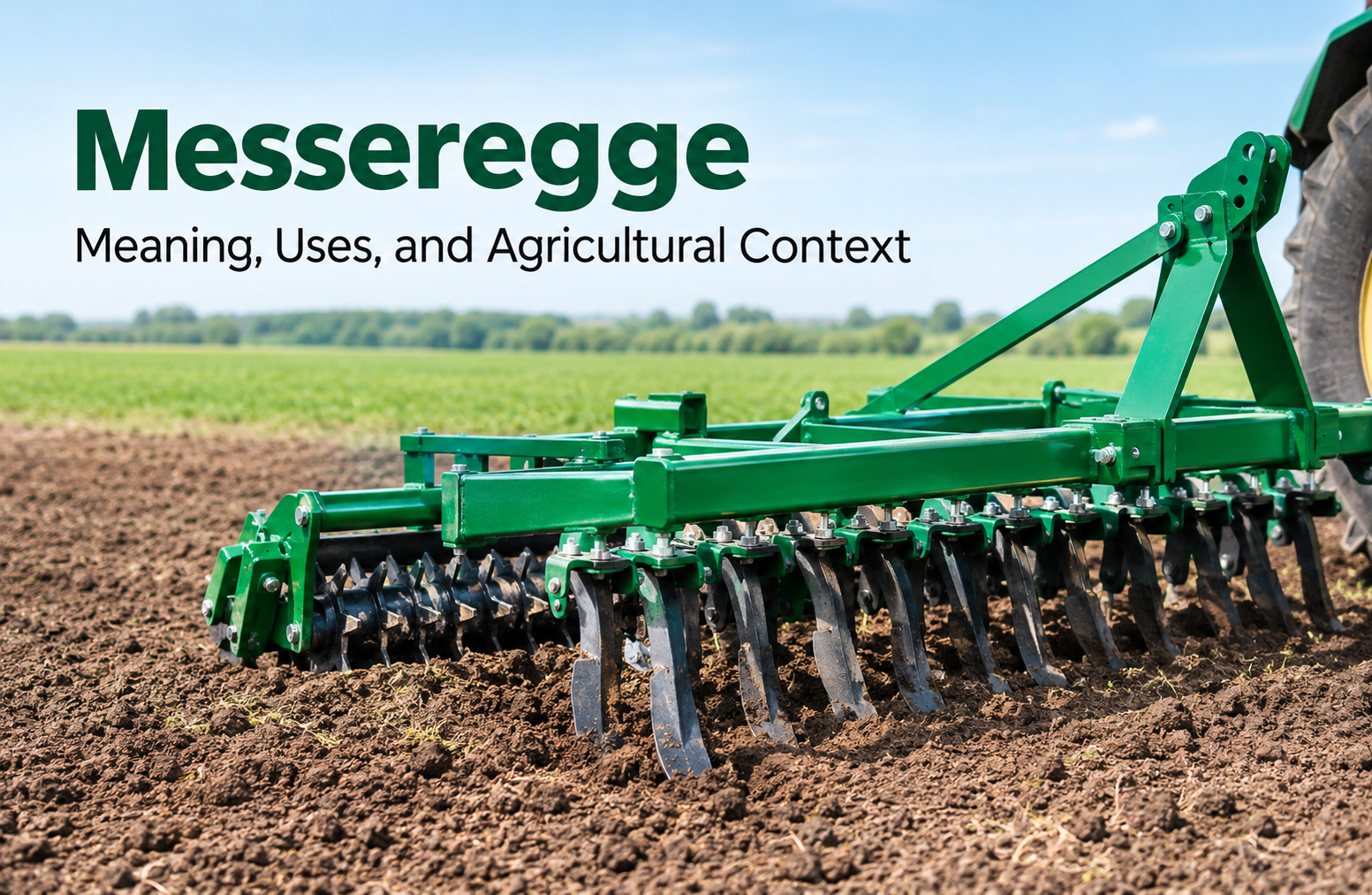
Messeregge is an unusual German agricultural term that can be confusing when encountered in English-language searches. In its agricultural context, the word refers to a harrow or soil-working implement associated with knife or blade-shaped working elements. The clearest way to understand it is through the German words behind the compound: Messer, meaning knife, and Egge, meaning harrow. Duden defines an Egge as an agricultural implement used for superficial loosening and crumbling of soil and for weed control.
Because the word is uncommon outside specialist agricultural circles, it is sometimes explained incorrectly online. Some pages have connected it with trade fairs, digital concepts, locations, or unrelated tools. Those interpretations should not automatically be treated as established meanings. In agricultural machinery documentation, however, the term has a concrete technical context. Manufacturer documentation from Kerner Maschinenbau, for example, identifies a specific Messeregge configuration and lists dedicated knife components and a supporting frame.
This distinction matters. Someone searching for the term may simply want to know what it means, but a farmer, machinery student, researcher, translator, or equipment enthusiast may also need to understand how the word fits into the broader family of harrows and soil preparation equipment. This guide focuses on that documented agricultural meaning while separating established information from assumptions that are not well supported.
What Is Messeregge?
In agricultural terminology, Messeregge can be understood as a knife harrow or a harrow incorporating knife-like working elements.
The second part of the word is particularly useful for understanding its purpose. In German, Egge refers to an agricultural implement used to work the surface of the soil. Duden describes the implement in terms of superficial soil loosening, crumbling, and weed control.
The first part, Messer, refers to a knife. Together, the compound therefore points toward a harrow design in which blade or knife elements form an important part of the working system.
That does not mean every machine called a Messeregge has exactly the same physical design. Agricultural machinery manufacturers can use related terminology for different configurations, attachments, and combinations. Kerner documentation, for example, shows the term in connection with a front-packer system and identifies individual knife components and a frame specifically associated with the implement.
The most useful definition, therefore, is not an overly narrow description of one particular machine. It is better to think of the term as a category or technical designation connected with knife-equipped harrowing and shallow soil preparation.
Understanding the Word Behind the Equipment
German agricultural vocabulary often makes the function of equipment easier to understand because compound nouns combine descriptive words.
In this case:
- Messer refers to a knife or blade.
- Egge refers to a harrow.
- Messeregge combines those concepts into an agricultural implement associated with knife-type working elements.
The distinction between Messer and Messe is important.
Messer and Messe look similar when written, particularly to someone who does not know German. They do not mean the same thing. Messe can refer to a trade fair, while Messer refers to a knife. As a result, explanations that build an agricultural definition around trade exhibitions can confuse two separate German words.
For an agricultural reader, Egge is the stronger clue because it immediately places the compound within the world of field implements.
Duden also documents the verb eggen, meaning to work land with a harrow. That linguistic connection reinforces the agricultural interpretation.
Why the Definition Can Be Difficult to Find
The main challenge with this term is not that the underlying agricultural idea is impossible to understand. The challenge is that the word is relatively specialized and appears in different forms of online content.
A search can produce pages that treat the term as:
- An agricultural implement.
- A knife harrow.
- A machinery attachment.
- A supposed digital concept.
- A supposed location or cultural term.
- A creative brand or invented expression.
These interpretations should not be treated as equally authoritative.
A technical manufacturer document has a different evidentiary value from a newly published general-interest article that provides no machinery documentation. In research, the surrounding context is therefore extremely important.
If the word appears beside terms such as Frontpacker, Messer, Rahmen, agricultural machinery, soil preparation, or field equipment, the agricultural interpretation is strongly supported. Kerner’s parts documentation, for example, explicitly lists components described as knives for a Messeregge and a frame for the implement.
This is a useful lesson for researching unfamiliar technical vocabulary: do not rely only on the spelling of a word. Look at the industry, surrounding terminology, manufacturer documentation, and actual equipment context.
The Agricultural Role of a Harrow
To understand the value of a knife-equipped harrow, it helps to understand what a harrow does generally.
A harrow is part of the broader family of agricultural implements used for working the upper part of the soil. Depending on its design, a harrow may contribute to several field-preparation objectives.
These can include:
- Breaking or reducing surface soil clods.
- Loosening the upper soil layer.
- Smoothing an uneven surface.
- Preparing conditions for subsequent field operations.
- Managing certain types of surface vegetation or weeds.
- Redistributing soil material across the working area.
The exact result depends heavily on the harrow design, soil conditions, crop system, and overall cultivation strategy.
This is why it would be misleading to describe every harrow as doing the same job. A tine harrow, disc harrow, spring-tooth harrow, chain harrow, and knife-based system use different working principles.
The word Egge itself establishes the basic agricultural category, while the Messer component provides the clue about the working elements.
How Messeregge Differs From a Generic Harrow
A generic harrow is a broad category rather than a single machine.
That distinction is important when discussing Messeregge because the term describes a more specific type of agricultural equipment.
A conventional tine harrow relies on teeth or tines. A disc harrow relies on rotating discs. Other harrow systems use chains, flexible elements, springs, or other mechanical arrangements.
A knife-equipped design introduces another approach, using knife or blade-type components as part of the soil-working system.
This can influence the character of the soil interaction, but it does not mean that one design is automatically superior to every alternative.
Agricultural machinery is highly dependent on context. Soil texture, moisture, residue conditions, crop rotation, field history, available horsepower, equipment combinations, and the farmer’s broader soil-management strategy can all affect which type of implement makes sense.
The right question is therefore not simply, “Is a Messeregge better?”
A more useful question is, “What type of soil-working effect is required, and does this implement category provide it within the intended farming system?”
That way of thinking avoids the common mistake of evaluating equipment in isolation.
Messeregge and Seedbed Preparation
One important agricultural context is seedbed preparation.
A suitable seedbed generally needs an appropriate balance between soil structure, surface condition, moisture, and seed placement requirements. The objective is not simply to make soil look smooth.
A field can appear visually attractive while still having problems that affect crop establishment. Excessive disturbance, unsuitable moisture conditions, compaction, or poor residue distribution can all influence the final result.
A shallow soil-working implement can therefore be considered as one part of a larger system rather than a complete solution by itself.
Manufacturer documentation illustrates this systems-based approach. Kerner’s material describes its front-packer arrangement with different harrow configurations and discusses the relationship between soil processing and the following roller system.
That is an important real-world insight. Agricultural machinery often works as a sequence.
One component changes the soil condition, another affects consolidation or surface structure, and subsequent equipment may handle sowing or other operations.
Surface Soil Work and Reduced Disturbance
One reason shallow-working agricultural equipment attracts attention is the increasing interest in reducing unnecessary soil disturbance.
Soil is not simply an inert material. It contains organic matter, microorganisms, roots, pores, moisture, and structural aggregates. Agricultural management therefore involves a balance between achieving the required field condition and avoiding disturbance that does not contribute to the intended result.
A surface-focused implement can fit into systems where the objective is to work primarily near the soil surface rather than aggressively overturning deeper material.
However, the presence of a knife element does not automatically prove that a particular machine is a conservation-tillage machine.
That conclusion requires information about the complete implement, its working characteristics, the field operation, and the farming system in which it is used.
This distinction is important because online descriptions sometimes turn a single equipment feature into a broad environmental claim. Good technical writing should avoid that shortcut.
Practical Benefits in an Agricultural Context
The potential benefits of a knife-based harrow are best understood as equipment characteristics rather than universal promises.
Surface Conditioning
A knife-based working system can be designed for controlled interaction with the upper soil layer. This makes it relevant to applications where surface condition is more important than deep soil inversion.
Soil Surface Preparation
Harrowing can contribute to the preparation of a more suitable surface for later agricultural operations. The exact result depends on the machine design and field conditions.
Integration With Other Equipment
One of the most interesting aspects of modern agricultural machinery is equipment integration.
The manufacturer documentation examined for this article shows Messeregge equipment associated with front-packer machinery.
This illustrates how a harrow does not necessarily operate as an isolated implement. It can form part of a larger field-preparation arrangement.
Mechanical Simplicity of the Basic Concept
The concept itself is straightforward: a harrow category combined with knife-like working components.
That simplicity makes the terminology relatively intuitive once the German compound is understood.
Where the Term Appears in Modern Machinery
The word is particularly useful to recognize when reading German or Central European agricultural machinery material.
It can appear in:
- Machinery brochures.
- Parts lists.
- Operator documentation.
- Equipment specifications.
- Agricultural engineering material.
- Dealer descriptions.
- Discussions of front-mounted field equipment.
Kerner’s parts documentation is particularly useful because it does not merely use the word as a general concept. It identifies specific parts described as knives for the Messeregge and identifies a dedicated frame.
That type of evidence is stronger than a generic article that simply repeats the word.
For translators and researchers, this also means that context should guide translation. Depending on the document, translating the term as “knife harrow” may be more informative than leaving the German word unexplained.
Messeregge in Modern Farming Systems
Modern farming increasingly involves equipment combinations rather than isolated machines.
A field operation may involve several stages, each designed to achieve a particular soil or crop-management objective.
Within such a system, a knife harrow may have a role related to surface preparation. It can also appear as part of a front-mounted configuration, where its function is coordinated with other equipment.
This is why agricultural machinery should be evaluated at the system level.
A machine can perform well in one soil type and be less suitable in another. The same implement can have different practical value depending on crop residue, moisture, timing, field condition, and the farmer’s management objectives.
Consequently, there is no credible universal statement that a particular harrow design is always the correct choice.
The more accurate approach is to describe what the equipment is designed to do and then consider whether those characteristics match the agricultural context.
Common Misunderstandings
It Does Not Mean “Messenger”
The spelling may initially remind English speakers of words such as “message” or “messenger.”
That resemblance is accidental.
Messeregge belongs to German agricultural terminology and is not an alternative spelling for a messaging platform or communication method.
It Is Not the Same as “Messe”
The difference between Messer and Messe is especially important.
Messer means knife.
Messe can refer to a trade fair.
Confusing the two can lead to an incorrect explanation of the agricultural word.
It Is Not Simply a Handheld Knife
The agricultural context matters.
The term contains Egge, which identifies a harrow or agricultural implement. It should therefore not be interpreted as the name of an ordinary handheld cutting tool.
It Does Not Describe One Universal Machine
Manufacturers may use related terminology for different configurations.
The documented Kerner material demonstrates that the term can appear in a particular machinery system and in parts documentation.
That does not justify assuming that every machine described using the term has identical dimensions, construction, or capabilities.
Not Every Online Explanation Is Equally Reliable
This may be the most important point for researchers.
An unusual keyword can attract speculative content because publishers want to explain something that relatively few people understand. That can result in confident claims that are not supported by primary documentation.
When researching specialist agricultural terminology, manufacturer manuals, parts catalogs, agricultural dictionaries, and established technical references deserve greater weight than unsupported explanations.
Why Context Matters When Translating the Term
Technical translation is rarely just a matter of replacing one word with another.
Suppose a German machinery manual contains the term Messeregge. Translating it as “knife harrow” immediately gives an English reader a useful functional description.
But in a parts catalog, retaining the original German term alongside the translation may be useful because the original name can help identify the exact component or machine family.
In a general article, a sentence such as “The German term Messeregge refers to a knife-equipped harrow used in agricultural soil preparation” provides both the original terminology and its meaning.
This approach reduces ambiguity.
It also helps readers distinguish the technical term from similarly spelled words that belong to completely different areas.
What Buyers and Researchers Should Look For
Anyone researching agricultural equipment should avoid selecting machinery based solely on the name.
The name provides a starting point, not a complete specification.
Important information normally includes:
- The manufacturer’s technical documentation.
- The intended agricultural application.
- The machine’s working configuration.
- Compatibility with associated equipment.
- Soil and crop conditions for which the equipment is intended.
- Available technical specifications.
- Maintenance requirements.
- Safety information.
- Local agricultural requirements.
Because equipment designs vary, the manufacturer’s documentation for a specific machine should always take priority over a generic internet explanation.
This is particularly important when terminology is being used as a category name rather than a precise model designation.
The Difference Between Description and Recommendation
There is another useful lesson in researching agricultural machinery.
Describing an implement is different from recommending it.
A factual description can explain that a knife harrow is associated with blade-type working elements and surface soil preparation. A recommendation would require considerably more information about a particular farm, field, crop, soil, machinery fleet, and management objective.
Without that information, a blanket recommendation would be unreliable.
This distinction is especially valuable for online agricultural content. Readers often need facts first. They can then compare those facts with their own circumstances or consult qualified agricultural professionals and equipment specialists.
Historical and Linguistic Importance
Agricultural vocabulary often preserves information about how farming tools were designed.
Words such as Egge reflect a long history of describing implements according to their physical form and function. Duden records the agricultural meaning of Egge and traces the associated verb eggen through historical German usage.
Compound terms such as Messeregge follow a familiar German naming pattern.
Rather than creating a completely abstract product name, the compound tells the reader something about the object itself.
That makes the term valuable from a linguistic perspective as well as an agricultural one.
It shows how technical vocabulary can develop directly from the physical characteristics of machinery.
Why This Term Matters for Agricultural Research
For students and researchers, recognizing the word can prevent major misunderstandings.
A researcher working with German agricultural literature may encounter a machine description that does not have an obvious English equivalent.
Understanding that Messeregge belongs to the harrow family immediately narrows the subject.
From there, the researcher can investigate:
- The type of working elements.
- The machine configuration.
- The intended soil-working function.
- The manufacturer or historical source.
- The relationship with other agricultural implements.
This is much more reliable than assuming the word represents a completely new or unrelated technology.
A Better Way to Research Unfamiliar Agricultural Terms
When encountering an unfamiliar machinery term, use a source-first approach.
Start With the Original Language
Do not immediately assume that an unusual German word has a direct English equivalent.
First identify its components and grammatical structure.
Check a Recognized Dictionary
A dictionary can establish whether a component such as Egge has a documented agricultural meaning. Duden provides that evidence for Egge.
Examine Manufacturer Documentation
Manufacturer manuals and parts catalogs can reveal how the term is used in real equipment.
This is especially valuable for technical terms because manufacturers must use terminology consistently enough for parts identification and equipment documentation.
Compare Multiple Sources
One website may simplify a term too aggressively.
Comparing dictionaries, manufacturer documents, and agricultural literature can reveal where the evidence is strong and where uncertainty remains.
Separate Meaning From Marketing
A company may give a product a commercial name, but that does not necessarily redefine the underlying agricultural term.
The distinction between a technical category and a brand or model name should remain clear.
Safety and Responsible Interpretation
Agricultural machinery is powerful equipment, and knife or blade components can present serious physical hazards.
For that reason, technical descriptions should not be confused with operating instructions.
The safe interpretation of the term is informational: it identifies an agricultural implement or configuration associated with knife-type working elements.
Actual operation, adjustment, maintenance, transport, and repair should be governed by the specific manufacturer’s documentation and appropriate adult or professional supervision.
This is particularly important for students or people encountering agricultural machinery for the first time. Understanding the terminology is useful, but terminology alone is not sufficient preparation for working around powered equipment.
Messeregge Versus Other Agricultural Implements
It is helpful to place the term within the larger machinery landscape.
| Equipment category | General working concept | Typical agricultural role |
| Tine harrow | Teeth or tines interact with soil | Surface cultivation and preparation |
| Disc harrow | Rotating discs work the soil | Soil cutting, mixing, and cultivation |
| Chain harrow | Flexible linked elements drag across the surface | Light surface treatment |
| Knife harrow | Knife or blade-type elements form part of the working system | Surface soil preparation |
| Roller or packer | Rolling and consolidation | Surface finishing and soil consolidation |
This comparison should not be interpreted as a performance ranking.
Each category exists because agricultural conditions vary. Different soil types and production systems create different requirements.
The purpose of the comparison is simply to show where a knife harrow fits.
The Most Important Takeaway
The simplest reliable explanation is also the most useful:
Messeregge is a German agricultural term associated with a knife-equipped harrow or blade-based harrowing system.
The word is best understood as a compound involving Messer and Egge. The latter clearly belongs to agricultural vocabulary, with Duden defining it as a farm implement used for superficial soil loosening, crumbling, and weed control.
Modern machinery documentation provides further evidence that the term is used in real agricultural equipment contexts. Kerner documentation, for example, refers specifically to a Messeregge and identifies associated knife and frame components.
At the same time, the term should not be stretched into unsupported meanings. Online content can introduce speculative interpretations, but a documented agricultural meaning should remain the starting point when the word appears in farming or machinery material.
Understanding that distinction makes the term much easier to research, translate, and place within the wider field of agricultural engineering.
Frequently Asked Questions
What does Messeregge mean?
Messeregge is a German agricultural term associated with a knife harrow or harrow using knife or blade-type working elements for soil preparation.
Is Messeregge a type of harrow?
Yes. In its agricultural context, the term belongs to the harrow family and describes equipment associated with knife-type working components.
What does “Egge” mean in German agriculture?
Egge means harrow. Duden defines it as an agricultural implement used for superficial loosening and crumbling of soil and for weed control.
Is Messeregge the same as Messe?
No. Messer and Messe are different German words. The agricultural interpretation comes from Messer and Egge, not from Messe.
Is Messeregge a brand?
Not necessarily. The term is used in an agricultural equipment context and can describe a type or configuration rather than one universal brand. Specific manufacturers may use the term for particular equipment designs.
Where can the term Messeregge be found?
It can appear in German agricultural machinery documentation, parts lists, equipment descriptions, and technical material. Manufacturer documentation provides particularly useful evidence for understanding its practical meaning.
Conclusion
Messeregge is a specialized agricultural term that becomes much easier to understand once its German structure and technical context are recognized. It is associated with a knife-equipped harrow or blade-based soil-working system, placing it firmly within agricultural machinery rather than digital communication, exhibition design, or other speculative interpretations.
The most reliable way to understand the term is to combine linguistic evidence with real machinery documentation. The meaning of Egge is clearly established in German agricultural vocabulary, while manufacturer documentation demonstrates that Messeregge is used in actual agricultural equipment contexts.
The broader lesson is useful beyond this single word. Technical agricultural terminology should be interpreted through context, primary documentation, and established terminology rather than through unsupported online definitions. For farmers, students, translators, and machinery researchers, that approach produces a clearer and more trustworthy understanding of specialized equipment.