Michigan wolverines football vs Nebraska cornhuskers football match player stats
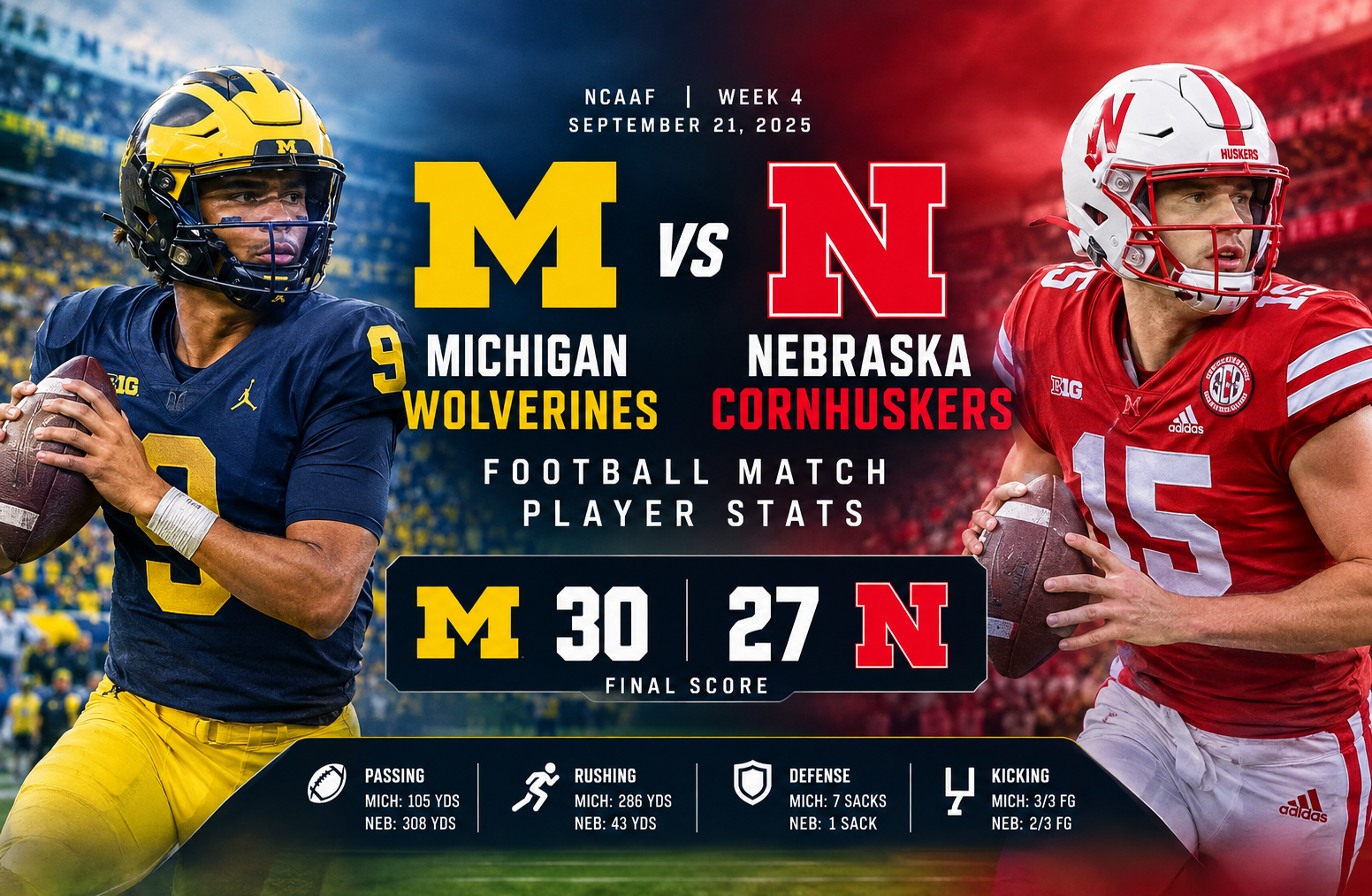
The michigan wolverines football vs nebraska cornhuskers football match player stats from the 2025 Big Ten matchup show how Michigan won a 30-27 road game through an explosive rushing attack, timely defensive pressure, and reliable kicking, even though Nebraska produced the stronger passing performance. Michigan finished with 286 rushing yards and three rushing touchdowns, while Nebraska produced 308 passing yards and three passing touchdowns through Dylan Raiola. The official Michigan record lists the game as September 20, 2025, at Memorial Stadium in Lincoln, Nebraska, although the supplied dataset identifies September 21. (University of Michigan Athletics)
Michigan entered the contest at 2-1 and Nebraska also carried a 3-0 record into the matchup. By the end of the afternoon, Michigan had moved to 3-1 overall and 1-0 in Big Ten play, while Nebraska dropped to 3-1 and 0-1 in conference competition. The final score was Michigan 30, Nebraska 27. (University of Michigan Athletics)
The box score tells a particularly interesting story because the winning team did not dominate every statistical category. Nebraska gained more passing yards, produced more first downs, ran more offensive plays, and controlled possession for longer. Michigan, however, generated the explosive plays that changed the scoreboard, especially through Justice Haynes, Jordan Marshall, and Bryce Underwood.
Michigan Wolverines Football vs Nebraska Cornhuskers Football Match Player Stats
The simplest way to understand the game is to separate production into passing, rushing, receiving, defense, and special teams.
| Category | Michigan | Nebraska |
| Final score | 30 | 27 |
| Passing yards | 105 | 308 |
| Rushing yards | 286 | 43 |
| Total offensive yards | 391 | 351 |
| First downs | 16 | 23 |
| Offensive plays | 56 | 72 |
| Possession | 26:43 | 33:17 |
| Third-down conversions | 4/12 | 2/13 |
| Fourth-down conversions | 0/0 | 2/3 |
| Sacks allowed | 1 | 7 |
The official Michigan box score confirms the major statistical contrast: Nebraska had 308 passing yards but only 43 rushing yards, while Michigan had 286 rushing yards and 105 passing yards. Michigan also recorded seven sacks compared with Nebraska’s one. (University of Michigan Athletics)
That contrast is central to the game. Nebraska moved the ball through the air, but Michigan repeatedly created negative plays and explosive rushing gains. Michigan did not need a high-volume passing attack because its ground game consistently produced field position and scoring opportunities.
How Michigan Won Despite Throwing for Only 105 Yards
At first glance, Michigan’s passing total looks modest. Bryce Underwood completed 12 of 22 passes for 105 yards, with no touchdowns and no interceptions. Semaj Morgan attempted one pass and did not complete it.
Those numbers would normally suggest that Michigan needed another way to create offense. It found that answer on the ground.
Michigan rushed 33 times for 286 yards, averaging 8.7 yards per attempt. The Wolverines scored three rushing touchdowns, with all three coming on long runs.
Justice Haynes was the most productive Michigan runner. He carried the ball 17 times for 149 yards, averaging 8.8 yards per attempt. His longest run went 75 yards, and that play became one of the defining moments of the afternoon.
Jordan Marshall provided another major burst. He had only six carries but gained 80 yards, an extraordinary 13.3 yards per carry. His longest run covered 54 yards and resulted in a touchdown.
Bryce Underwood also contributed 61 rushing yards on eight carries. His 37-yard touchdown run gave Michigan an early advantage and demonstrated that the quarterback could create significant yardage outside the passing game.
Justice Haynes Produced the Biggest Rushing Performance
Haynes’ 149 yards represented more than half of Michigan’s rushing total.
His 75-yard touchdown run in the second quarter was particularly important because Nebraska had begun to establish momentum. Michigan had entered halftime tied 17-17, and Haynes’ explosive run prevented the Cornhuskers from controlling the second-quarter narrative.
The play also illustrates why rushing averages need context. A player averaging 8.8 yards per carry can arrive at that figure in very different ways. Haynes combined steady carries with a game-changing 75-yard play.
His other contribution came as a receiver, where he caught three passes for 12 yards. That gave him 161 yards from scrimmage.
Jordan Marshall Changed the Third Quarter
Marshall’s 54-yard touchdown run came at 5:40 of the third quarter.
The score moved Michigan ahead 27-17 after the Wolverines had already taken a 20-17 lead through Dominic Zvada’s 56-yard field goal.
That sequence mattered because Nebraska had just completed a strong second quarter and entered halftime level. Michigan responded with a 10-point third quarter while keeping Nebraska scoreless.
Marshall’s limited workload makes his efficiency even more notable. Six rushing attempts produced 80 yards and one touchdown.
Bryce Underwood Added a Quarterback Rushing Threat
Underwood’s passing line was not the main reason Michigan won, but his rushing production helped make the offense difficult to defend.
He carried eight times for 61 yards and scored once. His 37-yard touchdown came late in the first quarter and helped Michigan establish a 10-0 lead.
He also had one lost fumble during the game. Nebraska recovered after Underwood was stripped on a second-quarter rushing play.
Despite that mistake, Michigan continued to use his legs as an important part of the offensive approach.
Dylan Raiola Led Nebraska’s Passing Attack
If Michigan controlled the game on the ground, Nebraska controlled it through the air.
Dylan Raiola completed 30 of 41 passes for 308 yards, three touchdowns, and one interception. His completion rate was approximately 73.2%, and his average gain was 7.5 yards per attempt.
The official box score records seven sacks against Raiola, which reduced Nebraska’s effective offensive efficiency despite his strong passing numbers. (ESPN)
Raiola’s three touchdown passes kept Nebraska within striking distance throughout the game.
Two of his touchdown passes went to Jacory Barney Jr., while another went to Heinrich Haarberg.
The biggest of the three came at the end of the first half when Raiola connected with Barney Jr. for a 52-yard touchdown. That play tied the game at 17-17 just before halftime.
Jacory Barney Jr. Was Nebraska’s Top Receiving Threat
Barney Jr. finished with six receptions for 120 yards and two touchdowns.
His 20.0 yards-per-reception average was the highest among Nebraska players with multiple catches, and his longest reception covered 52 yards.
His production explains much of Nebraska’s passing success. Michigan’s defense had difficulty preventing explosive plays through the air, even though it generated substantial pressure on Raiola.
Barney’s second touchdown, a 52-yard catch, was particularly damaging because it arrived with no time remaining in the second quarter.
Luke Lindenmeyer Provided Consistent Volume
Luke Lindenmeyer led Nebraska in receptions with seven.
He gained 60 yards, averaging 8.6 yards per catch. Unlike Barney Jr., whose impact came from explosive gains, Lindenmeyer provided a more consistent outlet for Raiola.
His seven catches represented almost one-quarter of Nebraska’s 30 completions.
Other Nebraska Receivers
Nebraska’s passing attack was not limited to one player.
Dane Key caught three passes for 36 yards, while Nyziah Hunter added two receptions for 34 yards.
Emmett Johnson caught five passes for 32 yards, giving Nebraska’s primary running back another role in the passing game.
Heinrich Haarberg caught three passes for 18 yards and scored the Cornhuskers’ final touchdown on a three-yard reception in the fourth quarter.
That touchdown cut Michigan’s lead to 30-27 with 1:34 remaining.
Michigan’s Receiving Production Was Quiet but Functional
Michigan did not produce a 100-yard receiver.
Donaven McCulley led the Wolverines with three receptions for 39 yards. His longest catch was 16 yards.
Semaj Morgan caught two passes for 22 yards, while Marlin Klein also caught two for 21.
Justice Haynes recorded three receptions for 12 yards, and Zack Marshall and Channing Goodwin added one reception apiece.
Michigan finished with 12 completions for 105 yards and no receiving touchdowns.
That lack of production through the air was offset by the rushing game. The Wolverines did not need their receivers to produce a large number of yards because their running backs repeatedly generated chunk plays.
Defensive Statistics Explain Michigan’s Victory
One of the most important parts of the michigan wolverines football vs nebraska cornhuskers football match player stats is the defensive comparison.
Michigan recorded 76 total tackles, including 40 solo tackles, seven sacks, and nine tackles for loss.
Nebraska recorded 54 tackles, 26 solo tackles, one sack, and five tackles for loss.
The seven-sack difference is significant.
Nebraska threw the ball 41 times. That created opportunities for Michigan’s pass rush to affect the game, and the Wolverines repeatedly got to Raiola.
Ernest Hausmann Led Michigan in Tackles
Ernest Hausmann finished as Michigan’s leading tackler with nine total tackles.
He recorded six solo tackles, one sack, and one tackle for loss.
His production reflects the broader role Michigan’s defense played. The Wolverines had to defend 72 Nebraska offensive plays, yet they consistently created negative plays despite spending more time on the field.
Jayden Sanders Made a Major Defensive Contribution
Jayden Sanders recorded eight tackles, including five solo tackles, and defended one pass.
His involvement was especially important because Nebraska’s passing attack generated more than 300 yards.
Michigan needed its defensive backs and linebackers to handle a high number of passing situations while the defensive front attempted to pressure Raiola.
Jaishawn Barham Added Pressure
Jaishawn Barham finished with four tackles, two solo tackles, one sack, and two tackles for loss.
His sack was part of Michigan’s seven-sack defensive performance.
The combination of pressure and tackling allowed Michigan to survive Nebraska’s strong passing numbers.
Nebraska’s Defense Could Not Match Michigan’s Explosiveness
Nebraska recorded 54 total tackles and one sack.
Javin Wright led the Cornhuskers with 10 total tackles and one tackle for loss.
Vincent Shavers Jr. added seven tackles and one tackle for loss.
The defensive numbers show that Nebraska was active, but Michigan’s rushing efficiency presented a difficult problem.
Giving up three rushing touchdowns of 37, 54, and 75 yards meant Michigan could score quickly without sustaining long drives.
That is an important distinction when analyzing total yardage. Nebraska actually ran more plays and possessed the ball for more than 33 minutes, but Michigan created more points from fewer offensive opportunities.
Third Down Was a Major Part of the Story
Michigan converted four of 12 third downs.
That is only 33.3%, so third-down conversion was not a dominant strength for the Wolverines.
Nebraska was even less successful, converting only two of 13 third-down opportunities.
That works out to 15.4%.
The difference becomes more meaningful when combined with the sack totals.
Nebraska needed to convert difficult downs to maintain drives, but Michigan’s defense repeatedly forced long-yardage situations.
Michigan also went 0-for-0 on fourth down because it did not need to attempt one.
Nebraska went 2-for-3 on fourth down, showing that the Cornhuskers were willing to extend possessions. Still, those conversions were not enough to overcome the negative plays created by Michigan’s defense.
Time of Possession Favored Nebraska
Nebraska held the ball for 33:17.
Michigan possessed it for 26:43.
This is another statistic that makes the final result more interesting.
Nebraska ran 72 offensive plays compared with Michigan’s 56. The Cornhuskers also recorded 23 first downs to Michigan’s 16.
Normally, those figures can indicate strong offensive control.
However, Michigan produced far more yards per rushing attempt and generated three explosive rushing touchdowns.
The Wolverines therefore gained more from individual plays even though they had fewer possessions and fewer total plays.
The Field Goal Battle Also Mattered
Dominic Zvada had a perfect afternoon for Michigan.
He made all three of his field-goal attempts, including a 56-yarder, and converted all three extra-point attempts.
He scored 12 total points.
His 56-yard field goal came in the third quarter and gave Michigan a 20-17 lead.
Later, he converted a 21-yard field goal with 3:54 remaining to extend Michigan’s advantage to 30-20.
That kick became especially important when Nebraska scored its final touchdown less than three minutes later.
Kyle Cunanan made two of three field goals for Nebraska and converted all three extra points. He scored nine points.
The kicking difference was three points, exactly the final margin.
Michigan’s Defense Made the Final Stand
Nebraska’s final scoring drive made the closing minutes uncomfortable for Michigan.
Raiola continued moving the ball through short and intermediate completions. Nebraska converted a fourth-and-one when Raiola connected with Haarberg for six yards.
The Cornhuskers reached the Michigan 39-yard line during the final drive and continued to push for another scoring opportunity.
However, Michigan’s earlier defensive work had created enough separation on the scoreboard.
The final 30-27 margin reflected a game in which neither side completely controlled all four quarters.
Michigan dominated the first quarter 10-0.
Nebraska answered with a 17-point second quarter.
Michigan then produced the only points of the third quarter, scoring 10.
Nebraska responded with 10 points in the fourth, but Michigan’s 30-27 lead held.
Quarter-by-Quarter Breakdown
| Quarter | Michigan | Nebraska | What Happened |
| First | 10 | 0 | Michigan established early control |
| Second | 7 | 17 | Nebraska erased the deficit |
| Third | 10 | 0 | Michigan regained momentum |
| Fourth | 3 | 10 | Nebraska rallied late |
| Final | 30 | 27 | Michigan held on |
The official scoring log confirms that Michigan’s first-quarter points came from a 46-yard field goal by Zvada and Underwood’s 37-yard rushing touchdown. Nebraska’s second-quarter comeback included two touchdowns, one of them a 52-yard Raiola-to-Barney Jr. connection. (University of Michigan Athletics)
Michigan’s third-quarter response was equally important. Zvada hit from 56 yards before Marshall broke free for a 54-yard touchdown.
That sequence gave Michigan a 27-17 advantage.
Explosive Plays Decided the Game
The clearest lesson from this matchup is the value of explosive plays.
Michigan had three rushing touchdowns:
- Bryce Underwood: 37 yards
- Justice Haynes: 75 yards
- Jordan Marshall: 54 yards
Nebraska had two particularly explosive passing touchdowns to Barney Jr.:
- 26 yards
- 52 yards
Nebraska’s final touchdown came on a three-yard reception by Haarberg.
This means both teams had explosive offensive moments, but Michigan generated three long rushing touchdowns while Nebraska’s explosive passing game was counterbalanced by seven sacks.
That combination explains why Nebraska could gain 308 passing yards and still lose by three points.
Turnovers Were Limited but Important
Michigan lost one fumble by Underwood.
Nebraska did not lose a fumble, according to the official team statistics, but Michigan recorded one interception by Cole Sullivan.
That gave the Wolverines the only interception of the game.
The turnover margin therefore favored Michigan by one.
When a game is decided by three points, even a single takeaway can have major importance.
Sullivan’s interception did not produce a defensive touchdown, but preventing another Nebraska scoring possession was valuable in a matchup where the Cornhuskers were capable of moving the ball through the air.
Special Teams Comparison
Special teams also contributed to the statistical picture.
Michigan
Dominic Zvada:
- 3/3 field goals
- 3/3 extra points
- 56-yard long field goal
- 12 points
Hudson Hollenbeck:
- 4 punts
- 164 total punting yards
- 41.0-yard average
- 49-yard long
- 1 inside the 20
Kendrick Bell returned one kickoff for one yard.
Semaj Morgan returned one punt for minus one yard.
Nebraska
Kyle Cunanan:
- 2/3 field goals
- 3/3 extra points
- 39-yard long field goal
- 9 points
Archie Wilson:
- 4 punts
- 197 total yards
- 49.3-yard average
- 56-yard long
Isaiah Mozee returned one kickoff for 23 yards.
Jacory Barney Jr. returned three punts for 21 yards.
The punting numbers favored Nebraska in average distance, while Michigan had the more productive field-goal performance.
What the Player Stats Reveal About Each Offense
The michigan wolverines football vs nebraska cornhuskers football match player stats reveal two very different offensive identities in this particular game.
Michigan’s offense was built around the running game.
The Wolverines produced 286 rushing yards at 8.7 yards per attempt. Three different players averaged more than seven yards per carry.
Nebraska’s offense relied heavily on the passing game.
Raiola completed 30 passes, and Nebraska’s receivers combined for 308 yards.
The contrast was almost exact:
Michigan:
286 rushing yards + 105 passing yards = 391 total yards
Nebraska:
43 rushing yards + 308 passing yards = 351 total yards
Michigan therefore produced 40 more total yards despite having 16 fewer offensive plays.
That is one of the most useful statistical observations from the game.
Efficiency Was More Important Than Volume
Nebraska’s 72 offensive plays generated 351 yards.
That equals approximately 4.9 yards per play.
Michigan’s 56 plays produced 391 yards.
That equals approximately 7.0 yards per play.
The difference is substantial.
Michigan averaged roughly 2.1 more yards per offensive play.
That efficiency gap helps explain why the Wolverines could have less possession time and fewer first downs while still scoring 30 points.
Michigan’s offense did not need long, methodical drives every time. One successful rushing play could move the ball 50 or 70 yards.
What Went Wrong for Nebraska’s Running Game
Nebraska finished with only 43 rushing yards on 31 attempts.
Emmett Johnson led the team with 19 carries for 65 yards, but the overall team total was pulled down by negative rushing plays.
Raiola carried seven times for minus-49 yards, largely because sacks count against team rushing totals in college football statistics.
That negative production heavily affected Nebraska’s rushing number.
Mekhi Nelson had three carries for 19 yards, while Jacory Barney Jr. had one carry for seven yards.
Nebraska therefore had some efficient individual rushing attempts but lacked consistent team rushing production.
The Importance of Michigan’s Seven Sacks
The seven sacks deserve special attention because they affected more than the defensive stat sheet.
Raiola’s passing numbers were excellent in several respects. He completed 30 of 41 attempts for 308 yards and three touchdowns.
But seven sacks created a different picture.
Sacks ended drives, created long-yardage situations, reduced field position, and forced Nebraska to overcome negative plays.
Michigan’s defensive front therefore contributed to the victory without needing to completely shut down the passing game.
This is a good example of why evaluating a quarterback only through completions, yards, and touchdowns can miss an important part of the game.
Player Stat Leaders
Michigan Leaders
Passing: Bryce Underwood, 12/22, 105 yards
Rushing: Justice Haynes, 17 carries, 149 yards, 1 TD
Receiving: Donaven McCulley, 3 receptions, 39 yards
Tackles: Ernest Hausmann, 9 total
Sacks: Michigan defense recorded 7 as a team
Field goals: Dominic Zvada, 3/3
Nebraska Leaders
Passing: Dylan Raiola, 30/41, 308 yards, 3 TD, 1 INT
Rushing: Emmett Johnson, 19 carries, 65 yards
Receiving: Jacory Barney Jr., 6 receptions, 120 yards, 2 TD
Tackles: Javin Wright, 10 total
Field goals: Kyle Cunanan, 2/3
A Closer Look at the Most Important Numbers
| Player | Team | Key Stat |
| Justice Haynes | Michigan | 149 rushing yards, 1 TD |
| Jordan Marshall | Michigan | 80 rushing yards, 1 TD |
| Bryce Underwood | Michigan | 61 rushing yards, 1 TD |
| Dominic Zvada | Michigan | 12 points |
| Ernest Hausmann | Michigan | 9 tackles |
| Dylan Raiola | Nebraska | 308 passing yards, 3 TD |
| Jacory Barney Jr. | Nebraska | 120 receiving yards, 2 TD |
| Emmett Johnson | Nebraska | 65 rushing yards |
| Javin Wright | Nebraska | 10 tackles |
| Heinrich Haarberg | Nebraska | 18 receiving yards, 1 TD |
These numbers demonstrate that the game did not have one universal statistical leader.
Raiola produced the strongest passing line.
Haynes produced the strongest rushing line.
Barney Jr. produced the strongest receiving line.
Zvada produced the strongest kicking performance.
Michigan’s defense produced the most significant team-level pressure statistic with seven sacks.
The final result came from how those individual performances interacted rather than from one overwhelming box-score category.
Why the 30-27 Score Makes Sense Statistically
The final score initially looks like a close offensive shootout.
In reality, it was a contrast between two styles.
Michigan scored 30 points while producing only 105 passing yards because its rushing attack was extremely efficient.
Nebraska scored 27 points while rushing for only 43 yards because Raiola completed 30 passes for 308 yards.
The Wolverines also converted three field goals, including one from 56 yards.
Nebraska’s three touchdowns through the air kept the score close, but Michigan’s ability to generate long rushing touchdowns gave it the scoring advantage.
The game therefore illustrates an important football principle: total passing yards, possession time, and first downs do not automatically determine the winner.
Michigan’s Three Long Touchdowns
The three Michigan rushing touchdowns came from three different players.
Underwood opened the scoring with a 37-yard run.
Haynes then delivered the game’s longest touchdown run at 75 yards.
Marshall followed with a 54-yard touchdown.
Together, those three plays accounted for 166 yards and 18 points.
That is remarkable production from only three individual plays.
It also explains why Michigan’s 286 rushing yards were so efficient.
Nebraska’s Passing Game Kept the Game Competitive
Nebraska’s passing production prevented the game from becoming a one-sided contest.
Raiola completed 30 passes to nine different receivers who recorded positive yardage.
Barney Jr. led the group, but Lindenmeyer, Key, Hunter, Johnson, and Haarberg all contributed.
The distribution gave Nebraska several ways to attack Michigan’s defense.
Even after falling behind 30-20 in the fourth quarter, Nebraska continued to move the ball and eventually scored to make it 30-27.
That late drive demonstrated the effectiveness of the passing attack, even though Michigan ultimately prevented the comeback.
The Defensive Difference
The defensive comparison is arguably the clearest explanation for Michigan’s victory.
Michigan allowed 308 passing yards but held Nebraska to 43 rushing yards.
At the same time, Michigan recorded seven sacks and one interception.
Nebraska’s defense had one sack and no interceptions.
Michigan therefore created more disruption against the opposing quarterback.
The Wolverines also recorded nine tackles for loss, compared with five for Nebraska.
Those negative plays helped compensate for Nebraska’s advantage in possession and first downs.
Final Statistical Assessment
The most useful way to read the game is not to ask which team dominated every category.
Neither did.
Instead, the numbers show that Michigan won through efficiency and explosive rushing plays, while Nebraska relied on passing volume and sustained possession.
Michigan’s 391 total yards came on only 56 offensive plays.
Nebraska’s 351 yards came on 72 plays.
Michigan averaged approximately 7.0 yards per play compared with Nebraska’s approximately 4.9.
The Wolverines also produced seven sacks, while Nebraska recorded one.
Dominic Zvada converted all three field-goal attempts.
Those details collectively explain how Michigan could win despite Nebraska recording more first downs, more offensive plays, more passing yards, and more possession time.
Michigan Wolverines Football vs Nebraska Cornhuskers Football Match Player Stats: Key Takeaways
The michigan wolverines football vs nebraska cornhuskers football match player stats provide several clear conclusions from the September 2025 meeting.
First, Michigan’s rushing attack was the biggest source of offensive efficiency. Haynes, Marshall, and Underwood combined for 290 rushing yards and three touchdowns.
Second, Nebraska’s passing attack was highly productive. Raiola threw for 308 yards and three touchdowns, while Barney Jr. produced 120 receiving yards and two touchdowns.
Third, Michigan’s defense changed the game with seven sacks and an interception.
Fourth, special teams mattered. Zvada scored 12 points and made every kick he attempted.
Finally, the game shows why box-score analysis requires multiple categories. Nebraska led in possession, first downs, offensive plays, and passing yards, yet Michigan produced more total yards and significantly more yards per play.
The official Michigan box score provides the complete scoring sequence and individual statistics for the matchup. official Michigan box score
Frequently Asked Questions
What was the final score between Michigan and Nebraska in 2025?
Michigan defeated Nebraska 30-27 in the 2025 Big Ten matchup at Memorial Stadium in Lincoln. The official game record lists the date as September 20, 2025. (University of Michigan Athletics)
Who was Michigan’s leading rusher against Nebraska?
Justice Haynes led Michigan with 149 rushing yards on 17 carries. He averaged 8.8 yards per carry and scored one touchdown on a 75-yard run.
How did Dylan Raiola perform against Michigan?
Dylan Raiola completed 30 of 41 passes for 308 yards, three touchdowns, and one interception. He was also sacked seven times.
Who led Nebraska in receiving?
Jacory Barney Jr. led Nebraska with six receptions for 120 yards and two touchdowns. His longest reception was 52 yards.
How many rushing yards did Michigan have?
Michigan rushed for 286 yards on 33 attempts, averaging 8.7 yards per carry and scoring three rushing touchdowns.
Why did Michigan win despite Nebraska having more passing yards?
Michigan’s rushing efficiency and defensive pressure were major factors. The Wolverines gained 286 rushing yards, scored three long rushing touchdowns, and recorded seven sacks, while Nebraska gained 43 rushing yards.
Conclusion
The michigan wolverines football vs nebraska cornhuskers football match player stats show a game decided by contrasting strengths rather than complete statistical dominance.
Nebraska’s passing game was the more productive aerial attack, with Dylan Raiola throwing for 308 yards and three touchdowns. Jacory Barney Jr. added 120 receiving yards and two touchdowns, while several other Nebraska receivers contributed to a 30-completion passing performance.
Michigan answered with a highly efficient ground game. Justice Haynes ran for 149 yards, Jordan Marshall added 80, and Bryce Underwood contributed 61. All three scored rushing touchdowns, and the Wolverines averaged 8.7 yards per rushing attempt.
Michigan’s defense supplied another major difference with seven sacks, nine tackles for loss, and one interception. Dominic Zvada then completed all three of his field-goal attempts, including a 56-yarder, and finished with 12 points.
Nebraska controlled possession for 33:17 and recorded 23 first downs, but Michigan gained 391 total yards on only 56 offensive plays. The resulting efficiency difference helps explain the 30-27 final score.
The matchup ultimately stands as a useful example of how football games can be decided by explosive plays, defensive pressure, and scoring efficiency even when the losing team controls several traditional volume statistics.