Padres vs Red Sox Match Player Stats
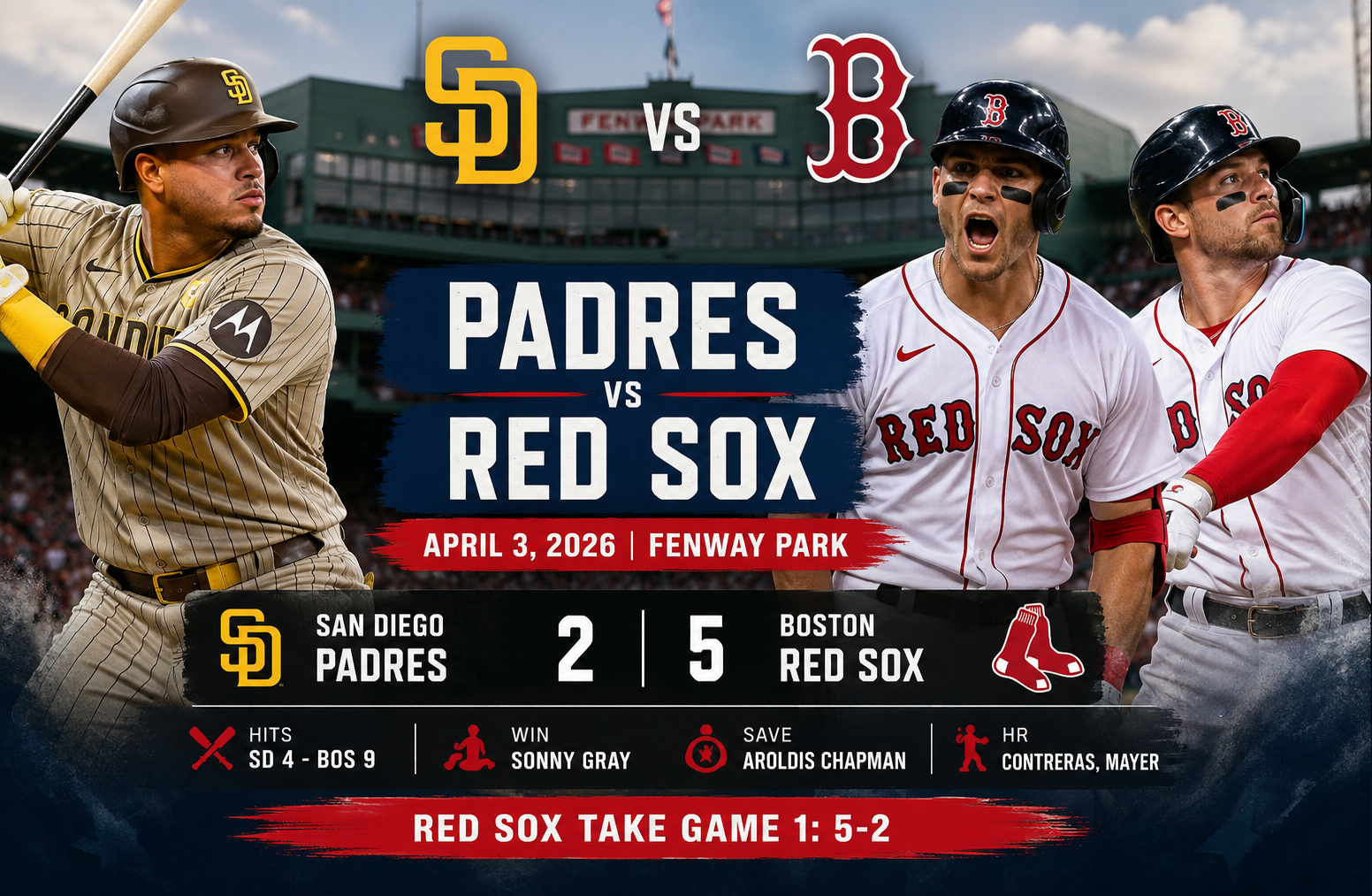
The Padres vs Red Sox match player stats from April 3, 2026, tell the story of an exciting MLB matchup in which the Boston Red Sox defeated the San Diego Padres 5-2 at Fenway Park. Although both teams entered the sixth inning tied at 2-2, Boston’s offense came alive with back-to-back home runs from William Contreras and Marcelo Mayer. Their powerful contributions changed the direction of the game and helped the Red Sox secure an important victory in front of 36,233 fans.
The matchup featured several impressive individual performances, particularly from Boston’s young offensive talent and starting pitcher Sonny Gray. Marcelo Mayer delivered a standout performance with two hits, two runs, two RBIs, and a home run. William Contreras also played a major role by breaking the tie with a 423-foot solo homer. Meanwhile, San Diego’s Gavin Sheets and Luis Campusano provided the team’s most important offensive contributions, but the Padres struggled to produce enough hits to overcome Boston’s advantage.
On the pitching side, Sonny Gray controlled the game over six innings, allowing four hits and two earned runs without issuing a walk. Michael King pitched well enough to keep San Diego competitive through much of the contest, but Boston’s sixth-inning power display ultimately handed him the loss.
This detailed breakdown examines the individual batting numbers, pitching performances, scoring sequence, defensive contributions, and important moments that shaped the contest. It also explains why certain players made a greater impact than their basic statistics might initially suggest.
Padres vs Red Sox Match Player Stats: Complete Game Overview
The April 3 meeting between Boston and San Diego produced a 5-2 result, with the Red Sox recording nine hits and the Padres finishing with four. The difference in offensive production was particularly noticeable after the fifth inning.
Boston established an early advantage before San Diego responded with two runs to level the score. However, the Red Sox immediately answered in the sixth inning, scoring three runs through two home runs.
Match Information
| Match Detail | Information |
| Matchup | San Diego Padres vs Boston Red Sox |
| Date | April 3, 2026 |
| Venue | Fenway Park |
| Location | Boston, Massachusetts |
| Final Score | Red Sox 5, Padres 2 |
| Padres Runs | 2 |
| Red Sox Runs | 5 |
| Padres Hits | 4 |
| Red Sox Hits | 9 |
| Padres Errors | 1 |
| Red Sox Errors | 0 |
| Attendance | 36,233 |
| Game Duration | 2 hours, 19 minutes |
| Winning Pitcher | Sonny Gray |
| Losing Pitcher | Michael King |
| Save | Aroldis Chapman |
The numbers show that Boston had a clear advantage in total hits and defensive consistency. The Red Sox collected five more hits than San Diego and avoided committing an error.
The Padres, meanwhile, struggled to create consistent scoring opportunities. Their four-hit performance limited their ability to challenge Boston’s pitching staff throughout the contest.
Final Score Comparison
| Statistical Category | Padres | Red Sox |
| Runs | 2 | 5 |
| Hits | 4 | 9 |
| Errors | 1 | 0 |
| Runs in Scoring Position | 1-for-5 | 2-for-8 |
| Strikeouts by Batters | 6 | Not specified |
| Walks | 1 | Not specified |
| Double Plays Turned | 2 | Not specified |
| Grounded Into Double Plays | Not specified | 2 |
One important detail is that Boston did not dominate every offensive category. The Red Sox went 2-for-8 with runners in scoring position, while San Diego went 1-for-5. Neither team converted every opportunity, but Boston’s ability to hit home runs with the score tied proved decisive.
Boston Red Sox Batting Stats and Player Performances
Boston’s offense delivered the biggest moments of the game. Nine hits and five runs provided enough production to support a strong starting pitching performance and a reliable bullpen.
Marcelo Mayer and William Contreras were the standout hitters, but several other Red Sox players contributed to the scoring effort.
Marcelo Mayer: Boston’s Offensive Standout
Marcelo Mayer produced one of the most impressive individual performances of the matchup.
His batting numbers included:
- At-bats: 2
- Hits: 2
- Runs: 2
- RBIs: 2
- Home runs: 1
Mayer finished 2-for-2, meaning he recorded a hit in both of his official at-bats. He also scored twice and drove in two runs.
His most important contribution came in the sixth inning when he hit a two-run home run that traveled 385 feet. The homer followed William Contreras’s solo shot and extended Boston’s advantage from 3-2 to 5-2.
The timing made Mayer’s performance especially valuable. Contreras had already broken the tie, but the Red Sox still needed another run to create a more comfortable advantage. Mayer supplied two.
His performance demonstrated why extra-base power can be so important in a close baseball game. A single might have advanced a runner, but a home run brought two runs across the plate immediately.
Mayer also scored earlier in the game. Ceddanne Rafaela’s third-inning single brought him home for Boston’s opening run.
This combination of early scoring and late power made Mayer a central figure in the victory.
William Contreras: The Game-Changing Home Run
William Contreras delivered another major offensive contribution.
His sixth-inning solo home run traveled an impressive 423 feet and gave Boston a 3-2 lead.
His recorded contribution included:
- Hits: 1
- Runs: 1
- RBIs: 2
- Home runs: 1
The most significant moment was the home run that broke the 2-2 tie.
Before Contreras stepped up with the decisive power contribution, Boston and San Diego were level. A single swing changed the scoreboard and put the Red Sox ahead.
The reported 423-foot distance also highlighted the strength of the hit. It was not simply a ball that barely cleared the wall. It was a powerful drive that gave Boston a meaningful advantage.
Contreras’s contribution was particularly important because it came immediately before Mayer’s two-run homer. Together, the two home runs created a three-run sixth inning that San Diego could not answer.
Ceddanne Rafaela: An Important Early RBI
Ceddanne Rafaela helped Boston establish its first lead in the third inning.
His run-scoring single to center field brought Marcelo Mayer home and gave the Red Sox a 1-0 advantage.
His recorded contribution included:
- Hits: 1
- Runs: 1
- RBIs: 1
Rafaela’s hit demonstrated the importance of making contact when a scoring opportunity appears.
Unlike a home run, an RBI single depends on the movement of runners already on base. Rafaela delivered when Boston needed an early breakthrough.
The third-inning run also placed pressure on San Diego’s offense to respond rather than allowing the Padres to settle into a scoreless contest.
Jarren Duran: Creating an Early Scoring Opportunity
Jarren Duran contributed a double and scored a run.
His extra-base hit helped put Boston in a position to increase its advantage. Caleb Durbin subsequently delivered an RBI single in the fourth inning, bringing Duran home.
Duran’s contribution was valuable because doubles can change the structure of an inning. Instead of requiring multiple singles to move a runner into scoring position, a double immediately places the batter in a more advanced position.
His run helped Boston move ahead 2-0.
Caleb Durbin: Delivering in the Fourth Inning
Caleb Durbin recorded an RBI single in the fourth inning.
The hit brought Jarren Duran home and extended Boston’s lead to 2-0.
Although the Red Sox eventually won through their home-run production, Durbin’s contribution should not be overlooked.
His single gave Boston an additional run before San Diego began its comeback in the fifth inning.
In close games, early runs can become extremely important. They provide a team with some breathing room and make opposing hitters work harder to catch up.
Willson Abreu: Contributing to the Scoring Effort
Willson Abreu recorded one hit and scored one run.
His run became particularly important during the sixth inning because he was the runner brought home by Marcelo Mayer’s two-run home run.
That sequence helped Boston increase its lead from 3-2 to 5-2.
While Abreu did not produce the home run himself, his presence on base contributed directly to the value of Mayer’s hit.
Boston’s Batting Summary
| Player | Hits | Runs | RBIs | Key Contribution |
| Marcelo Mayer | 2 | 2 | 2 | Two-run home run |
| William Contreras | 1 | 1 | 2 | 423-foot home run |
| Ceddanne Rafaela | 1 | 1 | 1 | Third-inning RBI single |
| Jarren Duran | 1 | 1 | Not specified | Double |
| Caleb Durbin | 1 | Not specified | 1 | Fourth-inning RBI single |
| Willson Abreu | 1 | 1 | Not specified | Scored in sixth inning |
The table highlights the main offensive contributors identified in the available game information. Individual statistics not supplied in the source have been left unspecified rather than estimated.
San Diego Padres Batting Stats and Player Performances
The Padres finished with four hits and two runs. Their offensive performance was less productive than Boston’s, but several players created meaningful scoring opportunities.
Gavin Sheets and Luis Campusano were responsible for San Diego’s two RBIs. Miguel Andújar also contributed with an extra-base hit and a run.
Gavin Sheets: Leading San Diego’s Offensive Production
Gavin Sheets was one of the most productive Padres hitters in the matchup.
His recorded numbers included:
- Hits: 2
- Runs: 1
- RBIs: 1
Sheets collected two of San Diego’s four hits, accounting for half of the team’s total offensive production in the hit column.
His most important contribution came in the fifth inning when he singled to right field. The hit allowed Miguel Andújar to score and reduced Boston’s lead to 2-1.
Sheets later scored himself when Luis Campusano doubled to center field.
These contributions made him a central part of the Padres’ attempt to get back into the game.
His two-hit performance also demonstrated that San Diego had some success making contact against Sonny Gray. However, the team needed more consistent production from the rest of its lineup to build on those opportunities.
Luis Campusano: Delivering the Game-Tying RBI
Luis Campusano recorded a double and one RBI.
His fifth-inning double to center field brought Gavin Sheets home and tied the game at 2-2.
That hit was arguably San Diego’s most important offensive moment.
The Padres had already reduced Boston’s lead to one run through Sheets’ single. Campusano then followed with another productive hit, completing the comeback and putting both teams on equal terms.
The double showed how quickly the momentum of a baseball game can change.
At that stage, San Diego had successfully erased Boston’s early advantage. The contest appeared ready for a close finish.
However, the Padres were unable to maintain their offensive pressure after the sixth inning.
Campusano also had a defensive error charged to him for catcher’s interference, according to the supplied game information. This was the only error recorded against San Diego.
Miguel Andújar: Providing Extra-Base Power
Miguel Andújar contributed a triple and scored one run.
His extra-base hit gave San Diego an opportunity to challenge Boston’s early advantage.
The triple was especially useful because it placed Andújar in scoring position immediately.
Gavin Sheets followed with a single to right field, allowing Andújar to score and making the game 2-1.
This sequence was an example of effective offensive execution. Andújar created the opportunity, and Sheets converted it into a run.
Although San Diego eventually lost, this combination represented one of its most productive offensive sequences.
Padres Batting Summary
| Player | Hits | Runs | RBIs | Key Contribution |
| Gavin Sheets | 2 | 1 | 1 | Fifth-inning RBI single |
| Luis Campusano | Not fully specified | Not specified | 1 | Game-tying double |
| Miguel Andújar | Not fully specified | 1 | Not specified | Triple |
The available information identifies four total Padres hits but does not provide a complete individual batting line for every player. Therefore, missing at-bats, batting averages, and other figures should not be assumed.
Why San Diego’s Offense Fell Short
The Padres had a productive fifth inning, but their overall offensive output was limited.
Three factors explain much of the difficulty:
- Limited hits: San Diego collected only four hits throughout the game.
- Missed scoring opportunities: The Padres went 1-for-5 with runners in scoring position.
- Difficulty sustaining pressure: After tying the score, San Diego did not produce another scoring run.
The Padres also struck out six times and drew just one walk.
Those numbers suggest that Boston’s pitching staff did a good job limiting additional opportunities. Once the Red Sox regained the lead, San Diego struggled to create the consistent baserunner traffic needed for another comeback.
Complete Pitching Stats: Sonny Gray vs Michael King
Pitching was another major part of this matchup.
Sonny Gray delivered six innings for Boston, while Michael King started for San Diego and worked 5.2 innings.
Both pitchers kept their teams competitive for much of the contest. However, Gray ultimately received the win, while King was charged with the loss.
Sonny Gray: A Strong Six-Inning Performance
Sonny Gray earned the victory after allowing four hits and two earned runs across six innings.
His recorded pitching statistics were:
| Statistic | Sonny Gray |
| Innings Pitched | 6.0 |
| Hits Allowed | 4 |
| Earned Runs | 2 |
| Strikeouts | 3 |
| Walks | 0 |
| Decision | Win |
One of the most impressive aspects of Gray’s performance was his control.
He did not issue a walk, meaning every Padres baserunner who reached through the hit column had to earn that opportunity through contact.
Gray’s three strikeouts also contributed to his ability to manage the lineup.
Although San Diego scored twice in the fifth inning, Gray limited the damage and completed six innings.
That mattered because Boston needed its starting pitcher to provide enough length for the bullpen to take over.
A starting pitcher does not always need to dominate every inning to deliver a winning performance. Consistency, limiting walks, and preventing a big offensive inning can be just as important.
Gray accomplished those objectives well enough to give Boston the foundation for its victory.
Michael King: A Competitive Start That Ended in Defeat
Michael King took the loss after allowing seven hits and four earned runs over 5.2 innings.
His recorded pitching line was:
| Statistic | Michael King |
| Innings Pitched | 5.2 |
| Hits Allowed | 7 |
| Earned Runs | 4 |
| Strikeouts | 5 |
| Walks | 1 |
| Decision | Loss |
King recorded five strikeouts, two more than Gray.
That figure indicates that he was capable of missing bats and getting important outs.
However, the difference came in the number of hits and earned runs allowed.
King surrendered seven hits and four earned runs. Boston’s offense eventually took advantage of the opportunities presented to it.
The sixth inning was particularly damaging.
Contreras hit a solo home run to break the tie, and Mayer followed with a two-run homer.
Those two hits transformed a competitive game into a three-run Boston advantage.
King’s five strikeouts were a positive aspect of his performance, but they could not compensate for the damage caused by the Red Sox’s sixth-inning power.
Pitching Comparison
| Category | Sonny Gray | Michael King |
| Innings | 6.0 | 5.2 |
| Hits Allowed | 4 | 7 |
| Earned Runs | 2 | 4 |
| Strikeouts | 3 | 5 |
| Walks | 0 | 1 |
| Decision | Win | Loss |
The comparison reveals an interesting difference between the two starting pitchers.
King recorded more strikeouts, but Gray allowed fewer hits and earned runs. Gray also avoided walks entirely.
Strikeouts are important, but they are only one part of pitching effectiveness. A pitcher must also control baserunners and limit damaging contact.
In this game, Gray was more successful at preventing offensive production.
Aroldis Chapman: Securing the Ninth-Inning Save
Aroldis Chapman completed Boston’s victory with a scoreless ninth inning.
His recorded contribution included:
- Innings pitched: 1
- Hits allowed: 0
- Runs allowed: 0
- Strikeouts: 1
- Save: 2nd of the season
Chapman’s performance was important because closing a three-run game requires concentration and control.
He did not allow a hit and recorded one strikeout, preventing San Diego from creating a late scoring opportunity.
The save was his second of the season.
For Boston, having a reliable closer available after the starting pitcher and middle relievers had completed their work helped protect the lead.
Boston’s Relief Pitchers
Greg Weissert and Justin Slaten each contributed a scoreless inning.
Their performances helped Boston maintain control after Gray completed his six innings.
The bullpen’s role was especially important because San Diego had already shown it could score multiple runs in one inning.
By keeping the Padres off the scoreboard during the later stages, Boston prevented the game from becoming competitive again.
San Diego’s Relief Pitchers
Wandy Peralta allowed one run across 1.1 innings, while Ron Marinaccio pitched a scoreless inning.
Although the Padres received some effective relief work, Boston had already created its decisive advantage.
The difference in the final score had largely been established before the later relief innings were completed.
Complete Game Scoring Summary: How Boston Won 5-2
The scoring sequence explains why this matchup was competitive for five innings before Boston took control.
The Red Sox scored twice in the first part of the game. San Diego responded with two runs in the fifth inning. Boston then produced three runs in the sixth.
Third Inning: Boston Takes the Lead
The Red Sox opened the scoring in the third inning.
Ceddanne Rafaela singled to center field, allowing Marcelo Mayer to score.
The hit gave Boston a 1-0 lead.
This was an important early breakthrough because it forced San Diego to play from behind.
Fourth Inning: Durbin Extends the Advantage
Boston increased its lead to 2-0 in the fourth inning.
Caleb Durbin delivered an RBI single that brought Jarren Duran home.
The Red Sox had now scored in consecutive innings and appeared to be building control over the contest.
Fifth Inning: San Diego Responds
The Padres finally found their offensive rhythm in the fifth.
Miguel Andújar scored on Gavin Sheets’ single to right field.
The run reduced Boston’s advantage to 2-1.
San Diego continued its attack when Luis Campusano doubled to center field, allowing Sheets to score.
The game was now tied at 2-2.
This was the most productive inning of the contest for the Padres. They successfully erased Boston’s two-run advantage through consecutive scoring contributions.
Sixth Inning: Two Home Runs Change Everything
The sixth inning became the defining moment of the game.
William Contreras hit a 423-foot solo home run, giving Boston a 3-2 advantage.
Marcelo Mayer followed with a 385-foot two-run homer, bringing Willson Abreu home and extending the lead to 5-2.
Boston scored three runs in the inning without needing several separate rallies.
The two home runs provided an immediate offensive advantage and changed the pressure on San Diego’s hitters.
Seventh Through Ninth Innings: Boston Protects Its Lead
After the sixth inning, the Red Sox maintained their three-run advantage.
Greg Weissert and Justin Slaten each delivered scoreless relief work.
Aroldis Chapman then completed the game with a scoreless ninth inning and recorded his second save of the season.
San Diego could not produce another scoring run, and Boston secured the 5-2 victory.
Inning-by-Inning Scoring Table
| Inning | Padres | Red Sox |
| 1st | 0 | 0 |
| 2nd | 0 | 0 |
| 3rd | 0 | 1 |
| 4th | 0 | 1 |
| 5th | 2 | 0 |
| 6th | 0 | 3 |
| 7th | 0 | 0 |
| 8th | 0 | 0 |
| 9th | 0 | 0 |
| Final | 2 | 5 |
The scoring table makes the sixth-inning difference easy to understand.
Boston scored three times in that inning, while San Diego was unable to respond. That single offensive burst separated the teams on the scoreboard.
The Most Important Statistical Differences
The final score was not the result of one statistic alone. Several categories worked together to explain Boston’s advantage.
1. Total Hits
Boston recorded nine hits compared with San Diego’s four.
This five-hit difference was one of the clearest indicators of Boston’s offensive advantage.
More hits generally create more opportunities to score, especially when players are able to move runners into scoring position.
The Red Sox also produced two home runs, which helped maximize the value of their offensive opportunities.
2. Home Run Production
Boston’s two sixth-inning home runs were the biggest individual offensive moments.
Contreras hit a 423-foot solo shot, while Mayer followed with a 385-foot two-run homer.
The Padres did not record a home run in the supplied game summary.
This difference was especially important because both Boston home runs came during a tie game.
3. Starting Pitching Efficiency
Gray allowed four hits and two earned runs in six innings.
King surrendered seven hits and four earned runs in 5.2 innings.
Although King recorded more strikeouts, Gray delivered the more effective overall outing.
The difference in earned runs directly affected the final result.
4. Walks and Baserunner Control
Gray did not issue a walk, while King allowed one.
The difference may appear small, but avoiding free baserunners is an important part of controlling an opponent’s offense.
Gray forced San Diego to produce hits to reach base and did not give the Padres additional opportunities through walks.
5. Defensive Reliability
Boston committed no errors, while San Diego recorded one.
The Padres’ error was charged to Luis Campusano for catcher’s interference.
Boston’s clean defensive performance helped its pitchers maintain control and prevented unnecessary opportunities for the opposing lineup.
6. Runners in Scoring Position
Boston went 2-for-8 with runners in scoring position.
San Diego finished 1-for-5.
Neither team had an outstanding conversion rate, but Boston managed one additional successful hit in these situations.
This statistic also shows why the home runs were so valuable. Boston’s biggest scoring burst did not depend on repeatedly advancing runners through singles.
Defensive Performance and Fielding Analysis
Defense often receives less attention than batting and pitching, but it can influence the result of a close MLB game.
Boston’s defense completed the contest without committing an error.
San Diego recorded one error, charged to Luis Campusano for catcher’s interference.
The Padres also completed two double plays, demonstrating that their defense was capable of producing important outs.
Boston recorded two grounding-into-double-play plays, which limited some of its own offensive opportunities.
These numbers reveal a more balanced defensive story than the final score might suggest.
San Diego successfully turned two double plays, but its single error and limited offensive production made it difficult to overcome Boston’s advantage.
The Red Sox, meanwhile, avoided defensive mistakes and received enough support from their fielders to protect their pitchers.
A clean defensive performance does not guarantee victory, but it reduces the number of unnecessary opportunities an opponent can receive.
In this matchup, Boston combined error-free fielding with more productive hitting and effective relief pitching.
Three Biggest Turning Points of the Game
Although the sixth-inning home runs decided the contest, several earlier moments shaped the final result.
First Turning Point: Boston’s Third-Inning Run
Rafaela’s RBI single gave Boston the first lead.
Scoring first allowed the Red Sox to establish control and put immediate pressure on San Diego.
Second Turning Point: The Padres Tie the Score
Sheets and Campusano combined for two runs in the fifth inning.
This was an important response because the Padres eliminated Boston’s early advantage and made the game competitive again.
At 2-2, San Diego had an opportunity to build on its momentum.
Third Turning Point: Contreras and Mayer Deliver Back-to-Back Home Runs
The sixth inning changed the game.
Contreras broke the tie with a solo homer, and Mayer followed with a two-run shot.
Instead of allowing San Diego to take advantage of its fifth-inning comeback, Boston immediately restored control.
This sequence was the most important part of the matchup because it created the final three-run difference.
Why Marcelo Mayer Was One of the Biggest Difference-Makers
Marcelo Mayer’s performance deserves special attention because his contribution extended beyond simply hitting a home run.
He recorded two hits in two at-bats, scored twice, and drove in two runs.
His first scoring contribution came in the third inning when Rafaela brought him home.
His second major contribution arrived in the sixth inning when he hit the two-run home run.
This combination made Mayer one of the most productive players in the game.
His performance also illustrates the value of combining consistent contact with extra-base power.
A player who can reach base and later deliver a decisive hit creates multiple ways for an offense to generate runs.
Mayer accomplished both during this matchup.
For readers examining individual performance, his two-hit, two-run, two-RBI line provides a strong example of why box-score statistics should be considered together rather than separately.
What Sonny Gray’s Performance Tells Us About Pitching
Sonny Gray’s outing provides another important lesson.
His three strikeouts were fewer than Michael King’s five, but Gray still delivered the stronger starting performance.
The main reasons were his ability to limit hits, avoid walks, and allow fewer earned runs.
Gray’s six innings also gave Boston a useful amount of work from its starting pitcher.
When a starter completes six innings while keeping the opponent to two runs, the team can manage its bullpen more effectively.
Boston was able to use its relief pitchers to protect the advantage rather than needing them to cover an unusually long stretch of the game.
Gray’s outing was not based entirely on strikeouts. It was based on controlling the overall damage.
That distinction is important when evaluating pitching statistics.
A high strikeout total can be impressive, but the ultimate goal is to prevent the opposing team from scoring.
In this game, Gray accomplished that more effectively than King.
What Went Wrong for the Padres?
San Diego had a chance to make the matchup much closer after tying the score in the fifth inning.
However, several problems prevented the Padres from completing the comeback.
First, their offense produced only four hits. That limited the number of scoring opportunities available.
Second, the Padres did not consistently convert runners in scoring position. Their 1-for-5 performance showed that they struggled to capitalize on important situations.
Third, Boston’s sixth-inning home runs created an immediate three-run deficit.
Finally, the Red Sox bullpen did not allow San Diego to recover during the final three innings.
The Padres did show some positive signs. Sheets collected two hits, Campusano delivered a game-tying double, and Andújar produced a triple.
However, those individual contributions were not enough to overcome Boston’s more productive offense.
What Went Right for the Red Sox?
Boston’s victory came from a combination of offensive production, starting pitching, and defensive consistency.
The Red Sox benefited from several important factors:
- They collected nine hits.
- They scored in the third and fourth innings.
- They responded immediately after San Diego tied the game.
- Contreras and Mayer delivered decisive home runs.
- Sonny Gray completed six effective innings.
- The bullpen protected the three-run advantage.
- Boston committed no defensive errors.
The biggest strength was the team’s ability to respond under pressure.
After San Diego tied the game, Boston did not allow the momentum to remain with the visitors.
Instead, the Red Sox produced three runs in the next inning and controlled the rest of the contest.
That response was the foundation of their 5-2 victory.
Matchup Context: The Opening Game and Series Result
The supplied series information identifies Boston’s 5-2 victory on April 3 as the opening game.
However, the subsequent results show that San Diego won the second game 3-2 and the third game 8-6.
The series therefore finished with the Padres winning two games to one.
This distinction matters when reviewing the matchup.
Boston won this particular game through a strong sixth-inning performance, but San Diego ultimately won the overall series.
A single-game result and a series result measure different things.
The opening matchup highlighted Boston’s ability to produce timely power, while the following results show that San Diego responded successfully over the remainder of the series.
For readers researching this specific contest, the 5-2 result should not be confused with the final series outcome.
How to Read MLB Match Player Statistics Correctly
Understanding a baseball box score requires more than looking at runs and hits.
Several individual categories help explain how a player or pitcher influenced the game.
Batting Average
Batting average measures how frequently a batter records a hit in official at-bats.
It is calculated by dividing hits by at-bats.
For example, Marcelo Mayer’s supplied line of two hits in two at-bats represents a 1.000 batting average for this particular game.
However, a single-game batting average should not be confused with a player’s season average.
Runs
A run is recorded when a player legally crosses home plate.
Mayer and Sheets were among the players who scored during this matchup.
Runs help identify who completed scoring opportunities, but they do not always show who created those opportunities.
Runs Batted In
RBIs measure how many runs a batter drives home through qualifying offensive actions.
Contreras and Mayer were particularly important in this category because their sixth-inning home runs produced three combined runs.
Extra-Base Hits
Extra-base hits include doubles, triples, and home runs.
They are important because they allow hitters to reach more advanced bases with a single hit.
Duran’s double, Andújar’s triple, and the two Boston home runs were important extra-base contributions in this game.
Earned Runs
Earned runs are runs charged to a pitcher that are not the result of errors or passed balls.
Gray allowed two earned runs, while King allowed four.
This statistic helps explain the difference between their overall performances.
Strikeouts
A strikeout occurs when a batter is retired after receiving three strikes.
King recorded five strikeouts, compared with Gray’s three.
Although strikeouts are an important pitching measure, they should be evaluated alongside hits, walks, innings, and runs allowed.
Saves
A save is credited to a relief pitcher who finishes a qualifying victory under the official scoring rules.
Chapman secured the save after completing a scoreless ninth inning.
His second save of the season confirmed his role in protecting Boston’s advantage.
For additional official baseball statistics and league-wide information, readers can explore the MLB statistics section.
Frequently Asked Questions
1. Who won the Padres vs Red Sox game on April 3, 2026?
The Boston Red Sox defeated the San Diego Padres 5-2 at Fenway Park in Boston. The decisive moment came in the sixth inning when William Contreras and Marcelo Mayer hit consecutive home runs.
2. Who was the best player in the Padres vs Red Sox matchup?
Marcelo Mayer was one of the standout performers. He went 2-for-2 with two runs, two RBIs, and one home run. William Contreras also played a major role with a 423-foot solo homer.
3. How many hits did the Padres and Red Sox record?
The Boston Red Sox recorded nine hits, while the San Diego Padres finished with four hits. Boston also scored five runs compared with San Diego’s two.
4. How did Sonny Gray perform against the Padres?
Sonny Gray earned the win after pitching six innings. He allowed four hits and two earned runs, struck out three batters, and did not issue a walk.
5. Why did Michael King lose against Boston?
Michael King took the loss after allowing seven hits and four earned runs in 5.2 innings. Boston’s decisive sixth inning, featuring home runs from Contreras and Mayer, proved particularly costly.
6. Who recorded the save for the Red Sox?
Aroldis Chapman recorded his second save of the season. He pitched a scoreless ninth inning, allowed no hits, and struck out one batter.
Conclusion
The April 3, 2026, matchup between the San Diego Padres and Boston Red Sox demonstrated how quickly a competitive baseball game can change through timely hitting and effective pitching.
Boston secured a 5-2 victory after collecting nine hits and producing three decisive runs in the sixth inning. William Contreras broke the 2-2 tie with a 423-foot solo home run, while Marcelo Mayer followed with a 385-foot two-run homer. Mayer finished with two hits, two runs, and two RBIs, making him one of the game’s most influential offensive performers.
Sonny Gray also played a major role by allowing just two earned runs across six innings without issuing a walk. His performance gave Boston’s bullpen a strong foundation, and Aroldis Chapman completed the victory with a scoreless ninth inning.
San Diego had its own positive contributions. Gavin Sheets recorded two hits, Luis Campusano delivered the game-tying double, and Miguel Andújar scored after hitting a triple. However, the Padres’ four-hit offensive performance was not enough to match Boston’s production.
Ultimately, the most important difference was Boston’s ability to respond immediately after San Diego tied the game. The consecutive home runs in the sixth inning created the advantage that the Red Sox protected through the final three innings.
Although Boston won this opening matchup, the supplied series results show that San Diego eventually claimed the series by winning the next two games. This makes the individual game an interesting example of how a strong performance on one night does not necessarily determine the outcome of an entire series.