Denver nuggets vs houston rockets match player stats
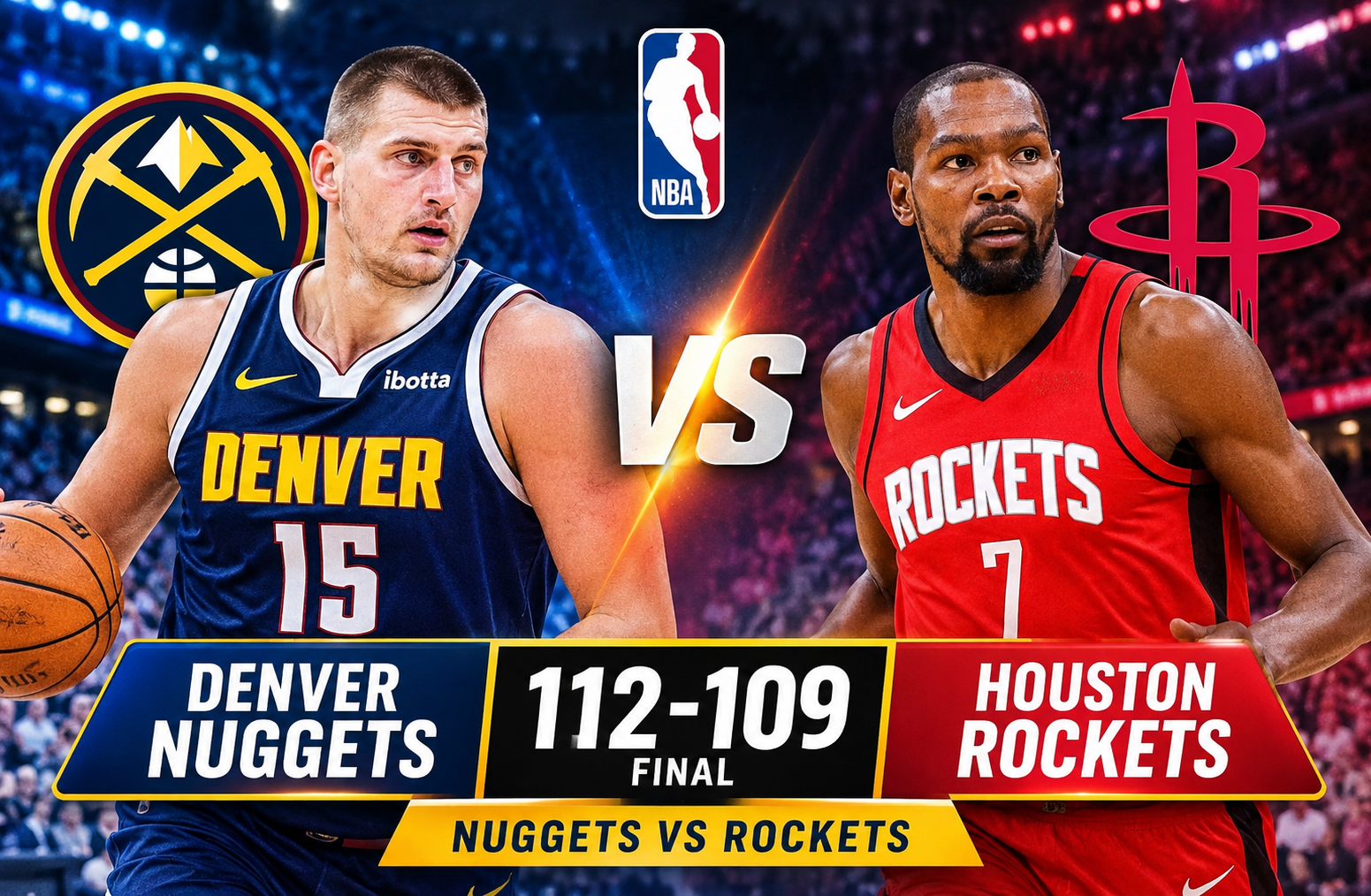
The denver nuggets vs houston rockets match player stats from November 21, 2025, tell the story of a closely contested NBA Cup game that Denver eventually won 112-109 at Toyota Center in Houston. Nikola Jokic delivered an outstanding performance with 34 points, 10 rebounds, and nine assists, while Jamal Murray contributed 26 points and 10 assists. Despite a strong comeback from Houston, the Nuggets made the important plays in the closing minutes to secure a three-point victory.
Houston had several impressive individual performances of its own. Reed Sheppard led the Rockets with a career-high 27 points, while Amen Thompson added 22 points and Jabari Smith Jr. recorded 21 points and 11 rebounds. The Rockets also produced a dominant second quarter, scoring 37 points and briefly taking control of the contest. However, Denver responded with better offensive execution in the second half and found a way to finish the game.
The matchup offered an interesting comparison between Denver’s experienced offensive leadership and Houston’s athletic young core. It also demonstrated how shooting efficiency, ball movement, late-game decisions, and individual shot creation can determine the outcome of a close NBA contest.
This breakdown examines the complete player performances, team statistics, quarter-by-quarter scoring, important turning points, and the individual contributions that shaped the result.
Denver Nuggets vs Houston Rockets Match Player Stats: Game Overview
The Nuggets entered the matchup looking to strengthen their position in NBA Cup group play. Houston had home-court advantage and an opportunity to continue its positive run. Both teams had strong offensive options, making the contest an important test of execution on both ends of the floor.
Denver ultimately won 112-109 after overcoming Houston’s second-quarter scoring surge.
Final Game Information
| Match Detail | Information |
| Matchup | Denver Nuggets vs Houston Rockets |
| Date | November 21, 2025 |
| Competition | NBA Cup, West Group C |
| Final Score | Denver 112, Houston 109 |
| Venue | Toyota Center |
| Location | Houston, Texas |
| Attendance | 18,108 |
| Game Status | Final |
| Winning Team | Denver Nuggets |
| Losing Team | Houston Rockets |
| Game ID | 401809796 |
| Denver Record | 12-3 |
| Houston Record | 10-4 |
| Denver Away Record | 6-2 |
| Houston Home Record | 5-2 |
The game attracted 18,108 spectators at Toyota Center. Playing in front of their home crowd, the Rockets had an opportunity to challenge one of the Western Conference’s strongest offensive teams.
Denver’s victory came from a balanced offensive effort. Jokic and Murray combined for 60 points and 19 assists, providing the primary scoring and playmaking foundation. Houston received contributions from several players, but its lower overall field-goal percentage and weaker free-throw accuracy became important factors.
Quarter-by-Quarter Score
| Quarter | Denver Nuggets | Houston Rockets |
| First Quarter | 25 | 12 |
| Second Quarter | 21 | 37 |
| Third Quarter | 34 | 29 |
| Fourth Quarter | 32 | 31 |
| Final Score | 112 | 109 |
The scoring pattern explains why the game remained competitive.
Denver established a 13-point advantage in the opening quarter. Houston responded with a 37-point second period, turning the momentum around and entering halftime with a three-point lead.
The Nuggets then scored 34 points in the third quarter and continued their offensive production in the fourth. Neither team managed to create a comfortable separation during the final period.
Denver’s ability to recover after Houston’s strong second quarter was one of the defining features of the game.
Denver Nuggets Player Stats and Individual Performances
Denver’s offensive performance was led by Nikola Jokic and Jamal Murray. Both players contributed as scorers and playmakers, making it difficult for Houston to focus its defensive attention on one individual.
The supporting cast also played an important role. Tim Hardaway Jr. provided scoring from the bench, Bruce Brown contributed defensive pressure, and Peyton Watson helped Denver control important possessions through his rebounding.
Complete Denver Nuggets Player Statistics
| Player | Points | Rebounds | Assists | Steals | Blocks |
| Aaron Gordon | 1 | 2 | 0 | 0 | 0 |
| Cameron Johnson | 9 | 5 | 1 | 1 | 1 |
| Nikola Jokic | 34 | 10 | 9 | 2 | 2 |
| Jamal Murray | 26 | 2 | 10 | 1 | 1 |
| Peyton Watson | 9 | 10 | 3 | 1 | 1 |
| Spencer Jones | 3 | 4 | 0 | 0 | 0 |
| Jonas Valanciunas | 8 | 1 | 0 | 0 | 1 |
| Tim Hardaway Jr. | 12 | 3 | 2 | 0 | 0 |
| Bruce Brown | 10 | 1 | 3 | 3 | 1 |
Did Not Play: Hunter Tyson, Zeke Nnaji, and Jalen Pickett were listed as DNP due to the coach’s decision.
Nikola Jokic: 34 Points, 10 Rebounds, 9 Assists
Nikola Jokic was the most influential player on the court. His 34-point performance provided Denver with a dependable scoring option throughout the contest.
He also collected 10 rebounds and distributed nine assists, finishing just one assist short of a triple-double.
Jokic’s importance extended beyond his scoring total. His ability to create opportunities for teammates forced Houston’s defense to make difficult decisions. When defenders concentrated on limiting his scoring, he could find open teammates. When Houston gave him room to operate, he was capable of converting his opportunities.
His performance included:
- 34 points
- 10 rebounds
- 9 assists
- 2 steals
- 2 blocks
One of the most important details was his second-half production. According to the official game recap, Jokic scored 24 of his 34 points after halftime. That scoring contribution helped Denver recover from the difficult second quarter.
His ability to maintain offensive efficiency while contributing as a rebounder and passer made him the central figure in Denver’s victory.
Jamal Murray: 26 Points and 10 Assists
Jamal Murray provided the second major offensive contribution for Denver.
He finished with 26 points and 10 assists, recording a double-double and giving the Nuggets another reliable player capable of creating offense.
His 10 assists were particularly important because Houston had to defend both Murray and Jokic as primary playmakers. This reduced the effectiveness of simply concentrating defensive pressure on one player.
Murray’s performance demonstrated the value of having two experienced offensive creators on the floor.
His statistical contribution included:
- 26 points
- 2 rebounds
- 10 assists
- 1 steal
- 1 block
Murray’s scoring gave Denver additional offensive stability, while his passing helped teammates become involved in the attack.
The combination of Murray’s perimeter creation and Jokic’s interior playmaking was one of Denver’s biggest advantages.
Peyton Watson: 9 Points and 10 Rebounds
Peyton Watson produced a valuable all-around performance.
He scored nine points and collected 10 rebounds, matching Jokic for Denver’s highest individual rebound total.
His contribution was important because rebounding helped Denver maintain possession and limit Houston’s opportunities for second-chance scoring.
Watson also recorded three assists, one steal, and one block. Those numbers demonstrate that his impact was not restricted to collecting rebounds.
He provided defensive activity, passing support, and additional size around the basket.
Although his scoring total was modest, his overall contribution helped Denver maintain balance around its leading offensive players.
Tim Hardaway Jr.: 12 Points Off the Bench
Tim Hardaway Jr. was an important scoring option for Denver’s second unit.
He recorded 12 points, three rebounds, and two assists. His scoring gave the Nuggets additional offensive production without requiring Jokic or Murray to create every basket.
Bench contributions are especially valuable in competitive games because the starting players cannot maintain their highest workload throughout the entire contest.
Hardaway’s 12 points helped Denver distribute its offensive responsibilities and maintain pressure on Houston’s defense.
Bruce Brown: 10 Points and 3 Steals
Bruce Brown contributed 10 points, three rebounds, and three assists.
His three steals were particularly notable because they represented the highest individual steal total among Denver players in the supplied statistics.
Defensive activity can influence a close game even when it does not immediately appear in the scoring column. Steals can disrupt offensive rhythm, create transition opportunities, and prevent opponents from completing their preferred plays.
Brown also contributed a block, giving him a useful all-around performance.
Other Denver Contributions
Cameron Johnson finished with nine points, five rebounds, one assist, one steal, and one block.
Jonas Valanciunas recorded eight points and one rebound, adding another interior scoring option.
Spencer Jones contributed three points and four rebounds.
Aaron Gordon’s night was unusually short. He exited early with a right hamstring strain after playing just 3 minutes and 21 seconds. The official game recap reported that he left during the first quarter. His limited participation meant Denver had to adjust its rotation and distribute his responsibilities among other players.
This was an important development because Gordon normally provides the team with additional athleticism, defensive versatility, and offensive support.
Houston Rockets Player Stats and Individual Performances
Houston had several strong individual performances despite losing by three points.
Reed Sheppard was the team’s leading scorer with 27 points. Amen Thompson added 22 points, while Jabari Smith Jr. recorded 21 points and 11 rebounds.
The Rockets demonstrated their offensive potential through their second-quarter comeback and their ability to create scoring opportunities from multiple positions.
However, their shooting efficiency and free-throw performance were not enough to secure the victory.
Complete Houston Rockets Player Statistics
| Player | Points | Rebounds | Assists | Steals | Blocks |
| Kevin Durant | 13 | 8 | 2 | 2 | 1 |
| Jabari Smith Jr. | 21 | 11 | 4 | 0 | 1 |
| Steven Adams | 5 | 8 | 2 | 0 | 0 |
| Alperen Sengun | 14 | 5 | 6 | 1 | 0 |
| Amen Thompson | 22 | 7 | 2 | 2 | 0 |
| Clint Capela | 0 | 0 | 0 | 1 | 0 |
| Aaron Holiday | 1 | 0 | 0 | 0 | 0 |
| Josh Okogie | 6 | 2 | 1 | 0 | 0 |
| Reed Sheppard | 27 | 0 | 4 | 2 | 0 |
Did Not Play: Jeff Green, Jae’Sean Tate, and JD Davison were listed as DNP due to the coach’s decision.
Reed Sheppard: 27 Points and Four Assists
Reed Sheppard delivered Houston’s highest-scoring individual performance.
He finished with 27 points and four assists, making an important contribution to the Rockets’ offensive production.
His performance was especially impressive in the first half. The official game recap reported that Sheppard scored 20 points before halftime, shooting 8-for-11 from the field and making four of his six three-point attempts.
That shooting helped Houston recover from its slow opening quarter.
Sheppard’s final numbers included:
- 27 points
- 0 rebounds
- 4 assists
- 2 steals
- 5 three-pointers made
His shooting efficiency was one of the brightest aspects of Houston’s performance.
He gave the Rockets an effective perimeter scoring option and demonstrated how quickly a young guard can change the direction of a game.
Despite his excellent scoring night, Houston could not turn his individual performance into a team victory.
Amen Thompson: 22 Points and 7 Rebounds
Amen Thompson provided Houston with another major offensive contribution.
He finished with 22 points, seven rebounds, two assists, and two steals.
His combination of scoring and defensive activity made him one of the Rockets’ most productive players.
Thompson’s ability to attack the basket and create opportunities helped Houston maintain offensive pressure. His seven rebounds also gave the team additional support on the glass.
His two steals were another important contribution because they helped Houston create defensive disruptions.
The performance showed his ability to influence multiple areas of the game rather than depending exclusively on scoring.
Jabari Smith Jr.: 21 Points and 11 Rebounds
Jabari Smith Jr. recorded a double-double with 21 points and 11 rebounds.
He was Houston’s leading rebounder and one of the team’s most important offensive contributors.
Smith’s performance was valuable because he combined perimeter scoring with rebounding responsibility.
His 11 rebounds helped Houston compete on the glass, while his 21 points gave the Rockets another dependable scoring option.
He also recorded four assists and one block.
His late three-pointer was especially important. With only five seconds remaining, Smith connected from beyond the arc to bring Houston within one point at 110-109.
That shot gave the Rockets another opportunity to potentially change the outcome.
However, Denver responded at the free-throw line, and Houston could not complete the comeback.
Alperen Sengun: 14 Points and 6 Assists
Alperen Sengun finished with 14 points, five rebounds, and six assists.
His passing contribution was particularly valuable because Houston needed multiple players to create offensive opportunities against Denver.
Sengun’s six assists were the highest total among Rockets players.
His ability to distribute the ball from the frontcourt helped Houston maintain offensive movement and create scoring opportunities for teammates.
He also contributed one steal.
Although his scoring was lower than that of Sheppard, Thompson, and Smith, his passing role remained an important part of Houston’s offensive structure.
Kevin Durant: 13 Points and 8 Rebounds
Kevin Durant recorded 13 points, eight rebounds, two assists, two steals, and one block.
His final scoring total was lower than his usual reputation as an elite scorer might lead some readers to expect.
However, his contribution included several defensive and rebounding elements.
Durant’s eight rebounds helped Houston compete around the basket, while his two steals demonstrated defensive involvement.
His 13 points also provided another scoring contribution in a game where four Houston players reached double figures.
Steven Adams: 5 Points and 8 Rebounds
Steven Adams finished with five points, eight rebounds, and two assists.
His rebounding contribution helped Houston remain competitive in the interior.
Adams is particularly valuable when a team needs physical presence around the basket and additional opportunities to secure missed shots.
His eight rebounds were the second-highest total among Houston players.
Other Houston Contributions
Josh Okogie recorded six points, two rebounds, and one assist.
Aaron Holiday finished with one point.
Clint Capela did not score or collect a rebound in his limited appearance, but he recorded one steal.
Houston’s bench and supporting players provided additional contributions, although the largest scoring responsibilities were carried by Sheppard, Thompson, Smith, and Sengun.
Denver Nuggets vs Houston Rockets Team Statistics Comparison
Individual performances explain much of the game, but team statistics provide a clearer picture of why Denver won.
The Nuggets were more efficient from the field, while Houston attempted considerably more shots.
Denver also recorded more assists, demonstrating the effectiveness of its offensive distribution.
Complete Team Statistics
| Statistical Category | Denver Nuggets | Houston Rockets |
| Total Points | 112 | 109 |
| Field Goals | 40/76 | 41/93 |
| Field Goal Percentage | 53% | 44% |
| Three-Pointers | 11/29 | 14/36 |
| Three-Point Percentage | 38% | 39% |
| Free Throws | 21/27 | 13/20 |
| Free-Throw Percentage | 78% | 65% |
| Total Rebounds | 38 | 41 |
| Offensive Rebounds | 11 | 18 |
| Defensive Rebounds | 27 | 23 |
| Assists | 28 | 21 |
| Turnovers | 14 | 14 |
| Steals | 8 | 8 |
| Blocks | 7 | 2 |
| Personal Fouls | 20 | 22 |
Field Goal Efficiency Favored Denver
Denver made 40 of its 76 field-goal attempts, finishing with a shooting percentage of approximately 53%.
Houston made 41 of 93 attempts, finishing at approximately 44%.
Although Houston made one more field goal, Denver needed significantly fewer attempts to score its points.
The difference is important.
A team can attempt more shots and still lose if it does not convert those opportunities efficiently. Denver’s higher field-goal percentage allowed it to remain competitive despite Houston’s advantage in total rebounds and offensive rebounds.
The Nuggets also benefited from their ability to generate high-quality scoring opportunities through Jokic and Murray.
Three-Point Shooting Was Nearly Even
Houston made 14 three-pointers compared with Denver’s 11.
The Rockets also had a slightly better three-point percentage:
- Houston: 39%
- Denver: 38%
This was one of Houston’s statistical advantages.
Reed Sheppard’s five made three-pointers were particularly important. His perimeter shooting helped the Rockets recover from their first-quarter struggles and establish a lead.
However, making more three-pointers did not guarantee victory.
Denver compensated through better overall field-goal efficiency and a stronger free-throw performance.
Free-Throw Shooting Made a Difference
Denver converted 21 of its 27 free-throw attempts, finishing at 78%.
Houston made 13 of 20, finishing at 65%.
The Nuggets therefore made eight more free throws than the Rockets.
In a game decided by only three points, this difference deserves attention.
Free throws provide opportunities to score without needing to create a field-goal attempt. Teams that convert these opportunities consistently can build a meaningful advantage in close contests.
Houston’s lower percentage meant that several scoring opportunities did not produce the maximum possible return.
Houston Controlled the Rebounding Numbers
Houston finished with 41 rebounds, compared with Denver’s 38.
The Rockets also collected 18 offensive rebounds, seven more than Denver’s 11.
That advantage gave Houston additional opportunities to score after missed shots.
However, Denver collected more defensive rebounds, recording 27 compared with Houston’s 23.
The Nuggets also made better use of their offensive possessions through efficient shooting and ball movement.
This illustrates why rebounding totals should not be evaluated in isolation. A team can win the rebounding battle but still lose because of shooting efficiency, turnovers, or missed free throws.
Denver Had the Passing Advantage
Denver recorded 28 assists, while Houston finished with 21.
That seven-assist difference highlights the Nuggets’ ability to create scoring opportunities through teamwork.
Jokic and Murray combined for 19 assists.
Their passing helped Denver involve several players in the offense and reduced the team’s dependence on individual scoring.
Houston also had productive playmaking from Sengun and Sheppard, but Denver’s overall passing production was stronger.
Defensive Statistics Favored Denver in Blocks
Both teams recorded eight steals.
However, Denver finished with seven blocks compared with Houston’s two.
This difference shows that Denver produced more recorded shot-blocking activity around the basket.
Blocks do not represent every successful defensive possession, but they can disrupt shooting attempts and force opponents to reconsider their approach near the rim.
Denver’s advantage in this category was another useful contribution to the victory.
How Denver Nuggets Defeated Houston Rockets 112-109
The result was not determined by one isolated moment. Instead, the game developed through several important changes in momentum.
First Quarter: Denver Established Early Control
Denver started the game strongly and limited Houston to only 12 points in the opening period.
The Nuggets scored 25 points and created a 13-point advantage.
Their defensive activity restricted Houston’s early offensive rhythm, while Denver found enough scoring opportunities to establish control.
Houston struggled to convert its attempts consistently.
The opening quarter placed the Rockets in a difficult position and created pressure to respond in the second period.
Second Quarter: Houston Produced a Major Comeback
Houston completely changed the direction of the game in the second quarter.
The Rockets scored 37 points while Denver managed only 21.
That 16-point quarter advantage erased the Nuggets’ early lead and gave Houston a three-point halftime advantage.
Reed Sheppard was a major part of the offensive improvement.
His scoring and three-point shooting helped Houston create momentum.
Amen Thompson and other Rockets players also contributed to the improved attack.
The second quarter demonstrated Houston’s ability to respond after a difficult start. Instead of allowing Denver to control the entire game, the Rockets found better offensive rhythm and made the contest competitive.
Third Quarter: Denver Recovered Its Offensive Rhythm
Denver responded with 34 points in the third quarter.
Houston scored 29, allowing the Nuggets to reduce the deficit and regain control of the overall scoring pattern.
Jokic became especially important during this stage.
His scoring and playmaking helped Denver generate more consistent offensive possessions.
Murray also remained an important contributor, allowing Houston to defend multiple offensive threats.
The third quarter was a turning point because Denver avoided allowing Houston’s second-quarter advantage to become a lasting momentum shift.
Fourth Quarter: Both Teams Fought for the Result
The final period was closely contested.
Denver scored 32 points, while Houston added 31.
Neither side produced a large scoring advantage, and the game remained undecided until the closing seconds.
According to the official game recap, Denver trailed 92-87 with approximately nine minutes remaining.
The Nuggets then produced a 20-9 run, eventually taking a six-point lead after Murray converted two free throws with 23 seconds remaining.
Houston refused to give up.
Smith made a three-pointer with five seconds remaining to reduce the deficit to 110-109.
Jokic then converted two free throws with just under three seconds left.
Sengun attempted a half-court shot at the buzzer, but it missed.
Denver secured the 112-109 victory.
The Most Important Statistical Factors Behind the Result
The final score was close, but several statistical differences explain why Denver finished ahead.
1. Jokic and Murray Combined for 60 Points
Denver’s two primary offensive creators combined for 60 points.
Jokic scored 34, while Murray added 26.
This gave the Nuggets a reliable offensive foundation throughout the contest.
Their combined 19 assists were equally important because they created opportunities for other players.
2. Denver Converted More Free Throws
The Nuggets made 21 free throws compared with Houston’s 13.
The eight-point difference in made free throws was greater than the final three-point margin.
This does not mean free throws alone decided the contest, but it demonstrates how important conversion efficiency can become in a close game.
3. Houston’s Shooting Volume Did Not Produce Better Efficiency
Houston attempted 93 field goals, while Denver attempted only 76.
Despite the higher volume, Houston finished with a lower field-goal percentage.
Denver’s 53% shooting gave it a more efficient offensive performance.
4. Denver Produced More Assists
The Nuggets recorded 28 assists.
Houston recorded 21.
This difference suggests that Denver was more successful at creating scoring opportunities through passing and coordinated offensive possessions.
5. Houston Had a Stronger Offensive Rebounding Total
Houston collected 18 offensive rebounds compared with Denver’s 11.
This was a genuine strength for the Rockets.
However, the additional opportunities did not overcome their lower shooting efficiency and free-throw conversion.
Key Player Matchups and Individual Comparisons
Comparing players from both teams helps explain how the individual performances influenced the result.
Nikola Jokic vs Alperen Sengun
Jokic finished with 34 points, 10 rebounds, and nine assists.
Sengun recorded 14 points, five rebounds, and six assists.
Both players contributed as frontcourt playmakers, but Jokic produced a considerably larger scoring and rebounding performance.
Jokic’s ability to create shots for himself and his teammates was a major advantage for Denver.
Sengun remained an important offensive facilitator for Houston, but his overall production was not enough to match Jokic’s influence.
Jamal Murray vs Reed Sheppard
Murray scored 26 points and recorded 10 assists.
Sheppard led Houston with 27 points and four assists.
Sheppard actually finished one point ahead of Murray in scoring.
However, Murray’s playmaking contribution was substantially higher.
His 10 assists helped Denver create opportunities across the lineup, while Sheppard’s biggest contribution came through perimeter scoring.
Both guards had important performances, but their statistical profiles reflected different responsibilities.
Peyton Watson vs Jabari Smith Jr.
Watson recorded nine points and 10 rebounds.
Smith finished with 21 points and 11 rebounds.
Smith had the stronger scoring performance and narrowly led this comparison in rebounds.
Watson still provided valuable support through his defensive activity, three assists, and overall contribution.
Team Scoring Depth
Denver received double-digit scoring from Jokic, Murray, Hardaway Jr., and Brown.
Houston had four players reaching double figures: Sheppard, Thompson, Smith, Sengun, and Durant actually made five players with at least 13 points.
That scoring distribution shows that Houston had several productive offensive options.
However, Denver’s greater passing efficiency and shooting percentage helped it turn its contributions into a winning performance.
What the Game Reveals About Denver’s Offensive Approach
Denver’s performance highlighted the importance of having multiple players capable of controlling offensive possessions.
Jokic is not simply a traditional center who depends on receiving the ball near the basket. He can create opportunities from different areas of the court, distribute the ball, and recognize defensive changes.
Murray provides another dimension.
He can create his own shot, attack defensive gaps, and distribute the ball when opponents concentrate on stopping his scoring.
When both players perform effectively, Denver becomes difficult to defend because opponents cannot focus all their attention on one offensive option.
The team’s 28 assists reflected this approach.
Another important element was scoring support from the bench. Hardaway Jr. and Brown contributed 22 combined points.
That production reduced the pressure on the starting lineup and helped Denver maintain offensive balance.
The game also showed the importance of adaptability.
After Gordon exited with an injury, Denver had to adjust its rotation. Watson and other players helped fill the available responsibilities.
The Nuggets maintained their offensive structure despite the early disruption.
What the Game Reveals About Houston’s Performance
Houston’s performance demonstrated that the team had enough offensive talent to challenge Denver.
The Rockets showed considerable resilience after scoring only 12 points in the opening quarter.
Their 37-point second period was evidence of their ability to create a scoring run and change the direction of a game.
Sheppard’s shooting was a major positive.
Thompson provided scoring and defensive activity, while Smith contributed a double-double.
Sengun also helped the offense through his passing.
However, Houston’s performance revealed several areas that affected the final result.
Free-Throw Consistency
Houston made only 65% of its free throws.
In a close game, missed free throws can become especially costly.
Improving conversion at the line would give the team a better chance of turning competitive performances into victories.
Field-Goal Efficiency
The Rockets attempted 93 shots but converted only 41.
Their 44% field-goal percentage was below Denver’s 53%.
More attempts do not automatically translate into more points. Shot selection and conversion efficiency remain important.
Late-Game Execution
Houston made the contest close in the final seconds.
Smith’s three-pointer brought the Rockets within one point, but Denver responded with successful free throws.
The final possession ended with Sengun’s missed half-court attempt.
The Rockets came close to completing the comeback, but Denver handled the final moments more effectively.
NBA Cup Context and Importance of the Win
This matchup was part of the Emirates NBA Cup group stage, specifically West Group C.
The competition gives teams another meaningful objective during the regular season and creates additional importance around selected group-stage games.
According to the official game recap, Denver improved to 2-1 in NBA Cup play, while Houston dropped to 1-2.
The victory was useful for Denver because it kept the team competitive in its group with one game remaining at that stage.
Houston, meanwhile, had to respond in its remaining group-stage opportunity.
The result also ended the Rockets’ five-game winning streak, adding another layer of significance to Denver’s victory.
Although the game was part of the regular-season schedule, the NBA Cup setting created an additional competitive incentive.
Statistical Lessons for Basketball Fans
There are several useful lessons that readers can take from this matchup.
A High Rebound Total Does Not Guarantee Victory
Houston collected three more total rebounds and seven more offensive rebounds.
However, Denver won the game.
This shows why rebounding statistics should be considered alongside shooting efficiency, assists, and free throws.
Assists Reveal Offensive Coordination
Denver’s 28 assists compared with Houston’s 21 reflected a difference in offensive distribution.
The Nuggets generated more assisted scoring opportunities, allowing multiple players to contribute.
Individual Scoring Must Be Evaluated in Context
Sheppard scored 27 points, more than Murray’s 26.
However, Murray recorded 10 assists compared with Sheppard’s four.
Both performances were valuable, but their overall contributions were different.
A complete statistical evaluation should consider scoring, rebounding, passing, defense, and the player’s role.
Small Differences Can Decide Close Games
The final margin was only three points.
Denver’s eight additional made free throws, higher field-goal percentage, and seven-assist advantage all contributed to the outcome.
No single statistic explains everything, but together they provide a clearer picture of the contest.
Frequently Asked Questions
1. Who won the Denver Nuggets vs Houston Rockets game on November 21, 2025?
The Denver Nuggets won 112-109 against the Houston Rockets at Toyota Center in Houston. Denver secured the victory after a competitive fourth quarter.
2. How many points did Nikola Jokic score against the Rockets?
Nikola Jokic scored 34 points, collected 10 rebounds, and recorded nine assists. He was Denver’s leading scorer and most productive all-around player.
3. Who was Houston’s leading scorer against Denver?
Reed Sheppard led Houston with 27 points. He also recorded four assists and made five three-pointers.
4. How many points did Jamal Murray score against Houston?
Jamal Murray scored 26 points and recorded 10 assists. His performance gave Denver an important second offensive creator alongside Nikola Jokic.
5. Which Houston player recorded the most rebounds?
Jabari Smith Jr. led Houston with 11 rebounds. He also scored 21 points and recorded four assists.
6. What was the biggest statistical advantage for Denver?
Denver’s biggest advantages included field-goal efficiency, free-throw conversion, and assists. The Nuggets shot approximately 53% from the field, made 21 free throws, and recorded 28 assists.
Conclusion
The November 21, 2025, contest between Denver and Houston was an excellent example of how a close NBA game can be decided by offensive efficiency, playmaking, and late-game execution.
Denver won 112-109 after overcoming Houston’s impressive second-quarter comeback. Nikola Jokic led the way with 34 points, 10 rebounds, and nine assists, while Jamal Murray added 26 points and 10 assists. Their combined production gave the Nuggets the offensive leadership they needed throughout the game.
Houston also produced several outstanding individual performances. Reed Sheppard scored 27 points, Amen Thompson contributed 22, and Jabari Smith Jr. recorded 21 points and 11 rebounds. The Rockets showed resilience and nearly completed a late comeback, but Denver made the decisive plays in the final seconds.
The statistical comparison reveals why the result favored the Nuggets. Denver shot more efficiently from the field, converted more free throws, and recorded seven additional assists. Houston controlled the offensive rebounding numbers and made more three-pointers, but those advantages were not enough to overcome Denver’s overall efficiency.
Ultimately, the game highlighted the value of experienced playmaking, balanced scoring, and disciplined execution under pressure. It also demonstrated that individual scoring achievements become even more meaningful when evaluated alongside the complete team performance.