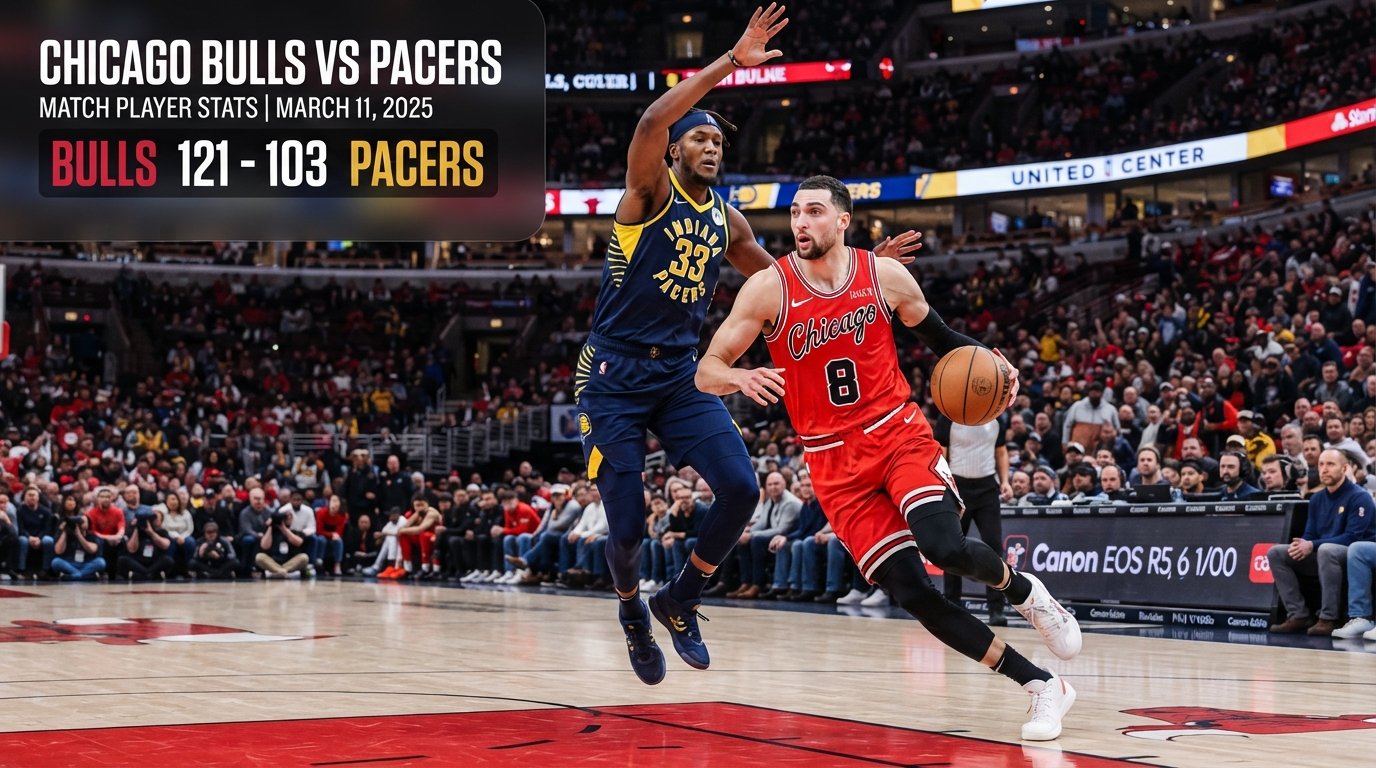
Chicago Bulls vs Pacers Match Player Stats
The chicago bulls vs pacers match player stats from March 11, 2025, reveal how Chicago delivered a convincing 121-103 victory over Indiana at the United Center. Coby White and Josh Giddey led the Bulls with 29 points apiece, while Chicago’s dominance on the boards and an outstanding second quarter helped the team control the contest. Although Indiana entered the matchup with a better season record and had already won the first three meetings between these teams during the 2024-25 campaign, the Bulls finished the season series with an impressive performance in front of 20,697 spectators.
This game was particularly interesting because the final score did not tell the entire story. Both teams started competitively, finishing the opening quarter tied at 27-27. However, Chicago completely changed the direction of the contest in the second quarter, scoring 40 points while limiting Indiana to just 21. That 19-point quarter advantage created a comfortable halftime lead and forced the Pacers to spend the remainder of the game trying to recover.
Individual performances also played an important role. White and Giddey provided the offensive production Chicago needed, while Nikola Vucevic contributed a double-double with 11 points and 11 rebounds. Tre Jones added eight assists, giving the Bulls another important playmaker. Indiana received a team-high 15 points from Myles Turner, but the Pacers struggled to match Chicago’s shooting efficiency and rebounding strength.
This statistical breakdown examines the leading performers, shooting numbers, quarter-by-quarter developments, team comparisons, and important lessons from the matchup. It also explains why Chicago’s second-quarter performance and control of the rebounds were more significant than the final score alone might suggest.
Chicago Bulls vs Pacers Match Player Stats: Complete Game Overview
The March 11 matchup took place at the United Center in Chicago, Illinois. The Bulls entered the contest looking to finish their season meetings against Indiana on a positive note. The Pacers, meanwhile, had already established an advantage in the season series by winning the previous three encounters.
Chicago ultimately produced one of its more convincing performances against Indiana during the 2024-25 season.
Match Information
| Match Detail | Information |
| Matchup | Chicago Bulls vs Indiana Pacers |
| Date | March 11, 2025 |
| Venue | United Center |
| Location | Chicago, Illinois |
| Final Score | Bulls 121, Pacers 103 |
| Winning Team | Chicago Bulls |
| Losing Team | Indiana Pacers |
| Attendance | 20,697 |
| Chicago Record After Game | 27-38 |
| Indiana Record After Game | 35-28 |
| Season Series | Indiana won 3-1 |
The Bulls finished with 121 points, giving them an 18-point victory. Their 50% field-goal shooting percentage demonstrated their ability to convert scoring opportunities efficiently. Indiana, by comparison, finished at 40% from the field.
The rebounding numbers were another major difference. Chicago collected 56 rebounds, while Indiana managed 39. That 17-rebound advantage gave the Bulls additional opportunities to control possessions and limit the Pacers’ second-chance opportunities.
Final Score Breakdown
| Team | Final Points |
| Chicago Bulls | 121 |
| Indiana Pacers | 103 |
| Winning Margin | 18 points |
Chicago’s advantage developed gradually during the first quarter but became much more significant before halftime. The Bulls maintained their strong position during the second half and avoided allowing Indiana to complete a comeback.
For readers checking the official box score, the complete game record is available through ESPN’s official matchup statistics.
Chicago Bulls Player Stats and Individual Performances
Chicago’s victory was built around several effective individual contributions. White and Giddey delivered the biggest scoring performances, but the supporting players also helped the Bulls maintain their advantage.
A strong team performance does not always require every player to score heavily. In this matchup, Chicago benefited from a combination of scoring, rebounding, and passing.
Coby White: 29 Points, 7 Rebounds, 4 Assists
Coby White was one of the most important players in the game. He finished with 29 points, seven rebounds, and four assists, matching Giddey’s scoring total and providing Chicago with another reliable offensive option.
His scoring contribution was particularly valuable because the Bulls did not have to depend on a single player to generate their offense.
White’s 29 points represented a major part of Chicago’s offensive production. His ability to contribute alongside Giddey made the Bulls more difficult to defend.
From a statistical perspective, three aspects of his performance deserve attention:
- Scoring production: His 29 points helped Chicago maintain consistent offensive pressure.
- Rebounding contribution: Seven rebounds gave the Bulls additional support beyond their frontcourt players.
- Playmaking: Four assists showed that he also contributed to the team’s ball movement.
White’s performance was important because Indiana needed to account for more than one high-scoring threat. When a defense focuses heavily on one player, another offensive option can take advantage of the available opportunities.
That was one of the defining characteristics of Chicago’s offensive performance.
Josh Giddey: 29 Points, 10 Rebounds, 4 Assists
Josh Giddey produced an equally impressive scoring performance, finishing with 29 points, 10 rebounds, and four assists.
His double-double demonstrated his influence across multiple statistical categories. While his scoring matched White’s production, his rebounding added another important dimension to his performance.
The 10 rebounds were especially valuable in a matchup where Chicago dominated the overall rebounding numbers.
Giddey’s contribution can be understood through three important areas.
- Scoring efficiency and offensive responsibility
Giddey provided 29 points, making him one of the primary scoring options for Chicago. His production helped prevent Indiana from concentrating its defensive attention exclusively on White.
- Rebounding strength
His 10 rebounds gave Chicago additional control over possessions. Rebounding is particularly important against a team that wants to create extra scoring opportunities through missed shots.
- All-around contribution
Four assists demonstrated his involvement in creating opportunities for teammates. His performance was not limited to putting points on the scoreboard.
Giddey’s statistical contribution was one of the clearest reasons Chicago maintained an advantage throughout the contest.
His double-double also highlighted how important versatile players can be in games where scoring and possession control both matter.
Nikola Vucevic: 11 Points and 11 Rebounds
Nikola Vucevic contributed 11 points and 11 rebounds off the bench, recording a double-double that strengthened Chicago’s frontcourt production.
His rebounding was particularly useful because the Bulls already had an advantage in this category. Instead of allowing Indiana to improve its position around the basket, Chicago received additional support from Vucevic.
His 11 rebounds were equal to his scoring total, making his contribution valuable even without a high-scoring performance.
Vucevic’s impact can be understood through the following points:
- He provided 11 points to Chicago’s offensive total.
- He collected 11 rebounds.
- He added important frontcourt depth.
- His rebounding supported Chicago’s overall 56-39 advantage.
Bench contributions often receive less attention than performances from starting players. However, Vucevic’s double-double shows why reserve production can be important in maintaining a team’s advantage.
Tre Jones: 8 Assists
Tre Jones played an important role in Chicago’s offensive organization by recording eight assists.
Assists help explain how effectively a team creates scoring opportunities through passing rather than relying entirely on individual shot creation.
Jones’ eight assists were particularly valuable in a game where Chicago recorded 30 assists as a team.
His performance reflected the Bulls’ ability to involve multiple players in their offense.
Rather than depending exclusively on White and Giddey’s scoring, Chicago benefited from additional playmaking that helped distribute offensive responsibilities.
The eight assists also provide useful context when evaluating Chicago’s overall ball movement.
Chicago’s Supporting Contributions
The leading performances from White, Giddey, Vucevic, and Jones were central to the result, but the Bulls’ success also depended on their collective effort.
Chicago finished with 121 points and 30 assists. That combination suggests that the team was able to create scoring opportunities through both individual performances and coordinated offensive possessions.
The Bulls also collected 56 rebounds, a major advantage that supported their offensive and defensive efforts.
The important lesson from Chicago’s performance is that individual scoring leaders become even more effective when other players contribute in complementary ways.
Indiana Pacers Player Stats and Individual Performances
Indiana entered the matchup with a stronger season record than Chicago, but the Pacers could not translate that advantage into a victory.
The team finished with 103 points, shooting 40% from the field and 25% from three-point range.
Myles Turner led the Pacers in scoring, while Pascal Siakam and Ben Sheppard also made meaningful offensive contributions.
However, Indiana’s individual performances were not enough to overcome Chicago’s advantages in shooting and rebounding.
Myles Turner: 15 Points
Myles Turner was Indiana’s leading scorer with 15 points.
Although his scoring total was lower than those of White and Giddey, he remained the Pacers’ most productive individual scorer in the matchup.
Turner’s contribution was important because Indiana needed consistent offensive production to compete with Chicago’s scoring output.
However, the Pacers struggled to generate enough points across the roster.
Turner’s 15 points represented a team-high performance, but the difference between his production and Chicago’s two 29-point performances illustrates the scoring challenge Indiana faced.
The Bulls had two players score nearly twice as many points as Indiana’s leading scorer.
This difference became particularly important after Chicago established its halftime advantage.
Pascal Siakam: 13 Points and 4 Assists
Pascal Siakam finished with 13 points and four assists.
His performance combined scoring with playmaking, giving Indiana some offensive support beyond Turner’s contribution.
The four assists showed that Siakam was involved in creating opportunities for teammates.
However, Indiana needed a more consistent offensive response to match Chicago’s balanced scoring.
Siakam’s 13 points were useful, but the Pacers still finished 18 points behind.
His performance also highlights an important distinction between individual productivity and team success. A player can contribute in several statistical categories without those contributions being enough to change the final outcome.
Ben Sheppard: 12 Points Off the Bench
Ben Sheppard added 12 points off the bench, providing Indiana with an additional scoring option.
His contribution was important because the Pacers needed production from their reserve players to compete with Chicago’s offensive depth.
Sheppard’s 12 points also demonstrated that Indiana received some support beyond its leading scorers.
However, the team’s overall shooting efficiency remained a major problem.
Indiana finished with 40% shooting from the field and 25% from three-point range. Those numbers made it difficult to generate enough offense against a Chicago team shooting 50%.
Johnny Furphy: 8 Rebounds
Johnny Furphy led Indiana with eight rebounds.
His contribution was important in a category where the Pacers struggled collectively.
Indiana finished with 39 total rebounds compared with Chicago’s 56. Furphy’s eight rebounds represented a useful individual effort, but the team needed more contributions across the roster to close the gap.
Rebounding differences can affect both ends of the court.
Defensive rebounds help a team finish possessions, while offensive rebounds can create additional scoring opportunities.
Chicago’s advantage in this area made it harder for Indiana to establish consistent control.
Quenton Jackson: 5 Assists
Quenton Jackson recorded five assists for Indiana.
His playmaking contribution provided additional support in a game where the Pacers finished with 30 total assists.
Indiana actually matched Chicago’s team assist total, demonstrating that passing volume alone was not enough to determine the winner.
The difference came from how effectively each team converted its offensive opportunities.
Chicago’s superior shooting percentage and rebounding advantage were more decisive factors.
Complete Player Performance Comparison
The following table summarizes the leading individual contributions recorded in the matchup.
| Player | Team | Points | Rebounds | Assists |
| Coby White | Bulls | 29 | 7 | 4 |
| Josh Giddey | Bulls | 29 | 10 | 4 |
| Nikola Vucevic | Bulls | 11 | 11 | Not specified |
| Tre Jones | Bulls | Not specified | Not specified | 8 |
| Myles Turner | Pacers | 15 | Not specified | Not specified |
| Pascal Siakam | Pacers | 13 | Not specified | 4 |
| Ben Sheppard | Pacers | 12 | Not specified | Not specified |
| Johnny Furphy | Pacers | Not specified | 8 | Not specified |
| Quenton Jackson | Pacers | Not specified | Not specified | 5 |
Note: The table includes the individual statistics available in the supplied game data. Unspecified figures have been left blank rather than estimated.
The comparison highlights the different ways both teams generated production.
Chicago had two players scoring 29 points, another player recording a double-double, and a reserve playmaker contributing eight assists.
Indiana received useful contributions from Turner, Siakam, Sheppard, Furphy, and Jackson, but its leading scorer finished with only 15 points.
The statistical difference between the two teams was especially noticeable in scoring concentration and rebounding.
Quarter-by-Quarter Game Breakdown
The most important part of this matchup was Chicago’s second-quarter performance.
Both teams entered the game with opportunities to establish their offensive rhythm. The opening quarter was competitive, but Chicago gradually took control and produced a decisive scoring advantage before halftime.
First Quarter: Bulls and Pacers Finish Tied 27-27
The opening quarter ended with both teams scoring 27 points.
A tied first quarter demonstrated that Indiana initially remained competitive despite eventually losing by 18 points.
Neither team established a significant advantage during the opening period.
For Chicago, the first quarter provided an opportunity to understand Indiana’s defensive approach and identify ways to generate better scoring opportunities.
For Indiana, staying level with the Bulls created a reasonable starting position.
However, the balance did not last.
The next quarter completely changed the direction of the contest.
Second Quarter: Chicago Scores 40 Points
<PRIVATE_PERSON> Chicago produced its strongest stretch of the game during the second quarter, outscoring Indiana 40-21.
This was the decisive period.
The Bulls scored 19 more points than the Pacers during the quarter, transforming a tied contest into a substantial halftime advantage.
At the end of the first half, Chicago led 67-48.
That difference created pressure on Indiana because the Pacers needed to find a way to reduce the deficit while also preventing the Bulls from continuing their offensive production.
Several factors help explain why the second quarter was so important:
- Chicago increased its scoring output significantly.
- Indiana struggled to match the Bulls’ offensive pace.
- The Bulls established a 19-point halftime advantage.
- Chicago’s leading scorers helped create a difficult defensive challenge.
- The Pacers entered the second half needing a major response.
A strong second quarter can influence the entire structure of a basketball game.
When a team creates a substantial halftime lead, its opponent often has to take more offensive risks. Those risks can produce additional scoring opportunities, but they can also lead to difficult shots and turnovers.
Chicago’s second-quarter advantage gave the Bulls greater control over the remaining game.
Third Quarter: Bulls Extend Their Advantage
Chicago continued to control the matchup after halftime.
The Bulls extended their advantage to 21 points by the end of the third quarter.
That development was significant because Indiana had not managed to reduce the deficit enough to make the final period a close contest.
The Pacers needed a strong third-quarter response, but Chicago maintained its position.
The Bulls’ ability to preserve their advantage demonstrated the importance of consistency after a successful first half.
A team that builds a substantial lead still needs to execute properly after halftime. Allowing the opponent to create momentum can quickly make a comfortable game competitive.
Chicago avoided that situation.
Fourth Quarter: Chicago Completes the 121-103 Victory
The final period brought the matchup to its conclusion.
Chicago finished with 121 points, while Indiana ended with 103.
The Bulls secured an 18-point victory and completed their season meetings against Indiana with a win.
Although the Pacers had won the first three encounters during the 2024-25 campaign, Chicago finished the series with a much-needed positive result.
The final score reflected Chicago’s advantages throughout the game, particularly its second-quarter scoring and overall rebounding performance.
Team Statistics: Chicago Bulls vs Indiana Pacers
Individual performances explain who contributed most, but team statistics show why Chicago won.
The biggest differences appeared in field-goal percentage, three-point percentage, and total rebounds.
Interestingly, both teams recorded 30 assists, while Indiana actually finished with fewer turnovers and more steals.
This makes the matchup particularly useful for understanding why one or two statistical categories cannot explain an entire basketball result.
Complete Team Statistics
| Statistical Category | Chicago Bulls | Indiana Pacers |
| Final Score | 121 | 103 |
| Field Goals Made | 49 | 40 |
| Field Goals Attempted | 98 | 101 |
| Field-Goal Percentage | 50% | 40% |
| Three-Pointers Made | 12 | 10 |
| Three-Pointers Attempted | 33 | 40 |
| Three-Point Percentage | 36% | 25% |
| Total Rebounds | 56 | 39 |
| Assists | 30 | 30 |
| Turnovers | 18 | 9 |
| Steals | 4 | 14 |
These figures reveal several important differences.
Chicago made nine more field goals despite attempting three fewer shots. The Bulls also collected 17 additional rebounds.
Indiana, however, performed better in turnovers and steals.
The Pacers committed nine turnovers compared with Chicago’s 18 and recorded 14 steals against the Bulls’ four.
Despite those advantages, Indiana could not overcome its shooting and rebounding disadvantages.
Field-Goal Shooting: Chicago’s Biggest Offensive Advantage
Chicago made 49 of its 98 field-goal attempts, finishing with a 50% shooting percentage.
Indiana converted 40 of 101 attempts, finishing at 40%.
The difference was 10 percentage points.
This was one of the most important statistical factors behind Chicago’s victory.
The Bulls were more effective at converting their attempts into points.
They also made nine more field goals while attempting fewer shots.
That combination demonstrates why shooting efficiency matters.
A team does not necessarily need to take more shots to score more points. Converting a greater percentage of available opportunities can create a significant advantage.
Indiana’s 40% field-goal percentage made it difficult to keep pace with Chicago’s offensive production.
Three-Point Shooting: Another Advantage for Chicago
Chicago made 12 of its 33 three-point attempts, recording a 36% percentage.
Indiana converted 10 of 40 attempts, finishing at 25%.
The Bulls therefore held an 11-percentage-point advantage in three-point shooting.
Although the difference in made three-pointers was only two, the shooting percentages reveal a more significant efficiency gap.
Indiana attempted seven more shots from beyond the arc but made fewer three-pointers.
This is an important distinction.
Taking additional three-point attempts does not automatically produce a better offensive performance. The quality and conversion rate of those opportunities matter.
Chicago’s 36% shooting percentage provided a more effective result from long distance.
The Pacers needed greater accuracy to make their three-point volume more valuable.
Rebounding: Chicago Controls the Boards
Chicago finished with 56 rebounds, while Indiana recorded 39.
The 17-rebound difference was one of the clearest statistical advantages in the game.
Rebounding is important because it determines which team controls possession after a missed shot.
When a team consistently secures defensive rebounds, it limits the opponent’s opportunities to score again.
Offensive rebounds can also create additional possessions and give a team more chances to generate points.
Chicago’s advantage suggests that the Bulls were more effective at controlling this part of the game.
Giddey’s 10 rebounds and Vucevic’s 11 rebounds were particularly notable individual contributions.
Indiana received eight rebounds from Furphy, but the team could not match Chicago’s overall production.
The rebounding difference was significant enough to stand out even alongside Indiana’s advantages in steals and turnovers.
Assists: Both Teams Finish With 30
One interesting feature of the game was the identical assist total.
Chicago and Indiana both recorded 30 assists.
This means neither team had an advantage in the final assist count.
However, identical totals do not necessarily mean that both teams created equally effective scoring opportunities.
Chicago converted 50% of its field-goal attempts, while Indiana converted only 40%.
The Bulls therefore received more scoring value from their overall shooting opportunities.
Tre Jones led Chicago’s individual playmaking contribution with eight assists.
Quenton Jackson recorded five assists for Indiana, while Siakam added four.
The team totals show that both sides involved teammates in their offense, but Chicago was more successful at turning those opportunities into points.
Turnovers: Indiana Makes Better Use of Possessions
Indiana committed only nine turnovers, compared with Chicago’s 18.
This was a clear statistical advantage for the Pacers.
Turnovers represent possessions that end without a successful field-goal attempt or another scoring opportunity.
Reducing turnovers generally helps a team maintain offensive continuity.
Indiana’s ability to limit mistakes should have provided an opportunity to remain competitive.
However, the Pacers still lost by 18 points.
This demonstrates that protecting the basketball is only one part of a successful offensive performance.
Indiana’s shooting percentage and rebounding numbers created problems that its lower turnover count could not overcome.
Steals: Pacers Lead 14-4
Indiana recorded 14 steals, while Chicago managed only four.
This was another area where the Pacers clearly outperformed the Bulls.
The 10-steal advantage showed that Indiana was able to disrupt Chicago’s possessions and create defensive pressure.
However, the Pacers could not turn that defensive activity into enough points to change the final result.
The difference between steals and turnovers is important when evaluating this matchup.
Steals represent defensive actions that directly take possession away from the opponent. Turnovers include a wider range of possession-ending mistakes.
Indiana’s higher steal total and lower turnover count demonstrate that the Pacers performed well in those specific categories.
Nevertheless, Chicago’s superior shooting and rebounding proved more decisive.
Why Did the Chicago Bulls Beat the Indiana Pacers?
The final result was influenced by several connected factors rather than one individual performance.
White and Giddey were outstanding, but their scoring production was supported by strong rebounding, effective shooting, and a decisive second quarter.
1. Two Players Scored 29 Points Each
The most obvious offensive advantage was Chicago’s balanced scoring leadership.
Coby White and Josh Giddey each scored 29 points.
Having two players reach that scoring total created a difficult situation for Indiana’s defense.
The Pacers could not focus exclusively on stopping one offensive threat.
Both players also contributed in other categories, with Giddey recording 10 rebounds and four assists and White adding seven rebounds and four assists.
Their combined production gave Chicago a strong foundation.
2. The Second Quarter Changed Everything
Chicago’s 40-21 second quarter was arguably the most important stretch of the game.
The Bulls transformed a tied contest into a 19-point halftime lead.
That scoring difference gave them control of the matchup and forced Indiana to chase the result.
The Pacers could not generate a sufficient response during the remaining periods.
3. Chicago Won the Rebounding Battle
The Bulls collected 56 rebounds compared with Indiana’s 39.
This 17-rebound advantage was particularly important because it helped Chicago control possessions.
Giddey and Vucevic were major contributors, combining for 21 rebounds.
Their production strengthened Chicago’s position around the basket.
4. Better Shooting Efficiency
Chicago finished with 50% shooting from the field, compared with Indiana’s 40%.
The Bulls also converted 36% of their three-point attempts, while the Pacers managed 25%.
The difference in shooting efficiency helped Chicago maintain its scoring advantage.
Indiana attempted more field goals and more three-pointers, but its lower conversion rates limited the value of those additional attempts.
5. Strong Contributions Beyond the Leading Scorers
Chicago received 11 points and 11 rebounds from Vucevic and eight assists from Tre Jones.
Those performances provided support beyond White and Giddey.
A team becomes more difficult to defend when multiple players contribute to different aspects of the game.
Chicago’s offensive production was not limited to two scorers.
What the Matchup Reveals About the Bulls’ Offensive Performance
The most interesting lesson from this game is the relationship between balanced scoring and shooting efficiency.
Chicago did not simply win because two players scored 29 points.
The Bulls also converted their attempts at a significantly higher rate.
Their 50% field-goal percentage and 36% three-point percentage demonstrate that they were more efficient than Indiana in the most important shooting categories.
The combination of White’s scoring and Giddey’s all-around production also gave Chicago different offensive options.
White provided 29 points with seven rebounds and four assists.
Giddey matched his scoring total while adding a double-double.
Vucevic contributed another double-double, while Jones provided eight assists.
This distribution of production made the Bulls’ offensive performance more complete.
It is also worth noting that Chicago committed 18 turnovers. That figure shows the victory was not statistically perfect.
The Bulls had areas that could have been improved, particularly possession management.
However, their shooting and rebounding advantages were substantial enough to overcome the turnover difference.
This is why evaluating an NBA game requires looking beyond one statistic.
What Went Wrong for the Indiana Pacers?
Indiana’s defeat was not caused by a complete absence of individual production.
Turner scored 15 points, Siakam contributed 13 points and four assists, and Sheppard added 12 points from the bench.
The Pacers also recorded 30 assists, 14 steals, and only nine turnovers.
Those figures demonstrate that Indiana had several positive statistical contributions.
The biggest problem was converting those advantages into a competitive scoring result.
Poor Field-Goal Efficiency
Indiana shot 40% from the field.
That percentage was significantly lower than Chicago’s 50%.
The Pacers attempted 101 shots but made only 40.
The Bulls attempted three fewer shots and made nine more field goals.
That difference illustrates the importance of shot conversion.
Struggles From Three-Point Range
Indiana made only 10 of its 40 three-point attempts.
The 25% conversion rate limited the effectiveness of its long-range offense.
Although taking 40 three-point shots created opportunities for additional scoring, the Pacers needed a higher percentage to make those attempts more valuable.
Rebounding Disadvantage
Indiana lost the rebounding battle 56-39.
That 17-rebound gap made it difficult to control the game around the basket.
The Pacers needed more collective rebounding support to match Chicago’s production.
The Halftime Deficit Was Too Large
Indiana entered halftime trailing 67-48.
The 19-point deficit created a difficult situation.
Even though the Pacers had positive defensive statistics, they needed to overcome the scoring advantage Chicago had already established.
The Bulls extended their lead to 21 points after three quarters, making the comeback challenge even greater.
Season Series: Indiana Wins 3-1 Despite Losing the Finale
One important detail surrounding this matchup is that Chicago’s victory did not change the overall season-series winner.
Indiana won three of the four meetings between the teams during the 2024-25 season.
The March 11 game was Chicago’s victory in the final meeting.
This context matters because one game should not be used to describe the entire relationship between two teams during a season.
The Pacers had performed better across the four-game series, but the Bulls demonstrated that they could produce an effective performance against Indiana.
For Chicago, the victory offered a positive ending to the season meetings.
For Indiana, the loss represented a missed opportunity to complete a clean sweep.
The 3-1 series result also demonstrates why head-to-head records and individual game statistics should be evaluated separately.
A team can win the season series while losing the final encounter.
Likewise, a single impressive performance does not automatically establish overall superiority between two teams.
Statistical Lessons From the Bulls vs Pacers Game
Several useful basketball insights can be taken from this matchup.
These lessons are valuable for readers who want to understand more than the final score.
Shooting Percentage Can Matter More Than Shot Volume
Indiana attempted 101 field goals, while Chicago attempted 98.
Despite taking fewer shots, Chicago made 49 field goals compared with Indiana’s 40.
This demonstrates why shooting efficiency is a more useful measure than attempts alone.
A team can generate many opportunities but still struggle if it cannot convert them.
Rebounding Helps Control the Game
Chicago’s 17-rebound advantage was another major factor.
Rebounding can affect how many opportunities each team receives and how effectively it finishes defensive possessions.
Giddey’s 10 rebounds and Vucevic’s 11 rebounds illustrate how individual contributions can support a larger team advantage.
Balanced Scoring Creates More Offensive Options
Chicago had two players score 29 points.
The team also received contributions from its bench and additional playmakers.
This balance made it harder for Indiana to concentrate its defensive attention on one player.
Turnovers Do Not Explain Every Result
Indiana committed only nine turnovers, compared with Chicago’s 18.
However, the Pacers still lost by 18 points.
This is an important reminder that a single favorable statistic does not guarantee victory.
Teams must combine effective ball handling, shooting, rebounding, and defensive execution.
A Strong Quarter Can Determine the Final Result
Chicago’s 40-point second quarter changed the game.
The Bulls entered the contest level with Indiana after the opening period but went into halftime with a 19-point advantage.
That shift illustrates how a short stretch of effective basketball can influence the outcome of an entire matchup.
Frequently Asked Questions
1. Who won the Chicago Bulls vs Indiana Pacers game on March 11, 2025?
The Chicago Bulls defeated the Indiana Pacers 121-103 on March 11, 2025. Chicago secured an 18-point victory at the United Center in front of 20,697 spectators.
2. Who scored the most points for the Chicago Bulls?
Coby White and Josh Giddey were Chicago’s leading scorers. Both players finished with 29 points. Giddey also recorded 10 rebounds and four assists, while White added seven rebounds and four assists.
3. Who was the leading scorer for the Indiana Pacers?
Myles Turner led Indiana with 15 points. Pascal Siakam added 13 points and four assists, while Ben Sheppard contributed 12 points off the bench.
4. How many rebounds did the Chicago Bulls and Indiana Pacers record?
Chicago collected 56 total rebounds, while Indiana finished with 39. The Bulls therefore held a 17-rebound advantage. Josh Giddey recorded 10 rebounds, and Nikola Vucevic contributed 11.
5. What was the biggest turning point in the game?
The second quarter was the biggest turning point. Chicago outscored Indiana 40-21 during that period, turning a 27-27 tie into a 67-48 halftime lead. The Bulls later extended their advantage to 21 points after three quarters.
6. Who won the 2024-25 season series between the Bulls and Pacers?
Indiana won the four-game season series 3-1. The Pacers won the first three meetings, while Chicago claimed victory in the final matchup on March 11, 2025.
Conclusion
The March 11, 2025, matchup between Chicago and Indiana demonstrated how balanced scoring, efficient shooting, and rebounding can determine an NBA result. The Bulls secured a 121-103 victory by combining outstanding individual performances with a dominant second quarter.
Coby White and Josh Giddey were the leading offensive performers, scoring 29 points each. Giddey also recorded 10 rebounds and four assists, while White contributed seven rebounds and four assists. Nikola Vucevic added 11 points and 11 rebounds, and Tre Jones provided eight assists.
Indiana received useful contributions from Myles Turner, Pascal Siakam, Ben Sheppard, Johnny Furphy, and Quenton Jackson. However, the Pacers struggled to match Chicago’s shooting efficiency and rebounding production.
The team statistics explain the outcome clearly. Chicago shot 50% from the field and 36% from three-point range, compared with Indiana’s 40% and 25%. The Bulls also won the rebounding battle 56-39.
Indiana performed better in turnovers and steals, recording nine turnovers and 14 steals compared with Chicago’s 18 turnovers and four steals. Both teams finished with 30 assists, but the Pacers could not turn their defensive advantages into enough scoring production.
Ultimately, Chicago’s 40-21 second quarter created the foundation for the victory. The Bulls maintained their advantage, completed the game with an 18-point win, and finished their 2024-25 season series against Indiana with a 1-3 record.
The matchup remains an excellent example of why individual player performances, team efficiency, and game progression should all be considered when evaluating an NBA contest. Looking at these elements together provides a much clearer understanding of how Chicago secured its victory and why Indiana could not produce a comeback.