Chicago Cubs vs Phillies Match Player Stats
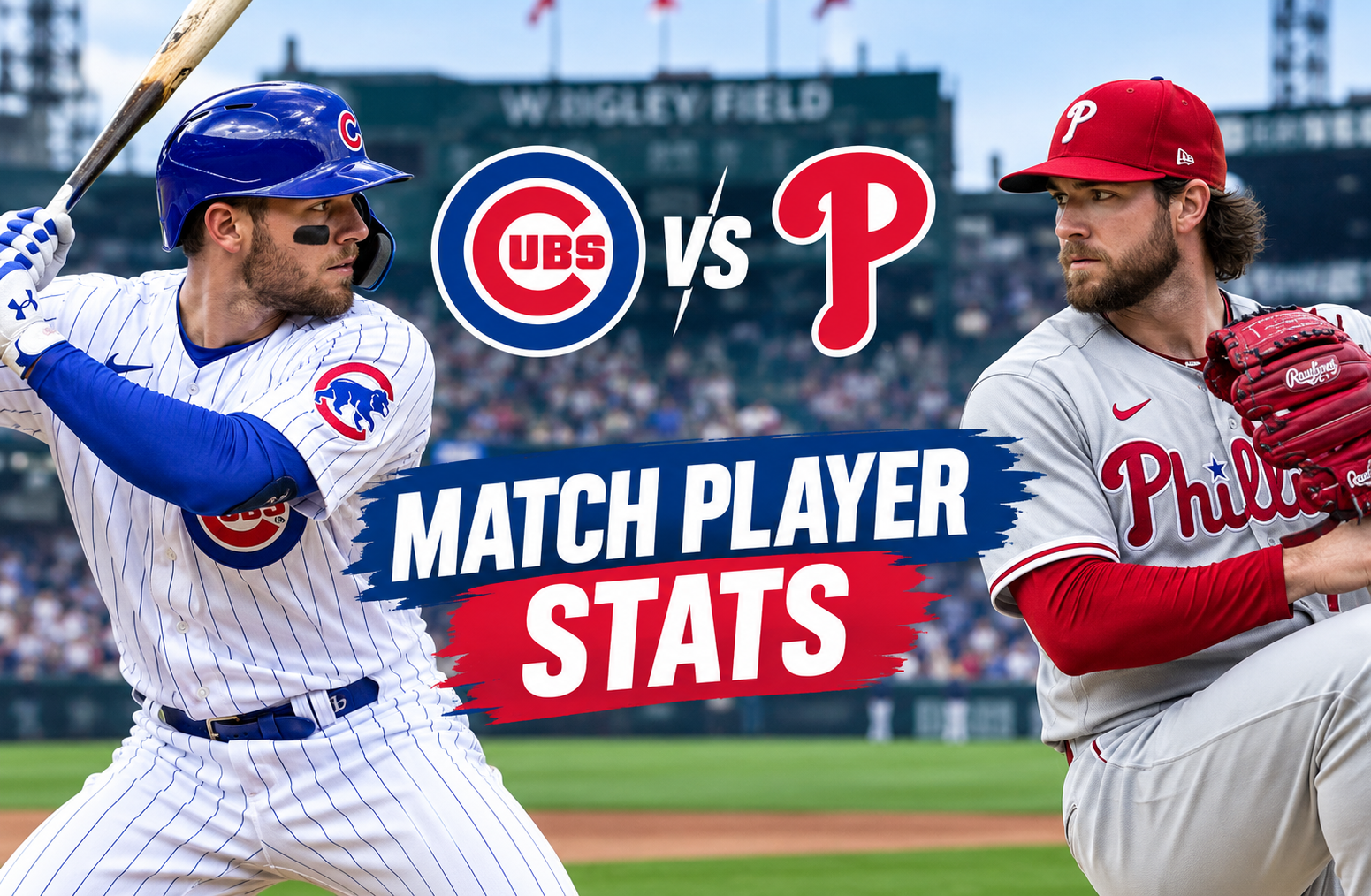
The chicago cubs vs phillies match player stats from April 23, 2026 tell the story of a dramatic 10-inning game at Wrigley Field that ended with the Chicago Cubs defeating the Philadelphia Phillies 8-7. Chicago collected 18 hits and overcame multiple Philadelphia comebacks before Dansby Swanson delivered the walk-off RBI single in the bottom of the 10th inning.
The final score alone does not explain how competitive this game was. Philadelphia hit three home runs, Brandon Marsh produced three hits and three RBIs, and Adolis García tied the game with a ninth-inning home run. Chicago answered with 18 total hits, three home runs, a four-RBI performance from Michael Busch, three hits from Seiya Suzuki, and the late-game heroics of Swanson.
For readers studying the chicago cubs vs phillies match player stats, this game provides an excellent example of why baseball analysis should go beyond simply looking at the final score. The Cubs controlled much of the middle innings, Philadelphia repeatedly erased deficits, and Chicago ultimately won because its lineup continued creating opportunities deep into extra innings.
Chicago Cubs vs Phillies Match Player Stats at a Glance
The game was played on April 23, 2026, at Wrigley Field in Chicago. The official attendance was 31,057, and the game lasted 3 hours and 1 minute.
| Category | Philadelphia Phillies | Chicago Cubs |
| Final Score | 7 | 8 |
| Hits | 8 | 18 |
| Runs | 7 | 8 |
| Errors | 0 | 1 |
| Home Runs | 3 | 3 |
| Walks | 5 | 5 |
| Strikeouts | 7 | 7 |
| At-Bats | 38 | 45 |
| RBI | 6 | 8 |
| Runners Left on Base | 8 | 17 |
| RISP | 2-for-11 | 5-for-18 |
| Stolen Bases | 2 | 1 |
| Winning Pitcher | Javier Assad | |
| Losing Pitcher | Tanner Banks |
The most striking difference is the hit total. Chicago recorded 18 hits compared with eight for Philadelphia. Despite that advantage, the Cubs still needed extra innings because the Phillies repeatedly converted their limited opportunities into important runs.
That contrast is one of the most useful lessons from this game. More hits generally create more scoring opportunities, but they do not automatically produce a comfortable win. Chicago stranded 17 runners, while Philadelphia left eight on base.
Game Context and Final Result
The Cubs entered the game with a 16-9 record, including an 11-5 home mark. Philadelphia entered at 8-17 and 3-7 on the road according to the supplied game data.
Chicago eventually won 8-7 in the 10th inning, completing a four-game sweep of Philadelphia. MLB’s game coverage described the victory as Chicago’s ninth consecutive win at the time, while Philadelphia suffered its ninth straight loss.
The game was also notable because Chicago repeatedly held a lead but could not put Philadelphia away.
The Cubs led 6-2 after six innings. Philadelphia then scored three runs in the seventh, added another in the eighth, and tied the game again in the ninth on García’s pinch-hit homer.
That sequence turned what looked like a controlled Cubs victory into a tense extra-inning contest.
How the Game Developed Inning by Inning
Second Inning: Philadelphia Strikes First
Brandon Marsh opened the scoring with a solo home run in the top of the second inning.
The homer gave Philadelphia an early 1-0 advantage and was the first indication that Marsh would become one of the game’s most productive hitters.
Chicago responded in the bottom half when Dansby Swanson drove in a run with a sacrifice fly. The game was tied at 1-1.
Third Inning: Michael Busch Changes the Game
The Cubs moved ahead in the third inning when Michael Busch hit a three-run home run.
The homer pushed Chicago’s advantage to 4-1 and gave Busch the first major offensive swing of the afternoon. MLB’s game coverage noted that the home run was only the fifth by a left-handed hitter against Cristopher Sánchez during Sánchez’s six-year MLB career.
This was important because Sánchez had already allowed only limited damage against left-handed hitters during that span.
Fourth Inning: Both Teams Trade Runs
Philadelphia responded in the fourth.
Marsh delivered an RBI single that scored Bryce Harper, cutting Chicago’s advantage to 4-2.
Chicago immediately answered with Ian Happ’s solo home run, restoring a three-run lead at 5-2.
At this point, the Cubs had established control without completely shutting down Philadelphia’s offense.
Sixth Inning: Chicago Adds Another Run
The Cubs extended their lead to 6-2 in the bottom of the sixth when Busch grounded out and Happ scored.
The play did not add another home run to Busch’s line, but it did give him another RBI and brought his total to four for the game.
Seventh Inning: Philadelphia Starts the Comeback
Marsh launched his second home run of the game in the seventh inning.
Philadelphia then benefited from a Chicago throwing error, allowing another run to score. Garrett Stubbs followed with a sacrifice fly.
Three Philadelphia runs turned a 6-2 deficit into a 6-5 game.
The comeback was now fully underway.
Eighth Inning: The Lead Changes Again
Edmundo Sosa produced an RBI single in the top of the eighth, tying the game 6-6.
Chicago responded immediately.
Seiya Suzuki hit a solo home run in the bottom of the eighth, giving the Cubs a 7-6 advantage. MLB recorded the homer at 103.6 mph exit velocity with a 39-degree launch angle and a 393-foot distance.
The Cubs were once again one inning away from winning.
Ninth Inning: García Ties It
Philadelphia refused to go quietly.
Adolis García came off the bench as a pinch hitter and launched a game-tying home run in the ninth inning.
The score was 7-7.
The Phillies had erased multiple deficits, and the game moved into extra innings.
Tenth Inning: Swanson Walks It Off
Javier Assad handled the top of the 10th for Chicago and kept Philadelphia scoreless.
The Cubs then created the winning opportunity in the bottom half.
Ian Happ scored on Dansby Swanson’s sharp single, giving Chicago the 8-7 walk-off victory. MLB’s official game coverage identifies Swanson’s hit as the game-winning play.
The win completed the Cubs’ four-game sweep.
Phillies Hitting Performance
Philadelphia’s eight-hit total was modest compared with Chicago’s 18, but several Phillies hitters made their opportunities count.
Brandon Marsh
Brandon Marsh was the clear offensive standout for Philadelphia.
His final line was:
| Statistic | Brandon Marsh |
| At-Bats | 4 |
| Runs | 2 |
| Hits | 3 |
| RBI | 3 |
| Home Runs | 2 |
| Walks | 1 |
| Strikeouts | 1 |
Marsh reached base four times and accounted for three of Philadelphia’s six RBIs.
His two home runs came at important points in the game. The first opened the scoring in the second inning, while the second helped begin Philadelphia’s seventh-inning comeback.
MLB noted that Marsh’s multi-homer performance was especially notable because his previous multi-homer game had also come against the Cubs in 2023.
Bryce Harper
Bryce Harper finished with one hit, one run, and one walk.
His presence also mattered in the fourth inning when Marsh’s RBI single brought him home.
Although Harper did not produce one of Philadelphia’s three home runs, he contributed to the scoring sequence that kept the Phillies within striking distance.
Edmundo Sosa
Sosa produced one of Philadelphia’s most important late-game hits.
His eighth-inning RBI single tied the game at 6-6 and demonstrated how Philadelphia continued to generate scoring chances even after falling behind.
He also recorded a stolen base.
Adolis García
García had only one official at-bat, but it was highly significant.
His ninth-inning pinch-hit home run tied the game at 7-7 and forced extra innings.
This is a good reminder that traditional counting statistics such as at-bats can sometimes hide the importance of a player’s contribution.
Garrett Stubbs
Stubbs recorded a sacrifice fly in the seventh inning that brought Philadelphia within one run.
His contribution did not appear as a hit or home run, but it directly affected the scoreboard.
Cubs Hitting Performance
Chicago’s offensive production was much broader.
The Cubs recorded 18 hits, with multiple players collecting two or more hits. That depth kept pressure on Philadelphia’s pitching throughout the game.
Michael Busch
Michael Busch produced perhaps the most complete offensive performance for Chicago.
His line included:
| Statistic | Michael Busch |
| At-Bats | 6 |
| Runs | 1 |
| Hits | 2 |
| RBI | 4 |
| Home Runs | 1 |
| Walks | 0 |
| Strikeouts | 2 |
Busch’s three-run homer in the third inning gave Chicago an early advantage.
He later drove in another run with a groundout in the sixth inning.
That produced four RBIs, tying together two different forms of offensive production: power hitting and productive outs.
Seiya Suzuki
Suzuki was another major contributor.
| Statistic | Seiya Suzuki |
| At-Bats | 4 |
| Runs | 2 |
| Hits | 3 |
| RBI | 1 |
| Home Runs | 1 |
| Walks | 2 |
| Strikeouts | 0 |
His three hits tied him with Marsh for the most hits by either team.
Suzuki also reached base five times if his three hits and two walks are considered together.
His eighth-inning home run gave Chicago a temporary 7-6 lead.
Ian Happ
Happ supplied both power and timely baserunning.
He hit a solo home run in the fourth inning and finished with two hits.
Most importantly, Happ scored the winning run in the 10th inning.
His ability to contribute early and then appear in the decisive extra-inning sequence made him one of the most important players in Chicago’s offensive structure.
Dansby Swanson
Swanson’s contribution came at both ends of the game.
He drove in Chicago’s first run with a sacrifice fly and then delivered the walk-off RBI single in the 10th.
His final production included two hits and two RBIs.
The final single was the most important hit of the afternoon from a game-result perspective because it ended the contest.
Matt Shaw
Shaw recorded two hits and also stole a base.
His contribution was less dramatic than Busch’s home run or Swanson’s walk-off single, but his ability to reach base helped support Chicago’s unusually high 18-hit total.
Carson Kelly
Kelly also recorded three hits and scored twice.
His performance illustrates how widely distributed the Cubs’ offensive success was. Chicago did not rely on only one or two hitters to generate its 18-hit attack.
Starting Pitching Comparison
The starting pitching matchup featured Cristopher Sánchez for Philadelphia and Edward Cabrera for Chicago.
Cristopher Sánchez
Sánchez worked 5.1 innings.
His line was:
| Statistic | Cristopher Sánchez |
| Innings | 5.1 |
| Hits Allowed | 12 |
| Runs Allowed | 6 |
| Earned Runs | 6 |
| Walks | 2 |
| Strikeouts | 4 |
| Home Runs Allowed | 2 |
The biggest challenge for Sánchez was Chicago’s ability to string together hits.
The Cubs did not need to depend exclusively on the long ball. They collected 18 hits overall and consistently put runners on base.
Sánchez allowed Busch’s three-run homer in the third and Happ’s solo homer in the fourth, contributing to Chicago’s early lead.
Edward Cabrera
Cabrera had a different type of outing.
| Statistic | Edward Cabrera |
| Innings | 7.0 |
| Hits Allowed | 6 |
| Runs Allowed | 5 |
| Earned Runs | 3 |
| Walks | 0 |
| Strikeouts | 5 |
| Home Runs Allowed | 2 |
Cabrera completed seven innings and did not issue a walk.
That is significant because Philadelphia eventually scored seven runs, yet Cabrera’s individual line included only three earned runs.
The difference came from the unearned run created by Chicago’s seventh-inning throwing error.
Cabrera also recorded his 500th career strikeout during the game.
Bullpen and Extra-Inning Impact
The game became a bullpen contest after the starters exited.
Philadelphia eventually used multiple relievers before Tanner Banks took the loss.
Banks faced the decisive situation in the 10th inning and was charged with the loss after Chicago produced the winning run.
Javier Assad earned the win for Chicago after pitching a scoreless 10th inning. His line was one inning, no hits, no runs, no walks, and no strikeouts.
The official record lists Assad at 2-1 and Banks at 0-2 after the game.
The extra-inning pitching sequence was therefore simple but decisive: Assad prevented Philadelphia from scoring, while Chicago’s offense created the winning run against Banks.
RISP Analysis: Why the Game Stayed Close
One of the most interesting numbers in the box score is the performance with runners in scoring position.
Philadelphia went 2-for-11 with runners in scoring position.
Chicago went 5-for-18.
The Cubs therefore created substantially more opportunities and converted a larger share of them.
Yet Chicago still left 17 runners on base.
That number may seem surprising considering the final result. The Cubs generated enough traffic to produce 18 hits, but many of those opportunities did not become runs.
This explains why Philadelphia remained alive deep into the game.
The Cubs’ offensive volume was excellent, but their inability to consistently cash in runners meant that a seven-run Phillies comeback was possible.
Power Hitting Comparison
Both teams hit three home runs.
Phillies Home Runs
- Brandon Marsh: 2
- Adolis García: 1
Cubs Home Runs
- Michael Busch: 1
- Ian Happ: 1
- Seiya Suzuki: 1
Philadelphia’s home runs were concentrated among two hitters.
Chicago’s three homers came from three different players.
That distinction matters because Chicago’s power was distributed across the lineup, while Marsh accounted for two of Philadelphia’s three home runs himself.
What the Hit Differential Tells Us
The 18-8 hit advantage is probably the clearest statistical indicator of Chicago’s offensive control.
The Cubs had 10 more hits than Philadelphia.
They also had 45 team at-bats compared with 38 for the Phillies.
However, the difference in hits did not translate into a large scoring margin because Philadelphia was efficient when it did generate opportunities.
The Phillies scored seven runs from only eight hits.
That is a very different offensive profile from Chicago’s 18-hit, eight-run performance.
Chicago generated volume.
Philadelphia generated timely damage.
Both approaches nearly produced the same number of runs.
Why the Cubs Won Despite Leaving 17 Runners on Base
The Cubs’ 17 runners left on base might initially look like an offensive weakness.
A closer look provides a different interpretation.
Chicago repeatedly put runners on base.
The problem was not a lack of opportunities. The issue was converting enough of them before the next inning ended.
The Cubs still finished 5-for-18 with runners in scoring position and scored eight runs.
More importantly, they continued creating opportunities late in the game.
That persistence mattered in the 10th inning.
When the game reached extra innings tied at seven, Chicago’s large volume of baserunners and at-bats gave the lineup another chance to produce.
Swanson converted that opportunity.
Why Brandon Marsh’s Performance Stands Out
Marsh’s performance deserves special attention because his production was responsible for a large share of Philadelphia’s offensive output.
He had three hits, two home runs, three RBIs, two runs, and a walk.
That means he was directly involved in five Philadelphia runs through his own scoring and run-producing hits.
- His first home run gave Philadelphia the opening lead.
- His second home run helped spark the seventh-inning comeback.
- His three-hit performance also accounted for 37.5 percent of Philadelphia’s eight hits.
That is a major concentration of offensive production.
Why Michael Busch Was Central to Chicago’s Attack
Busch’s four RBIs were the highest total for either team.
His three-run homer in the third inning immediately changed the game’s shape.
Instead of trailing 1-1 after the second inning, Chicago moved ahead 4-1.
His sixth-inning groundout then added another run.
This combination is useful when evaluating player performance because Busch did not rely on a single scoring event.
He contributed through both extra-base power and a productive groundball.
Seiya Suzuki’s Complete Offensive Day
Suzuki’s three-hit, two-walk performance is another example of why on-base production matters.
He did not simply collect hits.
He reached base five times.
His eighth-inning home run also gave Chicago a temporary one-run lead.
That meant his performance affected both the volume of offensive opportunities and the scoreboard itself.
The combination of three hits, two walks, one home run, and zero strikeouts made his plate appearances particularly productive.
The Importance of Swanson’s Walk-Off Hit
A walk-off hit is naturally memorable, but Swanson’s contribution was broader than one at-bat.
He had already produced Chicago’s first RBI with a sacrifice fly.
Then, with the game tied in the 10th, he delivered the final RBI.
That gave him two RBIs and made him directly responsible for two separate scoring moments.
His final single ended the game after Philadelphia had erased several Cubs leads.
Defensive Contributions and Mistakes
Chicago committed one error.
The throwing error by Alex Bregman contributed to Philadelphia’s seventh-inning comeback.
That error allowed Bryson Stott to score and helped turn a 6-3 situation into a closer game.
Philadelphia committed no errors.
This is an important part of the game because Chicago’s offense had created a three-run advantage, but the defensive mistake gave Philadelphia an additional opportunity.
Even with that mistake, the Cubs’ offensive production ultimately proved sufficient.
Stolen Bases and Baserunning
Philadelphia recorded two stolen bases.
Edmundo Sosa and Dylan Moore were credited with steals.
Chicago recorded one stolen base by Matt Shaw.
The stolen bases did not directly decide the final score, but they illustrate the different ways each team attempted to create pressure.
Philadelphia used speed as part of its late comeback.
Chicago’s bigger offensive advantage came from its ability to generate repeated hits.
A Statistical View of the Comeback
The game can be separated into three distinct phases.
Phase One: Cubs Establish Control
Chicago moved ahead 4-1 after three innings and later extended the lead to 6-2.
Busch’s three-run homer was the defining offensive event during this period.
Phase Two: Phillies Fight Back
Philadelphia scored three runs in the seventh, one in the eighth, and one in the ninth.
Marsh’s second homer, Sosa’s RBI single, and García’s pinch-hit homer were central to the comeback.
Phase Three: Cubs Finish in Extras
Suzuki had temporarily put Chicago ahead in the eighth, but García tied the game in the ninth.
Assad then kept Philadelphia scoreless in the 10th before Swanson ended the game.
The final phase shows why extra innings often reward teams that can continue producing baserunners after nine innings of play.
Key Statistical Takeaways
Several numbers summarize the game particularly well.
18 Cubs Hits
Chicago’s 18-hit total was the foundation of its offensive performance.
Eight Runs
Despite leaving 17 runners on base, Chicago scored eight times.
Three Home Runs Each
Both teams produced identical home-run totals, showing that the difference was not simply power.
Five-for-18 With Runners in Scoring Position
Chicago converted more of its scoring-position opportunities than Philadelphia.
Two-for-11 With Runners in Scoring Position
Philadelphia’s limited success in these situations helps explain why eight hits were enough to produce seven runs but not eight.
Three Hits and Four RBIs for Busch
Busch’s production was central to the Cubs’ early and middle-inning advantage.
Three Hits, Two Homers and Three RBIs for Marsh
Marsh carried much of Philadelphia’s offensive burden.
Three Hits and Two Walks for Suzuki
Suzuki repeatedly reached base and supplied the go-ahead homer in the eighth.
Walk-Off RBI for Swanson
Swanson’s 10th-inning single provided the final difference.
What These Stats Mean for Evaluating Players
When studying chicago cubs vs phillies match player stats, it is useful to divide player performance into several categories.
Volume
The Cubs had greater offensive volume because they collected 18 hits.
Efficiency
Philadelphia scored seven runs from eight hits, showing strong run production despite limited hit volume.
Power
Both teams hit three home runs.
Situational Hitting
Chicago went 5-for-18 with runners in scoring position, compared with Philadelphia’s 2-for-11.
Plate Discipline
Both teams drew five walks.
Pitching Control
Cabrera issued zero walks across seven innings.
Late-Game Execution
Chicago produced the only run of the 10th inning.
This framework is more useful than simply declaring one hitter the game’s top performer because it explains how different players influenced different parts of the contest.
The Four-Game Series
The Cubs completed a four-game sweep over Philadelphia.
The supplied series results were:
| Game | Result |
| April 21 | Phillies 1, Cubs 5 |
| April 22 | Phillies 4, Cubs 7 |
| April 23 | Phillies 2, Cubs 7 |
| April 23 | Phillies 7, Cubs 8 |
The final game was therefore the closest contest of the series.
Philadelphia lost the first three games by margins of four, three, and five runs before pushing Chicago into extra innings in the finale.
That makes the fourth game especially interesting when reviewing the series as a whole.
What Baseball Fans Can Learn From This Game
This matchup demonstrates why a complete statistical review should include more than runs and home runs.
A basic box-score reading might say:
Chicago won 8-7.
A deeper review shows:
- Chicago had 18 hits.
- Philadelphia had eight.
- Both teams hit three home runs.
- Philadelphia received huge production from Marsh.
- Chicago received four RBIs from Busch.
- Suzuki reached base five times.
- Cabrera threw seven innings without allowing a walk.
- Philadelphia repeatedly came back from deficits.
- Chicago stranded 17 runners.
- The Cubs eventually won through a 10th-inning walk-off.
That broader view explains the game rather than simply recording its result.
Frequently Asked Questions
What was the final score between the Cubs and Phillies on April 23, 2026?
The Chicago Cubs defeated the Philadelphia Phillies 8-7 in 10 innings at Wrigley Field. Dansby Swanson drove in the winning run in the bottom of the 10th.
Who was the best Phillies hitter in the game?
Brandon Marsh produced three hits, two home runs, three RBIs, two runs, and one walk. He was responsible for a large share of Philadelphia’s offensive production.
Who led the Cubs in RBIs?
Michael Busch led Chicago with four RBIs. He hit a three-run homer in the third inning and added another RBI on a sixth-inning groundout.
How many hits did the Cubs have?
Chicago collected 18 hits, compared with eight for Philadelphia.
Who hit the walk-off for Chicago?
Dansby Swanson hit the game-winning RBI single in the bottom of the 10th inning, scoring Ian Happ and giving the Cubs an 8-7 victory.
Who earned the win and who took the loss?
Javier Assad earned the win for Chicago, improving to 2-1. Tanner Banks took the loss for Philadelphia and fell to 0-2.
Conclusion
The chicago cubs vs phillies match player stats from April 23, 2026 show a game that was far more competitive than the hit differential might suggest.
Chicago dominated the hit count 18-8 and received major offensive contributions from Michael Busch, Seiya Suzuki, Ian Happ, and Dansby Swanson. Busch drove in four runs, Suzuki collected three hits and two walks, Happ scored the winning run, and Swanson delivered the decisive 10th-inning single.
Philadelphia, meanwhile, received an outstanding performance from Brandon Marsh. His three hits, two home runs, and three RBIs kept the Phillies competitive throughout the afternoon. Adolis García’s ninth-inning pinch-hit homer also demonstrated how quickly the game could change.
The pitching story was equally interesting. Edward Cabrera completed seven innings without issuing a walk, while Javier Assad protected the Cubs in the 10th. Philadelphia’s bullpen could not prevent Chicago from creating the final scoring opportunity.
Ultimately, the numbers reveal a game defined by offensive volume, situational hitting, power, missed opportunities, and late-game execution. Chicago’s 18-hit attack provided the foundation, Philadelphia’s timely hitting produced the comeback, and Swanson’s walk-off single supplied the final difference.
For anyone researching the matchup, these statistics provide a much clearer picture than the 8-7 score alone.