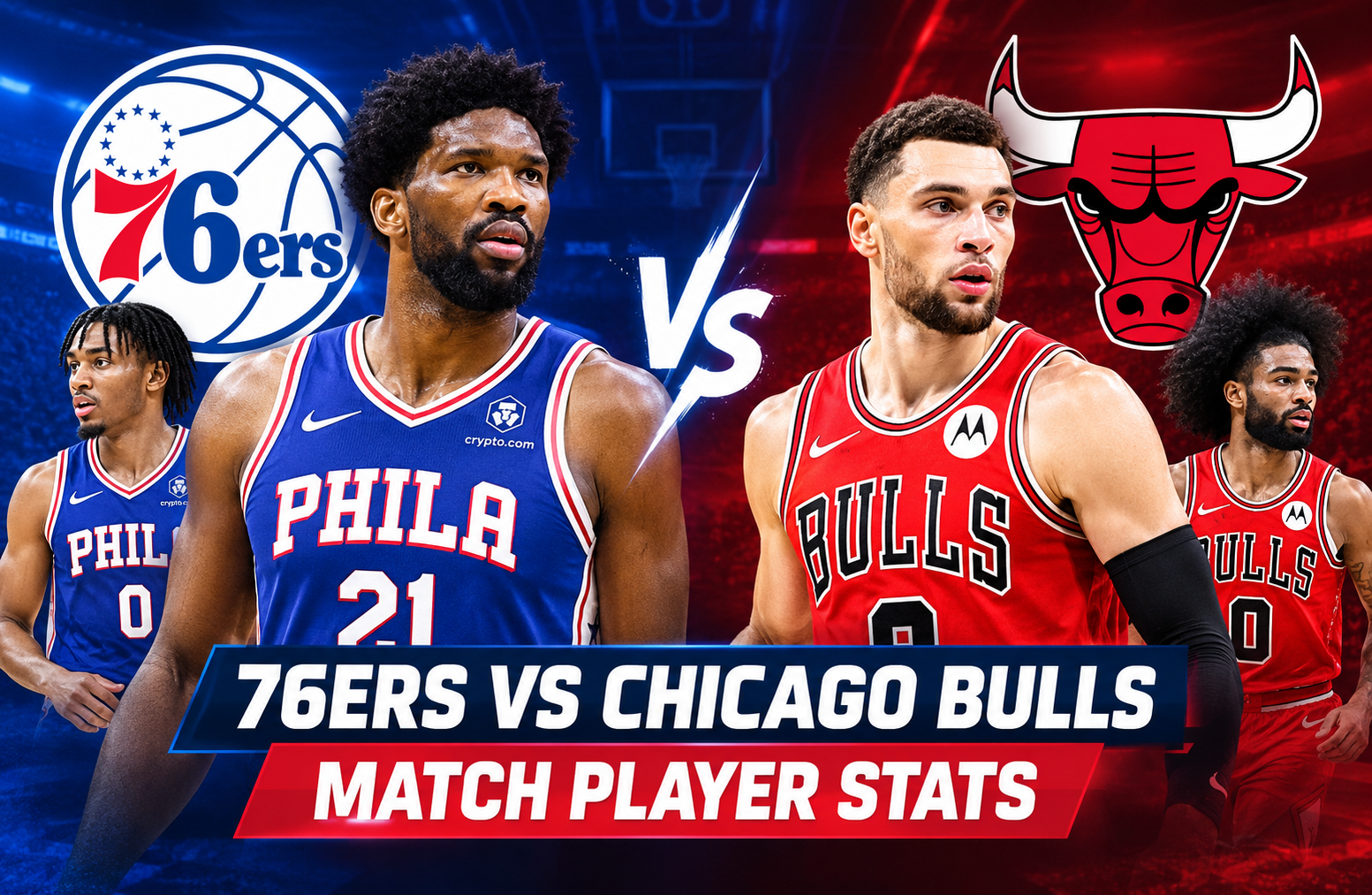
76ers vs Chicago Bulls Match Player Stats
The 76ers vs chicago bulls match player stats from the December 2025 meeting tell a much more interesting story than the 109-102 final score alone. Chicago defeated Philadelphia at the United Center after trailing 102-99 with 2:45 remaining, closing the game on a decisive 13-2 run. Joel Embiid led Philadelphia with 31 points, Tyrese Maxey added 27 points and 8 assists, while Chicago received balanced production from several players, including Zach Collins and Coby White. The official NBA record confirms the 109-102 result, the 20,952 attendance, and the detailed team and player statistics. (NBA)
The game is particularly useful for readers who want more than a basic box score. Philadelphia shot only 37.6% from the field and 28.2% from three, while Chicago converted 44.2% of its field-goal attempts and 34.1% from beyond the arc. Chicago also controlled the glass 52-46 and produced a substantial 31-22 advantage in assists. (NBA)
Below is a detailed breakdown of the individual performances, team statistics, quarter-by-quarter changes, shooting efficiency, rebounding, playmaking, and the late-game sequence that ultimately decided the matchup.
76ers vs chicago bulls match player stats: Game Overview
The matchup took place at the United Center in Chicago. The official NBA game record lists the game as December 26, 2025 in Chicago, while the NBA game information also references December 27 in its game-information display because of the post-midnight timestamp. The game ID was 401810282 according to the supplied ESPN record and the matchup finished with Chicago winning 109-102. (NBA)
Game summary
| Category | Philadelphia 76ers | Chicago Bulls |
| Final score | 102 | 109 |
| Q1 | 28 | 30 |
| Q2 | 24 | 19 |
| Q3 | 33 | 32 |
| Q4 | 17 | 28 |
| Field goals | 35-93 | 38-86 |
| Field-goal percentage | 37.6% | 44.2% |
| Three-pointers | 11-39 | 14-41 |
| Three-point percentage | 28.2% | 34.1% |
| Free throws | 21-24 | 19-25 |
| Rebounds | 46 | 52 |
| Assists | 22 | 31 |
| Turnovers | 8 | 11 |
| Steals | 7 | 3 |
| Blocks | 4 | 6 |
The raw numbers immediately show the central statistical difference. Philadelphia actually protected the ball better and shot free throws more efficiently, but Chicago made more shots, collected more rebounds, and created significantly more assisted offense. (NBA)
That combination mattered because Chicago did not need to win every statistical category. The Bulls needed enough advantages in shot-making, rebounding and ball movement to offset Philadelphia’s free-throw efficiency and lower turnover total.
Philadelphia 76ers Player Stats
Philadelphia’s offense was heavily concentrated around Joel Embiid and Tyrese Maxey.
Embiid scored 31 points on 10-of-19 shooting, while Maxey scored 27 on 9-of-24 shooting. Together, they produced 58 of Philadelphia’s 102 points, meaning the two leading scorers accounted for more than half of the team’s total offense.
Joel Embiid
31 points, 5 rebounds, 1 assist, 1 block, 2 turnovers
Embiid was Philadelphia’s leading scorer and its most efficient high-volume scorer in the game. He made 10 of 19 field-goal attempts, converted both of his three-point attempts, and went 9-for-9 from the free-throw line.
His final shooting line was:
- 31 points
- 10-for-19 FG
- 2-for-4 3PT
- 9-for-9 FT
- 5 rebounds
- 1 assist
- 1 block
- 2 turnovers
The free-throw line was particularly important. Embiid made every free throw he attempted, helping Philadelphia finish the game at 87.5% from the stripe as a team. (NBA)
His impact was not limited to the scoring total. Philadelphia’s offense repeatedly used Embiid as a half-court scoring option, especially when possessions slowed down. The problem for the Sixers was that his production was not enough to sustain the offense during the final stretch.
The NBA’s game summary notes that Philadelphia led 102-99 after Embiid scored inside with 2:45 remaining. Philadelphia then failed to score again, while Chicago scored 10 unanswered points after that possession and ultimately finished with a 13-2 run. (NBA)
Tyrese Maxey
27 points, 5 rebounds, 8 assists, 2 blocks, 2 turnovers
Maxey supplied the second major offensive engine for Philadelphia.
He finished with:
- 27 points
- 9-for-24 FG
- 5-for-11 3PT
- 4-for-4 FT
- 5 rebounds
- 8 assists
- 2 blocks
- 2 turnovers
His eight assists were a team high and demonstrated how important he was to Philadelphia’s creation. He also provided the team’s strongest three-point volume among its primary scorers, making five of 11 attempts from deep.
The challenge was efficiency. Maxey attempted 24 shots, the most on Philadelphia, but made nine. His 37.5% field-goal percentage was below the team’s overall standard required to keep pace with Chicago’s 44.2% shooting.
Still, the combination of 27 points and eight assists made him one of the most influential offensive players on the floor.
Paul George
15 points, 11 rebounds, 5 assists
Paul George produced one of the more complete statistical lines for Philadelphia.
He scored 15 points on 5-of-15 shooting and made four of nine three-point attempts. More importantly, he grabbed 11 rebounds and contributed five assists.
That made George Philadelphia’s leading rebounder. The NBA’s official game information identifies George as the Sixers’ rebounding leader with 11 boards. (NBA)
His four made three-pointers also gave Philadelphia valuable perimeter production. However, the team needed more efficient scoring from its supporting cast to turn his all-around contribution into a win.
VJ Edgecombe
10 points, 7 rebounds, 3 assists, 1 steal
Edgecombe added 10 points and provided useful work across several categories.
His seven rebounds ranked second among Philadelphia players, while his three assists helped supplement Maxey’s playmaking. He also recorded one steal.
His shooting was less efficient than Philadelphia needed, as he finished 4-for-13 from the field and 0-for-5 from three-point range. That lack of perimeter conversion contributed to Philadelphia’s overall 28.2% three-point percentage.
Dominick Barlow
7 points, 6 rebounds, 2 assists, 3 steals
Barlow delivered one of Philadelphia’s strongest contributions relative to his scoring total.
He scored seven points on 2-of-3 shooting, grabbed six rebounds, recorded two assists and led Philadelphia’s individual players with three steals.
He also shot 3-for-4 at the free-throw line.
His three steals were particularly useful because Philadelphia finished with seven steals as a team. Barlow’s defensive activity helped compensate for some of the offensive limitations elsewhere in the lineup.
Philadelphia’s bench production
Philadelphia’s bench had a mixed night.
Jared McCain scored six points and added three rebounds and two steals. Andre Drummond contributed two points and four rebounds. Adem Bona scored one point, while Justin Edwards finished without a field goal.
The overall bench production did not provide enough additional scoring to reduce the offensive burden on Embiid and Maxey.
That imbalance becomes clearer when looking at the scoring distribution. Embiid and Maxey combined for 58 points, while the rest of Philadelphia combined for 44.
Chicago Bulls Player Stats
Chicago’s scoring was more evenly distributed than Philadelphia’s.
Zach Collins and Coby White led the Bulls in scoring, but the victory was supported by important contributions from Josh Giddey, Jalen Smith, Tre Jones, Matas Buzelis and Nikola Vucevic.
Zach Collins
15 points, 5 rebounds, 1 assist, 1 block
Collins led Chicago in scoring with 15 points.
He shot 5-for-8 from the field, 2-for-3 from three-point range and 3-for-3 from the free-throw line.
That is an efficient scoring profile. He did not need a large number of attempts to make a meaningful offensive contribution.
His five rebounds and one block added further value.
Coby White
13 points, 7 rebounds, 6 assists
White finished with 13 points, seven rebounds and six assists.
His shooting line was 4-for-12 from the field, 1-for-6 from three and 4-for-4 from the free-throw line.
While the overall shooting percentage was not outstanding, White became especially important late in the contest. The official NBA summary records that White hit a step-back three during Chicago’s closing rally after Philadelphia had taken a 102-99 lead. (NBA)
That shot helped change the game’s momentum at a critical moment.
Josh Giddey
12 points, 6 rebounds, 11 assists, 1 steal
Giddey was Chicago’s primary playmaker.
His 11 assists were the highest total by any player in the game. He also recorded 12 points and six rebounds.
Although he shot only 3-for-12 from the field, his value was evident in Chicago’s 31 team assists.
Giddey’s passing helped the Bulls generate efficient opportunities without requiring one player to dominate the scoring column.
His five turnovers were also a weakness, but Chicago’s overall offensive balance allowed the team to absorb them.
Jalen Smith
12 points, 8 rebounds, 3 assists, 1 block
Smith provided a major spark off the bench.
He scored 12 points on 4-of-7 shooting, made two of four three-point attempts, collected eight rebounds and recorded three assists.
His plus/minus of +24 was the strongest figure among Chicago players shown in the box score. (ESPN)
His late-game contribution was especially memorable. The NBA’s official recap describes Smith driving along the baseline and dunking over a rotating Embiid shortly after Philadelphia had moved ahead 102-99. (NBA)
That play did more than add two points. It helped Chicago regain momentum inside a game that appeared to be slipping away.
Matas Buzelis
10 points, 8 rebounds, 3 blocks
Buzelis contributed 10 points and tied for Chicago’s highest individual rebound total with eight.
His three blocks were also significant. Chicago finished with six blocks overall, compared with four for Philadelphia.
The combination of eight rebounds and three blocks gave Chicago important interior activity, particularly against a Philadelphia team built around Embiid’s presence.
Nikola Vucevic
7 points, 7 rebounds, 1 assist, 1 block
Vucevic had a relatively quiet scoring night, making three of seven shots.
However, he contributed seven rebounds and one block.
His defensive involvement was also visible late in the game. The NBA recap notes that Maxey was blocked by Vucevic during a critical fourth-quarter possession. (NBA)
That defensive play helped Chicago protect its lead during the final possessions.
Tre Jones
15 points, 6 rebounds, 2 assists
Jones matched Collins for Chicago’s team high with 15 points.
He was highly efficient from the field, making six of 10 shots. He also grabbed six rebounds.
His importance increased during the closing minutes. After White’s three-pointer, Jones scored on a reverse layup and later added a free throw. The NBA game summary credits Jones with several of the decisive late possessions in Chicago’s closing run. (NBA)
Shooting Efficiency Was the Biggest Statistical Difference
One of the clearest lessons from the 76ers vs chicago bulls match player stats is that shot efficiency can outweigh a turnover advantage.
Philadelphia committed only eight turnovers compared with Chicago’s 11. On paper, that is a meaningful positive.
But Chicago shot 38-for-86 from the field, while Philadelphia shot 35-for-93.
That means Chicago:
- Made three more field goals
- Took seven fewer shots
- Shot 44.2% overall
- Held Philadelphia to 37.6%
- Made three more three-pointers
- Shot better from three
The Bulls’ 34.1% three-point shooting was not elite by itself, but it was considerably better than Philadelphia’s 28.2%.
This produced a useful efficiency advantage throughout the game.
Philadelphia also shot 87.5% from the free-throw line, better than Chicago’s 76%. Yet Chicago’s field-goal and three-point advantages were large enough to overcome that difference.
Rebounding Created Extra Opportunities
Chicago won the rebounding battle 52-46.
That six-rebound difference may look modest, but it helped explain why the Bulls could maintain offensive pressure despite committing three more turnovers.
Chicago collected 12 offensive rebounds compared with Philadelphia’s 13, so the main difference came from defensive rebounding.
The Bulls pulled down 40 defensive rebounds, while Philadelphia had 33.
That mattered because defensive rebounds end possessions.
When Chicago missed, the Bulls were often able to finish the possession without giving Philadelphia another immediate scoring opportunity. When Philadelphia missed, Chicago frequently secured the ball and transitioned into its own offense.
Paul George’s 11 rebounds and Embiid’s five prevented the gap from becoming larger, but Chicago still finished ahead 52-46.
Assists Showed the Difference in Offensive Structure
Philadelphia finished with 22 assists.
Chicago finished with 31.
That nine-assist difference is one of the strongest indicators of how the two offenses operated.
Maxey led Philadelphia with eight assists, while George added five. Those two players accounted for 13 of Philadelphia’s 22 assists.
Chicago’s distribution was broader.
Josh Giddey had 11 assists, White had six, and several other players contributed multiple assists.
That helped Chicago produce offense through movement and passing rather than relying primarily on individual shot creation.
The result was a 31-assist performance despite Chicago having only 38 made field goals.
In other words, a large portion of Chicago’s baskets came through assisted offensive actions.
Turnovers Favored Philadelphia, But Not Enough
Philadelphia committed eight turnovers.
Chicago committed 11.
This was one of the few straightforward statistical advantages for the Sixers.
Philadelphia’s three-turnover advantage reduced Chicago’s opportunities in transition and prevented the Bulls from gaining an even larger possession advantage.
However, turnover control could not compensate for the difference in shooting.
The lesson from this matchup is important for anyone analyzing box scores: a team can win the turnover battle and still lose comfortably if it gives away too much in shooting efficiency and rebounding.
Philadelphia needed its strong ball security to translate into more made shots.
It did not.
Quarter-by-Quarter Breakdown
The quarter scores reveal how dramatically the game changed.
First quarter: Chicago 30, Philadelphia 28
Chicago opened with a two-point advantage.
Philadelphia still scored 28 points, suggesting that the Sixers were able to generate offense early.
The game was competitive from the opening period, and neither side established a decisive lead.
Second quarter: Philadelphia 24, Chicago 19
Philadelphia responded in the second quarter.
The Sixers outscored Chicago 24-19 and entered halftime with a three-point advantage.
The NBA’s recap states that Philadelphia led 52-49 at halftime after overcoming early swings in momentum. Philadelphia had made only three of its first 15 three-point attempts by halftime and was shooting 19-for-50 overall. (NBA)
That detail is important because Philadelphia was ahead despite struggling from outside.
Third quarter: Philadelphia 33, Chicago 32
The third quarter was an offensive exchange.
Philadelphia scored 33 points, while Chicago scored 32.
The Sixers therefore carried a four-point lead into the final quarter.
At that stage, the game appeared to be leaning toward Philadelphia.
But Chicago had one more major adjustment left.
Fourth quarter: Chicago 28, Philadelphia 17
The fourth quarter decided everything.
Chicago outscored Philadelphia 28-17.
The Bulls’ 11-point advantage in the final period erased Philadelphia’s four-point entering margin and created the seven-point final victory.
The most important part was the closing sequence.
Philadelphia was ahead 102-99 with 2:45 remaining. It did not score again.
Chicago responded with a 13-2 closing run, eventually winning 109-102. (NBA)
That final sequence is the clearest explanation for the result.
The Final 2:45 Changed the Entire Game
When analyzing 76ers vs chicago bulls match player stats, the final 2:45 should not be treated as an ordinary part of the box score.
It was the defining stretch.
Philadelphia had already scored 102 points and had the lead.
Embiid had just scored to put the Sixers ahead.
Then Chicago responded.
Jalen Smith attacked the baseline and finished over a rotating Embiid. Coby White followed with a step-back three. Tre Jones then scored on a reverse layup, and later added a free throw. During the sequence, Vucevic blocked a Maxey drive.
The Bulls turned a three-point deficit into a seven-point victory.
This sequence also explains why raw scoring totals can sometimes hide late-game impact.
Embiid finished with 31 points and Maxey with 27, but Chicago’s late contributors were the players who converted the most important possessions.
What the Team Stats Say About the Matchup
The statistical profile can be summarized through five major categories.
1. Chicago shot better
The Bulls made 44.2% of their field goals compared with Philadelphia’s 37.6%.
That is a major difference over 86 and 93 attempts.
2. Chicago shot better from three
Chicago made 14 of 41 three-point attempts.
Philadelphia made 11 of 39.
The Bulls therefore had three more made threes while also shooting a higher percentage.
3. Chicago controlled total rebounds
The Bulls won 52-46.
That gave them a consistent possession advantage, particularly through defensive rebounding.
4. Chicago moved the ball better
The Bulls had 31 assists compared with Philadelphia’s 22.
Giddey’s 11 assists were the individual centerpiece of that advantage.
5. Philadelphia protected the ball better
The Sixers committed only eight turnovers.
Chicago committed 11.
This was a clear Philadelphia advantage, but it was not enough to overcome Chicago’s shooting and late-game execution.
Comparing the Leading Scorers
The scoring leaders tell an interesting story.
| Player | Team | Points | FG | 3PT | FT | REB | AST |
| Joel Embiid | 76ers | 31 | 10-19 | 2-4 | 9-9 | 5 | 1 |
| Tyrese Maxey | 76ers | 27 | 9-24 | 5-11 | 4-4 | 5 | 8 |
| Paul George | 76ers | 15 | 5-15 | 4-9 | 1-1 | 11 | 5 |
| Zach Collins | Bulls | 15 | 5-8 | 2-3 | 3-3 | 5 | 1 |
| Tre Jones | Bulls | 15 | 6-10 | 0-2 | 3-6 | 6 | 2 |
| Coby White | Bulls | 13 | 4-12 | 1-6 | 4-4 | 7 | 6 |
| Josh Giddey | Bulls | 12 | 3-12 | 1-6 | 5-6 | 6 | 11 |
| Jalen Smith | Bulls | 12 | 4-7 | 2-4 | 2-2 | 8 | 3 |
Embiid was the game’s highest scorer, but Chicago had more players contributing efficiently around its leading scorers.
That difference in depth was particularly important in the fourth quarter.
Why Tyrese Maxey’s Eight Assists Matter
Maxey’s 27 points are easy to notice.
His eight assists deserve equal attention.
Philadelphia needed Maxey to function as both scorer and creator. That responsibility becomes especially important when Embiid draws defensive attention in the half court.
Maxey’s eight assists show that he was not simply taking shots.
However, his 9-for-24 shooting also demonstrates the difficulty of carrying a large offensive workload.
He made five three-pointers, which kept Philadelphia competitive, but his overall field-goal efficiency was not enough to match Chicago’s team shooting.
Paul George’s Rebounding Was an Underrated Factor
George’s 11 rebounds were important because Philadelphia needed additional rebounding around Embiid.
He also contributed five assists and four made three-pointers.
His performance was therefore broader than his 15-point scoring total suggests.
For box-score analysis, this is a useful reminder that the leading scorer is not always the player contributing most across categories.
George ranked highly in three major areas for Philadelphia:
- Rebounding
- Assists
- Three-point makes
The problem was that Philadelphia needed more efficiency from the team around its top scorers.
Chicago’s Bench Changed the Balance
Chicago’s bench production deserves special attention.
Tre Jones scored 15 points.
Jalen Smith added 12.
Zach Collins scored 15.
That gave Chicago 42 points from those three players alone.
Smith’s performance was especially valuable because he shot 4-for-7 and made two three-pointers while also grabbing eight rebounds.
Philadelphia’s supporting cast did not produce a comparable combination of efficient scoring and rebounding.
This is one reason the Bulls were able to survive Philadelphia’s two-star scoring attack.
Defensive Plays That Do Not Show Up in the Scoring Column
Not every decisive moment appears as a scoring statistic.
Chicago recorded six blocks compared with Philadelphia’s four.
Buzelis had three blocks.
Vucevic had one.
Smith had one.
Those plays mattered because Philadelphia’s offense relied heavily on Maxey and Embiid creating difficult shots.
The late block on Maxey by Vucevic was particularly significant because it occurred during the closing stretch when Philadelphia was trying to answer Chicago’s rally. (NBA)
Philadelphia did have more steals, 7-3, but Chicago’s shot-blocking and defensive rebounding helped protect the rim and finish possessions.
Season Series Context
The supplied matchup data indicates that Chicago led the season series 2-0 following this result.
The broader significance is that Chicago’s win was not simply the product of one scoring category.
Across this particular game, the Bulls demonstrated:
- Better overall shooting
- Better three-point accuracy
- More rebounds
- More assists
- More blocks
- Strong fourth-quarter execution
Philadelphia’s advantages were mainly free-throw accuracy, steals and turnover control.
The contrast gives analysts a useful framework for understanding the result without relying solely on the final score.
Common Mistakes When Reading NBA Player Stats
A box score can answer who scored the most, but it cannot always explain why a team won.
Here are several common mistakes to avoid.
Mistake 1: Assuming the highest scorer had the best overall game
Embiid scored 31 points, but the Bulls won.
That does not mean his performance was poor. It means individual scoring does not automatically translate into team success.
Mistake 2: Ignoring efficiency
Maxey scored 27 points, but he needed 24 field-goal attempts.
Collins scored 15 using only eight field-goal attempts.
Those numbers describe very different scoring workloads.
Mistake 3: Looking only at turnovers
Philadelphia had three fewer turnovers.
Yet Chicago won.
Turnover margin is important, but it must be considered alongside shooting, rebounding and offensive creation.
Mistake 4: Ignoring the fourth quarter
Philadelphia led entering the final period.
Chicago outscored the Sixers 28-17.
A full-game average can hide that kind of late-game reversal.
Mistake 5: Treating all rebounds equally
Team rebounding is more informative when separated into offensive and defensive rebounds.
Chicago’s 40 defensive rebounds helped end Philadelphia possessions, while Philadelphia collected 33 defensive rebounds.
Frequently Asked Questions
Who scored the most points in the 76ers vs Bulls game?
Joel Embiid was the game’s leading scorer with 31 points for Philadelphia. Tyrese Maxey followed with 27 points. (NBA)
Who led the Bulls in scoring?
Zach Collins and Tre Jones each scored 15 points for Chicago. (ESPN)
What was the final score between Philadelphia and Chicago?
The Chicago Bulls defeated the Philadelphia 76ers 109-102 at the United Center. (NBA)
Who led the game in assists?
Josh Giddey led all players with 11 assists for Chicago. Tyrese Maxey led Philadelphia with eight assists. (ESPN)
Who led Philadelphia in rebounds?
Paul George led the 76ers with 11 rebounds. The official NBA game page also identifies George as Philadelphia’s rebounding leader. (NBA)
Why did Chicago win the game?
Chicago’s 44.2% field-goal shooting, 34.1% three-point shooting, 52 rebounds and 31 assists helped offset Philadelphia’s advantages in turnovers and free-throw shooting. The Bulls also finished the game with a 13-2 run after Philadelphia led 102-99 late in the fourth quarter. (NBA)
Conclusion
The 76ers vs chicago bulls match player stats show a game that was decided by more than one star performance.
Joel Embiid led everyone with 31 points, while Tyrese Maxey added 27 points and eight assists. Paul George provided 11 rebounds and five assists. Philadelphia also protected the basketball well, committing only eight turnovers and shooting 87.5% from the free-throw line.
Chicago answered with a broader statistical profile.
The Bulls shot 44.2% from the field, made 14 three-pointers, grabbed 52 rebounds and recorded 31 assists. Josh Giddey supplied 11 assists, Zach Collins and Tre Jones each scored 15 points, and Jalen Smith added 12 points and eight rebounds.
The decisive difference came late.
Philadelphia held a 102-99 advantage with 2:45 remaining, but Chicago scored the final points in a 13-2 closing run. Smith’s baseline dunk, White’s step-back three, Jones’ late scoring and Vucevic’s block on Maxey helped the Bulls close the game. (NBA)
For readers studying 76ers vs chicago bulls match player stats, the most useful takeaway is that the box score needs to be read as a connected story. Philadelphia had the stronger turnover margin and superior free-throw percentage, but Chicago’s advantages in field-goal efficiency, three-point shooting, rebounding, assists and late-game execution ultimately shaped the result.
The official NBA box score and game summary provide the complete statistical record for readers who want to verify individual minutes, shooting totals, rebounds, assists, turnovers and other box-score categories.