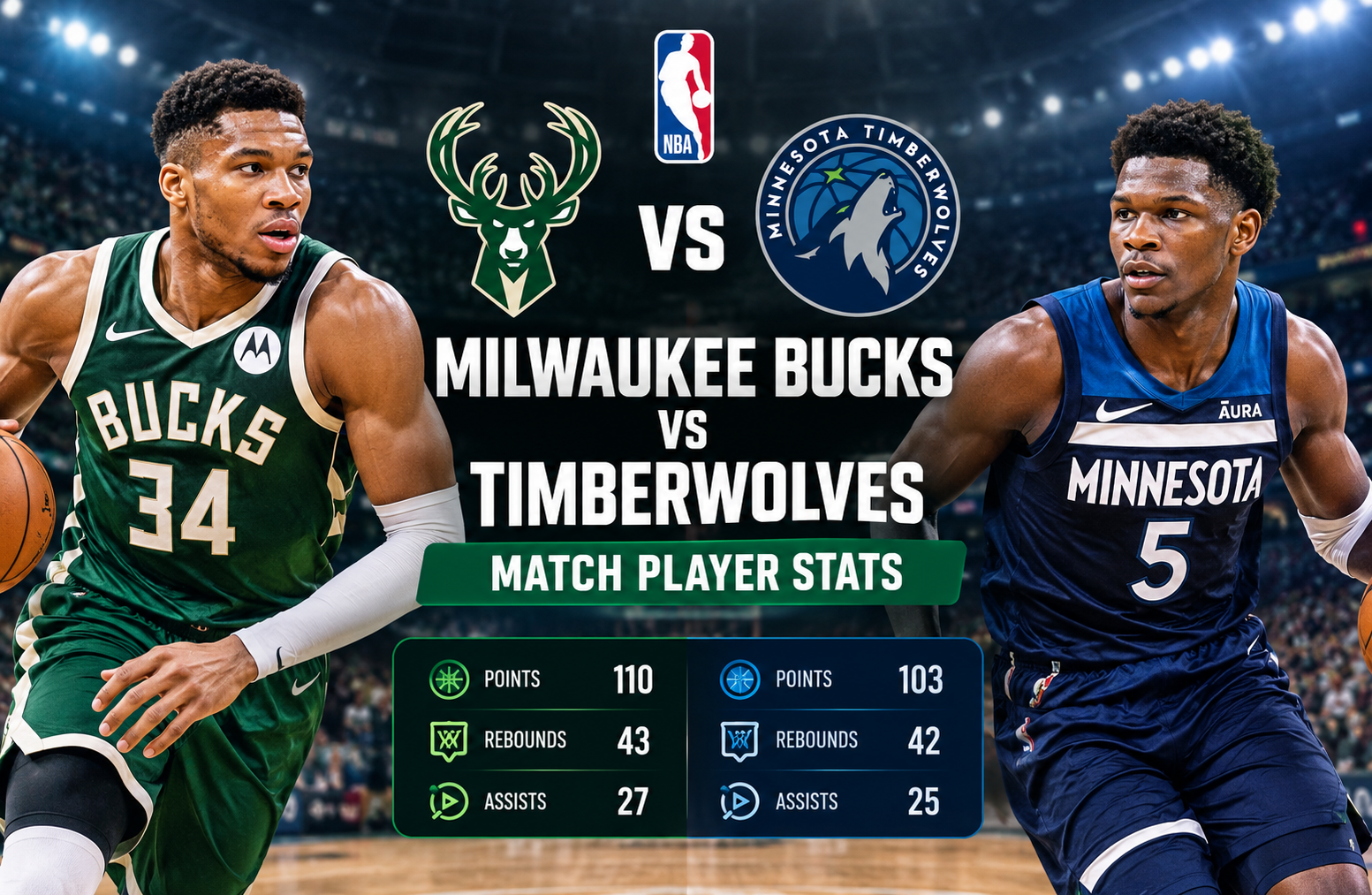
Milwaukee Bucks vs Timberwolves Match Player Stats
The milwaukee bucks vs timberwolves match player stats from the April 9, 2025 matchup tell a much more detailed story than the final score alone. Minnesota led by as many as 24 points in the fourth quarter, yet Milwaukee finished the game with a 110-103 victory at Fiserv Forum. The game featured strong individual performances from Giannis Antetokounmpo, Anthony Edwards, Donte DiVincenzo, Kevin Porter Jr., Rudy Gobert, and several important supporting players.
The official NBA record lists the matchup as Minnesota Timberwolves 103, Milwaukee Bucks 110, with Minnesota winning the first three quarters before Milwaukee produced a 40-point fourth quarter. The NBA’s game record also confirms that Milwaukee recorded 40 points in the final period after scoring only 70 through the first three quarters. (NBA)
This was not simply a game decided by one superstar. The box score shows a combination of shot-making, ball security, bench production, free-throw opportunities, turnovers, and late-game execution. Giannis finished with a triple-double, while Kevin Porter Jr. delivered 21 points and five steals. Minnesota received 25 points from Anthony Edwards and 24 from Donte DiVincenzo, but the Timberwolves could not maintain their advantage when the game entered its final stretch.
Game Overview
The matchup took place at Fiserv Forum in Milwaukee, Wisconsin, in front of 17,341 fans. Minnesota entered the game with a 46-33 record, including a 23-17 road record. Milwaukee entered at 45-34 with a 26-14 home record.
The final score was:
Milwaukee Bucks 110, Minnesota Timberwolves 103
The quarter-by-quarter scoring was particularly important:
| Quarter | Timberwolves | Bucks |
| First | 28 | 23 |
| Second | 28 | 22 |
| Third | 34 | 25 |
| Fourth | 13 | 40 |
| Final | 103 | 110 |
Minnesota controlled the first 36 minutes. The Timberwolves scored 28 points in both the first and second quarters, then exploded for 34 points in the third. At that stage, Minnesota had a 95-70 lead entering the final period.
Then the game completely changed.
Milwaukee scored 40 points in the fourth quarter while Minnesota managed only 13. NBA’s official recap records that the Bucks went on a 23-0 run during the fourth quarter and eventually turned a 24-point deficit into a seven-point victory. (NBA)
That fourth-quarter turnaround is the central fact to understand when analyzing the player statistics.
Milwaukee Bucks vs Timberwolves Match Player Stats
The milwaukee bucks vs timberwolves match player stats show two very different stories.
Minnesota had several players producing efficiently during the first three quarters. Anthony Edwards led the Timberwolves with 25 points, while Donte DiVincenzo added 24 points. Naz Reid contributed 17 points, and Jaden McDaniels scored 13.
Milwaukee was led by Giannis Antetokounmpo, who finished with 23 points, 13 rebounds, and 10 assists. Kevin Porter Jr. added 21 points and five steals, while Bobby Portis produced 18 points and 10 rebounds.
The individual production was:
Minnesota Timberwolves Player Statistics
| Player | Minutes | Points | Rebounds | Assists | FG | 3PT | FT |
| Anthony Edwards | 39:00 | 25 | 7 | 4 | 10-27 | 2-11 | 3-3 |
| Donte DiVincenzo | 27:38 | 24 | 3 | 2 | 9-15 | 6-10 | 0-1 |
| Naz Reid | 26:29 | 17 | 4 | 3 | 7-12 | 3-7 | 0-0 |
| Jaden McDaniels | 30:05 | 13 | 5 | 3 | 6-12 | 0-3 | 1-1 |
| Julius Randle | 35:08 | 9 | 7 | 6 | 3-8 | 1-3 | 2-2 |
| Mike Conley | 27:48 | 5 | 4 | 3 | 2-6 | 1-3 | 0-0 |
| Nickeil Alexander-Walker | 15:38 | 4 | 3 | 1 | 1-5 | 0-3 | 2-2 |
| Rudy Gobert | 34:23 | 6 | 9 | 2 | 3-4 | 0-0 | 0-0 |
| Jaylen Clark | 3:51 | 0 | 0 | 1 | 0-0 | 0-0 | 0-0 |
NBA’s official box score confirms Minnesota’s 41-for-89 shooting, 13-for-40 three-point shooting, and 8-for-9 free-throw shooting. (NBA)
Milwaukee Bucks Player Statistics
| Player | Minutes | Points | Rebounds | Assists | FG | 3PT | FT |
| Giannis Antetokounmpo | 36:17 | 23 | 13 | 10 | 7-13 | 0-1 | 9-11 |
| Kevin Porter Jr. | 25:14 | 21 | 4 | 5 | 6-9 | 0-2 | 9-9 |
| Bobby Portis | 28:40 | 18 | 10 | 1 | 7-15 | 2-6 | 2-2 |
| A.J. Green | 23:12 | 9 | 4 | 1 | 3-6 | 3-6 | 0-0 |
| Gary Trent Jr. | 25:06 | 7 | 2 | 4 | 2-8 | 2-6 | 1-1 |
| Kyle Kuzma | 22:36 | 5 | 2 | 1 | 2-6 | 1-3 | 0-0 |
| Taurean Prince | 24:48 | 7 | 2 | 1 | 3-9 | 1-6 | 0-0 |
| Ryan Rollins | 22:46 | 5 | 2 | 4 | 2-5 | 1-1 | 0-0 |
The official box score lists Milwaukee at 40-for-84 from the field, 12-for-36 from three-point range, and 18-for-25 at the free-throw line. (NBA)
Giannis Antetokounmpo’s Triple-Double
Giannis Antetokounmpo was the most complete statistical performer in the game.
His final line was:
23 points, 13 rebounds, 10 assists
That combination gave Milwaukee scoring, interior rebounding, and playmaking from the same player.
The 10 assists are especially important because Minnesota’s defensive attention toward Giannis naturally creates passing opportunities. When a defense collapses around a powerful interior scorer, the next decision can become more important than the original drive.
Giannis did not need to lead every statistical category. Instead, his contribution was distributed across multiple areas.
He had:
- 23 points
- 13 rebounds
- 10 assists
- 7-for-13 shooting
- 9-for-11 free throws
- 36:17 of playing time
The official NBA record identifies this as his third consecutive triple-double at the time. (NBA)
His 13 rebounds also helped Milwaukee remain competitive on the glass. The Bucks finished with 43 total rebounds compared with Minnesota’s 42.
Anthony Edwards Leads Minnesota in Scoring
Anthony Edwards finished as Minnesota’s leading scorer with 25 points.
He played 39 minutes and attempted 27 field goals, the highest field-goal volume on either team. Edwards made 10 of those attempts, giving him a 37.0 percent field-goal percentage.
His shooting line was:
- 25 points
- 10-for-27 from the field
- 2-for-11 from three
- 3-for-3 from the free-throw line
- 7 rebounds
- 4 assists
- 1 steal
- 1 block
The three-point shooting is one of the clearest areas to examine. Edwards made only two of 11 attempts from beyond the arc.
That does not erase the value of his 25 points, but it does explain why Minnesota had difficulty maintaining its offensive efficiency once the game became more competitive.
His workload was also significant. Edwards played 39 minutes, meaning Minnesota relied heavily on him for shot creation.
Donte DiVincenzo Provides Efficient Scoring
Donte DiVincenzo produced one of the most efficient offensive performances for Minnesota.
He scored 24 points in 27:38 while shooting 9-for-15 from the field and 6-for-10 from three-point range.
That equates to:
- 60.0 percent field-goal shooting
- 60.0 percent three-point shooting
- 24 total points
- 3 rebounds
- 2 assists
DiVincenzo’s six made three-pointers were particularly valuable because Minnesota needed perimeter scoring around Edwards and its frontcourt.
His efficiency stands out when compared with the volume of Edwards’ shooting. Edwards attempted 27 field goals, while DiVincenzo needed only 15 attempts to reach 24 points.
This is an important lesson when reviewing player statistics. Total points alone do not explain offensive efficiency. Shot volume and shot quality provide additional context.
Kevin Porter Jr. Changes the Game
Kevin Porter Jr. was one of the defining players in Milwaukee’s comeback.
He scored 21 points while shooting 6-for-9 from the field and 9-for-9 from the free-throw line. He also recorded five steals and five assists.
His line included:
- 21 points
- 4 rebounds
- 5 assists
- 5 steals
- 6-for-9 field goals
- 9-for-9 free throws
The five steals were particularly significant because turnovers became increasingly important during Milwaukee’s fourth-quarter surge.
The official NBA recap notes that Bobby Portis stole the ball from Anthony Edwards late in the game, setting up a Kevin Porter Jr. dunk that gave Milwaukee the lead for good. (NBA)
Porter therefore contributed in more than one way. His scoring mattered, but his defensive activity and transition opportunities were also directly connected to the game’s late momentum.
Bobby Portis Makes an Immediate Impact
Bobby Portis finished with 18 points and 10 rebounds.
His performance was important for Milwaukee’s frontcourt because the Bucks needed physical play against Minnesota’s size.
Portis shot 7-for-15 from the field and 2-for-6 from three-point range. He also made both of his free-throw attempts.
His double-double came with 28:40 of playing time.
The official game recap also notes that this was Portis’ return after a 25-game suspension. (NBA)
His return gave Milwaukee another frontcourt player capable of scoring, rebounding, and spacing the floor.
Rudy Gobert Controls the Glass
Rudy Gobert led Minnesota in rebounding with nine boards.
He scored six points while shooting 3-for-4 from the field and added two assists and one steal.
His offensive contribution was modest, but that is not unusual for a player whose value can also come from screening, rim protection, rebounding, and defensive positioning.
Minnesota finished with 42 rebounds overall, only one fewer than Milwaukee’s 43.
Gobert’s nine rebounds were therefore an important part of Minnesota’s effort to control the interior.
However, Milwaukee’s overall rebounding advantage, combined with its late offensive pressure, helped the Bucks maintain enough possessions to complete the comeback.
Julius Randle’s All-Around Numbers
Julius Randle did not have a high-scoring game, finishing with nine points.
His broader statistical contribution was more useful than the scoring number suggests.
Randle recorded:
- 9 points
- 7 rebounds
- 6 assists
- 1 steal
- 5 turnovers
He shot 3-for-8 from the field and 1-for-3 from three-point range.
The six assists were second among Minnesota players in the game, behind the 10 assists recorded by Giannis on the Milwaukee side and matching the importance of Randle’s role as a creator.
The five turnovers, however, were significant.
When evaluating a close or comeback game, turnovers should not be viewed in isolation. They become more important when they occur during a period in which the opponent is already generating momentum.
Team Shooting Comparison
The team shooting numbers provide another useful layer of analysis.
| Category | Timberwolves | Bucks |
| Field Goals | 41-89 | 40-84 |
| FG Percentage | 46.1% | 47.6% |
| Three-Pointers | 13-40 | 12-36 |
| 3PT Percentage | 32.5% | 33.3% |
| Free Throws | 8-9 | 18-25 |
| FT Percentage | 88.9% | 72.0% |
| Rebounds | 42 | 43 |
| Assists | 25 | 27 |
| Turnovers | 13 | 11 |
| Steals | 4 | 8 |
| Blocks | 3 | 2 |
| Personal Fouls | 20 | 15 |
One of the clearest differences is free-throw volume.
Minnesota attempted only nine free throws.
Milwaukee attempted 25.
That gave the Bucks 16 more free-throw attempts.
Even though Milwaukee converted at a lower percentage, the additional opportunities created a meaningful scoring advantage.
Milwaukee made 18 free throws compared with Minnesota’s eight, producing a 10-point advantage from the free-throw line.
That difference is almost large enough by itself to explain the final seven-point margin.
Turnovers and Steals Tell the Story
Minnesota committed 13 turnovers.
Milwaukee committed 11.
The raw difference was only two turnovers, but the defensive activity behind those turnovers was more notable.
The Bucks recorded eight steals compared with four for Minnesota.
Kevin Porter Jr. accounted for five of Milwaukee’s eight steals.
This is a major part of understanding the fourth-quarter comeback.
The Bucks were not simply making more shots. They were also creating additional opportunities by forcing Minnesota into difficult possessions and converting defensive plays into offense.
The NBA game data records 16 fast-break points for Milwaukee compared with three for Minnesota. (NBA)
That 13-point fast-break advantage is another useful indicator of how Milwaukee’s late defensive pressure translated into scoring.
The Fourth Quarter Was the Deciding Factor
The fourth quarter deserves its own analysis because the game was effectively transformed in 12 minutes.
Minnesota entered the final period with a 95-70 advantage.
The Timberwolves scored only 13 points in the quarter.
Milwaukee scored 40.
The NBA’s official recap states that Milwaukee erased a 24-point fourth-quarter deficit and produced a 23-0 run. (NBA)
The official game chart also lists Minnesota’s biggest lead as 24 points, Milwaukee’s biggest lead as seven points, three lead changes, and a longest run of 23 points. (NBA)
This makes the comeback statistically unusual.
A team does not normally turn a deficit of that size into a victory without a dramatic shift in both offensive efficiency and defensive pressure.
Why Minnesota’s Offense Stalled
Minnesota had scored 34 points in the third quarter.
That makes the fourth-quarter drop to 13 points even more striking.
The Timberwolves went from consistently finding scoring opportunities to struggling to maintain possession and generate efficient shots.
Several factors show up in the box score:
- Minnesota committed 13 turnovers overall.
- Milwaukee recorded eight steals.
- Anthony Edwards shot 2-for-11 from three.
- Julius Randle committed five turnovers.
- Minnesota scored only 13 fourth-quarter points.
- Milwaukee created 16 fast-break points overall.
The problem was therefore broader than one missed shot.
Minnesota’s offense lost rhythm while Milwaukee’s defense became increasingly disruptive.
Why Milwaukee’s Offense Exploded
Milwaukee scored 40 points in the final quarter.
The Bucks combined multiple scoring methods rather than relying on one player.
Giannis created offense through scoring and passing.
Kevin Porter Jr. attacked effectively and finished 9-for-9 from the free-throw line.
Bobby Portis provided interior scoring and rebounding.
A.J. Green supplied perimeter shooting.
Milwaukee’s 27 assists also indicate that the offense was not completely dependent on isolation scoring.
The Bucks finished with two more assists than Minnesota, 27 to 25.
The difference is not huge, but in combination with the Bucks’ lower turnover total and greater steal count, it helped produce more efficient possessions.
Bench Production
Bench scoring was another important factor.
Minnesota’s bench was led by Donte DiVincenzo with 24 points.
Naz Reid also added 17.
Milwaukee received 21 points from Kevin Porter Jr. and 18 from Bobby Portis.
That meant both teams had meaningful contributions beyond their primary stars.
Porter’s five steals were especially valuable because his production was not limited to scoring.
Portis’ 18 points and 10 rebounds also gave Milwaukee an interior presence that helped balance the perimeter-oriented parts of the offense.
Free-Throw Difference
The free-throw numbers deserve additional attention.
Minnesota:
8-for-9, 88.9 percent
Milwaukee:
18-for-25, 72.0 percent
Minnesota was more accurate from the line.
Milwaukee, however, reached the line much more frequently.
The result was:
Milwaukee 18 free-throw points
Minnesota 8 free-throw points
That created a 10-point difference in a game Milwaukee won by seven.
This is one of the most useful insights from the box score because it demonstrates why free-throw percentage alone is not enough to evaluate free-throw impact.
Volume matters.
Three-Point Shooting Comparison
Both teams were relatively similar from three-point range.
Minnesota made 13 of 40 attempts for 32.5 percent.
Milwaukee made 12 of 36 attempts for 33.3 percent.
Minnesota therefore made one more three-pointer, but Milwaukee shot slightly better from beyond the arc.
The most efficient perimeter shooter for Minnesota was DiVincenzo, who made six of 10 three-point attempts.
For Milwaukee, A.J. Green made three of six.
Portis and Gary Trent Jr. each made two threes.
The overall team numbers suggest that the comeback was not primarily created by a huge three-point shooting gap.
Instead, free throws, turnovers, steals, transition scoring, and fourth-quarter execution played major roles.
Rebounding Comparison
Minnesota finished with 42 rebounds.
Milwaukee finished with 43.
The difference was only one rebound.
Both teams recorded 32 defensive rebounds.
Milwaukee had 11 offensive rebounds compared with Minnesota’s 10.
That one extra offensive rebound may appear minor, but offensive rebounds can create second-chance possessions at important moments.
In this game, the bigger statistical story was not domination on the boards. The teams were relatively close.
That makes Milwaukee’s comeback even more connected to other areas of the game.
Assists and Ball Movement
Milwaukee recorded 27 assists.
Minnesota recorded 25.
The two-point difference is modest, but the individual distribution is interesting.
Giannis produced 10 assists by himself.
Julius Randle led Minnesota with six.
Giannis’ ability to combine scoring, rebounding, and playmaking forced Minnesota to account for several offensive possibilities whenever he had the ball.
That type of multi-category production is one reason his triple-double stands out in the overall statistical picture.
Player Efficiency Beyond Points
One of the biggest mistakes when reading basketball box scores is treating points as the only meaningful statistic.
This matchup offers several examples.
Anthony Edwards led Minnesota with 25 points, but he needed 27 field-goal attempts.
Donte DiVincenzo scored 24 points on only 15 field-goal attempts.
Kevin Porter Jr. scored 21 points on nine field-goal attempts while going 9-for-9 at the free-throw line.
Giannis scored 23 points while also collecting 13 rebounds and 10 assists.
Bobby Portis scored 18 points and collected 10 rebounds.
These different statistical profiles show why a complete player analysis needs to consider efficiency, playmaking, rebounding, defense, and usage rather than points alone.
Season Series Context
The supplied matchup data shows Milwaukee won the season series 2-0.
The two meetings were:
- February 13, 2025: Milwaukee 101, Minnesota 103
- April 9, 2025: Minnesota 103, Milwaukee 110
The first result was a Minnesota victory, while the later matchup went to Milwaukee.
This second meeting therefore completed the regular-season series with each team having one major result against the other in the supplied records.
The April matchup was especially notable because the final result came after Minnesota had controlled much of the game.
What the Box Score Says About Both Teams
The numbers reveal contrasting strengths.
Minnesota’s Statistical Strengths
Minnesota showed several positive indicators:
- 46.1 percent field-goal shooting
- 32.5 percent three-point shooting
- 88.9 percent free-throw shooting
- 42 rebounds
- 25 assists
- 34 points in the third quarter
- 24 points from DiVincenzo
- 25 points from Edwards
The Timberwolves were productive offensively for most of the game.
Their biggest issue was sustaining that production under Milwaukee’s late defensive pressure.
Milwaukee’s Statistical Strengths
Milwaukee finished with:
- 47.6 percent field-goal shooting
- 33.3 percent three-point shooting
- 18 made free throws
- 43 rebounds
- 27 assists
- 11 turnovers
- 8 steals
- 40 fourth-quarter points
- 23 points, 13 rebounds, and 10 assists from Giannis
The combination of efficient shooting, more free throws, fewer turnovers, and more steals helped Milwaukee recover from a huge deficit.
A Closer Look at Plus-Minus
Plus-minus can be useful, but it should always be interpreted carefully.
For Minnesota, several players had negative plus-minus figures despite strong individual statistics.
Anthony Edwards finished at -4.
Julius Randle finished at -16.
Mike Conley finished at -22.
Meanwhile, DiVincenzo and Reid both finished at +7.
For Milwaukee, Kevin Porter Jr., A.J. Green, Gary Trent Jr., and Bobby Portis all finished with positive plus-minus numbers.
Porter Jr. and A.J. Green were especially notable at +18 and +22 respectively.
Plus-minus does not explain exactly why a player produced a certain result, but it provides useful context about what happened during the player’s minutes.
The Most Important Statistical Takeaways
Several conclusions can be drawn directly from the box score.
1. The fourth quarter decided everything
Milwaukee won the final period 40-13.
That 27-point quarter differential was much larger than the seven-point final margin.
2. Milwaukee created more defensive events
The Bucks had eight steals compared with four for Minnesota.
Kevin Porter Jr. led Milwaukee with five.
3. Milwaukee reached the free-throw line more often
The Bucks attempted 25 free throws.
Minnesota attempted nine.
4. Giannis affected multiple categories
His 23 points were only one part of his statistical contribution.
He also had 13 rebounds and 10 assists.
5. Minnesota received strong bench scoring
DiVincenzo scored 24 points and Reid added 17.
6. Shooting percentages were relatively close
Milwaukee shot 47.6 percent overall.
Minnesota shot 46.1 percent.
The game was not decided by a massive overall field-goal percentage gap.
How to Read These Player Stats Correctly
If you are using milwaukee bucks vs timberwolves match player stats for fantasy analysis, historical research, basketball writing, or matchup study, it is useful to follow a consistent process.
Start with the final score.
Then examine the quarter-by-quarter results.
Next, look at individual scoring.
After that, check shooting efficiency.
Then review rebounds and assists.
Finally, examine turnovers, steals, free throws, and plus-minus.
This process prevents one statistic from dominating the entire interpretation.
For example, Edwards’ 25 points look impressive at first glance. They remain important, but the 10-for-27 shooting line and 2-for-11 three-point shooting provide additional context.
Likewise, Giannis’ 23 points do not fully capture his influence because his 10 assists and 13 rebounds created value beyond scoring.
Data Quality and Source Context
For a match-statistics article, source quality matters.
The official NBA game record provides the final score, player box score, team totals, game leaders, attendance, officials, and game information. (NBA)
The supplied data identifies the game with Game ID 401705718. The NBA’s game record uses its own game identifier for the matchup and provides the detailed box score and game chart.
There is also a date-labeling nuance worth noting. The supplied dataset identifies the game as April 9, 2025, while the NBA page labels the local game date as Tuesday, April 8, with the game information displaying April 9 at 12:00 AM. This appears to reflect date and time-zone presentation rather than a different matchup. (NBA)
For publishing purposes, using April 9, 2025 as the date in the supplied dataset is reasonable, while readers can use the official NBA game record to verify the matchup.
Frequently Asked Questions
Who scored the most points for the Timberwolves?
Anthony Edwards led Minnesota with 25 points. He shot 10-for-27 from the field and 2-for-11 from three-point range.
Who led the Bucks in scoring?
Giannis Antetokounmpo led Milwaukee with 23 points. He also recorded 13 rebounds and 10 assists for a triple-double.
Who had the most rebounds in the game?
Giannis Antetokounmpo led all players with 13 rebounds. Bobby Portis was Milwaukee’s second-leading rebounder with 10, while Rudy Gobert led Minnesota with nine.
Who had the most assists?
Giannis Antetokounmpo led the game with 10 assists. Julius Randle led Minnesota with six assists.
How did the Bucks come back from a large deficit?
Milwaukee overcame a 24-point deficit by dominating the fourth quarter. The Bucks scored 40 points while Minnesota scored 13, including a 23-0 Milwaukee run. (NBA)
Which player had the most steals?
Kevin Porter Jr. led the game with five steals. Milwaukee recorded eight team steals compared with four for Minnesota.
Conclusion
The milwaukee bucks vs timberwolves match player stats from this matchup provide a clear example of why a final score does not tell the complete story.
Minnesota controlled the opening three quarters and entered the fourth with a substantial lead. Anthony Edwards led the team with 25 points, while Donte DiVincenzo delivered 24 points on highly efficient shooting. Rudy Gobert controlled the team’s rebounding effort with nine boards, and Julius Randle contributed six assists.
Milwaukee’s response was built around a much broader statistical effort. Giannis Antetokounmpo recorded 23 points, 13 rebounds, and 10 assists. Kevin Porter Jr. added 21 points, five assists, and five steals. Bobby Portis supplied 18 points and 10 rebounds.
The team numbers reinforce the individual performances. Milwaukee shot 47.6 percent compared with Minnesota’s 46.1 percent, had 27 assists to 25, committed 11 turnovers to Minnesota’s 13, and recorded eight steals to Minnesota’s four. The Bucks also attempted 25 free throws compared with nine for the Timberwolves.
Most importantly, Milwaukee scored 40 points in the fourth quarter while Minnesota scored only 13. That single period transformed a game that appeared firmly controlled by Minnesota into a seven-point Milwaukee victory.
For anyone studying this matchup, the most useful lesson is to look beyond points. Shooting volume, efficiency, free-throw attempts, turnovers, steals, rebounding, assists, and quarter-by-quarter scoring all contribute to understanding how the game actually unfolded.