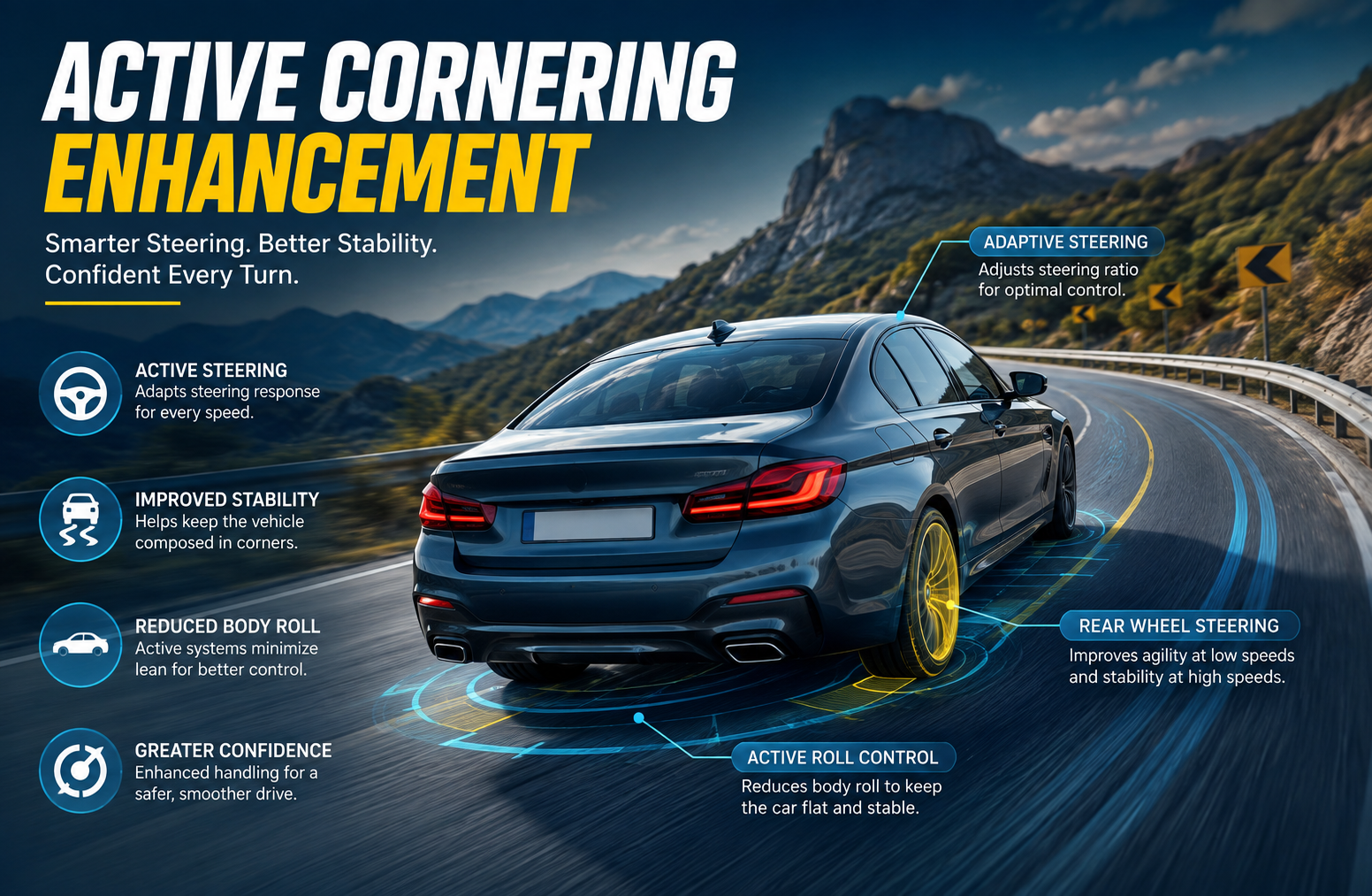
Active Cornering Enhancement: How It Works and Why It Matters
Active cornering enhancement is an automotive technology designed to help a vehicle remain more stable, controlled, and predictable while turning. In simple terms, it uses sensors, electronic controls, and sometimes active steering or chassis components to improve how a vehicle responds during a corner.
Modern vehicles must balance several competing goals. Drivers want easy maneuvering at low speeds, sharp response through bends, stability during lane changes, and predictable handling at highway speeds. A conventional fixed mechanical system cannot always deliver the ideal response in every situation. This is where advanced cornering technologies can make a meaningful difference.
The term active cornering enhancement may be used broadly to describe systems that improve vehicle behavior while cornering. Depending on the manufacturer and vehicle, the technology may involve active steering, rear wheel steering, active roll stabilization, electronic stability systems, adaptive suspension, or a combination of these systems.
The key idea is straightforward: instead of relying entirely on fixed mechanical settings, the vehicle can continuously adjust certain responses based on speed, steering input, vehicle movement, and road conditions.
For drivers, this can translate into easier low speed maneuvering, better confidence in corners, improved stability during sudden direction changes, and a more composed driving experience. However, the technology is not magic. It works within the physical limits of tire grip and road conditions, and it cannot eliminate the risks associated with excessive speed or unsafe driving.
What Is Active Cornering Enhancement?
Active cornering enhancement refers to technology that actively helps optimize a vehicle’s behavior while turning.
A traditional vehicle depends largely on fixed steering geometry, suspension components, tire characteristics, and the driver’s steering input. These systems can perform very well, but their mechanical settings are often compromises.
For example:
- Quick steering may feel excellent at low speeds but overly sensitive at high speeds.
- A soft suspension may provide comfort but allow more body movement in fast corners.
- A stiff suspension may improve handling but reduce ride comfort.
- A long vehicle may offer excellent interior space but be harder to maneuver.
An active system attempts to reduce some of these compromises by changing the vehicle’s response according to the situation.
Depending on the design, the system may analyze information from:
- Steering angle sensors
- Vehicle speed sensors
- Wheel speed sensors
- Yaw rate sensors
- Lateral acceleration sensors
- Suspension position sensors
- Driver input
- Road surface information in more advanced systems
The vehicle’s control units then process this information and command the appropriate steering, suspension, braking, or stabilization components.
The result is a vehicle that can react differently when parking, driving through a tight bend, changing lanes, or traveling at highway speed.
The Main Goal of the Technology
The main purpose is not simply to make a car feel sportier. A well-designed active system attempts to improve the relationship between three important characteristics:
- Agility
- Stability
- Comfort
These goals can conflict with one another.
A vehicle designed for maximum agility may respond very quickly to steering input. That can feel enjoyable and precise, but excessive responsiveness may feel nervous at higher speeds.
A vehicle tuned for maximum stability may feel calm and secure on the highway but less responsive in tight urban spaces.
Active systems attempt to adapt rather than forcing engineers to choose one fixed compromise.
How Active Cornering Enhancement Works
The exact hardware differs between vehicles, but the operating principle is generally based on three stages:
1. The Vehicle Detects What Is Happening
The vehicle first collects information about its current condition.
For example, when entering a corner, the system may monitor:
- How quickly the steering wheel is being turned
- Vehicle speed
- Wheel rotation
- Lateral acceleration
- Vehicle yaw movement
- The relationship between the driver’s intended direction and the vehicle’s actual movement
Yaw refers to the rotation of a vehicle around its vertical axis. In practical driving terms, it describes how the vehicle turns or rotates during a corner.
2. The Control System Evaluates the Situation
The electronic control unit compares the driver’s requested direction with the actual movement of the vehicle.
If the vehicle is behaving normally, the system may make only minor adjustments or none at all.
If the vehicle begins to move differently from the intended path, an advanced system may respond by adjusting available components.
For example, the system may:
- Alter steering behavior
- Change the steering ratio
- Steer the rear wheels
- Adjust suspension damping
- Reduce body roll
- Apply braking force to specific wheels
- Work alongside electronic stability control
3. The Vehicle Makes a Controlled Adjustment
The adjustment is intended to help the vehicle remain composed and predictable.
The driver may not always notice the intervention. In many situations, the purpose of the system is to make the vehicle’s behavior feel natural rather than artificial.
This is an important point. The best active chassis technologies often work quietly in the background. Their goal is generally not to take over normal driving but to improve the vehicle’s response.
Active Steering and Cornering Performance
One of the most important technologies associated with enhanced cornering is active steering.
A conventional steering system usually has a relatively fixed relationship between steering wheel movement and wheel angle. Active steering can vary this relationship.
At lower speeds, a more direct steering response can reduce the amount of steering wheel movement needed.
At higher speeds, the system can provide a less direct response to support smoother and more stable vehicle behavior.
BMW has described its active and integral steering technologies as systems that vary steering response according to driving conditions. Its newer Integral Active Steering combines variable front steering behavior with rear wheel steering to improve maneuverability at low speeds and stability at higher speeds.
Why Variable Steering Ratios Matter
Imagine making a tight parking maneuver.
With a conventional steering setup, the driver may need to turn the steering wheel significantly to achieve the required wheel angle.
A more direct low speed steering response can reduce that effort.
Now imagine traveling at highway speed.
An extremely direct steering response could make small steering movements produce excessive vehicle reactions. A less aggressive steering ratio can help make the vehicle feel calmer and more controlled.
This difference illustrates one of the central principles behind active vehicle dynamics: the ideal response changes depending on the situation.
Rear Wheel Steering and Cornering
Rear wheel steering is another technology that can contribute to improved cornering behavior.
The rear wheels do not necessarily remain fixed in one direction. In some systems, they can turn slightly.
At Low Speeds
The rear wheels may turn in the opposite direction from the front wheels.
This can effectively reduce the turning circle and improve maneuverability.
It is especially useful for:
- Parking
- U-turns
- Tight city streets
- Low speed maneuvering
At Higher Speeds
The rear wheels may turn in the same direction as the front wheels.
This can help make the vehicle’s movement more composed during:
- Lane changes
- Highway driving
- Fast direction changes
- Long sweeping corners
BMW’s official descriptions of Integral Active Steering explain this low speed and high speed behavior, with opposite rear wheel movement at lower speeds and same-direction movement at higher speeds.
Active Roll Stabilization
Cornering does not only involve steering direction. Vehicle body movement also matters.
When a car turns, lateral forces push the body toward the outside of the corner. This produces body roll.
Some amount of body roll is normal. Excessive roll, however, can affect:
- Driver confidence
- Passenger comfort
- Vehicle response
- Tire contact behavior
Traditional anti-roll bars provide resistance through mechanical design. Active roll stabilization systems can go further by actively controlling the forces that influence body movement.
BMW has described active roll stabilization as a system capable of compensating for lateral forces and reducing rolling movements during dynamic cornering.
The objective is not necessarily to make a vehicle feel completely flat. Instead, the system can help manage body movement according to driving conditions.
The Role of Electronic Stability Control
It is important not to confuse active cornering systems with electronic stability control, even though they may work together.
Electronic stability systems primarily focus on helping maintain vehicle stability when the vehicle begins to move in a way that differs significantly from the driver’s intended path.
For example, a vehicle may experience:
Understeer
Understeer occurs when the front tires lose grip and the vehicle turns less than the driver intends.
In simple terms, the vehicle may continue moving wider through the corner instead of following the desired path.
Oversteer
Oversteer occurs when the rear of the vehicle rotates more than intended.
In severe cases, the rear of the vehicle may slide outward and cause the vehicle to spin.
Advanced steering and chassis systems can work alongside stability control to help improve vehicle response. However, these technologies have different functions and should not be viewed as identical.
The most sophisticated vehicle dynamics systems often function as a coordinated network.
Key Benefits for Everyday Drivers
The advantages are not limited to performance driving.
Easier Parking and Urban Driving
Large vehicles can be difficult to maneuver in narrow streets and parking areas.
Systems that provide more direct low speed steering or rear wheel steering can make these vehicles easier to position.
This can be particularly valuable in:
- Parking garages
- Narrow residential streets
- Tight intersections
- Busy city centers
Improved Highway Stability
At higher speeds, smooth and predictable steering behavior becomes increasingly important.
A vehicle that reacts too sharply to every small steering input can feel unstable or tiring to drive.
Active systems can be calibrated to provide more stable and controlled responses.
Better Lane Changes
A sudden lane change requires a vehicle to transition smoothly from one direction to another.
Advanced steering and chassis technologies may help reduce unwanted body movement and improve directional control.
Improved Cornering Confidence
A well-tuned system can help a vehicle feel more predictable through corners.
The driver may notice:
- More consistent steering response
- Reduced body movement
- Better directional stability
- Improved agility
Confidence is an important benefit, but it should not be confused with unlimited capability. Tire grip and road conditions still determine what is physically possible.
Real-World Applications
Active cornering technologies appear in several types of vehicles.
Luxury Sedans
Luxury vehicles often use these systems to balance comfort with handling.
A large sedan may need to feel easy to maneuver in a parking lot while remaining stable during highway travel.
SUVs
SUVs are taller and often heavier than conventional sedans.
Their higher center of gravity can make body control especially important. Active steering and suspension technologies can help engineers improve maneuverability and reduce unwanted body movement.
Performance Cars
Performance vehicles may use advanced steering and chassis systems to improve responsiveness and handling precision.
However, the system must be carefully tuned. A vehicle that feels artificially controlled or disconnected from the driver may reduce the driving experience.
Electric Vehicles
Electric vehicles often have heavy battery packs mounted low in the vehicle.
This can provide a low center of gravity, but the overall vehicle weight may still be significant.
Advanced chassis control can help manage the combination of mass, acceleration, and cornering forces.
The Physics Behind Better Cornering
No electronic system can repeal the laws of physics.
A vehicle can only generate as much cornering force as the tires and road surface allow.
The available grip depends on factors including:
- Tire condition
- Tire pressure
- Road surface
- Weather
- Vehicle weight
- Weight transfer
- Suspension behavior
- Speed
This is why an advanced system should never be viewed as permission to drive beyond safe limits.
For example, an active steering system may improve response and stability, but it cannot create unlimited tire grip on ice.
An active roll system may reduce body lean, but it cannot eliminate the effects of excessive speed.
Electronic assistance can improve how efficiently a vehicle uses its available capability. It cannot remove physical limits.
Common Challenges and Limitations
Despite their advantages, active vehicle dynamics systems also introduce complexity.
Increased Mechanical and Electronic Complexity
A conventional steering or suspension system may have fewer electronic components.
Advanced systems can include:
- Electric motors
- Actuators
- Sensors
- Control modules
- Specialized wiring
- Communication networks
More components can create more potential failure points.
Higher Repair Costs
When an active component fails, repairs may be more expensive than repairs to a basic mechanical system.
A damaged sensor, actuator, control module, or steering component may require specialized diagnostics.
In some vehicles, replacement components may also need programming or calibration.
Maintenance Knowledge
Technicians working on advanced steering and chassis systems need appropriate diagnostic equipment and technical knowledge.
This is particularly important because modern systems may communicate with other vehicle control modules.
Driver Expectations
Some drivers expect an active system to eliminate all handling risks.
That expectation is unrealistic.
The technology can support the driver, but safe driving still depends on judgment, speed management, tire condition, and road awareness.
How Drivers Can Get the Best From These Systems
The technology is largely automatic, but drivers can still influence how effectively the vehicle performs.
Keep Tires in Good Condition
Tires are the connection between the vehicle and the road.
Even the most advanced steering system cannot compensate fully for severely worn or damaged tires.
Check:
- Tread depth
- Tire pressure
- Uneven wear
- Sidewall damage
- Recommended tire specifications
Avoid Aggressive Steering Inputs
Active systems can respond quickly, but smooth inputs remain important.
Abrupt steering can create rapid weight transfer and reduce the margin available for the tires.
Understand the Driving Modes
Some vehicles allow drivers to select modes such as:
- Comfort
- Normal
- Sport
- Individual
These modes may alter steering assistance, suspension behavior, throttle response, and other vehicle characteristics.
The sportiest setting is not automatically the safest or most suitable setting for every road.
Do Not Ignore Warning Lights
A warning related to steering, stability control, suspension, or vehicle dynamics should be investigated.
Modern systems often enter a reduced-function mode when a fault is detected.
The vehicle may remain drivable, but its behavior or available features may change.
Follow Manufacturer Maintenance Procedures
Complex systems should be serviced according to the manufacturer’s recommended procedures.
After some repairs, wheel alignment, steering calibration, or electronic initialization may be required.
Active Cornering Enhancement vs Traditional Suspension
The difference is best understood as fixed response versus adaptive response.
Traditional Systems
Traditional systems rely mainly on predetermined mechanical characteristics.
The suspension, steering, and anti-roll components are designed to provide a compromise suitable for a broad range of conditions.
Advantages include:
- Simpler design
- Lower complexity
- Potentially lower repair costs
- Predictable mechanical behavior
Active Systems
Active systems can modify certain characteristics according to current conditions.
Advantages may include:
- Better low speed maneuverability
- Improved high speed stability
- Reduced body movement
- Greater adaptability
The disadvantage is greater complexity.
Neither approach is automatically better for every vehicle or every driver.
A simple, well-engineered conventional chassis can provide excellent handling. An advanced system can offer additional flexibility when designed and calibrated effectively.
The Importance of System Integration
One of the most overlooked aspects of modern vehicle dynamics is integration.
A steering system alone does not determine how a car handles.
Vehicle behavior depends on the interaction between:
- Steering
- Suspension
- Tires
- Brakes
- Stability control
- Vehicle weight distribution
- Aerodynamics
- Power delivery
A highly advanced steering system installed in an otherwise poorly balanced vehicle will not automatically create excellent handling.
Likewise, excellent mechanical design can be enhanced by intelligent electronic control.
The strongest systems are designed as part of a complete vehicle architecture.
My Practical Perspective on the Technology
From an automotive engineering perspective, one of the most interesting aspects of these systems is that their value is often most noticeable in contradictory situations.
Drivers want a vehicle to be easy to maneuver at low speeds but stable at high speeds. They want comfort on rough roads but control during corners. They want quick responses without nervous behavior.
Those are difficult goals to achieve with one fixed mechanical setup.
This is where active systems make the most sense. Instead of trying to create one perfect setting for every situation, engineers can create different responses for different conditions.
That does not mean every vehicle needs the technology.
For a lightweight car with a simple mission, additional complexity may provide limited benefit. For a large luxury sedan, SUV, or performance vehicle expected to perform well across a wide range of conditions, the technology can be much more useful.
The most important question is not whether active technology is automatically superior. The better question is whether the added complexity provides meaningful benefits for the intended vehicle and driver.
Future Developments in Vehicle Cornering Technology
Vehicle dynamics technology continues to develop.
Future systems are likely to involve greater coordination between:
- Rear wheel steering
- Brake control
- Adaptive suspension
- Active roll systems
- Electric powertrains
- Vehicle sensors
- Advanced driver assistance systems
Electric vehicles may create additional opportunities because electric motors can respond rapidly to control commands.
At the same time, software will play an increasingly important role in determining how a vehicle behaves.
However, software development also increases the importance of:
- Reliable sensors
- Cybersecurity
- Software validation
- Accurate diagnostics
- Safe fallback modes
The future of vehicle handling is likely to become more software-defined, but tires, suspension geometry, and fundamental vehicle physics will remain essential.
Frequently Asked Questions
What does active cornering enhancement do?
Active cornering enhancement helps improve a vehicle’s stability, agility, and control while turning by adjusting steering, chassis, suspension, or other vehicle dynamics systems.
Is active cornering enhancement the same as stability control?
No. Stability control primarily helps correct significant differences between the driver’s intended path and the vehicle’s actual movement. Active cornering technologies may support normal handling as well as work alongside stability systems.
Does the technology make a vehicle safer?
It can improve vehicle control and stability in certain situations, but it cannot prevent every accident or overcome the limits of tire grip, road conditions, and excessive speed.
Can active steering improve parking?
Yes. Some active steering systems provide a more direct response at low speeds, reducing the steering wheel movement required for tight maneuvers.
Does rear wheel steering improve cornering?
It can. At low speeds, rear wheels may turn opposite to the front wheels to improve maneuverability. At higher speeds, they may turn in the same direction to support stability.
Is active cornering technology expensive to repair?
It can be more expensive than conventional steering or suspension systems because it may involve additional sensors, electronic modules, actuators, and calibration procedures.
Conclusion
Active cornering enhancement represents a major shift in how engineers approach vehicle handling. Rather than depending entirely on fixed mechanical settings, modern systems can adapt steering, chassis behavior, and vehicle stability responses to changing driving conditions.
Its greatest strength is adaptability. A vehicle can be more maneuverable when moving slowly, more composed during cornering, and more stable at higher speeds without relying on one fixed steering or suspension characteristic.
The technology also has limitations. It cannot defeat physics, replace safe driving, or compensate completely for poor tires and dangerous road conditions. It can only help a vehicle make better use of its available capability.
For drivers, the real value lies in understanding what the system does and what it does not do. When combined with good maintenance, quality tires, and responsible driving, advanced cornering technology can make modern vehicles more refined, predictable, and capable across a wide range of everyday driving situations.