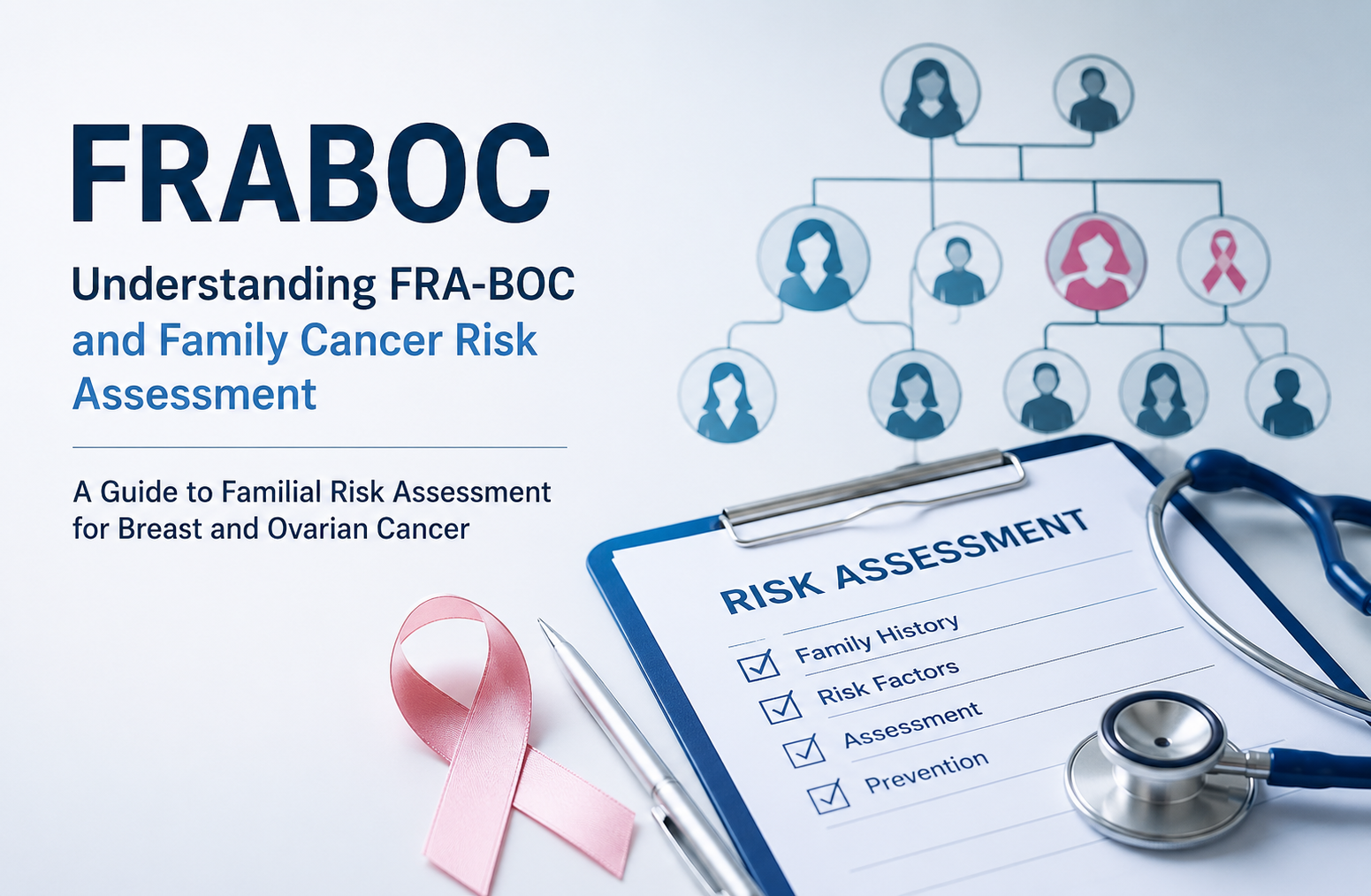
Fraboc: What It Means and Why It Still Matters
If you have searched for fraboc, you may have noticed that the term is surprisingly difficult to understand. Some recent websites describe it as a modern framework, digital concept, or productivity method, while the strongest documented meaning points to something very different: FRA-BOC, or Familial Risk Assessment for Breast and Ovarian Cancer, an Australian clinical assessment tool.
That difference matters.
When an unfamiliar term appears across unrelated websites, it is easy to assume that every page is describing the same thing. In the case of fraboc, that would be misleading. The documented healthcare meaning has a specific history and purpose, while newer uses of the word appear to be informal interpretations rather than a universally recognized framework.
This guide separates those meanings carefully. It explains what the term originally referred to, how the assessment was used, what family history has to do with breast and ovarian cancer risk, why the original tool is no longer available, and how readers should interpret modern claims about the word.
The goal is not simply to provide a definition. It is to give you enough context to recognize which meaning applies when you encounter fraboc online.
What Is Fraboc?
The most clearly established meaning of fraboc comes from the abbreviation FRA-BOC, which stood for Familial Risk Assessment, Breast and Ovarian Cancer.
It was an online clinical tool developed by Cancer Australia for health professionals, including general practitioners and nurses. Its purpose was to help assess a person’s risk of developing breast and ovarian cancer based on family history.
This is an important distinction because FRA-BOC was not designed to diagnose cancer.
It was a risk assessment tool.
In practical terms, the tool helped health professionals organize information about a patient’s family history and use that information to consider whether the person’s cancer risk might be higher than average.
Cancer Australia now states that the original FRA-BOC tool is no longer available on its website. More up-to-date breast cancer risk assessment tools are now available.
That makes the historical context especially important for anyone who finds the term in an older medical document, referral letter, clinical resource, or archived webpage.
Fraboc Has More Than One Meaning Online
One of the biggest problems with searching for fraboc today is that the word does not have one consistently used definition across the internet.
There are two broad categories of usage.
The documented medical meaning
The established meaning refers to FRA-BOC and its role in assessing familial breast and ovarian cancer risk.
This interpretation has a clear historical basis in Australian healthcare.
The newer informal meaning
Some newer websites use the word as if it describes a general framework for:
- Improving workflows
- Organizing information
- Simplifying complex decisions
- Increasing efficiency
- Managing digital processes
- Improving productivity
- Structuring problem-solving
However, these broader descriptions should be treated carefully.
There is not the same level of established evidence showing that fraboc is a formally standardized business, technology, productivity, or management methodology.
That distinction is one of the most important things to understand before relying on information found online.
The Medical Origin of Fraboc
The medical meaning of fraboc is connected to the way healthcare professionals evaluate familial cancer risk.
Family history can provide useful information when assessing cancer risk because relatives can share genetic factors as well as environmental and lifestyle factors.
For example, several close relatives with breast or ovarian cancer may be more significant than one distant relative with a cancer diagnosis.
The age at which relatives were diagnosed can also matter.
The broader pattern is more informative than a single isolated event.
This is why a structured family-history assessment can be useful.
Instead of simply asking whether someone has “cancer in the family,” a health professional can examine details such as:
- Which relatives were affected
- Whether they were related through the mother’s or father’s side
- What type of cancer they had
- How old they were when diagnosed
- Whether multiple relatives were affected
- Whether breast and ovarian cancers occurred within the same family
- Whether there is known genetic testing in the family
FRA-BOC was designed around this kind of clinical information.
What Did the Original Tool Do?
The original assessment was intended to support healthcare professionals rather than replace their judgment.
That point is worth emphasizing.
A risk assessment tool does not make a final diagnosis. Instead, it helps organize information that can contribute to a clinical decision.
A doctor or nurse could use family-history information to determine whether a patient appeared to fall into a category that might require further consideration.
Depending on the circumstances, this could lead to discussions about:
- Routine screening
- Additional risk assessment
- Referral to a specialist
- Genetic counselling
- Genetic testing
- Individualized risk management
The appropriate next step depends on the person’s circumstances.
That is why interpreting a historical assessment result without professional context can be misleading.
Fraboc Was Not a Cancer Diagnosis
A common misunderstanding is to treat a risk assessment as though it were a cancer test.
That is incorrect.
FRA-BOC was intended to help estimate familial risk. It did not tell a person whether they had breast cancer or ovarian cancer.
There is a major difference between these questions:
“How likely might this person be to develop cancer based on their family history?”
and
“Does this person currently have cancer?”
The first question involves risk assessment.
The second involves diagnosis.
Different clinical processes are required to answer them.
Understanding this distinction is especially important when reading older medical documents that mention FRA-BOC.
Why Family History Matters
Family history is one part of a much larger picture of cancer risk.
Having a relative with cancer does not automatically mean that another family member will develop the same disease.
Cancer Australia notes that inherited gene faults account for only a small proportion of breast cancers overall. At the same time, certain inherited genetic changes, including changes involving BRCA1 and BRCA2, can substantially increase risk.
This is why family history can sometimes provide an important signal.
For example, a pattern involving several close relatives with breast or ovarian cancer may warrant more attention than a single relative diagnosed at an older age.
The pattern matters.
The number of affected relatives
More affected relatives can strengthen the significance of a family history.
However, counting relatives alone is not enough.
Their relationship to the person, cancer type, age at diagnosis, and the broader family pattern also matter.
The age at diagnosis
Cancer occurring at an unusually young age can be more relevant when assessing familial risk.
This is one reason healthcare professionals generally ask not only whether relatives had cancer, but also how old they were when diagnosed.
The type of cancer
Breast cancer and ovarian cancer can be particularly relevant when assessing hereditary cancer patterns.
Other cancers can also matter depending on the family history and possible genetic associations.
Which side of the family
Genetic information can be inherited from either parent.
Therefore, a family history on the father’s side should not automatically be dismissed as irrelevant.
This is a common misunderstanding that can result in incomplete family histories.
Understanding Risk Versus Certainty
One of the most useful lessons from the history of fraboc is that risk assessment is about probability, not certainty.
A person can have a family history associated with increased risk and never develop cancer.
Likewise, someone without an obvious family history can still develop cancer.
This is because cancer develops through complex interactions among genetic, biological, environmental, and lifestyle factors.
A family history is therefore not a prediction of an individual’s future.
It is one piece of information that can help healthcare professionals understand risk.
What Happened to the Original FRA-BOC Tool?
The original FRA-BOC tool is no longer available through the Cancer Australia website.
This is particularly important for people who discover references to it in older resources.
An older document may tell you that FRA-BOC was used as a clinical assessment tool, while a current website may discuss newer tools.
There is no contradiction in that situation.
Medical resources change as evidence, technology, clinical guidelines, and risk-assessment methods develop.
A tool that was appropriate for a particular period may eventually be replaced by a newer system.
Cancer Australia currently identifies more up-to-date tools for assessing breast cancer risk.
What Is Used Instead?
Cancer Australia currently identifies iPrevent as a validated breast cancer risk assessment and risk-management decision support tool.
The purpose of a newer tool is not necessarily identical to every function of an older tool, but the broader clinical objective remains relevant: helping healthcare professionals and patients have better-informed discussions about risk, screening, and prevention.
This illustrates an important point about medical technology.
A retired tool does not necessarily mean that the underlying clinical question has disappeared.
The question remains important.
What changes is the method used to answer it.
Why People Still Search for Fraboc
There are several reasons the term continues to appear online.
Old medical records
Someone may find FRA-BOC mentioned in an old referral, report, letter, or clinical document.
They may then search the term because they want to understand what the document means.
Archived healthcare information
Older medical resources can remain accessible through search engines long after a tool has been retired.
This can make historical terminology appear current.
Family history concerns
A person who has recently learned about breast or ovarian cancer in their family may encounter the term while researching familial risk.
In this situation, understanding the historical meaning can provide context, but it should not replace a current professional risk assessment.
Search engines mix old and new meanings
Modern search results sometimes place unrelated explanations of the same word next to each other.
This can create the impression that a term has a single modern definition when it does not.
Fraboc and Genetic Risk
The connection between fraboc and genetics deserves careful explanation.
Some breast and ovarian cancers are associated with inherited genetic changes.
BRCA1 and BRCA2 are two well-known genes associated with hereditary breast and ovarian cancer risk.
However, having a genetic mutation does not guarantee that a person will develop cancer.
Likewise, not having a known mutation does not eliminate every possible cancer risk.
Genetics is one component of risk.
Family history can sometimes suggest that a hereditary cancer syndrome should be considered, particularly when cancer occurs in multiple close relatives, at younger ages, or in patterns associated with particular inherited conditions.
A qualified healthcare professional can determine whether genetic counselling or testing is appropriate.
Why Self-Assessment Can Be Misleading
It can be tempting to look at a family tree and try to calculate cancer risk independently.
The problem is that family histories are often incomplete.
People may not know:
- The exact cancer diagnosis of an older relative
- The age when the cancer was diagnosed
- Whether a cancer was primary or metastatic
- Which side of the family the history belongs to
- Whether relatives were genetically related
- Whether genetic testing has already been performed
- Whether another cancer in the family is clinically relevant
Even apparently small details can change how a professional interprets the history.
This is why an online article should explain the terminology but should not turn a historical risk tool into a do-it-yourself medical calculator.
How to Prepare Your Family History
If you are trying to understand whether your family history may be relevant, preparation can make a conversation with a healthcare professional more useful.
Start by creating a basic family health history.
Record:
- The relationship of each relative to you.
- Their approximate age or year of birth.
- Whether they developed breast, ovarian, prostate, pancreatic, or other significant cancers.
- Their approximate age at diagnosis.
- Whether the cancer occurred on your mother’s or father’s side.
- Whether more than one relative had cancer.
- Whether anyone in the family has had genetic testing.
- Any known genetic mutation.
Do not worry if you cannot obtain every detail.
Even incomplete information can provide a starting point.
The important thing is to distinguish known facts from assumptions.
For example, “my aunt had breast cancer around age 45” is more useful than simply recording “cancer in the family.”
A Practical Example
Imagine someone discovers that their mother had breast cancer and that two maternal aunts were also affected.
That information alone does not provide a diagnosis or a definitive prediction.
But it could be clinically relevant.
A healthcare professional might ask:
- How old were the relatives when diagnosed?
- Were there ovarian cancers in the family?
- Were any relatives diagnosed with breast cancer at a young age?
- Has anyone undergone genetic testing?
- Are there other related cancers in the family?
- Is there information available from medical records?
The answers could help determine whether further assessment is appropriate.
This example demonstrates why family history is more than a simple yes-or-no question.
The Difference Between Historical and Current Information
When researching fraboc, one of the safest approaches is to separate historical information from current medical guidance.
Historical information can help you understand:
- What FRA-BOC was
- Why it was developed
- Who used it
- What type of information it assessed
- Why it may appear in an older document
Current medical guidance is needed for:
- Present-day cancer screening
- Current risk assessment
- Genetic counselling
- Genetic testing
- Preventive treatment
- Individual medical decisions
A historical tool can explain an old document.
It should not automatically determine what someone should do today.
Common Misunderstandings About Fraboc
“Fraboc is a disease”
No.
FRA-BOC was the name of a risk assessment tool. It was not a disease or cancer condition.
“Fraboc diagnoses cancer”
No.
Its purpose was risk assessment based on familial information, not cancer diagnosis.
“Having a family history means you will develop cancer”
No.
Family history can increase risk in some circumstances, but increased risk is not certainty.
“The original tool is still the current standard”
No.
Cancer Australia states that the original FRA-BOC tool is no longer available and points to more up-to-date breast cancer risk assessment resources.
“The term always refers to the same modern framework”
Not necessarily.
Some recent websites use the word in broader ways, including productivity and business contexts. Those interpretations should not automatically be treated as established medical or technical definitions.
Is Fraboc a Business or Technology Framework?
This is where readers should be especially cautious.
Recent online articles sometimes describe fraboc as a flexible framework for workflow management, business optimization, productivity, or digital transformation.
These descriptions may be useful as informal interpretations of a newly used term, but they should not be confused with the documented healthcare meaning of FRA-BOC.
There is currently a significant difference between saying:
“Some websites use this word to describe a workflow concept.”
and saying:
“Fraboc is an officially established methodology used across industries.”
The second claim requires stronger evidence.
A responsible article should not present a loosely defined internet term as though it were a recognized international standard.
How to Evaluate Claims About Fraboc Online
If you encounter a website presenting a new definition, ask a few basic questions.
Who created the framework?
A legitimate framework normally has identifiable authors, organizations, documentation, or research behind it.
Is there primary documentation?
Look for original material rather than pages that simply repeat one another.
Is the term used consistently?
If ten websites give ten different definitions, that is a sign that the term may not yet have a standardized meaning in that context.
Are specific claims supported?
Statements about health, technology, business performance, or measurable outcomes should be supported by appropriate evidence.
Is the source current?
A historical medical tool should be clearly labeled as historical.
Likewise, a newer concept should not be presented as though it has decades of established research when it does not.
What Makes the Medical Meaning More Reliable?
The medical interpretation has a significant advantage: it can be traced to a recognized national cancer organization.
Cancer Australia documented FRA-BOC as an online tool designed for healthcare professionals to assess breast and ovarian cancer risk using family history.
That gives the historical definition a clear origin.
It also provides a useful lesson for online research.
When a word has competing definitions, the strongest definition is usually the one that can be traced to a reliable primary source, rather than the one repeated most frequently by secondary websites.
Popularity and authority are not the same thing.
The Role of Healthcare Professionals
Risk assessment is not simply a matter of entering family names into a calculator.
A healthcare professional can interpret information in context.
They can also identify gaps in a family history and determine whether additional investigation is appropriate.
Depending on the situation, this may involve a general practitioner, genetic counsellor, family cancer clinic, or other appropriate specialist.
This professional involvement is especially important when a family history appears strong or unusual.
What You Should Do If an Old Document Mentions Fraboc
If you find fraboc or FRA-BOC in an old medical document, do not assume that the reference represents a current recommendation.
Instead:
- Identify the date of the document.
- Determine whether the term is written as FRA-BOC.
- Check what the document says the assessment was used for.
- Note any family-history information included.
- Discuss the document with your doctor if it relates to your current health or cancer risk.
- Ask whether a current risk assessment is appropriate.
This approach preserves the historical information without treating an outdated tool as current medical advice.
Why Accurate Terminology Matters
Small differences in terminology can create large differences in understanding.
“Risk assessment” does not mean “diagnosis.”
“Family history” does not mean “inherited mutation.”
“Increased risk” does not mean “certain cancer.”
“Historical tool” does not mean “current clinical recommendation.”
These distinctions are especially important in healthcare content because readers may make decisions based on what they read.
Good health information should therefore explain both what a tool did and what it did not do.
Fraboc in the Broader Context of Cancer Risk Assessment
The story of FRA-BOC reflects a wider trend in medicine.
Healthcare professionals increasingly use structured tools to organize complex information.
A person’s risk may depend on multiple variables that are difficult to evaluate consistently without a framework.
A structured assessment can help bring those variables together.
But the tool remains part of a broader clinical process.
The output needs to be interpreted in context.
That principle applies beyond cancer.
Risk calculators, screening tools, diagnostic aids, and decision-support systems can improve consistency, but they do not remove the need for professional judgment.
What Readers Should Take Away
If you encounter fraboc today, the first question should be:
What context is this term being used in?
If the page or document mentions Australian healthcare, family history, breast cancer, ovarian cancer, general practitioners, nurses, or familial cancer risk, it is probably referring to FRA-BOC.
If the page talks about workflows, productivity, business systems, or digital processes, it may be using a newer informal interpretation.
Those two meanings should not be automatically combined.
The documented medical history is specific.
The broader modern usage is much less standardized.
A Simple Way to Remember the Term
You can think of FRA-BOC as a historical bridge between family history and cancer risk assessment.
It did not diagnose cancer.
It did not guarantee a prediction.
It helped healthcare professionals structure information about familial breast and ovarian cancer risk.
That simple distinction makes the term much easier to understand.
Frequently Asked Questions
What does fraboc mean?
The best-documented meaning is FRA-BOC, or Familial Risk Assessment, Breast and Ovarian Cancer. It was an Australian clinical tool used by health professionals to assess cancer risk based on family history.
Is Fraboc still available?
The original FRA-BOC tool is no longer available through the Cancer Australia website. Newer breast cancer risk assessment resources are now available.
Was Fraboc a cancer test?
No. FRA-BOC was a risk assessment tool. It was not designed to diagnose breast or ovarian cancer.
Who used the original Fraboc tool?
It was designed for healthcare professionals, including general practitioners and nurses, rather than as a general self-diagnosis tool for the public.
Does family history mean someone will get breast cancer?
No. Family history can increase risk in some circumstances, but it does not mean that a person will definitely develop cancer.
What should I do if an old medical document mentions Fraboc?
Treat the reference as historical information and discuss it with a qualified healthcare professional if it relates to your current cancer risk or screening decisions.
Conclusion
Fraboc is a term that requires context because its documented history is much more specific than some newer online explanations suggest.
The strongest established meaning is FRA-BOC, the Familial Risk Assessment, Breast and Ovarian Cancer tool developed for healthcare professionals in Australia. It helped assess familial cancer risk using family-history information. It was a risk assessment resource, not a cancer diagnostic test.
The original tool is no longer available through Cancer Australia, and current risk assessment resources have replaced it.
At the same time, newer websites have begun using the word in broader ways, including business, productivity, workflow, and technology discussions. Those meanings should be treated as informal unless supported by strong evidence and clear documentation.
For anyone researching an old medical record, the historical meaning is the most important one to understand. For anyone encountering the word in a modern business or technology article, the surrounding context should be examined before accepting a particular definition.
The most useful lesson is simple: do not judge an unfamiliar term by repetition alone. Look at its origin, purpose, evidence, and current status. In the case of fraboc, that approach separates a documented medical tool from newer interpretations that may not have the same level of authority.