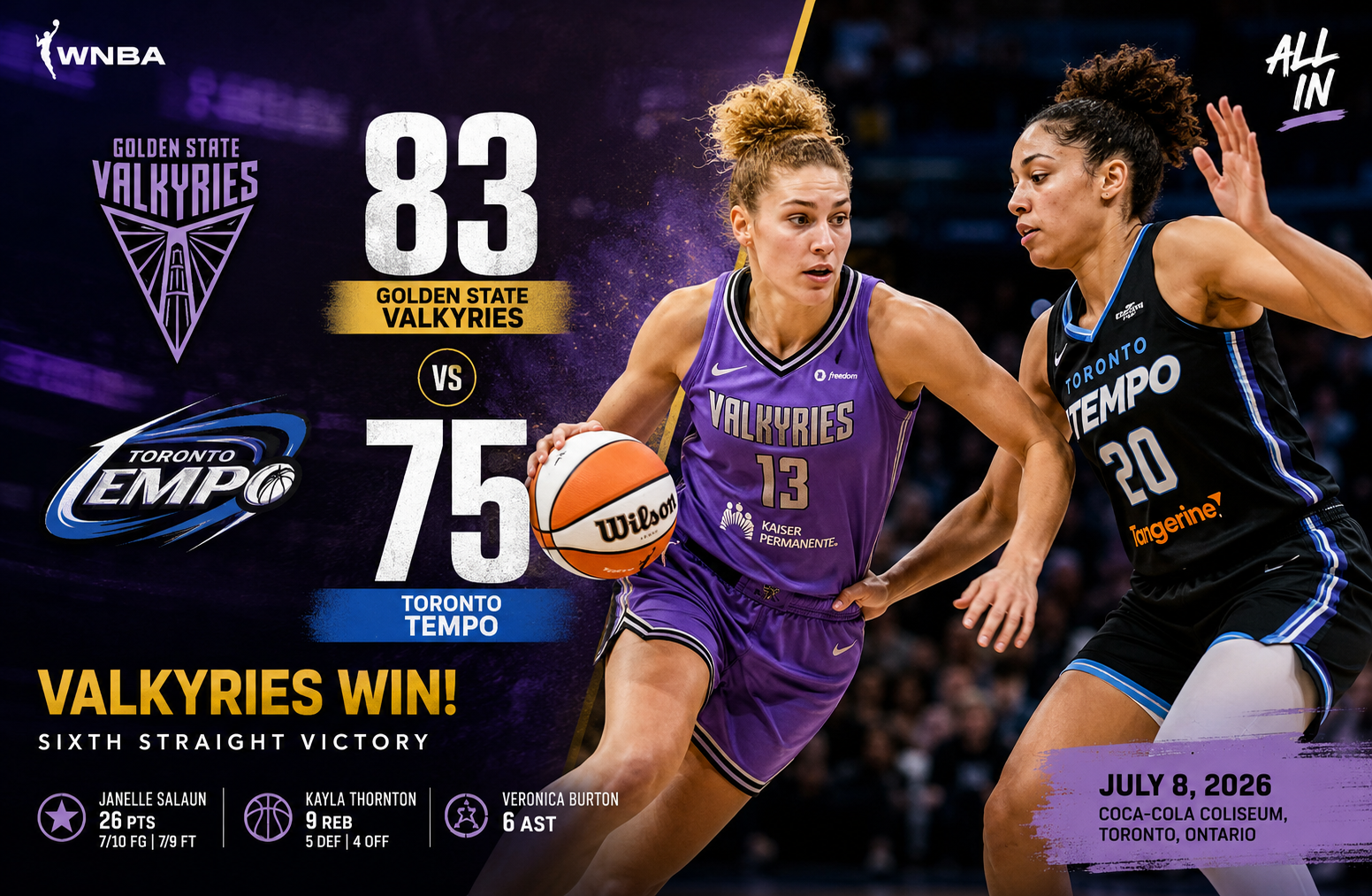
Golden State Valkyries vs Toronto Tempo Match Player Stats
Golden State Valkyries vs Toronto Tempo Match Player Stats
The Golden State Valkyries vs Toronto Tempo match player stats reveal how Golden State secured an important 83-75 victory over Toronto on July 8, 2026, at Coca-Cola Coliseum in Toronto, Ontario. Janelle Salaun delivered an outstanding 26-point performance, while Kaitlyn Chen contributed 16 points off the bench. For Toronto, Isabelle Harrison led the scoring with 24 points and eight rebounds. Although the Tempo shot a better percentage from the field and the free-throw line, Golden State created the difference through three-point shooting, rebounding, and better ball security.
The contest offered an interesting example of how basketball games are decided by more than shooting percentages. Toronto had several productive individual performances, but Golden State found more ways to turn important possessions into points. The Valkyries also responded effectively whenever Toronto threatened to take control, particularly during the fourth quarter.
This breakdown examines the complete player statistics, team shooting numbers, quarter-by-quarter scoring, individual performances, and tactical factors behind the result. It also explains which statistics mattered most and what the performance tells us about both teams.
Golden State Valkyries vs Toronto Tempo Match Player Stats: Game Overview
The July 8 matchup brought together two teams with different objectives and competitive circumstances. Golden State entered the game looking to continue its strong run, while Toronto aimed to protect its home court and stop a difficult stretch of results.
Golden State eventually secured an eight-point victory, improving its record to 16-7 and extending its winning streak to six consecutive games. Toronto moved to 9-12 following its third consecutive defeat.
Match Information
| Match Detail | Information |
| Competition | Women’s National Basketball Association |
| Matchup | Golden State Valkyries vs Toronto Tempo |
| Date | July 8, 2026 |
| Venue | Coca-Cola Coliseum |
| Location | Toronto, Ontario |
| Attendance | 8,210 |
| Final Score | Golden State 83-75 Toronto |
| Winning Team | Golden State Valkyries |
| Winning Streak | Six consecutive victories |
| Officials | Angelica Suffren, Marcy Williams, Josh Reed |
The final score reflects a competitive game that featured several momentum changes. Toronto started better, Golden State dominated the second quarter, and the Tempo produced a strong response after halftime.
However, Golden State delivered the more effective fourth-quarter performance and finished the game with an eight-point advantage.
Final Score by Quarter
| Quarter | Golden State Valkyries | Toronto Tempo |
| First Quarter | 11 | 17 |
| Second Quarter | 30 | 14 |
| Third Quarter | 16 | 28 |
| Fourth Quarter | 26 | 16 |
| Final Score | 83 | 75 |
The scoring pattern explains why the contest remained interesting until the closing minutes.
Toronto won the opening quarter by six points. Golden State then responded with a 16-point advantage in the second period. The Tempo reversed the momentum in the third quarter, scoring 28 points and briefly putting pressure on the visitors.
The final period ultimately separated the teams. Golden State scored 26 points while holding Toronto to just 16.
Complete Golden State Valkyries Player Stats
Golden State received contributions from several players, but Janelle Salaun was the standout performer. Her efficient scoring provided the offensive foundation for the victory.
Kaitlyn Chen also made a major impact from the bench, while Kayla Thornton combined efficient shooting with valuable rebounding.
Golden State Valkyries Full Box Score
| Player | MIN | FG | 3PT | FT | REB | AST | STL | BLK | TO | PTS |
| Kayla Thornton | 25:06 | 4-6 | 3-5 | 4-4 | 9 | 0 | 1 | 1 | 2 | 15 |
| Cecilia Zandalasini | 15:20 | 1-6 | 1-5 | 0-0 | 1 | 2 | 0 | 0 | 1 | 3 |
| Kiah Stokes | 14:28 | 0-2 | 0-1 | 0-0 | 3 | 0 | 0 | 1 | 2 | 0 |
| Veronica Burton | 21:11 | 1-2 | 1-2 | 3-4 | 2 | 6 | 2 | 0 | 1 | 6 |
| Gabby Williams | 18:01 | 3-9 | 1-3 | 0-0 | 1 | 2 | 1 | 0 | 2 | 7 |
| Kaila Charles | 24:58 | 1-7 | 0-3 | 3-4 | 5 | 1 | 0 | 0 | 1 | 5 |
| Laeticia Amihere | 15:10 | 1-1 | 0-0 | 1-2 | 3 | 0 | 0 | 0 | 1 | 3 |
| Janelle Salaun | 23:16 | 7-10 | 5-6 | 7-9 | 6 | 1 | 1 | 0 | 3 | 26 |
| Tiffany Hayes | 18:51 | 0-3 | 0-3 | 2-2 | 0 | 3 | 1 | 1 | 0 | 2 |
| Kaitlyn Chen | 22:07 | 8-12 | 0-2 | 0-0 | 1 | 3 | 1 | 0 | 1 | 16 |
| Nadia Fingall | 1:32 | 0-0 | 0-0 | 0-0 | 0 | 0 | 0 | 0 | 0 | 0 |
Team totals: 26-of-58 field goals, 11-of-30 three-pointers, 20-of-25 free throws, 31 rebounds, 18 assists, seven steals, three blocks, and 14 turnovers.
Janelle Salaun Leads Golden State With 26 Points
Janelle Salaun delivered the most influential individual performance of the game. She finished with 26 points in 23 minutes and 16 seconds, making seven of her 10 field-goal attempts.
Her three-point shooting was especially impressive. Salaun connected on five of six attempts from beyond the arc, producing an 83.3% success rate.
She also made seven of nine free throws and collected six rebounds. Her final statistical line included:
- 26 points
- 7-of-10 field goals
- 5-of-6 three-pointers
- 7-of-9 free throws
- Six rebounds
- One assist
- One steal
What makes her performance particularly important is the combination of scoring volume and shooting efficiency.
A player can score 26 points through a large number of attempts, but Salaun reached that total with only 10 field-goal attempts. Her ability to convert outside shots also forced Toronto’s defense to respect her perimeter presence.
That threat made it more difficult for Toronto to concentrate its defensive attention on Golden State’s other offensive options.
Kaitlyn Chen Provides 16 Important Points
Kaitlyn Chen was another major contributor. She scored 16 points in 22 minutes and seven seconds, making eight of her 12 field-goal attempts.
Her 66.7% field-goal percentage demonstrated excellent finishing efficiency.
Chen also recorded three assists, one rebound, and one steal. She did not make a three-pointer, but her scoring inside the arc helped Golden State maintain offensive production.
Her contribution was especially valuable because it reduced the pressure on the starting players.
A strong bench performance can change the structure of a basketball game. Instead of relying on one or two primary scorers for the entire contest, Golden State received meaningful production from another offensive option.
Chen’s 16 points were the second-highest individual total for the Valkyries.
Kayla Thornton Delivers an All-Around Performance
Kayla Thornton finished with 15 points and nine rebounds.
She shot four-of-six from the field and three-of-five from three-point range. She also converted all four free-throw attempts.
Her nine rebounds included four offensive rebounds and five defensive rebounds.
Thornton’s performance was important because she contributed in multiple areas rather than depending exclusively on scoring.
Her offensive rebounding helped Golden State create additional opportunities, while her defensive work limited Toronto’s chances to extend possessions.
She also recorded one steal and one block.
Thornton’s combination of scoring efficiency and physical play was a major part of Golden State’s overall advantage.
Veronica Burton Controls the Playmaking
Veronica Burton finished with six assists, the highest total among Golden State players.
She scored six points on one-of-two shooting from the field and made one three-pointer. Burton also contributed two steals.
Her scoring numbers were not particularly large, but her passing was valuable.
Assists provide a useful way to understand how a team creates its offense. Burton’s six assists show that she helped generate scoring opportunities for teammates instead of relying entirely on individual shot creation.
Her defensive activity also contributed to Golden State’s ability to disrupt Toronto’s offensive rhythm.
Supporting Contributions From the Valkyries
Several other Golden State players contributed in smaller but meaningful ways.
Gabby Williams recorded seven points, two assists, one steal, and one rebound. Her activity helped the team maintain offensive movement.
Kaila Charles finished with five points and five rebounds. Although her shooting was less efficient, she provided useful work on the glass.
Cecilia Zandalasini scored three points and recorded two assists. Laeticia Amihere also added three points while converting her only field-goal attempt.
Tiffany Hayes scored two points and recorded three assists. Her defensive contribution included one steal and one block.
Kiah Stokes did not score, but she collected three rebounds and recorded one block.
These individual contributions demonstrate why evaluating a team only through its leading scorer can create an incomplete picture.
Golden State’s victory was built through a combination of efficient scoring, defensive activity, rebounding, and contributions from several positions.
Complete Toronto Tempo Player Stats
Toronto also received an excellent individual performance from Isabelle Harrison. She led the Tempo with 24 points and eight rebounds.
Julie Allemand provided seven assists, while Marina Mabrey contributed 11 points.
However, Toronto struggled to maintain consistent offensive execution during the final quarter. The team’s 20 turnovers also created additional opportunities for Golden State.
Toronto Tempo Full Box Score
| Player | MIN | FG | 3PT | FT | REB | AST | STL | BLK | TO | PTS |
| Maria Conde | 35:22 | 3-8 | 1-4 | 2-2 | 3 | 1 | 0 | 0 | 3 | 9 |
| Isabelle Harrison | 30:32 | 10-17 | 1-2 | 3-3 | 8 | 2 | 0 | 0 | 4 | 24 |
| Nyara Sabally | 6:53 | 1-1 | 0-0 | 0-0 | 1 | 1 | 0 | 0 | 1 | 2 |
| Marina Mabrey | 33:42 | 2-9 | 0-3 | 7-8 | 6 | 4 | 1 | 0 | 5 | 11 |
| Julie Allemand | 35:51 | 4-7 | 1-4 | 0-0 | 3 | 7 | 2 | 0 | 2 | 9 |
| Laura Juskaite | 18:18 | 1-2 | 1-2 | 2-2 | 0 | 1 | 3 | 0 | 3 | 5 |
| Tima Pouye | 13:10 | 1-4 | 0-3 | 0-0 | 0 | 1 | 0 | 0 | 0 | 2 |
| Kia Nurse | 15:01 | 2-3 | 2-3 | 2-2 | 1 | 2 | 0 | 0 | 1 | 8 |
| Teonni Key | 11:11 | 2-3 | 0-1 | 1-1 | 1 | 0 | 0 | 0 | 1 | 5 |
Team totals: 26-of-54 field goals, six-of-22 three-pointers, 17-of-18 free throws, 23 rebounds, 19 assists, six steals, zero blocks, and 20 turnovers.
Temi Fagbenle, Kiki Rice, and Brittney Sykes did not play because of injury or illness-related reasons.
Isabelle Harrison Leads Toronto With 24 Points
Isabelle Harrison was Toronto’s most productive offensive player.
She scored 24 points while shooting 10-of-17 from the field. She also converted all three free throws and collected eight rebounds.
Her shooting percentage was 58.8%, making her one of the most efficient high-volume scorers in the contest.
Her statistical performance included:
- 24 points
- 10-of-17 field goals
- One three-pointer from two attempts
- Three-of-three free throws
- Eight rebounds
- Two assists
- Four turnovers
Harrison was particularly effective around the basket and from intermediate shooting positions.
Her performance gave Toronto a reliable scoring option even when the team’s overall offense became inconsistent.
However, individual scoring efficiency could not completely overcome the team’s difficulties in ball security and perimeter shooting.
Julie Allemand Records Seven Assists
Julie Allemand led all players in assists with seven.
She finished with nine points, three rebounds, two steals, and four-of-seven field-goal shooting.
Allemand’s passing was important because she helped Toronto generate scoring opportunities for Harrison and other teammates.
Her seven assists also demonstrate that Toronto was capable of creating good offensive possessions.
However, the team’s total of 20 turnovers reduced the value of some of those successful possessions.
The difference between creating opportunities and protecting possession became one of the defining aspects of the matchup.
Marina Mabrey Adds 11 Points
Marina Mabrey finished with 11 points, six rebounds, and four assists.
She converted seven of eight free throws but struggled from the field, making only two of nine attempts.
Mabrey’s three-point shooting was also limited, as she did not connect on any of her three attempts.
Her ability to reach the free-throw line helped her maintain a reasonable scoring contribution despite the shooting difficulties.
She also contributed as a rebounder and playmaker.
Nevertheless, Toronto needed more efficient perimeter scoring to challenge Golden State’s shooting advantage.
Toronto’s Supporting Players
Several other Tempo players made useful contributions.
Maria Conde recorded nine points, three rebounds, and one assist. She played more than 35 minutes, giving Toronto an extended presence in the rotation.
Kia Nurse scored eight points and made two of three three-point attempts. Her perimeter shooting was one of Toronto’s more efficient contributions.
Laura Juskaite finished with five points, one assist, and three steals. Her defensive activity helped Toronto create some additional opportunities.
Teonni Key also scored five points while shooting two-of-three from the field.
Tima Pouye and Nyara Sabally contributed two points each.
Although Toronto had several players capable of contributing offensively, the team struggled to maintain a balanced scoring attack throughout all four quarters.
Team Statistical Comparison: Golden State vs Toronto
The overall team statistics provide a clearer explanation of the final result.
Toronto actually finished with a better field-goal percentage and free-throw percentage. However, Golden State held important advantages in three-point shooting, rebounding, and turnovers.
Complete Team Comparison
| Statistical Category | Golden State | Toronto |
| Total Points | 83 | 75 |
| Field Goals Made | 26 | 26 |
| Field Goal Attempts | 58 | 54 |
| Field Goal Percentage | 44.8% | 48.1% |
| Three-Pointers Made | 11 | 6 |
| Three-Point Attempts | 30 | 22 |
| Three-Point Percentage | 36.7% | 27.3% |
| Free Throws Made | 20 | 17 |
| Free Throw Attempts | 25 | 18 |
| Free Throw Percentage | 80.0% | 94.4% |
| Total Rebounds | 31 | 23 |
| Offensive Rebounds | 11 | 4 |
| Defensive Rebounds | 20 | 19 |
| Assists | 18 | 19 |
| Steals | 7 | 6 |
| Blocks | 3 | 0 |
| Turnovers | 14 | 20 |
| Personal Fouls | 20 | 20 |
Three-Point Shooting Made the Difference
The most noticeable statistical advantage belonged to Golden State’s perimeter offense.
The Valkyries made 11 three-pointers from 30 attempts, producing a 36.7% shooting percentage.
Toronto made six three-pointers from 22 attempts, converting 27.3%.
This created a 15-point difference in three-point scoring.
That advantage was particularly important because both teams made exactly 26 field goals.
In other words, Golden State did not win by making more total field goals. It won partly because more of its successful shots came from beyond the three-point line.
This is an important distinction when analyzing modern basketball.
A team can have a lower overall field-goal percentage and still score more efficiently if it creates enough high-value three-point opportunities.
Salaun’s five three-pointers and Thornton’s three successful attempts were especially important.
Toronto Had Better Overall Field-Goal Accuracy
Toronto finished with a 48.1% field-goal percentage, compared with Golden State’s 44.8%.
The Tempo also had a superior free-throw percentage.
Toronto made 17 of 18 attempts, converting 94.4%. Golden State made 20 of 25, producing an 80% success rate.
Despite those advantages, Toronto lost.
The explanation is that shooting percentages cannot be evaluated independently of shot value and possession volume.
Golden State generated more three-point scoring and collected eight additional rebounds.
Toronto’s higher shooting percentages did not compensate for those disadvantages.
Rebounding Created Additional Opportunities
Golden State collected 31 rebounds, while Toronto recorded 23.
The eight-rebound difference was important.
The Valkyries also secured 11 offensive rebounds compared with Toronto’s four.
Offensive rebounds allow teams to recover missed shots and create another opportunity to score during the same possession.
Golden State’s seven-rebound advantage on the offensive glass helped increase its overall offensive opportunities.
Kayla Thornton led the Valkyries with nine rebounds, while Harrison led Toronto with eight.
This statistical category shows that Golden State’s advantage was not limited to perimeter shooting.
The team also performed better in an area that directly influences possession control.
Turnovers Gave Golden State Another Advantage
Golden State committed 14 turnovers, while Toronto committed 20.
That difference of six possessions was another important factor.
Turnovers can damage offensive rhythm because they end possessions without a shot attempt.
They can also create transition opportunities for the opposition.
Toronto’s 20 turnovers meant the team repeatedly lost opportunities to score.
Golden State was not completely mistake-free, but it protected the basketball more effectively.
The combination of fewer turnovers and more rebounds gave the Valkyries a stronger foundation for controlling the game.
Quarter-by-Quarter Game Analysis
The scoring progression provides an excellent way to understand how the matchup developed.
Both teams had periods of strong offensive production, but Golden State was more effective during the two quarters that ultimately determined the result.
First Quarter: Toronto Takes an Early Lead
Score: Golden State 11, Toronto 17
Toronto began the game with a six-point advantage.
The Tempo limited Golden State to just 11 points during the opening period and established early control through effective offensive execution.
Golden State struggled to find consistent scoring opportunities.
The Valkyries were unable to establish the offensive rhythm they would later demonstrate in the second quarter.
Toronto’s defensive pressure helped create a more difficult opening period for the visitors.
However, the six-point advantage was not large enough to guarantee control of the game.
Second Quarter: Golden State Produces a Major Response
Score: Golden State 30, Toronto 14
The second quarter was arguably the most important period of the entire contest.
Golden State scored 30 points while limiting Toronto to 14.
That 16-point advantage completely changed the scoreboard.
The Valkyries improved their offensive execution and made better use of their shooting opportunities.
Their perimeter production became particularly important.
Instead of continuing to struggle against Toronto’s defense, Golden State found more effective ways to create scoring chances.
The quarter demonstrated the team’s ability to adjust after an unsuccessful opening period.
It also showed how quickly a basketball game can change when a team improves its shot selection and offensive efficiency.
Third Quarter: Toronto Fights Back
Score: Golden State 16, Toronto 28
Toronto responded strongly after halftime.
The Tempo scored 28 points, their highest total in any quarter, while Golden State managed only 16.
The 12-point difference reduced Golden State’s lead and made the contest competitive again.
Toronto’s improved scoring reflected a much stronger offensive period.
Harrison continued to provide valuable production, while the team’s playmaking helped create additional opportunities.
However, Toronto’s third-quarter comeback did not eliminate the problems that had developed earlier.
The Tempo still needed a strong final period to complete the turnaround.
Fourth Quarter: Golden State Protects Its Advantage
Score: Golden State 26, Toronto 16
Golden State produced its most important response when the game was on the line.
The Valkyries scored 26 points and held Toronto to 16.
Their 10-point advantage in the final quarter was enough to secure the eight-point victory.
Golden State maintained offensive pressure and avoided allowing Toronto to complete another comeback.
Salaun’s scoring remained important, while Chen and Thornton provided additional production.
Toronto continued to fight, but its turnover problems and limited perimeter scoring made it difficult to close the gap.
The final quarter highlighted Golden State’s ability to execute under pressure.
Key Factors Behind Golden State’s Victory
The final score tells us which team won, but the underlying statistics explain why Golden State was successful.
Several factors contributed to the result. Three-point accuracy was important, but the Valkyries also benefited from stronger rebounding, fewer turnovers, and a more productive scoring contribution from their bench.
1. More Effective Perimeter Scoring
Golden State’s 11 successful three-pointers were a major advantage.
The team received five three-pointers from Salaun and three from Thornton. Those two players combined for eight successful shots from beyond the arc.
Toronto, by comparison, made only six three-pointers as a team.
The difference was not simply the number of successful shots. Golden State also created more opportunities to score three points from a single possession.
This helped the Valkyries overcome Toronto’s superior two-point and overall field-goal accuracy.
2. Better Control of Rebounding Opportunities
Golden State finished with eight more total rebounds.
The difference was particularly significant on the offensive glass, where the Valkyries collected 11 rebounds compared with Toronto’s four.
Offensive rebounds can be extremely valuable because they allow teams to recover missed shots and continue attacking.
Golden State’s advantage in this category helped compensate for its lower overall field-goal percentage.
3. Fewer Costly Turnovers
Toronto committed 20 turnovers, six more than Golden State.
That difference represented several lost opportunities to score.
The Tempo also had to spend additional energy recovering defensively after losing possession.
Golden State’s 14 turnovers were not perfect, but they demonstrated better ball security.
The difference became especially important during a game in which both teams made 26 field goals.
4. Stronger Bench Scoring
Kaitlyn Chen scored 16 points for Golden State, providing an important contribution outside the team’s leading scorer.
The Valkyries also received points from several supporting players.
This distribution helped reduce the team’s dependence on one offensive option.
Toronto had productive contributions from Harrison, Mabrey, and Allemand, but Golden State received a particularly effective scoring performance from Chen.
Bench production is often an overlooked part of basketball analysis. It can determine whether a team maintains offensive pressure when its primary players are resting.
5. Effective Fourth-Quarter Execution
Golden State’s 26-16 fourth-quarter advantage was the final difference.
Toronto had already demonstrated that it could produce a strong comeback during the third period.
However, the Valkyries responded with better execution when the game entered its decisive stage.
This ability to regain control after losing momentum was one of the strongest aspects of Golden State’s performance.
Individual Matchups That Influenced the Result
Looking at individual player matchups provides another useful perspective on the contest.
Rather than comparing players only by their final point totals, it is important to examine how their contributions affected the overall game.
Janelle Salaun vs Isabelle Harrison
<PRIVATE_PERSON> Salaun and Isabelle Harrison were the leading scorers for their respective teams.
| Statistic | Janelle Salaun | Isabelle Harrison |
| Points | 26 | 24 |
| Field Goals | 7-10 | 10-17 |
| Field Goal Percentage | 70.0% | 58.8% |
| Three-Pointers | 5-6 | 1-2 |
| Free Throws | 7-9 | 3-3 |
| Rebounds | 6 | 8 |
| Assists | 1 | 2 |
| Turnovers | 3 | 4 |
Both players delivered productive performances.
Harrison had the advantage in total rebounds and made more field goals.
However, Salaun produced more points with fewer field-goal attempts. Her three-point shooting was a major difference between the two performances.
Salaun’s 26 points also came in less playing time.
The comparison demonstrates two different scoring approaches. Harrison was effective through efficient interior and mid-range scoring, while Salaun combined perimeter shooting with free-throw production.
Kayla Thornton vs Toronto’s Frontcourt
Thornton’s 15 points and nine rebounds gave Golden State an important advantage in physical play.
She made three three-pointers and secured four offensive rebounds.
Harrison was Toronto’s leading rebounder with eight, but the Valkyries received additional rebounding support from several players.
The result was a team rebounding advantage of 31-23.
Thornton’s contribution was therefore important beyond her individual scoring total.
Veronica Burton vs Julie Allemand
Burton and Allemand were both important playmakers.
| Statistic | Veronica Burton | Julie Allemand |
| Points | 6 | 9 |
| Assists | 6 | 7 |
| Rebounds | 2 | 3 |
| Steals | 2 | 2 |
| Turnovers | 1 | 2 |
Allemand recorded one more assist and scored three additional points.
However, Burton committed fewer turnovers.
Both players demonstrated the importance of creating opportunities for teammates, but Burton’s ball security was a useful contribution to Golden State’s overall advantage.
What the Statistics Reveal About Both Teams
The matchup provides several useful lessons about team performance.
What Golden State Did Well
Golden State demonstrated an effective combination of perimeter shooting, rebounding, and offensive balance.
The team did not need to dominate every statistical category to win.
Instead, it identified areas where it could create a meaningful advantage.
Its 11 three-pointers produced a significant scoring difference, while its offensive rebounding helped create additional opportunities.
The team’s 14 turnovers also showed better possession management than Toronto.
Another important positive was the performance of the bench.
Chen’s 16 points allowed Golden State to maintain scoring production beyond its primary offensive options.
These factors helped the Valkyries recover from their slow first quarter and finish strongly.
What Toronto Could Improve
Toronto’s defeat should not hide the positive elements of its performance.
The Tempo shot 48.1% from the field and 94.4% from the free-throw line.
Harrison delivered 24 points, Allemand recorded seven assists, and Mabrey contributed across several statistical categories.
However, the team had difficulty in three important areas.
Perimeter shooting: Toronto made only six three-pointers. Improving outside shooting would give the offense another scoring option.
Ball security: Twenty turnovers were costly. Better passing decisions and improved possession management could reduce unnecessary lost opportunities.
Defensive rebounding: Toronto collected only four offensive rebounds and allowed Golden State to secure 11. Limiting second-chance opportunities should be an important focus.
The Tempo also needed a more consistent defensive response during Golden State’s second-quarter scoring run.
A team cannot always prevent its opponent from having a productive quarter, but limiting the size of a scoring run can prevent a manageable deficit from becoming a major problem.
Understanding the Most Important Basketball Statistics
For readers who want to understand a box score more deeply, several statistical categories deserve special attention.
Points
Points measure a player’s direct scoring contribution.
However, the total should always be considered alongside field-goal attempts and shooting efficiency.
For example, Salaun scored 26 points while making seven of 10 field-goal attempts. Harrison scored 24 while making 10 of 17.
Both performances were productive, but their scoring methods were different.
Field-Goal Percentage
Field-goal percentage measures the proportion of successful shots from the field.
The calculation is:
Field goals made ÷ Field goals attempted × 100.
Toronto’s 48.1% accuracy was higher than Golden State’s 44.8%.
However, this category includes both two-point and three-point shots.
It does not automatically explain which team generated more points from each successful attempt.
Three-Point Percentage
Three-point percentage measures shooting accuracy from beyond the three-point line.
Golden State converted 36.7% of its attempts, compared with Toronto’s 27.3%.
This difference helped the Valkyries generate more points despite attempting more total field goals.
Rebounds
Rebounds are divided into two main categories.
- Offensive rebounds recover missed shots by the player’s own team.
- Defensive rebounds recover missed shots by the opposing team.
Golden State’s 11 offensive rebounds were particularly valuable.
They created additional chances and helped the team maintain possession.
Assists
Assists measure passes that directly lead to successful field goals.
Julie Allemand led the game with seven assists, while Veronica Burton recorded six.
These figures show the importance of team coordination and passing.
Steals
Steals occur when a defensive player legally takes possession of the ball from an opponent.
Golden State recorded seven steals, while Toronto recorded six.
The difference was relatively small, but defensive activity helped both teams disrupt possessions.
Turnovers
Turnovers represent possessions lost without a successful field-goal attempt.
Golden State committed 14, while Toronto committed 20.
This was one of the clearest advantages for the winning team.
Plus-Minus
Plus-minus measures the team’s point differential while a particular player is on the court.
A positive number indicates that the player’s team outscored its opponent during that player’s playing time.
Salaun and Chen both finished at +11, the best figures among Golden State’s players.
Harrison finished at -13, while Allemand finished at -12 for Toronto.
Plus-minus should not be treated as a complete measure of individual quality. It is influenced by teammates, opponents, substitutions, and the timing of scoring runs.
Nevertheless, it provides another way to understand how the game developed while different players were on the floor.
How to Analyze a Basketball Box Score Correctly
A useful game analysis should go beyond copying numbers from a statistics page.
The following approach provides a more meaningful understanding of individual and team performances.
Step 1: Start With the Final Result
Identify the winning team, losing team, and final score.
In this matchup, Golden State won 83-75.
The eight-point margin provides the starting point for understanding the game.
Step 2: Examine the Quarter-by-Quarter Results
Quarter scoring shows when a team performed well and when it struggled.
Golden State’s 30-point second quarter was a major turning point.
Toronto’s 28-point third quarter demonstrated its ability to respond.
Step 3: Identify the Leading Players
The leading scorers provide an initial understanding of offensive production.
Salaun led Golden State with 26 points, while Harrison led Toronto with 24.
Next, examine the leading rebounders and playmakers.
Thornton collected nine rebounds, and Allemand recorded seven assists.
Step 4: Compare Shooting Efficiency
Field-goal percentage, three-point percentage, and free-throw percentage should be examined separately.
This prevents misleading conclusions.
Toronto had better overall field-goal and free-throw accuracy, but Golden State had the more productive three-point performance.
Step 5: Examine Rebounding and Turnovers
These statistics help explain how teams control possessions.
Golden State collected eight more rebounds and committed six fewer turnovers.
Together, those differences help explain why the Valkyries were able to win despite Toronto’s better overall shooting percentages.
Step 6: Consider Playing Time
Minutes played provide context for individual performances.
A player who scores 20 points in 20 minutes has produced a different scoring rate from someone who scores 20 points in 38 minutes.
Salaun’s 26 points in approximately 23 minutes were particularly impressive.
Playing time also helps explain why some players have smaller statistical totals despite making useful contributions.
Historical Significance of the July 8 Matchup
The July 8 contest was another important chapter in the development of the Toronto Tempo.
As an expansion franchise, Toronto was working to establish its identity in the WNBA and build consistency against established competition.
Golden State had its own recent expansion history and had already demonstrated the ability to compete effectively.
The matchup therefore offered an interesting comparison between two franchises at different stages of their development.
Golden State’s victory improved its season record to 16-7, while Toronto moved to 9-12.
The result also extended Golden State’s winning streak to six games.
For the Valkyries, the victory reinforced their ability to compete through a balanced offensive approach.
For Toronto, the game provided useful evidence of both individual strengths and areas requiring improvement.
The most important lesson was that a team can produce excellent individual performances and still lose when its possession management and perimeter defense are not consistent enough.
Official Match Statistics and Data Reliability
Accurate basketball analysis depends on using reliable statistics.
A box score should include more than points and shooting percentages. Minutes, rebounds, assists, steals, blocks, turnovers, and personal fouls all contribute to a better understanding of player performance.
For this matchup, the official league game page provides the final score, individual player statistics, team totals, quarter scoring, and game information.
Readers who want to verify the original numbers can consult the official WNBA game box score.
One important distinction is that individual player totals should not be confused with team totals.
For example, Salaun’s 26 points represent her personal scoring contribution, while Golden State’s 83 points include the production of the entire team.
Similarly, rebounds and assists should be evaluated at both individual and team levels.
Using consistent statistical definitions makes comparisons more useful and prevents incorrect conclusions.
Frequently Asked Questions (FAQs)
1. Who scored the most points in the Golden State Valkyries vs Toronto Tempo game?
Janelle Salaun led all players with 26 points for Golden State. She shot 7-of-10 from the field and made five three-pointers. Isabelle Harrison was Toronto’s leading scorer with 24 points.
2. What was the final score between Golden State and Toronto?
The Golden State Valkyries defeated the Toronto Tempo 83-75 on July 8, 2026, at Coca-Cola Coliseum in Toronto, Ontario.
3. How many rebounds did Kayla Thornton record?
Kayla Thornton recorded nine rebounds for Golden State, including four offensive rebounds and five defensive rebounds. She also scored 15 points.
4. Who recorded the most assists in the game?
Julie Allemand led all players with seven assists for Toronto. Veronica Burton was Golden State’s leading playmaker with six assists.
5. Which team had better three-point shooting?
Golden State had better three-point shooting. The Valkyries made 11 of 30 attempts, converting 36.7%. Toronto made six of 22 attempts, producing a 27.3% success rate.
6. Why did Golden State win despite Toronto’s better field-goal percentage?
Golden State benefited from stronger three-point shooting, an eight-rebound advantage, and six fewer turnovers. These advantages helped the Valkyries overcome Toronto’s better overall field-goal and free-throw percentages.
Conclusion
The Golden State Valkyries’ 83-75 victory over the Toronto Tempo was a result of efficient perimeter scoring, strong rebounding, and better possession management.
Janelle Salaun led the winning team with 26 points, while Kaitlyn Chen added 16 and Kayla Thornton contributed 15 points and nine rebounds. Toronto received an impressive 24-point performance from Isabelle Harrison, and Julie Allemand led the game with seven assists.
The team statistics explain the outcome particularly well. Toronto shot 48.1% from the field and 94.4% from the free-throw line, but Golden State made five more three-pointers, collected eight additional rebounds, and committed six fewer turnovers.
The quarter-by-quarter scoring also highlights Golden State’s ability to respond to difficult periods. After falling behind in the opening quarter, the Valkyries produced 30 points in the second period. Toronto fought back in the third, but Golden State regained control in the fourth to secure the victory.
Ultimately, this matchup demonstrated the importance of balanced team basketball. Individual scoring performances matter, but shooting value, rebounding, turnovers, and late-game execution can determine the final result. Golden State performed better in those decisive areas and deserved its eight-point win.