Mark Fluent: Career, Wife, Family, and Real Estate Success
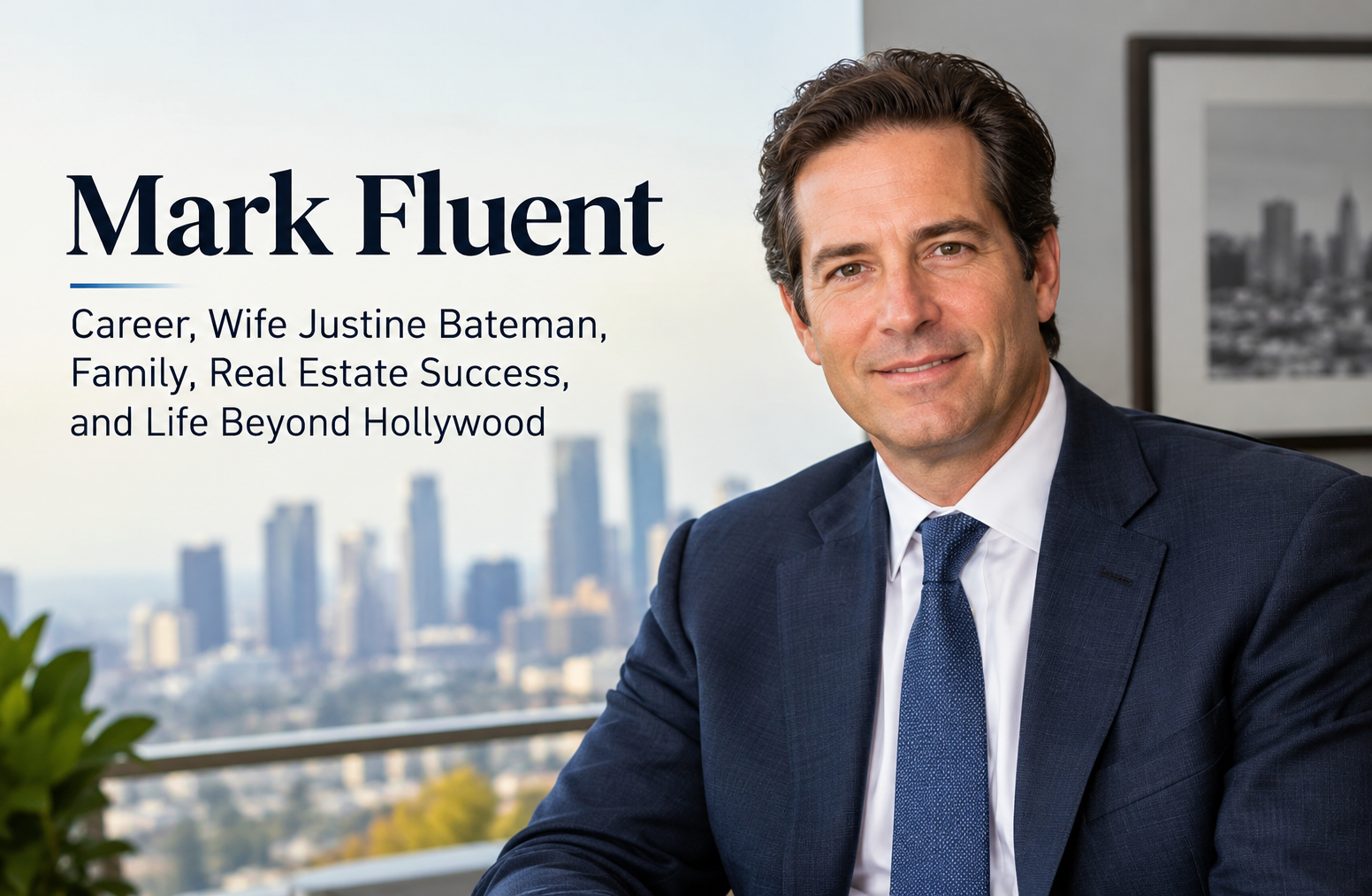
Mark Fluent is an American commercial real estate finance executive best known publicly as the husband of actress, writer, and filmmaker Justine Bateman. While his connection to a well-known Hollywood family has attracted curiosity, his professional career has developed primarily in the financial services and commercial property sectors. His reported experience at major financial institutions, including Deutsche Bank, and his appointment as Vice Chair of CBRE’s U.S. Debt and Structured Finance business in October 2024, form the central parts of his professional story.
Unlike many people associated with the entertainment industry, Fluent maintains a relatively private public profile. He is not principally known for acting or filmmaking. Instead, his work focuses on commercial real estate financing, institutional lending relationships, capital markets, and structured finance. These fields involve helping property owners, investors, and institutions evaluate and arrange financing for commercial real estate assets.
Interest in his life often centers on three questions: what he does professionally, how he became connected to Justine Bateman, and what is publicly known about his family and financial success. Answering these questions requires separating reported biographical information from details that remain private or have not been independently established.
Who Is Mark Fluent?
Mark Fluent is a commercial real estate finance professional whose career has been associated with major financial institutions and institutional property financing. His public identity differs from that of his wife, whose acting career brought her widespread recognition through television and film.
Fluent’s work belongs to a specialized area of finance that connects commercial property markets with banks, investment funds, insurance companies, and other sources of capital. Professionals in this field help clients understand borrowing options, structure financing arrangements, negotiate terms, and assess the risks associated with property investments.
His appointment as Vice Chair of CBRE’s U.S. Debt and Structured Finance business in October 2024 represents a significant reported milestone in his career. CBRE is a major commercial real estate services firm, and its debt and structured finance operations work with clients seeking financing solutions for property investments and related transactions.
Although online searches frequently connect Fluent’s name with celebrity biographies, his professional background is better understood through commercial real estate finance than through Hollywood. His marriage explains much of the public interest in his personal life, but it does not define the nature of his work.
Mark Fluent at a Glance
| Category | Information |
| Full name | Mark Fluent |
| Nationality | American |
| Profession | Commercial real estate finance executive |
| Current reported position | Vice Chair, CBRE U.S. Debt and Structured Finance |
| Employer | CBRE |
| Previous major employer | Deutsche Bank |
| Other reported employers | Lehman Brothers and Related Capital |
| Education | Reportedly graduated from the University of Southern California |
| Professional location | Los Angeles, California |
| Spouse | Justine Bateman |
| Marriage year | 2001 |
| Children | Two, a son named Duke and a daughter named Gianetta, according to published reporting |
| Public profile | Primarily professional, with limited personal publicity |
| Exact age | Not reliably confirmed |
| Personal net worth | Not reliably established by authoritative public information |
These details provide a useful overview, but not every biographical claim has the same level of verification. His reported professional appointment and marriage are distinct from details such as his exact age, private finances, and childhood, for which reliable public documentation is limited.
Mark Fluent’s Career in Commercial Real Estate Finance
Understanding Fluent’s career begins with the role of commercial real estate finance in the wider property industry. Commercial real estate involves properties such as office buildings, apartment communities, shopping centers, industrial facilities, hotels, and other income-producing assets.
Purchasing or developing these properties often requires substantial financing. Investors may use a combination of their own capital and borrowed funds, depending on the property’s value, expected income, market conditions, and the investment strategy.
Commercial real estate finance professionals help connect borrowers with lenders and develop financing structures that reflect a property’s characteristics and an investor’s objectives. Their work can involve complicated negotiations, detailed financial analysis, and coordination among several parties.
Fluent’s reported career across major financial institutions suggests experience within this specialized environment. However, individual transaction details should not be attributed to him without reliable documentation.
Early Professional Experience
Published biographical accounts associate Fluent with Lehman Brothers and Related Capital before or during the development of his career in institutional real estate finance. The precise dates, responsibilities, and progression of every position are not consistently documented in widely accessible public information.
Lehman Brothers was a major financial services firm before its collapse during the 2008 global financial crisis. Related Capital was associated with real estate investment and finance. Experience at organizations operating in these areas could expose a professional to property lending, investment analysis, financial structuring, and the relationships between capital providers and real estate owners.
It is important, however, to distinguish an employer’s history from an individual’s personal responsibilities. The fact that Fluent has been associated with a financial institution does not establish that he personally managed a particular transaction or participated in a specific corporate event.
The most useful way to understand this stage of his career is as part of a broader professional background in commercial property finance. The sector rewards financial knowledge, familiarity with lending structures, and the ability to work with clients whose financing requirements may differ significantly from one transaction to another.
His Work at Deutsche Bank
Deutsche Bank is one of the major international financial institutions associated with corporate banking, investment banking, and capital markets. Published reporting has described Fluent as a managing director and head of Western U.S. real estate at the bank.
A senior role in a regional real estate finance business can involve developing client relationships, evaluating financing opportunities, coordinating teams, and helping institutional customers navigate changing lending conditions. The exact scope of any individual’s responsibilities depends on the organization’s structure and the role held at a particular time.
Commercial property financing is rarely limited to identifying a lender and agreeing on an interest rate. A transaction may require analysis of the property’s operating income, outstanding debt, lease arrangements, projected expenses, market value, and future financing needs.
For example, an investor refinancing an office building may need to demonstrate that rental income can support the proposed debt payments. A lender may also examine vacancy rates, the quality of tenants, the remaining terms of major leases, and the possibility that interest rates or property values could change.
Professionals working in senior real estate finance positions must understand these considerations while communicating with borrowers, lenders, legal advisers, and other stakeholders. Fluent’s reported Deutsche Bank background places him within this professional environment, although specific accomplishments should be attributed only when supported by dependable records.
Joining CBRE as Vice Chair
One of the most important reported developments in Fluent’s career occurred in October 2024, when he joined CBRE as Vice Chair of its U.S. Debt and Structured Finance business.
The appointment is notable because debt and structured finance plays an important role in commercial real estate transactions. Property owners and investors often need financing that accounts for the unique economics of a building, development, or portfolio rather than relying on a standard lending arrangement.
A vice chair position can reflect substantial industry experience and established professional relationships. Nevertheless, a title alone does not establish a person’s exact authority, compensation, transaction volume, or day-to-day duties. Those details should not be assumed without further documentation.
According to the supplied company information, Fluent works alongside David Milestone and Bill Moyer in a business associated collectively with more than $150 billion in transaction experience. That figure refers to the combined experience attributed to the three professionals by CBRE, not to transactions personally completed by Fluent alone.
The distinction matters because large transaction figures are often presented in ways that can make individual achievements appear larger or more specific than the underlying evidence supports.
What Is Debt and Structured Finance?
Debt and structured finance refers to financing arrangements designed around the needs of borrowers, investors, and particular assets. In commercial property markets, these arrangements may include traditional mortgages, portfolio financing, construction loans, and other forms of debt.
The right structure depends on several factors:
- Property income: The amount and reliability of revenue generated by the asset.
- Loan-to-value ratio: The size of the proposed loan compared with the property’s assessed value.
- Debt service coverage: Whether property income is sufficient to cover required debt payments.
- Interest-rate exposure: Whether the borrowing cost is fixed or can change over time.
- Loan maturity: When the borrower must repay or refinance the debt.
- Lender requirements: The financial, legal, and operational conditions imposed by the capital provider.
A professional in this field needs to evaluate these variables together. A loan with a lower initial interest rate, for instance, may not be the best fit if it creates a refinancing problem at maturity or includes restrictions that conflict with the owner’s investment plans.
Fluent’s reported specialization places his work in a field where financial analysis and commercial judgment are closely connected.
Why Commercial Real Estate Finance Matters
Commercial property financing influences far more than the purchase of a building. It affects development projects, business expansion, property operations, investment returns, and the ability of owners to manage debt during uncertain economic conditions.
When financing is available on suitable terms, property investors may be able to acquire assets, improve buildings, or fund new construction. When lenders become more cautious, transactions may slow, refinancing may become harder, and property owners may need to contribute additional equity.
This is why experience in commercial real estate finance can be valuable across different stages of a market cycle.
Financing Acquisitions and Development
A commercial property acquisition usually involves more than negotiating a purchase price. Buyers must determine how much capital they can contribute, how much debt they can reasonably support, and whether the property’s expected income justifies the investment.
Development projects introduce additional uncertainties. Construction costs may rise, completion dates may change, and projected rental income may take longer to materialize than expected. Lenders must account for these risks when deciding whether and how to provide funding.
Finance professionals help organize the information needed to evaluate these decisions. They may compare financing options, coordinate discussions with lenders, and assess whether the proposed structure fits the client’s financial objectives.
Managing Refinancing Risk
Refinancing is particularly important when a commercial mortgage approaches maturity. A property owner may need a new loan to repay the existing one, even when the building continues to generate rental income.
Problems can arise if interest rates have increased, property values have declined, or lenders have tightened their requirements. A borrower who originally expected to refinance easily may discover that a new loan requires more equity or carries a higher interest rate.
This illustrates why financing expertise involves planning for future conditions rather than focusing exclusively on the initial transaction.
Building Institutional Relationships
Institutional real estate finance often involves large organizations with different investment priorities, risk limits, and approval processes. A borrower may need to communicate with banks, debt funds, insurance companies, pension-related investment entities, or other capital providers.
Professional relationships can help participants understand available options and identify potential sources of financing. However, relationships do not eliminate the need for careful analysis, due diligence, or appropriate loan terms.
Fluent’s reported senior roles are relevant in this context because institutional financing is a relationship-driven business as well as a technical financial discipline.
Mark Fluent’s Education and Professional Background
Published reporting identifies Fluent as a graduate of the University of Southern California. His specific degree, graduation year, and academic record have not been reliably established in the information available for this biography.
Education can provide a foundation for a career in finance, particularly through subjects such as economics, accounting, mathematics, business administration, and financial analysis. Yet a university affiliation alone does not reveal the full range of an executive’s qualifications or professional achievements.
Commercial real estate finance also depends heavily on practical knowledge. Professionals must understand lending documents, property valuation, cash-flow analysis, market conditions, client needs, and the practical challenges of completing transactions.
Over time, this knowledge can develop through work on financing assignments, collaboration with experienced colleagues, and exposure to different property types and economic conditions.
Fluent’s reported experience at several financial institutions suggests a career shaped by the commercial property capital markets. The precise sequence of his roles and the details of his education should be treated cautiously wherever primary documentation is unavailable.
Skills Relevant to His Profession
Several capabilities are central to senior commercial real estate finance work:
Financial analysis: Understanding how property income, operating expenses, debt payments, and valuations interact.
Negotiation: Comparing financing proposals and discussing interest rates, covenants, collateral, repayment schedules, and other loan terms.
Risk assessment: Considering what could happen if occupancy declines, expenses rise, property values change, or refinancing becomes difficult.
Client management: Coordinating with borrowers, lenders, investors, lawyers, and other advisers throughout a transaction.
Market awareness: Recognizing how economic conditions, interest rates, and lender appetite affect financing opportunities.
These are general requirements of the profession, not a verified list of Fluent’s personal performance ratings. They help explain the type of expertise associated with the positions attributed to him.
Mark Fluent and Justine Bateman: Their Marriage
Mark Fluent is married to Justine Bateman, an American actress, writer, director, and filmmaker. Published accounts identify 2001 as the year of their marriage.
Bateman became widely recognized through her portrayal of Mallory Keaton in the television sitcom Family Ties. Her career later expanded beyond acting into writing and directing, giving her a professional identity that extends beyond her early television success.
Their marriage connects two different professional environments. Bateman works in entertainment and creative production, while Fluent’s reported career centers on financial services and commercial property markets.
That difference is part of what makes public interest in their relationship distinctive. One spouse has an established entertainment profile, while the other has maintained a relatively low level of personal publicity.
Who Is Justine Bateman?
Justine Bateman is an American performer and filmmaker who rose to prominence in the 1980s. Her role as Mallory Keaton on Family Ties remains one of her best-known acting credits.
She subsequently pursued writing, directing, and other creative projects. Her work has included projects concerned with filmmaking, culture, technology, and the experience of working in the entertainment industry.
Bateman has also been associated with academic study at the University of California, Los Angeles, where published biographies report that she studied computer science and digital media management. The exact wording of her educational credentials should be checked against authoritative university or biographical records before being used in more detailed claims.
Her professional interests are separate from Fluent’s finance career, although both operate in fields where long-term relationships, specialized knowledge, and professional judgment can be important.
How Their Careers Differ
The contrast between the couple’s careers illustrates why public visibility should not be confused with professional importance.
Bateman’s work is visible through performances, films, writing, and public commentary. Fluent’s professional work takes place largely in commercial finance, where many achievements are associated with private client relationships and business transactions rather than entertainment coverage.
Their careers also differ in how success is measured. An actor’s career may be discussed through roles, creative projects, critical reception, or audience recognition. A commercial real estate finance executive’s career may be evaluated through leadership responsibilities, professional experience, client relationships, and involvement in financing activity.
There is no need to treat one career as an extension of the other. Each has its own professional demands and standards.
Mark Fluent’s Family and Children
Published reporting identifies Mark Fluent and Justine Bateman as parents of two children: a son named Duke and a daughter named Gianetta. Their reported birth years are 2002 and 2004, respectively.
The family has generally maintained a private profile compared with households that routinely share personal details through interviews or social media. As a result, detailed information about the children’s lives, education, careers, and current activities is limited.
Respecting those boundaries is important when writing about the family of a public figure. Being related to a well-known entertainer does not automatically make every aspect of a person’s life public information.
Their Son, Duke
Duke is identified in published biographical accounts as the couple’s son, with 2002 commonly reported as his birth year. Beyond that basic family information, detailed personal facts should not be treated as confirmed unless supported by reliable public sources.
It is especially important to avoid presenting unverified education, employment, relationship, or lifestyle claims as facts. The absence of extensive publicity does not justify filling gaps with speculation.
Their Daughter, Gianetta
Gianetta is identified as the couple’s daughter, with 2004 reported as her birth year. Like her brother, she has not maintained the kind of highly visible entertainment profile associated with her mother.
Limited public information makes it difficult to provide a comprehensive account of her personal life. A responsible biography should acknowledge that limitation rather than turning private family details into unsupported narratives.
A Private Family Life
Fluent’s relatively low public profile is consistent with a family that does not make every personal detail part of its public identity. Although Bateman’s work naturally places her in the public eye, that does not mean the family must share the same level of exposure.
Privacy can be particularly important for children of public figures. Keeping family details limited can allow individuals to pursue education, work, and relationships without being defined entirely by a parent’s fame.
For readers researching the family, the reliable starting point is the information established in published reporting, rather than rumors or assumptions about how the family lives.
Is Mark Fluent Related to Jason Bateman?
Mark Fluent is connected to actor and director Jason Bateman through his marriage to Justine Bateman. Jason Bateman is Justine’s brother, making him Mark Fluent’s brother-in-law.
Jason Bateman is known for a long career in television and film, including roles in Arrested Development and Ozark. His professional achievements have contributed to the wider public interest in the Bateman family.
The family connection is straightforward, but it should not be confused with Fluent’s professional background. There is no basis for assuming that his position in commercial real estate finance resulted from his wife’s or brother-in-law’s entertainment careers.
His reported work at financial institutions and his later CBRE appointment belong to a separate professional sphere. The fact that people search for him through celebrity-related queries reflects public curiosity, not necessarily the nature of his work.
Understanding the Hollywood Connection
Families can include people whose careers differ significantly in public visibility. In this case, the Bateman family’s entertainment history provides a reason for interest in Fluent, while his own career belongs to the commercial property industry.
A useful biography should explain the relationship without exaggerating it. Fluent is known publicly as Justine Bateman’s husband, but his professional identity is that of a real estate finance executive.
This distinction helps readers understand why information about his career may be found in business contexts while information about his marriage appears in celebrity biographies.
Mark Fluent’s Net Worth and Financial Success
Mark Fluent’s exact personal net worth is not reliably established through authoritative public information. Online estimates should therefore be treated with caution, especially when they present a precise dollar amount without explaining how it was calculated.
Commercial real estate finance can be a well-compensated field, particularly at senior levels within major financial institutions. However, a person’s title or employer does not reveal their actual salary, bonuses, investments, debts, property holdings, or other financial obligations.
Estimating wealth accurately requires more than identifying a person’s profession. Even when an executive’s career is publicly documented, private assets and liabilities may not be disclosed.
Why Net Worth Estimates Can Be Unreliable
Celebrity wealth websites sometimes publish estimates without providing audited financial statements, verified asset records, or a transparent methodology. These figures can be repeated across multiple websites, creating the appearance of confirmation even when the original basis is unclear.
A credible assessment would need to distinguish among several different concepts:
- Salary: Regular compensation received for employment.
- Bonuses and incentives: Additional compensation that may vary by role and performance.
- Investments: Assets held in stocks, funds, property, or other investments.
- Real estate holdings: Property interests, considered alongside associated debt.
- Liabilities: Mortgages, loans, and other financial obligations.
- Net worth: The value of assets after subtracting liabilities.
Without reliable evidence covering these categories, a precise personal wealth estimate would be speculative.
Does His Career Indicate Financial Success?
Fluent’s reported senior positions at Deutsche Bank and CBRE indicate a substantial professional career in commercial real estate finance. His appointment as Vice Chair is a meaningful career milestone, but it does not establish his private net worth.
Professional success and personal wealth are related concepts, yet they are not interchangeable. An executive may have a distinguished career without publicly disclosing financial details, and an impressive job title alone cannot establish the size of someone’s assets.
For this reason, the most accurate account of Fluent’s financial success focuses on his reported professional responsibilities and industry experience rather than repeating unverified net worth figures.
Mark Fluent’s Interest in Contemporary Art
Published biographical accounts have associated Fluent with an interest in contemporary art, reportedly developed during his time living in New York City in the 1990s.
Contemporary art includes a wide range of work produced by artists in recent decades. It can encompass painting, sculpture, photography, installation, digital media, and other forms that reflect changing artistic practices and cultural ideas.
An interest in art can take many forms. Some people collect works, while others visit galleries, follow artists, attend exhibitions, or simply enjoy learning about creative movements. Without stronger evidence, it would be inappropriate to describe Fluent as a major collector or assign a particular scale to his involvement.
The Relationship Between Art and Professional Life
Art and finance may appear to be distant fields, but both can involve judgment under uncertainty. Collectors and observers consider context, originality, reputation, historical importance, and changing interpretations. Finance professionals assess value, risk, market conditions, and long-term outcomes.
These are broad comparisons rather than claims about Fluent’s personal methods or motivations. His reported interest in contemporary art offers a small glimpse into his life beyond the workplace, but it should not be expanded into an elaborate personal story without evidence.
New York City’s art environment during the 1990s included galleries, museums, independent spaces, and a wide range of artistic communities. If Fluent’s reported interest developed during that period, it would have been in a city with extensive opportunities to encounter contemporary art.
Specific artists he may have followed, artworks he may own, or galleries he may have visited remain unconfirmed unless supported by credible sources.
Mark Fluent’s Life Beyond Hollywood
The phrase “life beyond Hollywood” helps explain the contrast between Fluent’s public associations and his working life. Although he is connected to an established entertainment family, his professional identity is not centered on acting, celebrity appearances, or film production.
Commercial real estate finance is a business-oriented field in which much of the work happens away from public attention. Negotiations, financial analysis, client meetings, loan documentation, and internal decision-making rarely generate the kind of publicity associated with films or television programs.
This difference can make business executives harder to research through ordinary celebrity news sources. Their professional details may be scattered across company announcements, financial industry coverage, and professional biographies.
Is Mark Fluent an Actor or Hollywood Producer?
Mark Fluent is not principally known as an actor. His established professional identity is in commercial real estate finance.
There is also no well-established evidence in the supplied biographical information that he has a primary career as a Hollywood producer. Confusion can arise when people connected to entertainers are assumed to work in the same industry.
A reliable biography should distinguish confirmed professional activity from speculation. Marriage to an actress does not, by itself, establish involvement in film production, talent management, or entertainment financing.
Why He Maintains a Low Public Profile
There is limited reliable information about Fluent’s personal views on privacy, so it would be inappropriate to claim a particular reason for his relatively low publicity.
Nevertheless, his professional field does not require the same public-facing presence as acting or filmmaking. Commercial real estate finance executives can build careers through institutional relationships, business development, and transactions without maintaining a highly visible personal brand.
His limited public profile also means that some personal details may simply not be available. A lack of public information should be treated as a limitation, not as an invitation to invent a more detailed biography.
The Broader Commercial Real Estate Market and Fluent’s Professional Context
Fluent’s career is easier to understand when considered within the broader commercial property market. Real estate finance changes as borrowing costs, property valuations, occupancy levels, construction expenses, and lender risk appetite change.
For example, higher interest rates can increase the cost of new borrowing and refinancing. If a property’s income does not grow enough to offset higher debt payments, an owner may need to contribute more equity or reconsider the investment.
Office properties can face different pressures from industrial buildings or multifamily housing. A property with long-term leases and reliable tenants may be evaluated differently from one with significant vacancies or large upcoming lease expirations.
These differences explain why commercial real estate financing cannot be reduced to a single lending formula. The same loan structure may be suitable for one property but inappropriate for another.
Evaluating Property Cash Flow
Lenders commonly examine the relationship between a property’s net operating income and its debt obligations. Net operating income generally reflects property revenue after operating expenses, before financing costs and certain other items.
One widely used measure is the debt service coverage ratio, which compares net operating income with required debt service. A higher ratio generally indicates more income available to cover scheduled debt payments, although lenders apply their own standards and consider other risks.
The loan-to-value ratio is another important measure. It compares the loan amount with the property’s value. A lower ratio generally means that the borrower has more equity relative to the debt, though it does not eliminate other risks.
These measures help lenders assess repayment capacity and the financial resilience of a proposed transaction. They are examples of the wider technical knowledge required in commercial real estate finance, not evidence of a particular transaction personally completed by Fluent.
Why Experience Across Market Cycles Matters
Commercial property markets move through periods of expansion, caution, and contraction. Financing that is readily available during one period may become more difficult to obtain during another.
Professionals with experience across different conditions may have encountered changing lender requirements, revised property valuations, refinancing challenges, and shifts in investor demand. Such experience can provide useful context when evaluating new financing opportunities.
Fluent’s reported career across major financial institutions suggests exposure to a long-running institutional finance environment. However, the exact market events he worked through and his individual contributions would need to be confirmed through reliable professional records.
The broader lesson is that commercial real estate finance depends on both technical analysis and an understanding of how changing conditions affect borrowers and lenders.
What Is Publicly Known About Mark Fluent’s Early Life?
Publicly available biographical information about Fluent’s childhood, parents, and early personal experiences is limited. Published accounts have reportedly identified Los Angeles, California, as his birthplace, but the detail should be treated as reported rather than conclusively established without a dependable primary source.
His exact date of birth and age have not been reliably confirmed in authoritative public information. As a result, biographies that provide a specific birthday or age without a clear source should be approached carefully.
The same caution applies to claims about his parents, upbringing, religion, and private beliefs. Such details may be absent from public records or may not have been shared publicly by Fluent himself.
A complete biography does not need to fill every gap. It is more useful to identify the facts that can be supported and clearly distinguish them from details that remain unknown.
Why Accurate Biographical Reporting Matters
Search results often reward pages that provide direct answers to questions about age, family, wealth, and relationships. This can create pressure for publishers to include exact figures even when trustworthy information is unavailable.
However, a confident tone does not make an unsupported claim accurate. Repeating a number across several websites does not necessarily establish its reliability, especially when those sites appear to rely on one another rather than independent records.
A responsible profile should therefore use clear language such as “not publicly confirmed” or “not reliably established” when evidence is insufficient. This approach helps readers distinguish documented information from online speculation.
How to Verify Information About Mark Fluent
Readers who want to learn more about Fluent can use a simple verification process. The goal is to find the original source of a claim rather than relying on repeated summaries.
1. Start With Official Professional Announcements
Company announcements and official professional biographies are useful starting points for confirming job titles, appointment dates, and business affiliations. For Fluent’s reported CBRE role, the company’s own announcement or current professional directory would be preferable to an unsourced celebrity biography.
2. Compare Independent Reporting
Reputable business publications may provide additional context about an executive’s career. Compare dates, job titles, and organizational details across independent sources, and note when several articles appear to repeat the same original report.
3. Separate Career Facts From Personal Estimates
Professional appointments may be documented in company materials, while private financial details may not be. A verified job title should not be treated as proof of a salary, investment portfolio, or net worth estimate.
4. Treat Family Information With Care
Marriage and family details can appear in established interviews or reliable biographical reporting. Claims about private relationships, children’s personal lives, or household arrangements deserve particular caution when they lack clear sourcing.
5. Use Clear Standards for Uncertainty
If a date, number, or personal detail cannot be confirmed, it is better to say so directly. This avoids turning an incomplete public record into a misleading biography.
The most reliable profile of Fluent is one that gives readers useful context while making the limits of available information clear.
Frequently Asked Questions About Mark Fluent
1. Who is Mark Fluent?
Mark Fluent is an American commercial real estate finance executive. He is publicly known as the husband of actress and filmmaker Justine Bateman and has been reported to hold the position of Vice Chair of CBRE’s U.S. Debt and Structured Finance business.
2. What does Mark Fluent do for a living?
He works in commercial real estate finance, a field involving property lending, institutional financing, debt structuring, and capital markets. His reported professional background includes positions at Deutsche Bank and other financial institutions.
3. Who is Mark Fluent’s wife?
His wife is Justine Bateman, an actress, writer, director, and filmmaker best known for playing Mallory Keaton on Family Ties. Published reporting identifies 2001 as their marriage year.
4. Does Mark Fluent have children?
Yes. Published biographical accounts identify two children, a son named Duke and a daughter named Gianetta. Their reported birth years are 2002 and 2004, respectively.
5. What is Mark Fluent’s net worth?
His exact personal net worth has not been reliably established through authoritative public information. Online estimates should be treated cautiously because transparent records of his assets, liabilities, investments, and compensation are not publicly available.
6. How old is Mark Fluent?
His exact date of birth and age have not been reliably confirmed by authoritative public sources. Any specific age should be verified before being presented as fact.
Conclusion
Mark Fluent’s biography brings together a career in institutional commercial real estate finance and a family connection to the entertainment industry. His reported professional history includes work associated with Deutsche Bank and other financial institutions, followed by his appointment as Vice Chair of CBRE’s U.S. Debt and Structured Finance business in October 2024.
His marriage to Justine Bateman, their two children, and his connection to Jason Bateman explain much of the public interest in his personal life. However, his professional identity is rooted in finance rather than acting or filmmaking.
Important details remain unconfirmed, including his exact age, personal net worth, and several aspects of his early life. The most accurate account distinguishes these unknowns from reported career and family information.
Ultimately, Fluent’s story illustrates how a person can be connected to a prominent entertainment family while building a separate professional career outside the spotlight. His reported experience in commercial real estate finance is the clearest foundation for understanding his work and public profile.