New York Yankees vs Kansas City Royals Match Player Stats
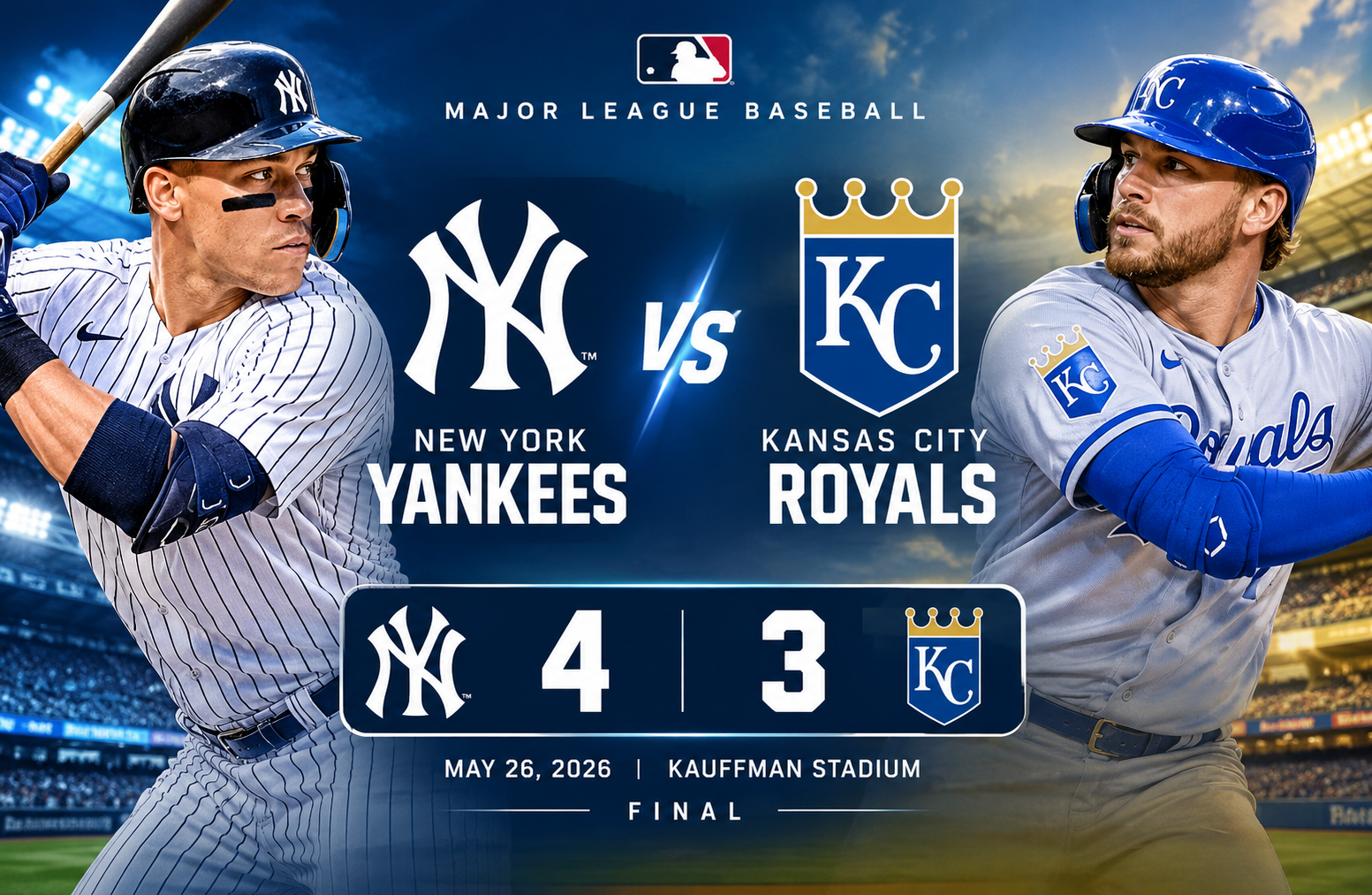
The New York Yankees vs Kansas City Royals match player stats from May 26, 2026, tell the story of a tightly contested MLB game decided by late-inning execution. The Yankees defeated the Royals 4-3 at Kauffman Stadium in Kansas City, Missouri, scoring twice in the ninth inning to overcome a 3-2 deficit. Anthony Volpe delivered the decisive hit, Cody Bellinger supplied an early home run, and the Yankees pitching staff held the Royals to five hits across nine innings.
The game offered a useful contrast between starting pitching and late-game relief work. Kansas City starter Michael Wacha delivered seven innings of effective pitching, while New York starter Will Warren kept the Yankees within reach through six innings. The difference came when the Yankees capitalized on their final scoring opportunity and Kansas City could not produce a comeback in the bottom of the ninth.
According to the supplied ESPN box-score data, New York recorded nine hits and four runs without committing an error. Kansas City managed five hits, three runs, and two home runs, but went 0-for-7 with runners in scoring position. Those numbers explain why the Royals remained competitive but ultimately fell short.
This breakdown examines the final score, individual batting performances, pitching statistics, inning-by-inning scoring, and the tactical details that shaped the result. It also places the opening game in the context of the three-game series, which the Yankees swept from May 26 through May 28.
New York Yankees vs Kansas City Royals Match Player Stats: Game Overview
The May 26 matchup was played at Kauffman Stadium, where the Yankees secured a one-run victory after trailing late in the game. Both teams played error-free defense, making offensive timing and bullpen execution especially important.
| Game detail | Information |
| Date | May 26, 2026 |
| Venue | Kauffman Stadium |
| Location | Kansas City, Missouri |
| Final score | Yankees 4, Royals 3 |
| Yankees hits | 9 |
| Royals hits | 5 |
| Yankees errors | 0 |
| Royals errors | 0 |
| Attendance | 26,162 |
| Game duration | 2 hours, 28 minutes |
| Winning pitcher | T. Hill |
| Losing pitcher | L. Erceg |
| Save | D. Bednar |
| Series outcome | Yankees won 3-0 |
The Yankees entered the matchup with a listed overall record of 32-22, while the Royals stood at 22-32. Those records provide background, but the individual game statistics offer a clearer explanation of the result.
New York generated more hits and made better use of its opportunities with runners in scoring position. Kansas City produced two home runs, yet the Yankees found a way to win without relying on a power display of their own.
The decisive factor was not simply the number of hits. It was when those hits occurred.
New York Yankees Batting Stats
New York’s offensive performance was built around one home run, timely singles, and a productive ninth inning. The Yankees finished with nine hits in 34 at-bats, scored four runs, and drove in four runs.
Their most important offensive contributions came from Cody Bellinger, Anthony Volpe, and José Caballero. Each played a different role in the scoring sequence, from providing early power to delivering the late hit that changed the outcome.
Yankees Player Statistics Table
The following table summarizes the principal batting contributions recorded in the supplied game data.
| Player | At-bats | Hits | Runs | RBI | Key contribution |
| Cody Bellinger | 4 | 1 | 1 | 1 | Solo home run |
| Anthony Volpe | 3 | 1 | 1 | 2 | Ninth-inning go-ahead single |
| José Caballero | 4 | 1 | 0 | 1 | RBI single in the second |
| Jazz Chisholm Jr. | 3 | 1 | 1 | 0 | Double and ninth-inning scoring sequence |
| J.C. Escarra | 4 | 3 | 0 | 0 | Three-hit performance |
| Aaron Judge | 4 | 1 | 0 | 0 | Double |
| Paul Goldschmidt | 4 | 1 | 0 | 0 | Hit that helped start the ninth-inning rally |
Note: Player details are drawn from the supplied game data. Individual lines are included where available; the table is not intended to replace a complete official box score.
Cody Bellinger: The Early Power Threat
Bellinger gave the Yankees an important early scoring contribution with a home run measured at 403 feet. His seventh homer of the season, according to the supplied statistics, helped New York establish an advantage in the second inning.
The home run mattered because it immediately rewarded the Yankees for putting pressure on Michael Wacha. A solo shot can change the tactical direction of an inning, forcing a pitcher to reconsider how aggressively to challenge the next hitters.
Bellinger’s contribution also proved valuable in retrospect. The Yankees eventually won by one run, meaning his early RBI was part of the narrow scoring margin that made the ninth-inning comeback possible.
However, a home run alone does not explain the victory. New York still needed another two runs after Kansas City took the lead. Bellinger’s role was to give the offense an early foundation, while other hitters had to finish the job later.
Anthony Volpe: The Decisive Ninth-Inning Hit
Volpe was the most important player in the final scoring sequence. With New York trailing 3-2 in the ninth, his single brought home two runners and moved the Yankees ahead 4-3.
The value of this hit becomes clearer when viewed through the game’s situation. Kansas City had just taken the lead in the eighth inning, putting pressure on the Yankees to respond immediately. New York could not afford to wait for a later opportunity.
Volpe’s two-run single converted the rally into a lead rather than merely tying the game. That distinction changed the Yankees’ approach to the bottom of the ninth: instead of needing another offensive inning to win, they needed three outs from their bullpen.
His two RBIs also represented half of New York’s total runs batted in. In a game with limited scoring, that was a substantial share of the offense.
Volpe was eventually thrown out at second during the play sequence, but the important result had already been achieved. The Yankees had moved from a one-run deficit to a one-run lead.
José Caballero: Contributing Before the Late Drama
Caballero supplied an RBI single in the second inning, scoring Volpe. His hit was one of the early plays that helped New York build its initial advantage.
These contributions can be overlooked when a game ends with a dramatic walk-off-style rally or a late go-ahead hit. Yet early runs remain important because they keep a team competitive when the opposition begins to respond.
Caballero’s RBI helped create the 2-1 game state after Kansas City had answered Bellinger’s home run with a sacrifice fly. Without that run, the Yankees would have entered the later innings in a different position.
J.C. Escarra: Consistent Contact
Escarra recorded three hits in four at-bats, giving him New York’s highest hit total among the listed players. His performance showed that the Yankees could create offense through repeated contact, not only through home runs or extra-base power.
Three hits in one game do not automatically indicate a lasting change in a player’s performance. They do, however, demonstrate how one productive hitter can keep innings alive and create more chances for the middle and lower parts of a lineup.
For a complete statistical assessment, hits should be considered alongside walks, strikeouts, total bases, and the situations in which a player reached base. In this game, Escarra’s three-hit line was an important part of New York’s nine-hit team total.
Jazz Chisholm Jr. and Aaron Judge
Chisholm hit a double, recorded a run, and helped create the late scoring opportunity. His extra-base hit was especially valuable in the ninth inning because it put pressure on the Kansas City defense and brought a potential go-ahead run closer to home.
Judge also recorded a double. Although his listed line did not include a run batted in, extra-base hits remain meaningful because they can move runners into scoring position with one swing.
Neither player needed to hit a home run to affect the result. Their contributions helped create the conditions for Volpe’s decisive single.
Kansas City Royals Batting Stats
Kansas City produced five hits and three runs. Its offense relied heavily on the long ball, with Salvador Perez and Bobby Witt Jr. each hitting a home run.
The Royals’ main limitation was their inability to convert scoring opportunities consistently. They went 0-for-7 with runners in scoring position and left seven runners on base. Those numbers do not mean every missed opportunity was equally costly, but they show that Kansas City failed to produce a hit in any of its seven recorded at-bats with runners in scoring position.
Royals Player Statistics Table
| Player | Key statistic | Runs | RBI | Main contribution |
| Salvador Perez | Home run, 422 feet | 1 | 1 | Sixth-inning home run |
| Bobby Witt Jr. | Home run, 432 feet | 1 | 1 | Eighth-inning go-ahead homer |
| Michael Massey | Sacrifice fly | 0 | 1 | Drove in Perez in the second |
| Vinnie Pasquantino | Double | Not specified | Not specified | Extra-base hit |
| Nick Loftin | Double | Not specified | Not specified | Extra-base hit |
| Tyler Tolbert | Stolen base | Not specified | Not specified | Added pressure on the bases |
The supplied data identifies Perez, Witt, and Massey as Kansas City’s RBI contributors. It does not provide a complete individual batting line for every Royal in the summary, so additional at-bats, batting averages, and strikeout totals should not be inferred.
Salvador Perez: Power That Kept Kansas City Close
Perez hit a home run measured at 422 feet in the sixth inning. His ninth homer of the season, according to the supplied data, helped Kansas City remain within reach after falling behind early.
Perez’s power was significant because the Royals had struggled to produce multiple hits in the same inning. A home run can bypass the need for consecutive singles and bring a team closer with one swing.
The sixth-inning shot also changed the feel of the contest. Rather than allowing New York’s early advantage to grow, Kansas City reduced the gap and made the final innings more competitive.
Perez’s contribution was a clear example of how isolated power can keep a team in a game even when its overall offensive production is limited.
Bobby Witt Jr.: The Eighth-Inning Lead
Witt delivered Kansas City’s most consequential offensive moment before the ninth inning. His 432-foot home run gave the Royals a 3-2 lead in the eighth.
At that point, Kansas City had converted a close game into a position from which it could attempt to protect a narrow advantage. A home run in the late innings often carries additional tactical weight because the defense can focus on securing the remaining outs rather than chasing additional runs.
Witt’s homer was not merely another entry in the box score. It temporarily changed which team controlled the game.
The difficulty for Kansas City was that the advantage did not last. The Yankees responded in the ninth, showing that a late lead remains vulnerable when the opposing offense can create traffic on the bases and deliver a timely hit.
Michael Massey: A Productive Sacrifice Fly
Massey drove in Perez with a sacrifice fly in the second inning. This play demonstrated a different way to produce a run without recording a hit.
A sacrifice fly can be valuable when a runner is positioned to score from third base. The batter’s goal is to put the ball in the air deep enough to allow the runner to advance after the catch.
The play contributed to Kansas City’s early response and prevented Bellinger’s home run from creating a larger immediate deficit. However, the Royals were unable to build on that scoring opportunity with enough additional production to take control earlier.
Kansas City’s Missed Opportunities
The most revealing offensive number for the Royals was their 0-for-7 performance with runners in scoring position.
A runner in scoring position is generally on second or third base, where a single has a stronger chance of producing a run. Going hitless in those situations means Kansas City did not record a base hit in any of its seven qualifying at-bats.
That does not mean the Royals were completely unproductive with runners aboard. Massey’s sacrifice fly produced a run, and home runs brought runners home through their own power. The distinction is that the offense did not consistently turn its other opportunities into additional scoring.
Kansas City also left seven runners on base. Those stranded runners represent opportunities that did not result in runs before the inning ended. They are useful context, although they should not be treated as proof that a team was careless or that every stranded runner would otherwise have scored.
The practical takeaway is straightforward: Kansas City had enough power to challenge New York, but its offense did not produce the timely contact needed to build a more secure lead.
Yankees vs Royals Pitching Stats
Pitching was central to the result because neither starting pitcher allowed the opposing offense to take complete control early. Will Warren limited Kansas City to two earned runs over six innings, while Michael Wacha worked seven innings and also allowed two earned runs.
The difference emerged after the starters left. Kansas City’s bullpen surrendered the go-ahead runs in the ninth, while New York’s relievers protected the narrow advantage.
Starting Pitcher Comparison
| Statistic | Will Warren, Yankees | Michael Wacha, Royals |
| Innings pitched | 6.0 | 7.0 |
| Hits allowed | 3 | 5 |
| Runs allowed | 2 | 2 |
| Earned runs | 2 | 2 |
| Walks | 3 | 2 |
| Strikeouts | 3 | 5 |
| Home runs allowed | 1 | 1 |
Wacha pitched one inning longer and recorded two more strikeouts. Warren allowed fewer hits but issued one additional walk. Both surrendered one home run and finished with two earned runs allowed.
The numbers show that neither starter dominated every aspect of the matchup. Wacha provided greater length, while Warren limited the number of hits Kansas City collected. Their performances were broadly comparable in terms of runs allowed.
Will Warren: Keeping the Yankees Within Reach
Warren’s six-inning outing gave New York a reasonable chance to win despite the Royals’ late power surge.
He allowed three hits, three walks, and two earned runs while striking out three. The three walks indicate that he did not completely eliminate baserunners, but the limited hit total helped prevent Kansas City from generating a large inning through consecutive base hits.
Warren also allowed a home run. In this game, however, the damage remained manageable because Kansas City did not consistently follow its extra-base hits with additional scoring.
A starter’s performance should be assessed through more than strikeouts alone. Innings completed, walks allowed, hits surrendered, and runs conceded all help explain how effectively a pitcher controlled the game.
Warren completed six innings without giving the Royals an insurmountable lead. That gave New York’s offense time to respond and allowed the bullpen to handle the remaining three innings.
Michael Wacha: Seven Effective Innings
Wacha recorded seven innings, five hits allowed, two earned runs, two walks, and five strikeouts. For much of the game, he gave Kansas City the length and control needed to compete.
His outing was particularly useful because the Yankees did not overwhelm him with walks. New York recorded only two walks as a team, limiting the number of free baserunners that could amplify the impact of its hits.
Wacha allowed Bellinger’s home run, but he otherwise kept the Yankees from creating a large lead during his seven innings. The fact that New York eventually scored four runs does not mean all four were charged to him.
The decisive damage came after the starting pitchers had completed their work. That distinction matters when evaluating Wacha’s individual performance: the Royals lost the game, but their starter’s seven-inning, two-earned-run line was not the main reason for the defeat.
Yankees Bullpen: Protecting the Final Lead
New York used B. Headrick, J. Bird, T. Hill, and D. Bednar after Warren left the game.
Hill received the win after recording two outs without allowing a hit or an earned run. His line included one strikeout and no walks. Bednar then pitched the ninth inning, allowing no hits or earned runs while issuing one walk to secure his 12th save.
| Pitcher | Innings | Hits allowed | Earned runs | Strikeouts | Walks |
| Tim Hill | 0.2 | 0 | 0 | 1 | 0 |
| David Bednar | 1.0 | 0 | 0 | 0 | 1 |
These two lines illustrate the value of bullpen execution in a one-run game. Hill kept the score from worsening, and Bednar completed the save despite allowing a baserunner through a walk.
The available summary does not provide complete individual pitching lines for Headrick and Bird. It would therefore be misleading to assign exact hit, walk, or strikeout totals to either pitcher without the corresponding official records.
Royals Bullpen: Where the Game Turned
Kansas City’s relief pitchers were D. Lynch IV and L. Erceg. Lynch recorded an inning, while Erceg was charged with the loss after allowing four hits and two earned runs in one inning, according to the supplied data.
| Pitcher | Innings | Hits allowed | Earned runs | Strikeouts | Walks |
| D. Lynch IV | 1.0 | Not supplied | Not supplied | Not supplied | Not supplied |
| L. Erceg | 1.0 | 4 | 2 | 0 | 0 |
Erceg’s line is the most important relief statistic in the game. He allowed four hits in one inning, and two of those baserunners eventually crossed home plate during New York’s comeback.
The issue was not simply that Kansas City lost its lead. It was the speed with which New York converted its opportunity. Once the Yankees put runners on base, they produced the single that brought both runners home.
Relief pitching is often evaluated through ERA, strikeout rate, and walks. In a single close game, however, the sequence of events also matters. A pitcher can enter with a lead and face a difficult situation in which even one well-placed hit changes the result.
Erceg’s appearance became the turning point because the Yankees converted their ninth-inning opportunity before Kansas City could record the outs needed to preserve the advantage.
Yankees vs Royals Score by Inning
The inning-by-inning scoring sequence shows how the game moved from New York’s early lead to Kansas City’s late advantage and then back to the Yankees.
The following table summarizes the scoring events in the supplied game data. It is a scoring-event summary rather than a complete official line score for every inning.
| Inning | Yankees scoring | Royals scoring | Key event |
| Second | 2 | 1 | Bellinger home run, Caballero RBI single, Massey sacrifice fly |
| Sixth | 0 | 1 | Perez home run |
| Eighth | 0 | 1 | Witt Jr. home run |
| Ninth | 2 | 0 | Volpe’s two-run single |
| Final | 4 | 3 | Yankees win |
The scoring events account for all seven runs in the final score: four for New York and three for Kansas City.
Second Inning: New York Takes an Early Lead
Bellinger’s 403-foot home run opened the scoring for the Yankees. Caballero followed with an RBI single that brought Volpe home, putting New York ahead 2-0.
Kansas City responded with a sacrifice fly by Massey that scored Perez. The Royals reduced the deficit to one run, establishing the close pattern that would continue throughout the contest.
This inning demonstrated two different forms of run production. New York combined a home run with a base hit, while Kansas City used a sacrifice fly to bring a runner home without recording an additional hit on that play.
Sixth Inning: Perez Restores the Pressure
Perez’s 422-foot home run reduced New York’s advantage and helped Kansas City remain in contention.
The home run was significant because the Royals had not generated a sustained offensive surge. Instead, Perez used one swing to add a run and put more pressure on the Yankees’ pitching staff.
From New York’s perspective, the priority became limiting further damage. Warren and the relief staff needed to prevent the Royals from turning a narrow deficit into a multi-run lead.
Eighth Inning: Witt Gives Kansas City the Lead
Witt’s 432-foot homer moved the Royals ahead 3-2. The timing made the hit especially important because Kansas City was now only three outs away from potentially closing out the game.
The home run also exposed how quickly a close contest can change. For much of the game, the Yankees had been in front. One late swing placed Kansas City in the position of defending a lead rather than chasing one.
The challenge for the Royals was to finish the game with their bullpen. That did not happen.
Ninth Inning: Volpe Changes the Result
New York’s decisive rally began with Goldschmidt reaching on a hit, followed by Chisholm’s double. Those plays created the opportunity for Volpe to drive in the go-ahead runs.
Volpe’s single scored Schuemann and Chisholm, putting the Yankees ahead 4-3. The play transformed a potential loss into a lead, leaving the Royals with one final opportunity to respond.
Bednar then completed the save. Although he issued a walk, he allowed no hits and no runs in the ninth.
The final inning illustrates an important baseball principle: a late lead is only secure when the defending team can record the remaining outs. Kansas City had produced the go-ahead home run, but New York’s hitters responded before the Royals could finish the game.
Key Statistical Comparisons That Explain the Result
A box score is most useful when the numbers are connected to the game’s actual events. Four comparisons help explain why New York won.
1. Hits: Yankees 9, Royals 5
New York collected four more hits than Kansas City. More hits do not guarantee victory, but they generally create more opportunities to score.
The Yankees spread their production across several hitters, including Escarra, who recorded three hits, and the players involved in the ninth-inning rally. Kansas City depended more heavily on individual power contributions.
The difference was especially relevant in the final inning. New York produced multiple baserunners and then converted them with one hit.
2. Home Runs: Yankees 1, Royals 2
Kansas City hit two home runs to New York’s one. Despite that advantage in home-run count, the Royals lost.
This is a useful reminder that home runs are only one part of offensive production. The timing of hits, the number of runners on base, and the ability to create scoring opportunities in other ways also influence the final score.
Bellinger’s homer helped New York early, while Perez and Witt supplied Kansas City’s power. Volpe’s ninth-inning single then proved more decisive than either of the Royals’ late power contributions.
3. Runners in Scoring Position: Yankees 2-for-7, Royals 0-for-7
The Yankees recorded two hits in seven at-bats with runners in scoring position. Kansas City recorded none in seven such at-bats.
Both teams had opportunities, but New York made better use of its chances for hits in these situations. The late rally showed how one successful at-bat can outweigh several earlier missed opportunities.
These figures should not be interpreted as a measure of long-term ability on their own. Performance with runners in scoring position can vary substantially across a small number of at-bats. For this individual game, however, the difference was meaningful.
4. Errors: Both Teams Recorded Zero
Neither team committed an error. That makes defensive mistakes an unlikely explanation for the difference in the final score.
The game was instead decided by offensive execution and relief pitching. New York found the decisive hit in the ninth, while Kansas City allowed the rally to develop.
The absence of errors also reinforces why a game summary should distinguish between defensive miscues and ordinary hits. A team can play error-free defense and still lose because the opposing offense produces timely contact.
What the Statistics Reveal About Game Strategy
The numbers point to several practical lessons about how a close baseball game can be won or lost.
Contact Can Be More Important Than Power
Kansas City hit more home runs, but New York recorded more total hits and scored the winning runs through a single. Power created the Royals’ late lead, but contact helped the Yankees reverse it.
This does not mean singles are inherently more valuable than home runs. It means their value depends on the situation. With two runners available to score, a well-placed single can produce multiple runs without clearing the fence.
Starting Pitchers Need Support From the Bullpen
Both starters allowed two earned runs. Wacha completed seven innings, while Warren completed six. Those performances kept the contest close enough for either team to win.
The late relief innings ultimately separated the teams. New York’s bullpen protected its lead after the comeback, while Kansas City’s relief appearance in the ninth allowed the decisive runs.
For future matchups, evaluating a starting pitcher without considering the bullpen can leave out a major part of the team’s performance.
Situational Hitting Determines Close Finishes
The Yankees’ 2-for-7 mark with runners in scoring position compared with Kansas City’s 0-for-7 mark reflects a meaningful difference in this game.
The final inning provides the clearest example. New York needed a hit that would score both runners, and Volpe delivered it. Kansas City, by contrast, did not produce a hit with runners in scoring position during its recorded opportunities.
A Late Lead Still Requires Three Outs
Witt’s eighth-inning home run gave Kansas City the lead, but it did not guarantee the victory. The Royals still needed to get through the ninth without allowing New York to score.
That is why bullpen management, command, and execution are central to late-game strategy. A relief pitcher entering a high-pressure inning must limit baserunners and avoid the sequence of hits that can quickly erase a narrow advantage.
Series Context: Yankees Sweep the Royals
The supplied series results show New York winning all three games against Kansas City.
| Game | Result |
| Game 1 | Yankees 4, Royals 3 |
| Game 2 | Yankees 15, Royals 1 |
| Game 3 | Yankees 7, Royals 0 |
| Series result | Yankees won 3-0 |
The opening game was the closest of the three. New York won by one run after a ninth-inning comeback, then followed with a 15-1 victory and a 7-0 shutout.
The series results show different ways the Yankees created separation. In the opener, late situational hitting made the difference. The next game featured a much larger offensive margin, while the final game saw New York prevent Kansas City from scoring.
It would be too simplistic to treat the three results as proof that every part of the Yankees’ roster was superior in every situation. Each game had its own pitching matchups and scoring patterns. Taken together, however, the results demonstrate that New York combined timely offense with effective run prevention across the series.
For Kansas City, the opening game showed that the team could generate home-run power and take a late lead. The subsequent results also highlight the importance of sustaining that offensive production and preventing the opposing lineup from building momentum.
Official Box Score and Statistical Verification
For readers who want to check the original game record, the ESPN Yankees vs. Royals box score is the primary reference supplied for this analysis.
When reviewing a baseball box score, pay attention to the difference between hits, runs, and runs batted in. Hits measure successful batting outcomes, runs show how many times a player crosses home plate, and RBIs credit a batter for qualifying run-producing plays. These categories are related, but they do not measure the same thing.
Pitching statistics also require careful interpretation. An earned run is charged to a pitcher under official scoring rules, while a team’s total runs can include unearned runs. Innings pitched are recorded in baseball thirds, so 0.2 innings means two outs rather than two-tenths of a decimal inning.
The supplied figures identify this game as a 4-3 Yankees victory on May 26, 2026. Some secondary listings display May 25 because of differences in local date presentation. The analysis above follows the date specified in the supplied game data.
For the same reason, individual statistics that were not included in the supplied record have not been filled in with estimates. A complete player-by-player comparison should use the official batting and pitching lines rather than infer missing figures from the final score.
Frequently Asked Questions
1. Who won the New York Yankees vs Kansas City Royals game on May 26, 2026?
The New York Yankees defeated the Kansas City Royals 4-3 at Kauffman Stadium. Anthony Volpe delivered a two-run single in the ninth inning to give New York the lead.
2. Which Yankees player had the biggest impact on the game?
Anthony Volpe was the decisive offensive contributor, recording two RBIs on the go-ahead single in the ninth. Cody Bellinger also played an important role with a home run and one RBI.
3. Which Royals players hit home runs?
Salvador Perez and Bobby Witt Jr. both homered for Kansas City. Perez hit a 422-foot home run in the sixth inning, while Witt hit a 432-foot home run in the eighth.
4. How did Will Warren and Michael Wacha perform?
Warren pitched six innings, allowing three hits and two earned runs while recording three strikeouts. Wacha pitched seven innings, allowing five hits and two earned runs while striking out five.
5. Why did the Yankees win despite hitting fewer home runs?
New York recorded nine hits compared with Kansas City’s five and went 2-for-7 with runners in scoring position. The Royals went 0-for-7 in those situations. The Yankees also scored twice in the ninth inning to turn a 3-2 deficit into a 4-3 lead.
6. What was the result of the three-game Yankees vs Royals series?
According to the supplied series results, New York swept Kansas City 3-0. The Yankees won the opening game 4-3, followed with a 15-1 victory, and completed the sweep with a 7-0 win.
Conclusion
The New York Yankees vs Kansas City Royals match player stats show how timely hitting and bullpen execution can decide a game even when the losing team produces more home runs. Kansas City received power contributions from Salvador Perez and Bobby Witt Jr., but the Royals could not consistently convert their scoring opportunities into runs.
New York benefited from Cody Bellinger’s early home run, José Caballero’s RBI single, and a productive ninth-inning rally led by Anthony Volpe. Will Warren and Michael Wacha both delivered competitive starting outings, leaving the final result to be decided by the relief pitchers and the hitters facing them.
The most important numbers are the final 4-3 score, New York’s nine hits, Kansas City’s five hits, and the contrast between the teams’ performance with runners in scoring position. Volpe’s two-run single provided the decisive moment, while David Bednar’s scoreless ninth secured the victory.
The game also formed the beginning of a three-game sweep, with the Yankees winning the following two matchups by much larger margins. Together, the results provide a useful example of the different ways a team can win: through a late rally in a close contest, a high-scoring offensive performance, or a dominant pitching display.
Ultimately, the box score is most informative when individual statistics are connected to the events that shaped the game. In this matchup, the Yankees made their most important hits count when the result was on the line.