How Restaurant Portion Sizes Affect Daily Calorie Intake
Eating at restaurants is convenient, enjoyable, and often part of everyday life. However, restaurant meals can make it difficult to understand how much energy you are consuming, especially when portions are larger than the amounts you normally prepare at home.
A meal that looks like a single serving may contain enough food for two people. Extra sauces, cheese, cooking oils, sugary beverages, and large side dishes can also increase its overall calorie content without making the difference immediately obvious.
Understanding portion sizes is therefore an important part of managing daily calorie intake. It does not mean avoiding restaurants or restricting every food choice. Instead, it means learning how food quantities, ingredients, and preparation methods influence the nutritional value of a meal.
This guide explains how restaurant portions affect calorie consumption, how to recognize hidden calories, and how to make informed food choices without sacrificing convenience or enjoyment.
What Is the Difference Between Portion Size and Serving Size?
No, portion size and serving size do not mean exactly the same thing. Although people frequently use these terms interchangeably, they describe two different measurements.
A portion is the amount of food someone actually chooses to eat during a meal. A serving size is a standardized or reference amount used to describe the nutritional content of a food.
For example, a package might list one serving as 150 grams, but someone may eat 300 grams in one sitting. In that situation, the person has consumed two servings.
| Term | Meaning | Practical example |
| Portion size | Amount actually eaten | A large restaurant bowl |
| Serving size | Reference amount used for nutrition information | 150 grams of a packaged food |
| Calorie intake | Energy obtained from consumed food and drinks | Total calories from a complete meal |
| Calorie density | Calories contained in a given weight of food | Energy provided per 100 grams |
The distinction matters because nutrition information is only useful when the quantity consumed is considered.
According to the U.S. National Institute of Diabetes and Digestive and Kidney Diseases, the amount someone chooses to eat can differ considerably from the serving size shown on a food label.
Can Larger Restaurant Portions Increase Your Daily Calorie Intake?
Yes, larger portions can increase daily energy intake, particularly when meals contain energy-dense ingredients.
The USDA Nutrition Evidence Systematic Review examined the relationship between portion size and energy intake. Its review found strong evidence that serving larger portions increases food and energy intake among adults and older adults.
This happens partly because people may continue eating when food remains available, even after consuming an amount that would otherwise satisfy their hunger.
Consider a restaurant meal containing rice, chicken, sauce, and a side dish. A larger serving of the same meal can provide considerably more energy than a smaller serving, even though the ingredients remain unchanged.
| Meal component | Smaller portion | Larger portion |
| Cooked rice | Less carbohydrate and energy | More carbohydrate and energy |
| Grilled chicken | Less protein and energy | More protein and energy |
| Creamy sauce | Fewer additional calories | More fat and energy |
| Side dish | Smaller contribution | Potentially substantial additional energy |
The actual difference depends on ingredient quantities and preparation methods.
A useful approach is to consider the complete meal rather than judging its nutritional value by appearance alone.
Why Do Restaurant Meals Sometimes Contain More Calories Than Expected?
Yes, restaurant meals can contain more calories than expected because several ingredients contribute energy simultaneously.
A meal may appear relatively simple, but its final nutritional profile depends on everything included in its preparation.
Cooking oil, dressings, cheese, butter, mayonnaise, and sweetened sauces can increase total calories without significantly changing the apparent size of the meal.
The following table highlights common ingredients that deserve attention.
| Ingredient | Main nutritional contribution | Why it matters |
| Cooking oil | Fat | Concentrated source of calories |
| Cheese | Fat and protein | Adds energy and saturated fat |
| Mayonnaise | Primarily fat | Small quantities can contribute considerable energy |
| Creamy dressing | Fat and sometimes added sugar | Can increase meal calories |
| Sweetened sauces | Carbohydrates and added sugar | May add calories without much fullness |
| Butter | Fat | Often overlooked in cooking |
| Avocado | Mostly unsaturated fat | Nutrient-rich but energy-dense |
This does not mean these ingredients should be eliminated. Their nutritional contribution simply needs to be considered alongside the rest of the meal.
How Do Cooking Methods Change Calorie Content?
Cooking methods can substantially influence the energy content of restaurant meals.
Grilling, steaming, baking, and roasting can require less added fat than deep-frying or preparing foods with generous amounts of butter and oil.
However, the cooking method alone does not determine whether a meal is nutritious. Ingredients, preparation quantities, and accompanying sides also matter.
| Cooking method | Common characteristics | What to consider |
| Grilling | Direct heat, often limited added fat | Check marinades and finishing oils |
| Steaming | Uses water vapor | Usually requires little added fat |
| Baking | Dry heat in an oven | Added butter and oil still matter |
| Deep-frying | Food cooked in hot oil | Oil absorption can increase energy content |
| Sautéing | Food cooked in a pan | Oil or butter quantity makes a difference |
| Roasting | Dry heat, sometimes with oil | Portion and added fat remain important |
Choosing a cooking method with less added fat can be a practical way to manage overall calorie intake.
Are Liquid Calories Important When Eating at Restaurants?
Yes, beverages can contribute significantly to total daily calorie intake.
People often focus on solid foods when estimating meal calories and forget about drinks. However, sweetened iced tea, soft drinks, milkshakes, flavored coffees, and specialty beverages can add energy to a meal.
Liquid calories can also be less filling than some solid foods, depending on the beverage and the individual.
| Beverage | What to check |
| Regular soft drinks | Added sugar and total calories |
| Sweetened iced tea | Sugar content and serving volume |
| Milkshakes | Milk, ice cream, syrups, and toppings |
| Flavored coffee | Creamers, syrups, and added sugar |
| Fruit juice | Natural sugars and portion size |
| Plain water | No calories |
For someone trying to understand their daily calorie consumption, beverages should be included in the same calculation as meals and snacks.
Water or unsweetened drinks can be useful alternatives when someone wants to reduce additional calories without changing their main meal.
Does Calorie Density Matter More Than Food Volume?
Yes, calorie density is an important factor when comparing foods of different sizes and weights.
Calorie density describes how much energy a particular amount of food provides. Foods containing substantial amounts of fat can have more calories in a smaller volume than foods with higher water or fiber content.
For instance, a small quantity of nuts can provide considerable energy, while a larger quantity of many vegetables may contain comparatively fewer calories.
This difference explains why judging a meal by its physical size alone can be misleading.
| Food category | Typical calorie-density characteristics |
| Non-starchy vegetables | Generally low |
| Fresh fruits | Generally low to moderate |
| Cooked grains | Varies by type and preparation |
| Lean protein | Moderate, depending on preparation |
| Nuts and seeds | Relatively high |
| Fried foods | Often high |
| Cream-based sauces | Often high |
A balanced meal can include both lower- and higher-calorie-density ingredients. The objective is to understand their proportions rather than label individual foods as good or bad.
How Can You Estimate Calories in a Restaurant Meal?
Yes, you can estimate restaurant meal calories by identifying individual ingredients and calculating their approximate contributions.
The most practical method is to divide the meal into components instead of attempting to guess the calories of the entire plate.
Start with the main carbohydrate source, identify the protein, account for vegetables, and then consider sauces, oils, cheese, and beverages.
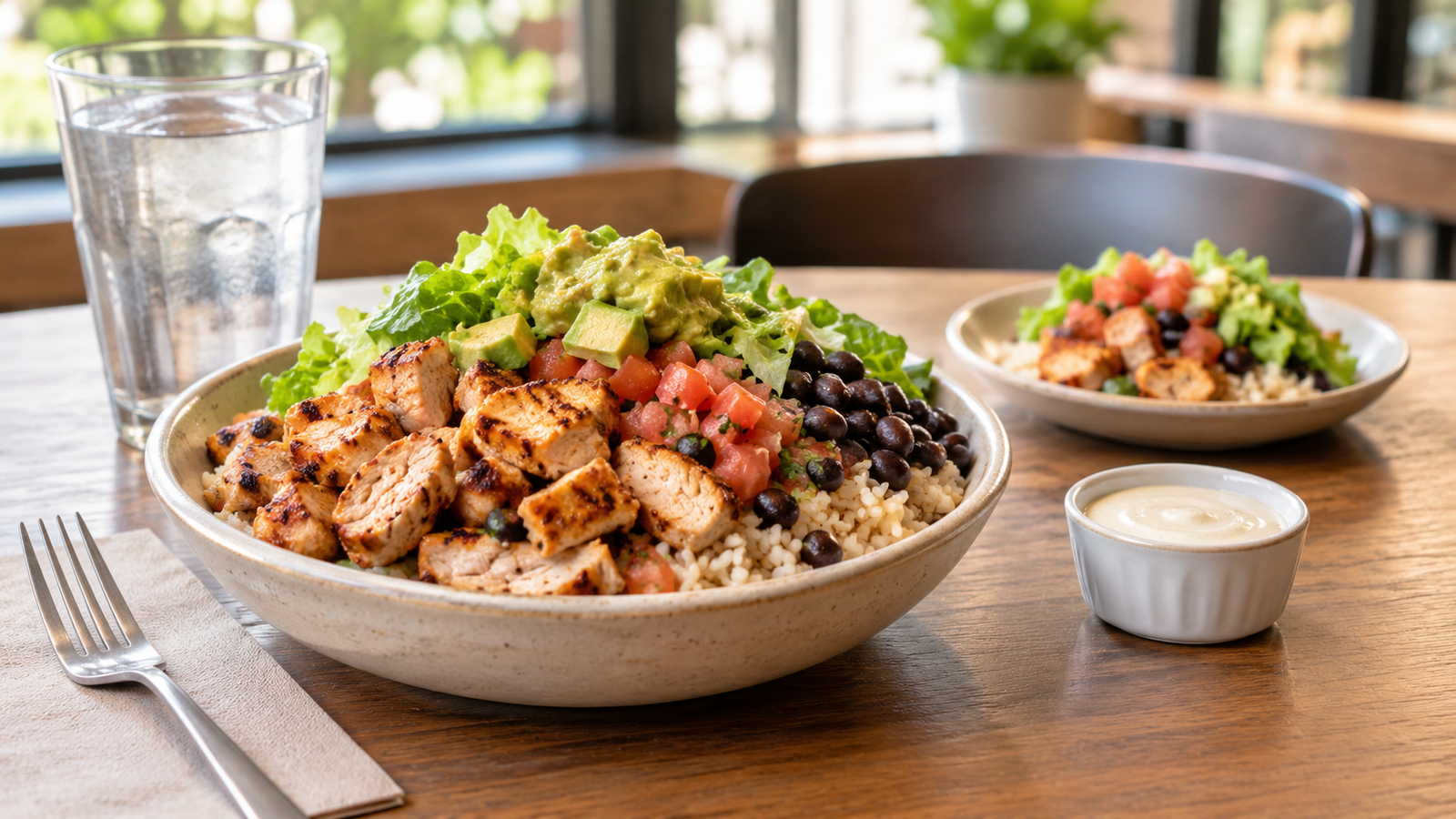
For example, a customizable rice bowl may contain several ingredients with different nutritional contributions.
| Meal component | What to measure or identify |
| Rice or grains | Approximate quantity and preparation |
| Chicken or another protein | Type, portion, and cooking method |
| Beans | Quantity and preparation |
| Vegetables | Types and approximate amounts |
| Cheese | Added quantity |
| Sauce or dressing | Type and serving amount |
| Beverage | Volume and sugar content |
For more accurate estimates, use official restaurant nutrition information whenever it is available.
For customizable meals, a Chipotle nutrition calculator can help estimate the nutritional contribution of selected ingredients and combinations. This is particularly useful when comparing different combinations before ordering.
Remember that estimates are not laboratory measurements. Actual portions, ingredient quantities, and restaurant preparation practices can create differences between estimated and consumed calories.
Can Protein Help Make Restaurant Meals More Satisfying?
Yes, protein can support satiety and is an important nutrient to consider when building a balanced meal.
Protein contributes to muscle maintenance, tissue repair, and several essential physiological processes. It can also help people feel satisfied after eating.
Common restaurant protein options include chicken, fish, eggs, lean meat, tofu, beans, and other legumes.
| Protein source | Nutritional consideration |
| Grilled chicken | Provides protein, with preparation affecting fat content |
| Fish | Provides protein; some varieties also contain omega-3 fats |
| Eggs | Supply protein and several micronutrients |
| Beans | Provide plant protein and dietary fiber |
| Tofu | Provides plant-based protein |
| Lean beef | Supplies protein, iron, and vitamin B12 |
| Fried chicken | Provides protein but may contain additional fat from preparation |
The best option depends on individual preferences, dietary requirements, and the overall composition of the meal.
Protein should be considered alongside carbohydrates, fats, fiber, and micronutrients rather than treated as the only measure of meal quality.
Should You Reduce Carbohydrates to Control Restaurant Meal Calories?
No, eliminating carbohydrates is not necessary to manage calorie intake.
Carbohydrates provide energy and are found in many nutritious foods, including rice, potatoes, beans, whole grains, fruits, and vegetables.
The more useful question is how much of each food is included in the meal and how it is prepared.
| Carbohydrate source | Nutritional characteristics |
| Brown rice | Provides carbohydrates and some fiber |
| White rice | Provides carbohydrates and energy |
| Beans | Supply carbohydrates, plant protein, and fiber |
| Potatoes | Provide carbohydrates and potassium |
| Whole grains | Can provide dietary fiber and micronutrients |
| Fruit | Provides carbohydrates, water, and vitamins |
A meal containing rice or another carbohydrate source can still fit into a balanced eating pattern.
Rather than removing an entire food group, consider the portion, preparation, and combination of ingredients.
How Do Sauces, Dressings, and Toppings Affect Total Calories?
Yes, toppings and sauces can change the nutritional value of a restaurant meal more than people realize.
A meal’s main ingredients may remain the same, while additional toppings introduce more fat, carbohydrates, sodium, and calories.
For example, a rice bowl with chicken and vegetables can have a different nutritional profile depending on whether it includes a light salsa, a creamy dressing, extra cheese, or a generous serving of sour cream.
| Addition | Potential nutritional impact |
| Fresh salsa | Usually contributes relatively few calories |
| Sour cream | Adds fat and calories |
| Cheese | Adds protein, fat, and sodium |
| Guacamole | Adds unsaturated fats and calories |
| Creamy dressing | Can add substantial fat and energy |
| Hot sauce | Nutritional impact varies by product |
| Sweet sauce | May contribute additional sugars |
These ingredients can still be enjoyed as part of an overall eating pattern.
The key is to recognize that customization changes the nutritional content of the final meal.
Is Sodium as Important as Calories in Restaurant Food?
Yes, sodium deserves attention even though it does not provide calories.
Sodium is an essential mineral, but consuming excessive amounts regularly can contribute to high blood pressure and increase cardiovascular health risks.
Restaurant foods may contain sodium from seasoning blends, processed meats, cheese, sauces, dressings, and packaged ingredients.
The U.S. Food and Drug Administration identifies 2,300 milligrams per day as the Daily Value for sodium.
| Food component | Possible source of sodium |
| Processed meat | Curing and preservation |
| Cheese | Manufacturing and added salt |
| Restaurant sauces | Seasoning and sodium-containing ingredients |
| Seasoned rice | Salt and seasoning blends |
| Pickled vegetables | Brining |
| Packaged dressings | Added sodium |
Checking sodium alongside calories gives a more complete understanding of a meal’s nutritional profile.
A meal can contain a moderate number of calories while still contributing a substantial amount of sodium.
Can You Eat at Restaurants While Maintaining a Balanced Diet?
Yes, restaurant meals can fit into a balanced eating pattern.
Eating outside the home does not automatically mean someone is consuming an unhealthy diet. What matters is the overall pattern of food choices, quantities, and nutritional balance over time.
A practical approach is to build meals using different food groups.
| Meal element | Examples | Main purpose |
| Protein | Chicken, fish, eggs, beans | Supports tissue maintenance and repair |
| Vegetables | Lettuce, peppers, tomatoes, broccoli | Supplies fiber and micronutrients |
| Carbohydrates | Rice, potatoes, whole grains | Provides energy |
| Healthy fats | Avocado, nuts, olive oil | Supplies essential fatty acids |
| Fruit | Berries, apples, oranges | Adds fiber, water, and vitamins |
| Beverage | Water or unsweetened tea | Supports hydration |
Not every meal needs to contain every food group in exactly the same proportions.
Individual nutritional requirements differ according to age, activity level, health status, and personal goals.
Does Eating Half a Restaurant Meal Help With Portion Control?
Yes, dividing a large restaurant meal into smaller portions can help some people manage how much they eat.
Restaurant meals sometimes contain more food than someone wants or needs at one sitting. Saving part of the meal for later is one way to avoid eating simply because food remains on the plate.
However, portion control should not become unnecessary restriction. Appetite, physical activity, and individual energy needs should also be considered.
| Situation | Practical approach |
| Very large meal | Consider saving part for later |
| Large side dish | Share it or choose a smaller size |
| Multiple high-energy toppings | Select the ingredients you actually enjoy |
| Large sugary beverage | Consider a smaller drink |
| Meal with several courses | Adjust quantities according to hunger |
Pre-portioning food can also make it easier to understand how much has been consumed.
The USDA’s systematic review found moderate evidence that smaller pre-portioned amounts can reduce energy intake among adults and older adults.
How Can You Read Nutrition Labels More Accurately?
Yes, understanding nutrition labels can make calorie estimates more reliable.
The Nutrition Facts label provides information about serving size, calories, fats, carbohydrates, protein, sodium, and other nutrients.
However, the first step is checking the quantity represented by the label.
The FDA explains that the serving size reflects amounts people typically consume and is not a recommendation for how much they should eat.
| Label section | What it tells you |
| Serving size | Quantity represented by the nutritional information |
| Calories | Energy per serving |
| Total fat | Amount of fat |
| Saturated fat | Amount of saturated fat |
| Total carbohydrates | Combined carbohydrate content |
| Dietary fiber | Amount of fiber |
| Added sugars | Sugars added during preparation or processing |
| Protein | Amount of protein |
| Sodium | Amount of sodium |
| % Daily Value | Contribution of a nutrient to the daily reference value |
If a product contains two servings and someone consumes the entire package, the calories and other nutrients must be calculated accordingly.
This is one of the most common reasons people underestimate their food intake.
Are Calorie Estimates Always Accurate at Restaurants?
No, restaurant calorie estimates are not always identical to the amount actually consumed.
Even when a restaurant provides nutrition information, real-world portions may differ because of ingredient quantities, cooking techniques, substitutions, and preparation practices.
A dish prepared by different employees may also contain slightly different amounts of oil, sauce, or toppings.
| Source of variation | How it affects estimates |
| Ingredient quantity | Changes total nutritional contribution |
| Cooking oil | Adds fat and calories |
| Sauce quantity | Changes calories, fat, sugar, or sodium |
| Food substitutions | Alters the original nutritional profile |
| Portion inconsistency | Creates differences between meals |
| Shared food | Makes individual intake harder to calculate |
For this reason, calorie estimates should be treated as practical approximations rather than exact measurements.
Consistency in tracking is generally more useful than trying to achieve unrealistic precision with every restaurant meal.
How Should You Plan Restaurant Meals During Pregnancy?
Yes, nutritional planning remains important during pregnancy, but calorie needs and food safety considerations may change.
Pregnancy involves nutritional requirements that differ from those of the general adult population. Protein, folate, iron, calcium, iodine, and other nutrients play important roles in maternal and fetal health.
However, pregnancy nutrition should not be reduced to calorie counting alone.
Food safety also matters. Pregnant individuals are generally advised to avoid certain higher-risk foods, including unpasteurized dairy products and undercooked meat, fish, or eggs.
Restaurant choices should be based on properly prepared ingredients, safe food handling, and individual medical guidance.
For readers who want more information about making informed restaurant food choices during pregnancy, this resource on eating at Chipotle while pregnant provides additional context.
Individual calorie requirements during pregnancy vary according to factors such as pre-pregnancy nutritional status, stage of pregnancy, activity, and medical circumstances. A qualified healthcare professional or registered dietitian can provide personalized advice.
What Is the Best Way to Track Daily Calorie Intake?
Yes, tracking daily calorie intake can help people understand their eating patterns when used consistently and appropriately.
The process does not need to be complicated. A simple food diary or nutrition tracking application can help identify common meals, beverages, portion sizes, and ingredients.
A useful record includes the food consumed, approximate quantity, preparation method, and any additional ingredients.
| Information to record | Example |
| Meal | Lunch |
| Main food | Chicken and rice |
| Portion | One medium bowl |
| Preparation | Grilled chicken |
| Additional ingredients | Sauce and vegetables |
| Beverage | Unsweetened tea |
| Estimated calories | Based on ingredient quantities |
For packaged foods, nutrition labels can provide a starting point. For fresh ingredients, established food composition databases can be useful.
The USDA FoodData Central database provides nutrient information for many foods and can help users compare nutritional values.
When using tracking tools, remember that database entries may differ according to the exact food, preparation, and portion being recorded.
What Are the Most Common Mistakes When Estimating Restaurant Calories?
Yes, several common mistakes can lead to inaccurate estimates of restaurant meal calories.
The biggest problem is usually focusing on the main dish while ignoring the smaller ingredients and beverages that contribute to the total.
| Common mistake | Why it creates problems | Better approach |
| Ignoring cooking oil | Underestimates added fat | Consider the preparation method |
| Forgetting beverages | Leaves out liquid calories | Record drinks separately |
| Guessing portion size | Creates inconsistent estimates | Compare quantities with known measurements |
| Ignoring sauces | Misses additional calories and sodium | Include toppings and dressings |
| Confusing servings with portions | Miscalculates nutritional totals | Check the quantity actually consumed |
| Assuming all similar meals are equal | Overlooks ingredient differences | Estimate each meal separately |
| Focusing only on calories | Ignores other nutrients | Review protein, fiber, fat, and sodium |
Avoiding these mistakes makes nutritional estimates more meaningful without requiring complicated calculations.
Frequently Asked Questions
Do restaurant meals usually contain more calories than homemade meals?
Yes, they can, but not always. Restaurant meals may contain larger portions, additional cooking fats, sauces, and toppings. Homemade meals offer greater control over ingredients and quantities, although their calorie content also depends on preparation.
Does eating a large portion automatically cause weight gain?
No, one large meal does not automatically cause weight gain. Long-term weight changes are influenced by overall energy balance, activity, metabolism, and other individual factors. Regularly consuming more energy than the body uses can contribute to weight gain over time.
How can I estimate calories without a food scale?
Yes, approximate estimates are possible without a food scale. Household measurements such as cups, tablespoons, teaspoons, and familiar food portions can provide useful reference points. However, estimates may be less precise than weighing ingredients.
Are smaller portions always healthier?
No, smaller portions are not automatically healthier. Nutritional quality depends on food composition, individual energy requirements, and dietary needs. Someone with higher energy requirements may need larger meals.
Do sauces make restaurant meals unhealthy?
No, sauces do not automatically make meals unhealthy. Their nutritional contribution depends on ingredients and quantities. Some sauces contain relatively few calories, while creamy or oil-based options may provide more energy.
Is calorie counting necessary for everyone?
No, calorie counting is not necessary for everyone. Some people find it useful for understanding eating patterns, while others can maintain balanced habits without tracking numbers. Individual circumstances and medical needs should guide the approach.
Which nutrients should I consider besides calories?
Protein, dietary fiber, fats, sodium, and added sugars are also important. Vitamins and minerals contribute to overall nutritional quality. Looking beyond calories gives a more complete picture of food.
Can I eat rice and still manage my calorie intake?
Yes, rice can be included in a balanced diet. Its contribution depends on portion size, preparation, and accompanying ingredients. Pairing rice with protein and vegetables can create a more varied meal.
Are nutrition calculator results exact?
No, nutrition calculator results are estimates rather than guaranteed measurements. Their accuracy depends on the information available, ingredient quantities, portion sizes, and preparation methods.
Should I skip meals after eating a high-calorie restaurant meal?
No, skipping meals is not generally necessary to compensate for one larger meal. Returning to regular, balanced eating habits is usually more practical than using restrictive eating patterns.
Final Thoughts
Restaurant meals can be part of a balanced lifestyle without making calorie management unnecessarily difficult. The most important step is understanding how portions, ingredients, preparation methods, and beverages contribute to total nutritional intake.
A meal’s appearance does not always reveal its calorie content. Paying attention to portion sizes, reading available nutrition information, and recognizing energy-dense additions can make food choices more informed.
Rather than eliminating favorite restaurant meals, focus on understanding their nutritional composition and choosing quantities that suit your individual requirements.
Small, consistent decisions can make a meaningful difference in how you approach everyday eating.