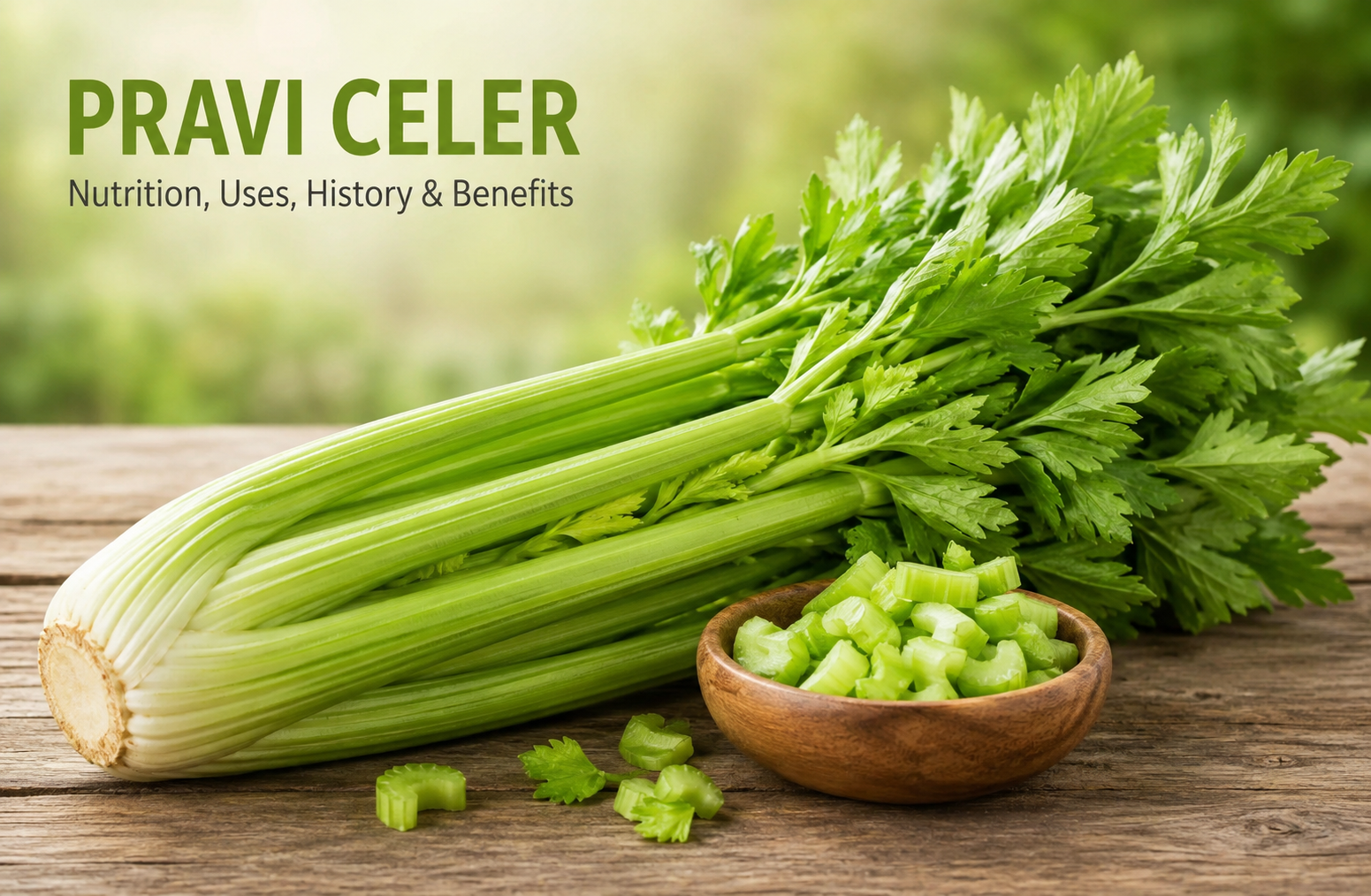
Pravi Celer: Complete Guide to Celery, Uses and Benefits
Pravi celer is a familiar vegetable in kitchens around the world, but its history, plant structure, culinary role, nutrition, cultivation, and safety profile are more interesting than its simple appearance suggests. Known scientifically as Apium graveolens, celery is used both as a crunchy vegetable and as a powerful flavoring ingredient. Its stalks, leaves, and seeds each have different culinary applications, while related cultivated forms such as celeriac offer another way to use the same species.
Celery is often associated with salads and snacks, yet that description misses its real importance. In French cooking it contributes to mirepoix, in Italian cuisine it forms part of soffritto, and in Louisiana Creole and Cajun cooking it joins onions and bell peppers in the traditional “holy trinity.” Its seeds are also used as a spice and as a source of essential oil.
Understanding celery properly means looking beyond modern food trends. It has been cultivated for centuries, has a documented botanical identity, and has a place in both ancient and modern food traditions. At the same time, claims surrounding celery juice and “detoxification” deserve a careful look because popular health language does not always match established evidence.
What Is Pravi Celer?
Pravi celer refers to celery, a cultivated plant belonging to the Apiaceae family. Its scientific name is Apium graveolens. The plant is grown as a vegetable and flavoring ingredient and is recognized by its long, ribbed, edible stalks, aromatic leaves, and small flowers arranged in compound umbels.
There are several cultivated forms of Apium graveolens. The main groups include:
- Stalk celery, associated with the Dulce Group
- Leaf celery, associated with the Secalinum Group
- Celeriac, associated with the Rapaceum Group
The celery most commonly seen in supermarkets is stalk celery. It has long stems that are usually eaten raw or cooked. Leaf celery is valued more for its aromatic foliage, while celeriac is cultivated primarily for its enlarged root-like stem.
The plant was formally described by Carl Linnaeus in Species Plantarum in 1753. Its English name has a long linguistic history. The word “celery” developed through French céleri and Italian seleri, with roots ultimately connected to Late Latin selinon and the Ancient Greek word σέλινον, or selinon.
Why Celery Matters More Than It Looks
Celery is sometimes treated as a background ingredient because its flavor is relatively mild compared with stronger vegetables and herbs. In practical cooking, however, it performs several important jobs.
Fresh stalks provide:
- Crisp texture
- Mild vegetal flavor
- Aromatic character
- High water content
- A useful base for salads and snacks
When cooked, celery becomes softer and its flavor integrates into soups, sauces, stews, and braised dishes.
The leaves have a stronger and more noticeable aroma than the stalks. They can be chopped into soups, used as a garnish, added to salads, or dried for later use.
Celery seeds are different again. They are small, strongly flavored, and commonly used as a spice. They can also be processed for essential oil, including applications in the perfume industry.
This versatility explains why celery has survived as an important food plant across different culinary traditions.
The Three Major Cultivated Forms
Stalk Celery
Stalk celery is the form most people associate with the vegetable. The stems are long, ribbed, and fibrous. They can be eaten raw or cooked.
Raw stalks are commonly served in:
- Salads
- Vegetable snacks
- Garnishes
- Dishes served with dips
Cooked stalks are frequently included in:
- Soups
- Stews
- Sauces
- Pot roasts
- Braised dishes
Pascal celery is a major commercial cultivar associated with North American production.
Leaf Celery
Leaf celery produces foliage with a stronger aromatic quality. Instead of treating the leaves as waste, cooks can use them as an herb-like ingredient.
Fresh leaves can be added to soups and salads. They can also be used as a garnish or dried for later use.
This is an important practical point because the leaves can contribute significant flavor even when only a small amount is required.
Celeriac
Celeriac is another cultivated form of Apium graveolens. Unlike standard stalk celery, it is grown for its enlarged underground portion.
Although celeriac and stalk celery look very different, they are closely related cultivated forms within the same species.
For people interested in the broader celery family, this distinction helps explain why the word “celery” can sometimes refer to plants that look quite different in the kitchen.
The Flavor and Aroma of Celery
Celery has a recognizable aroma that comes from naturally occurring compounds in the plant. Two important aroma compounds listed for celery are butylphthalide and sedanolide.
These compounds contribute to the characteristic smell and flavor that makes celery easy to recognize.
The intensity of celery flavor can vary according to the plant part being used. Stalks tend to provide a mild, fresh flavor, while the leaves and seeds can be more concentrated.
Celery seeds are especially useful when a cook wants celery-like flavor without adding large pieces of fresh stalk.
This makes seed-based seasonings useful in spice blends, sauces, cured foods, and drinks.
Nutritional Profile of Celery
Celery has a very high water content. Per 100 grams, it contains approximately:
| Nutrient | Amount per 100 g |
| Water | 95.43 g |
| Energy | 14 kcal |
| Carbohydrates | 2.97 g |
| Sugars | 1.34 g |
| Dietary fiber | 1.6 g |
| Protein | 0.69 g |
| Fat | 0.17 g |
| Saturated fat | 0.042 g |
| Monounsaturated fat | 0.032 g |
| Polyunsaturated fat | 0.079 g |
| Starch | 0.00 g |
The numbers show why celery is often considered a light vegetable. Approximately 95 percent of its weight is water, while its carbohydrate, protein, and fat contributions are relatively modest.
Celery also provides vitamin K. A 100 gram serving supplies approximately 24 percent of the U.S. Daily Value according to the supplied nutritional data.
However, nutrition should be considered in the context of the entire diet. Celery can contribute useful nutrients and fiber, but it should not be presented as a replacement for a varied diet.
Pravi Celer in Everyday Cooking
One of the strongest reasons celery remains popular is its ability to work quietly in a recipe.
A cook does not always want one ingredient to dominate. Celery can instead build a flavor foundation that supports other ingredients.
In Soups
Celery is frequently added to soups because its flavor works well with onions, carrots, meat, legumes, and stocks.
The stalk can be chopped into small pieces and cooked until tender. In this form, its crunchy texture disappears while its aromatic contribution remains.
In Stews
Stews benefit from vegetables that can withstand extended cooking. Celery can contribute flavor while becoming softer during the cooking process.
It works particularly well alongside onions and carrots.
In Salads
Raw celery provides a crisp texture that contrasts with softer ingredients.
It can be sliced thinly, diced, or cut into larger pieces depending on the salad. Its mild flavor also makes it compatible with many dressings and other vegetables.
As a Snack
Raw celery stalks are commonly eaten as a simple vegetable snack. The crunchy texture makes it convenient to serve with other foods.
As a Garnish
Celery leaves can add aroma and visual contrast to soups, salads, and other dishes.
The leaves are particularly useful when a recipe already contains celery but the cook wants additional fresh celery flavor.
The Culinary Foundations Built Around Celery
Celery’s importance becomes clearer when looking at traditional cooking systems.
Mirepoix
French cuisine uses a combination of celery, onions, and carrots known as mirepoix.
The ingredients are typically cooked together as a foundation for other dishes. Rather than serving as the main component, this mixture establishes an aromatic base.
The lesson is simple: an ingredient does not need to be the star of a dish to be essential to its flavor.
Soffritto
Italian cooking uses onions, carrots, and celery cooked slowly in olive oil to create soffritto.
The slow cooking process allows the vegetables to soften and develop a deeper aromatic foundation.
This technique demonstrates why celery is valuable even when the final dish does not visibly resemble a celery-based recipe.
Louisiana Holy Trinity
In Louisiana Creole and Cajun cooking, celery joins onions and bell peppers in the traditional “holy trinity.”
Again, celery plays a supporting role, helping form the flavor foundation of many dishes.
These three examples show that celery is not simply a salad vegetable. It is part of several major culinary traditions.
Celery Seeds and Celery Salt
Celery seeds have a distinct culinary identity of their own.
They can be used as:
- A spice
- A flavoring ingredient
- A source of essential oil
- An ingredient in seasoning mixtures
Celery salt is traditionally made using ground celery seeds or celery extracts combined with salt.
It has been used in a variety of foods and drinks, including Bloody Mary cocktails, Chicago-style hot dogs, Old Bay Seasoning, and cured meats.
The difference between fresh celery and celery seed is important. Fresh stalks bring water, texture, and mild flavor, while seeds provide a more concentrated celery character.
Celery Juice and the Detoxification Question
Celery juice became particularly prominent in the United States during a major “detoxification” trend around 2019.
The popularity of celery juice created many claims about cleansing the body and removing toxins. These claims should be approached carefully.
The supplied reference information specifically states that detoxification claims associated with celery juice have no scientific basis.
This does not mean celery juice is inherently useless. It means that it should not be described as a scientifically established detoxification treatment.
There is also a nutritional difference between drinking celery juice and eating whole celery. Juice contains less fiber than the whole vegetable and can provide higher concentrations of oxalates.
That distinction matters because the form in which a food is consumed can change its nutritional characteristics.
A sensible approach is to view celery as a vegetable rather than as a miracle product.
Whole Celery Versus Celery Juice
The comparison is useful because many modern discussions focus heavily on juice.
Whole Celery
Whole celery provides:
- Water
- Dietary fiber
- Crunchy texture
- Vitamin K
- A relatively low energy contribution
- Stalk and leaf nutrients together when both are consumed
Celery Juice
Juicing removes much of the original structure of the vegetable.
As a result, celery juice contains less fiber than whole raw celery. The supplied information also notes higher concentrations of oxalates in celery juice.
This does not automatically make juice “bad.” It simply means that whole celery and celery juice should not be treated as nutritionally identical.
The broader lesson is valuable for nutrition: changing a food’s physical form can change what remains in the final product.
How Celery Is Grown
Celery is generally grown from seed. Traditionally, growers raised plants in hot beds or gardens before transplanting them into trenches.
Growing celery requires more attention than simply placing seeds in soil and waiting for harvest. The plant develops edible stalks that must reach a suitable market size, and traditional cultivation has included specific methods for improving stalk appearance and eating quality.
Commercial production involves carefully managed fields and harvesting practices.
Commercial fields are generally harvested once the average crop reaches marketable size.
What Is Blanching in Celery?
Traditional celery can be blanched by earthing up soil around the stems to reduce their exposure to light.
The purpose is to change the appearance and eating characteristics of the stalks.
Self-blanching varieties are also widely grown, reducing the need for the traditional earthing-up method.
This is an interesting example of how cultivation techniques can influence the final vegetable. What reaches the supermarket is not simply the result of genetics. Growing conditions and agricultural practices also matter.
Commercial Celery Production
Celery is cultivated commercially on a large scale and is sold in different classes, including white and red celery.
Commercial packaging commonly contains 36 to 48 stalks and may weigh up to 27 kilograms, or 60 pounds.
After harvesting, storage conditions become important.
Under optimal conditions, celery can be stored for approximately seven weeks at 0 to 2°C, or 32 to 36°F.
Anti-fogging, micro-perforated shrink wrap can extend shelf life by helping manage the conditions surrounding the stalks.
These details show why the celery supply chain is more complicated than it appears to consumers. Harvest timing, packaging, temperature, and humidity all influence how long the vegetable remains suitable for sale.
How to Store Fresh Celery
For home cooks, good storage begins with temperature management.
Celery benefits from cold storage, and the supplied commercial data identifies approximately 0 to 2°C as optimal storage conditions.
The practical goal is to slow deterioration while preventing conditions that encourage excessive moisture loss or spoilage.
If celery begins losing its crispness, it may still be suitable for cooked dishes depending on its condition. A stalk that is slightly less crisp can work well in soups or stews even when it is no longer ideal for a raw salad.
This is a useful kitchen principle: freshness requirements depend on how you intend to use the ingredient.
Preserving Celery
Celery can also be preserved through pickling.
A basic preservation approach can use:
- Water
- Vinegar
- Salt
- Vegetable oil
Pickling changes the flavor and texture of the stalk while extending its usefulness beyond the fresh harvest period.
Preservation also demonstrates how celery can move from being a fresh vegetable to becoming a component of a longer-lasting prepared food.
Celery Allergies and Food Safety
Celery deserves attention from people with food allergies.
It can cause allergic reactions, and reactions can potentially include anaphylactic shock.
The plant may also cross-react with carrots and ragweed in some allergic individuals.
The supplied information gives celery an OPALS allergy rating of 4 out of 10, described as moderate allergy potential.
This is not a reason for most people to avoid celery. It is a reason for people with known food allergies to take ingredient labeling seriously.
In the European Union and United Kingdom, foods containing or potentially containing celery, including trace amounts, must be clearly marked.
That labeling requirement is especially important for prepared foods, spice blends, sauces, stocks, and processed products where celery may not be visually obvious.
The Historical Sulfite Issue
Celery also has an interesting food safety history involving sulfites.
Sulfite-containing preservatives were formerly used on raw celery and other produce. These substances caused allergic reactions in some people.
The U.S. Food and Drug Administration banned sulfites on fruits and vegetables intended to be eaten raw in 1986.
This history illustrates why food regulation matters. An ingredient or preservative may have practical benefits in food handling but can also create risks for susceptible people.
The Ancient History of Celery
Celery has a history that reaches back thousands of years.
Celery leaves and inflorescences were found among garlands in the tomb of Pharaoh Tutankhamun, providing an archaeological connection between the plant and ancient Egypt.
Literary evidence also indicates that celery was cultivated in Ancient Greece.
Wild celery appears in descriptions associated with Homer’s Iliad and Odyssey.
The plant also had symbolic associations in ancient Greek culture. Celery was associated with death and was used in garlands for the dead.
Celery was reportedly used for winner wreaths at the Isthmian Games before pine crowns became associated with those games. Winner garlands at the Nemean Games were also reportedly made from celery.
These traditions show that the plant had cultural meaning beyond food.
From Ancient Plants to Modern Vegetable
The historical story of celery is not simply a straight line from ancient use to modern supermarkets.
The cultivated plant gradually changed through selection and agricultural development.
In medieval Europe, celery eventually displaced alexanders as a cultivated plant.
During the era of Charlemagne, Apium was included among herbs and vegetables recommended for cultivation.
By the 17th century, celery had become more established in English cuisine. John Evelyn recommended it in Acetaria: A Discourse of Sallets in 1699.
An earlier English attestation of the word “celery” is recorded in 1664, also associated with John Evelyn.
These references help explain how celery moved from a plant with ancient cultural connections into an established European culinary ingredient.
Celery in Colonial America
Celery appeared in colonial American gardens, although it initially had limited culinary importance.
Its popularity increased substantially in the United States during the 19th and early 20th centuries.
Historical accounts even reported celery as the third-most-popular dish on New York City menus during that period, behind coffee and tea.
Modern food culture may make that ranking seem surprising, but it reflects how strongly food preferences can change over time.
A vegetable that now appears ordinary once occupied a much more prominent position in certain dining cultures.
Where the Name Comes From
The word celery has a long linguistic journey.
The English term derives through French céleri and Italian seleri. These forms are connected to Late Latin selinon and ultimately to the Ancient Greek selinon.
This linguistic history is consistent with the plant’s long presence in Mediterranean and European food traditions.
The scientific name also provides useful information. Apium graveolens is the botanical name for the species, while different cultivated groups represent different agricultural forms.
Knowing both the common and scientific names is helpful when distinguishing celery from visually similar plants in the Apiaceae family.
What Makes Celery Distinct?
Several characteristics help identify celery.
Stalks
The edible stalks are long, ribbed, and fibrous.
Leaves
The leaves are pinnate to bipinnate and aromatic. They have a stronger flavor than the stalks and can be used in cooking.
Flowers
The flowers are creamy white, approximately 2 to 3 millimeters wide, and arranged in dense compound umbels.
Seeds
The seeds are broad, ovoid to globose, and approximately 1.5 to 2 millimeters long and wide.
These botanical features are useful for understanding why different parts of the plant have different culinary roles.
How to Use Every Part of the Plant
A practical approach to reducing food waste is to think about celery as a whole plant rather than simply a bundle of stalks.
Stalks
Use them in salads, soups, stews, sauces, snacks, and garnishes.
Leaves
Use them to intensify celery flavor in soups, salads, sauces, and garnishes. They can also be dried.
Seeds
Use them as a spice or seasoning ingredient. They can also be processed for essential oil.
This approach can make celery more useful in the kitchen and reduce the tendency to discard flavorful leaves.
Common Misunderstandings About Celery
“Celery is only useful in salads.”
Not true. It is widely used in soups, stews, sauces, pot roasts, and culinary flavor bases.
“Celery juice detoxes the body.”
The supplied information states that detoxification claims associated with celery juice have no scientific basis.
“Celery and celeriac are completely unrelated.”
They are different cultivated forms or groups associated with Apium graveolens.
“Celery stalks are the only useful part.”
The leaves and seeds also have important culinary uses.
“A vegetable with high water content has no nutritional value.”
Celery provides dietary fiber and vitamin K along with its high water content, although it should be considered as one part of a varied diet.
Practical Ways to Add Celery to Meals
If celery is not already part of your regular cooking routine, simple applications are usually the easiest starting point.
Try using chopped celery in:
- Homemade soups
- Vegetable salads
- Stews
- Sauces
- Pot roasts
- Stuffing-style preparations
- Fresh vegetable snacks
- Garnishes
- Traditional aromatic vegetable bases
- Seasoning blends using celery seed
The best use depends on the desired texture.
For crunch, keep the stalk raw or lightly cooked.
For background flavor, cook it slowly with other aromatic vegetables.
For concentrated celery flavor, consider celery leaves or seeds.
A Balanced View of Celery’s Benefits
Celery can be a useful addition to a balanced diet because it is water-rich, relatively low in energy, and provides fiber and vitamin K.
Its culinary value may be even more important than any single nutrient. Because celery works in so many recipes, it can help build flavorful meals without requiring a complicated ingredient list.
However, it is important to avoid turning an ordinary vegetable into a supposed cure-all.
There is no need to claim extraordinary health effects when celery already has clear, practical strengths.
Its value comes from what can be supported: its nutritional composition, culinary flexibility, historical importance, and role as a widely cultivated vegetable.
Pravi Celer and Modern Food Culture
Today, celery exists at the intersection of traditional cooking and modern wellness culture.
On one side, it remains a classic ingredient used by professional and home cooks. It forms part of foundational preparations such as mirepoix, soffritto, and the Louisiana holy trinity.
On the other side, celery juice became a major wellness trend.
The difference between these two uses is instructive.
Traditional culinary use focuses on flavor, texture, and nutrition as part of a meal. Wellness trends may sometimes focus on exaggerated claims about what a single food can do.
A more reliable approach is to appreciate celery for what it genuinely offers.
It is versatile, historically significant, nutritionally modest but useful, and capable of contributing both texture and aroma to everyday food.
Frequently Asked Questions
What is pravi celer?
Pravi celer refers to celery, scientifically known as Apium graveolens. It is a cultivated vegetable in the Apiaceae family and is commonly grown for its edible stalks, leaves, and seeds.
Is celery a healthy vegetable?
Celery can be part of a healthy, varied diet. It contains approximately 95.43 grams of water, 1.6 grams of dietary fiber, and provides vitamin K, while containing about 14 calories per 100 grams.
What are the main uses of celery?
Celery is commonly used raw in salads and snacks and cooked in soups, stews, sauces, pot roasts, and flavor bases. Its leaves are used for flavoring and its seeds are used as a spice.
Is celery juice a detox drink?
Celery juice is often marketed as a detox drink, but the supplied information states that detoxification claims associated with celery juice have no scientific basis. Whole celery also contains more fiber than celery juice.
Can celery cause allergies?
Yes. Celery can cause allergic reactions, including potentially severe reactions such as anaphylaxis. People with known food allergies should carefully check ingredient labels.
What is the difference between celery and celeriac?
Both are cultivated forms or groups associated with Apium graveolens, but they are grown for different parts of the plant. Stalk celery is mainly grown for its edible stems, while celeriac is grown primarily for its enlarged root-like portion.
Conclusion
Pravi celer is far more than a crunchy vegetable commonly placed beside dips or added to salads. It is a cultivated form of Apium graveolens with a long history, several distinct cultivated groups, and a surprisingly broad culinary role.
Its stalks provide crisp texture and a mild flavor. Its leaves provide stronger aroma. Its seeds work as a concentrated spice and can also produce essential oil. In traditional cuisines, celery contributes to important flavor foundations such as French mirepoix, Italian soffritto, and the Louisiana holy trinity.
Its nutritional profile is straightforward. Celery contains a very high proportion of water, relatively few calories, dietary fiber, and useful vitamin K. These qualities make it a practical vegetable, but they do not justify exaggerated health claims.
The history of celery is equally compelling. Evidence connects it with ancient Egypt and Greece, while later references document its growing importance in European and American cuisine. Modern cultivation, commercial storage, preservation, and food labeling have further shaped how celery reaches consumers today.
Perhaps the most useful way to understand celery is to appreciate it without exaggeration. It does not need to be presented as a miracle food to be valuable. Its versatility, flavor, nutritional contribution, cultural history, and everyday usefulness are more than enough to make it an important vegetable.