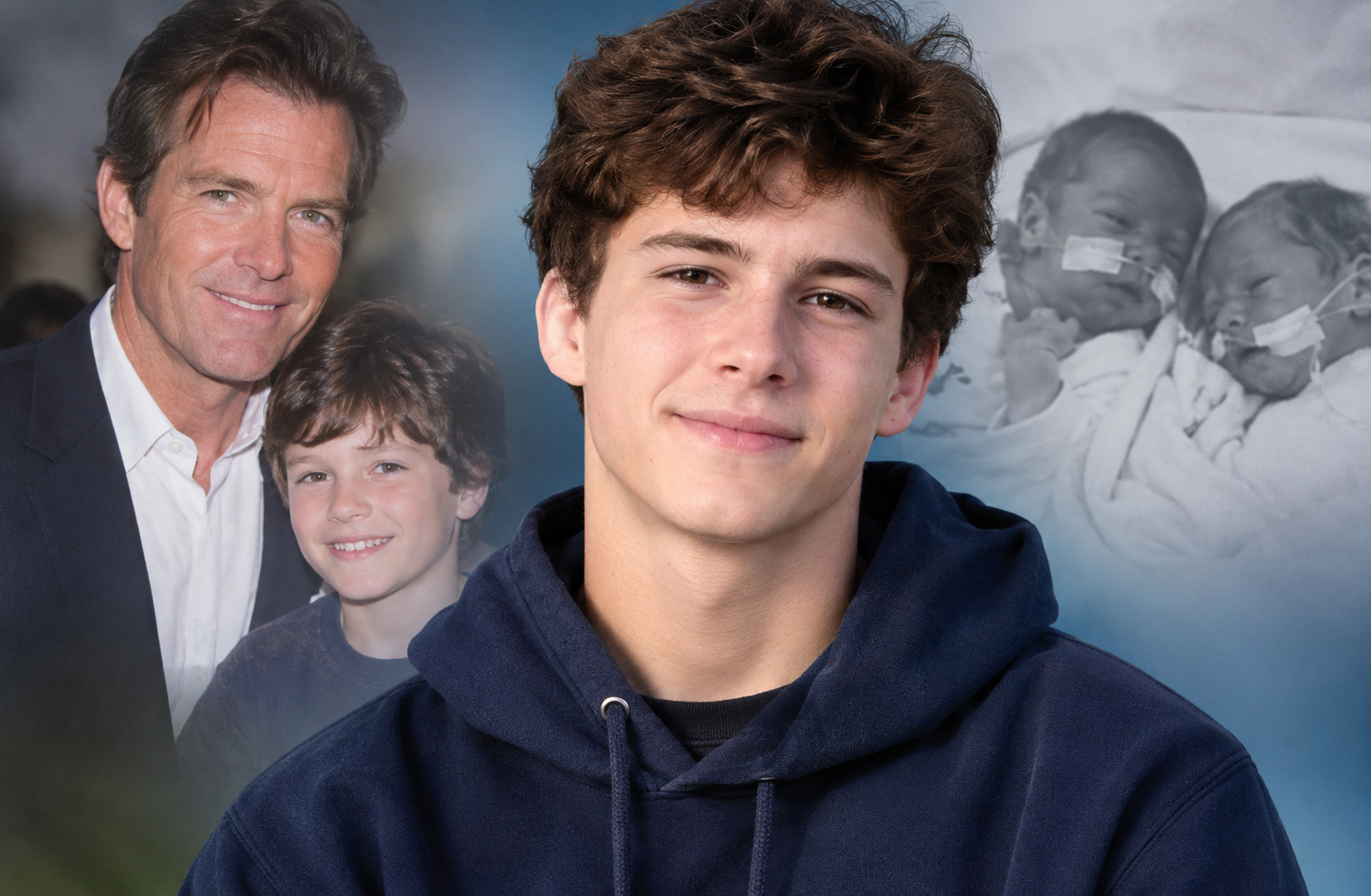
Thomas Boone Quaid: Family, Early Life, and Medical Crisis
Thomas Boone Quaid is best known as the son of Hollywood actor Dennis Quaid, but the story of Thomas Boone Quaid goes beyond his famous family name. Born on November 8, 2007, Thomas entered public awareness because of a serious medical emergency he experienced with his twin sister, Zoe Grace Quaid, shortly after birth. The twins survived a dangerous medication error that later became an important part of their father’s public efforts to raise awareness about patient safety.
Despite his connection to a well-known entertainment family, Thomas has largely grown up away from the spotlight. Unlike his older half-brother, actor Jack Quaid, he has not established a publicly confirmed acting career. His life has attracted interest because of his family background, his early medical experience, and questions about what he may choose to do as an adult.
As of 2026, Thomas is 18 years old. Information provided about his recent life indicates that he completed high school and was preparing for university, although details of his education and future plans should be treated cautiously unless confirmed by reliable public sources. His story offers a different perspective on celebrity families, one in which personal privacy and family experiences matter more than public recognition.
Understanding his life requires separating documented family history from unverified online claims. His father’s career is widely known, and the twins’ medical emergency received significant public attention. However, many details about Thomas’s personal interests, relationships, finances, and professional ambitions remain private. This article examines what is known about his background while respecting the limits of publicly available information.
Who Is Thomas Boone Quaid?
Thomas Boone Quaid is the son of American actor Dennis Quaid and his former wife, Kimberly Buffington. He was born as a twin, alongside his sister Zoe Grace Quaid, in November 2007. His early life became the subject of national attention after both children experienced a serious medication error during hospital treatment.
Thomas is part of a family associated with American film and television, yet he has not followed an established public career in entertainment. His father has spent decades working in Hollywood, while his older half-brother Jack Quaid has developed a career as an actor. Thomas, by comparison, has maintained a much lower public profile.
Several facts help explain why people search for information about him:
- Family background: He is the son of a prominent Hollywood actor and a real estate professional.
- Twin relationship: He shares his birthday with his twin sister, Zoe Grace.
- Medical history: He survived a potentially life-threatening medication error as a newborn.
- Patient safety awareness: His family’s experience contributed to public discussion about preventing medication errors in hospitals.
- Private upbringing: He has largely remained outside the entertainment industry’s public spotlight.
- Transition to adulthood: Reports supplied for this article describe him as a recent high school graduate preparing for university in 2026.
The distinction between public facts and private details is especially important when discussing someone whose recognition comes primarily from family connections. Being the child of a celebrity does not automatically mean that every aspect of a person’s life is documented or open to public scrutiny.
Thomas’s story is therefore best understood through three connected themes: his family, the medical emergency that shaped his early public history, and his opportunity to develop an independent adult life.
Thomas Boone Quaid Biography at a Glance
The following table summarizes the principal biographical information available for this article.
| Detail | Information |
| Full name | Thomas Boone Quaid |
| Date of birth | November 8, 2007 |
| Age in 2026 | 18 years old |
| Nationality | American |
| Father | Dennis Quaid |
| Mother | Kimberly Buffington |
| Twin sister | Zoe Grace Quaid |
| Older half-brother | Jack Quaid |
| Birth circumstances | Born through a gestational carrier, according to the supplied information |
| Early medical history | Survived a serious heparin medication error as a newborn |
| Public profession | No established professional career publicly confirmed |
| Acting career | No established public acting career confirmed |
| Education | Reportedly completed high school in 2026 |
| University plans | University of Colorado Boulder is reported, but current enrollment is not independently established here |
| Relationship status | Not reliably established in public information |
| Personal net worth | No verified figure available |
| Public profile | Relatively private |
This overview highlights an important point: a biography can include meaningful, documented information without inventing details to fill gaps. Thomas’s public story is substantial because of his family history and the medical safety issue, even though information about his day-to-day life remains limited.
Family Background: Dennis Quaid, Kimberly Buffington, and Jack Quaid
Family plays a central role in understanding Thomas’s background. His parents have different public profiles, and his connection to his older half-brother places him within a family that has experienced both Hollywood success and periods of intense public attention.
Who Is Dennis Quaid?
Dennis Quaid is an American actor known for performances in films such as The Parent Trap, The Day After Tomorrow, The Rookie, and Frequency. His career spans several decades and includes comedy, drama, thrillers, and family films.
His professional life has made the Quaid family recognizable to audiences, but his experience as a father has also attracted public attention. The medical emergency involving Thomas and Zoe became one of the most personal stories he shared publicly.
For Dennis, the incident was not simply a news story involving a famous family. It was a frightening experience involving his newborn children and a medication error that raised questions about how hospitals and pharmaceutical companies protect patients.
His subsequent advocacy demonstrated how a parent’s personal experience can become part of a wider public discussion. Rather than focusing exclusively on his acting career, Dennis used interviews and congressional testimony to explain why medication labeling, hospital procedures, and accountability matter.
Thomas’s connection to his father is therefore significant in two ways. It explains much of the public interest in his biography, and it provides the context for understanding why his earliest days became associated with patient-safety advocacy.
Who Is Kimberly Buffington?
Kimberly Buffington is Thomas’s mother and Dennis Quaid’s former wife. The couple married in 2004 and welcomed their twins in November 2007.
Compared with Dennis, Kimberly has maintained a more private public profile. Her role in the family’s medical emergency was nevertheless important. She was directly involved in seeking medical attention for the twins when they developed signs of infection and later joined Dennis in discussing the experience publicly.
The family’s experience also illustrates how the relatives of celebrities can become public figures through circumstances they did not choose. Kimberly’s involvement in the patient-safety discussion came from her experience as a mother, not from a conventional entertainment career.
Dennis and Kimberly’s divorce was finalized in 2018, according to the biographical information supplied for this article. Their marital history is part of Thomas’s family background, but it does not establish details about his present relationship with either parent.
There is no reliable basis here for making assumptions about private family arrangements, personal disagreements, or how the divorce affected Thomas emotionally.
Who Is Jack Quaid?
Jack Quaid is Thomas’s older paternal half-brother. Jack is the son of Dennis Quaid and actress Meg Ryan.
Jack developed an acting career of his own and became widely recognized for roles in productions such as The Boys and The Hunger Games. His professional visibility creates a natural point of comparison with Thomas, but the two should not be treated as if they share the same career goals.
Their family connection comes through Dennis Quaid. They have different mothers and grew up in different stages of their father’s life.
It is tempting for celebrity biographies to predict that a younger family member will follow an older sibling into the same profession. However, family connections alone do not demonstrate shared ambitions, interests, or career plans.
As of 2026, no established professional acting career has been publicly confirmed for Thomas. His future could involve entertainment, education, business, or another field entirely. Without a reliable statement from Thomas or a credible public record, any prediction would be speculation.
Birth and Childhood: What Is Publicly Known?
Thomas Boone Quaid was born on November 8, 2007, alongside his twin sister, Zoe Grace Quaid. According to his parents’ congressional testimony, the twins were born approximately four weeks prematurely and were initially reported to be healthy.
The twins were born through a gestational carrier. In this arrangement, a person carries a pregnancy for the intended parents. The available reporting identifies Dennis and Kimberly Quaid as the twins’ parents.
Their birth marked an important moment for the family after the couple had experienced difficulties in trying to have children. Dennis and Kimberly later described their experience as parents in public testimony, providing a firsthand account of what happened during the twins’ first weeks.
The children spent their first days outside the hospital before a medical concern prompted their parents to seek further treatment. That decision led to a chain of events that would eventually become a widely reported patient-safety case.
Growing Up Outside the Hollywood Spotlight
Thomas’s childhood has not been documented in the same way as the careers of his father and half-brother. There is limited verified information about his schools, friendships, hobbies, daily routine, or private interests.
That absence of detail should not be confused with a lack of meaningful experiences. It reflects the difference between growing up in a recognizable family and choosing to live as a public entertainer.
Children of famous parents may attract attention before they are old enough to make decisions about their own public identities. Some later enter the entertainment industry, while others prefer education, professional work, or a life outside celebrity culture.
Thomas appears to have maintained a comparatively private profile. It is therefore more responsible to discuss his documented family history than to invent stories about his personality or childhood.
This approach also matters for readers. Celebrity biographies are most useful when they distinguish confirmed information from claims repeated across websites without clear sourcing.
The Medical Emergency That Changed His Family’s Story
One of the most significant events associated with Thomas’s early life occurred in November 2007, when he and Zoe were treated at Cedars-Sinai Medical Center in Los Angeles.
The twins developed staph infections and required hospital treatment, including intravenous antibiotics. During that treatment, both received a potentially fatal overdose of heparin, a medication used as a blood thinner.
The event received national attention because of the severity of the error and the subsequent efforts by their parents to draw attention to medication safety.
What Happened to Thomas Boone Quaid?
According to Dennis and Kimberly Quaid’s testimony before the U.S. House Committee on Oversight and Government Reform on May 14, 2008, the twins were supposed to receive a small amount of a heparin-based product used to maintain their intravenous lines.
Instead, they were given a much higher concentration of heparin.
Contemporary reporting and the family’s testimony described the difference as a dose of 10,000 units rather than the intended 10 units. That is a 1,000-fold difference, making the mistake potentially life-threatening for newborn infants.
The two products had similar packaging, and the incident raised concerns about how high-risk medications were labeled, stored, selected, and administered.
The medication error was not a minor dosing discrepancy. Heparin affects blood clotting, so an excessive dose can lead to dangerous bleeding. In the twins’ case, the overdose caused severe bleeding concerns and required urgent medical intervention.
The experience was especially frightening because the children were only days old. Their parents had taken them to the hospital for treatment of an infection, not for a condition that required such a dangerous exposure to a blood thinner.
Why Was Heparin Involved?
Heparin is an anticoagulant, meaning that it reduces the blood’s ability to clot. It has legitimate medical uses, but the concentration and dose must match the treatment being provided.
The incident involving Thomas and Zoe highlighted the danger of confusing products that contain the same active medication but have very different concentrations.
A small amount of a low-concentration product can serve a different purpose from a much stronger formulation. When the wrong concentration is selected, the resulting dose can be dramatically higher than intended.
The central safety problem was therefore not simply that a medicine was administered. It was that several protective steps failed to prevent the wrong product and dose from reaching the patients.
The case drew attention to several connected risks:
- Similar-looking medication packaging can increase the chance of selection errors.
- High-concentration medications require safeguards appropriate to their risks.
- Staff must verify the product, concentration, dose, and intended use.
- Medication handling procedures must be followed consistently.
- Clear documentation and communication help identify errors and support a timely response.
These lessons extend beyond the Quaid family. They apply to medication systems in which products with similar names, packaging, or appearances may be used for different clinical purposes.
How Did Thomas and Zoe Survive?
After the overdose was identified, medical staff treated the twins and used protamine, a medication that can reverse the anticoagulant effects of heparin.
The family’s testimony described an extended period of serious concern while the children’s blood-clotting measurements gradually improved. Both infants survived the incident and recovered sufficiently to leave the hospital.
The survival of the twins was an enormous relief for their family. It also allowed their parents to speak publicly about the circumstances of the event and the changes they believed were needed to reduce the risk of similar incidents.
It is important, however, to distinguish survival from a claim about every possible long-term medical outcome. The fact that Thomas survived does not give the public access to his complete medical history, and his private health information should not be inferred from reports about the original incident.
What can be stated confidently is that the medication error was serious, both twins survived, and the event became a prominent example in discussions about preventing avoidable medication harm.
What Made the Incident Especially Important?
The case became particularly significant because similar medication errors had previously caused serious harm to other infants.
Public reporting described earlier incidents involving confusion between low-dose and high-dose heparin products. That history intensified questions about labeling, product design, hospital procedures, and whether existing warnings and safeguards were sufficient.
The Quaid family’s experience helped bring these issues to a broader audience. Their public position was that medication safety should not depend on an individual recognizing a confusing label at the final moment of administration.
A safer system uses multiple layers of protection. These can include clearer packaging, standardized storage, independent checks where appropriate, dose limits, barcode verification, and procedures that prevent high-risk products from being selected or administered incorrectly.
The incident therefore remains relevant as a case study in patient safety, not merely as a dramatic episode in the life of a celebrity’s child.
Dennis Quaid’s Fight for Patient Safety
The medical emergency involving Thomas and Zoe did not end when the twins recovered. Their parents became advocates for safer medication practices and greater accountability when preventable medical errors occur.
Dennis and Kimberly Quaid spoke publicly about their experience, explaining how a product-selection mistake could place newborn children at risk. Their involvement helped connect a family’s private trauma with broader questions about medication safety and the responsibilities of hospitals and pharmaceutical manufacturers.
Congressional Testimony in 2008
On May 14, 2008, Dennis and Kimberly Quaid testified before the U.S. House Committee on Oversight and Government Reform. They described the overdose and discussed the legal questions surrounding the responsibilities of pharmaceutical manufacturers.
Their testimony is part of the public record and offers a firsthand account of the event. Readers seeking the original source can consult the official congressional hearing transcript published through GovInfo.
The testimony is important because it separates the family’s direct experience from later summaries and secondhand accounts. It documents what the parents reported to lawmakers and explains why they wanted stronger attention to medication safety.
The hearing also addressed a broader legal question: how federal regulation of medicines interacts with consumers’ ability to seek legal remedies when a product allegedly causes harm.
This was not simply a discussion about one hospital visit. It involved questions about product labeling, pharmaceutical oversight, responsibility for preventable harm, and the legal rights of injured patients.
The Quaid Foundation and Public Awareness
The supplied biographical information states that Dennis Quaid established the Quaid Foundation to raise awareness of medical errors. His advocacy helped draw public attention to the risks associated with medication confusion and failures in safety procedures.
The wider lesson is that medical safety depends on systems, not just individual intentions. A healthcare professional may be working under pressure, but the process should still include reliable safeguards against a dangerous mistake.
Public advocacy can help bring these issues into conversations among patients, healthcare professionals, manufacturers, regulators, and lawmakers.
Thomas did not choose to become associated with this public issue. He was an infant when the incident occurred. Nevertheless, his survival became part of a story that helped his parents explain why better safeguards matter.
It is reasonable to recognize that contribution without assuming Thomas himself has pursued an advocacy career or publicly expressed views about the issue as an adult.
The Legal Case Following the Medication Error
The incident also led to legal action involving Baxter Healthcare Corporation, the manufacturer associated with the heparin products at issue.
Dennis and Kimberly Quaid argued that similarities in the products’ labeling and packaging contributed to the danger. The case raised questions about whether manufacturers had adequately addressed known risks and whether their products were designed and distributed with sufficient safeguards.
Legal cases involving medical products can be complex. They may examine product design, warnings, manufacturing practices, hospital procedures, causation, and the interaction between state and federal law.
Why the Case Drew Attention
The dispute attracted public interest for several reasons.
First, the patients were newborn infants who had been admitted for treatment of an infection. Second, the reported difference between the intended dose and the administered dose was enormous. Third, reports of earlier incidents involving similar products raised questions about whether lessons from previous errors had been applied effectively.
The case also illustrated why responsibility in a medical incident may need to be examined at several levels. Product manufacturers, pharmacies, hospitals, and individual healthcare workers can have different responsibilities within the medication process.
A careful account should not reduce every such incident to one simple explanation. The relevant evidence, findings, settlements, and legal rulings must be considered separately.
Contemporary reporting documented a settlement between the Quaids and Cedars-Sinai in December 2008. The supplied information also identifies legal action involving Baxter Healthcare Corporation. These matters should not be described as identical proceedings or treated as proof of every allegation made during the dispute.
The broader point is that the family pursued accountability after a serious medical error, while the public debate examined the safeguards needed to prevent similar events.
Patient-Safety Lessons From Thomas Boone Quaid’s Experience
The story has practical value because it illustrates several principles that hospitals and other healthcare settings can use to reduce medication-related risks.
These principles are not a substitute for professional medical guidance. They are general safety lessons drawn from the circumstances of the reported incident.
1. Medication Labels Must Be Clear
Products with different concentrations should be easy to distinguish. Similar colors, bottle shapes, or label layouts can increase the possibility of confusion, especially when staff must work quickly.
Clear labeling should make the medicine’s name, concentration, and relevant warnings easy to identify.
2. The Correct Dose Must Be Verified
Checking the medication name alone is not enough. A safe medication process also verifies the concentration, dose, route, patient, and intended purpose.
When a prescribed dose appears unusual or the product does not match the order, the discrepancy should be resolved before administration.
3. High-Risk Medicines Need Additional Safeguards
Some medicines can cause severe harm if administered incorrectly. These medications may require restricted access, standardized concentrations, independent verification, or electronic safeguards, depending on the clinical setting.
The exact measures should follow appropriate professional standards and institutional protocols.
4. Similar Products Should Be Stored Carefully
Storage arrangements can influence selection errors. Separating products with substantially different concentrations and limiting unnecessary access to high-risk formulations can reduce the chance of choosing the wrong medicine.
5. Errors Must Be Reported and Examined
A safety-focused organization should investigate medication errors and near misses. The goal is to identify what allowed the error to happen and make the system more reliable.
That includes reviewing procedures, training, packaging, communication, and documentation rather than relying solely on reminders to be more careful.
6. Patients and Families Should Be Encouraged to Ask Questions
Patients and caregivers can participate in safety by asking which medication is being given and why, when they are able to do so. They should feel comfortable raising concerns if something seems inconsistent with the treatment plan.
However, the responsibility for safe medication administration remains with the healthcare system and its qualified professionals. Families should not be expected to replace professional checks.
Taken together, these lessons show why Thomas’s medical history remains relevant beyond celebrity news. It demonstrates how one family’s experience can help illustrate a larger challenge in healthcare: building reliable processes that prevent foreseeable mistakes.
Thomas Boone Quaid’s Education and Life Today
Interest in Thomas has increasingly shifted from his early medical history to his transition into adulthood.
Born in 2007, he turned 18 on November 8, 2025. He is therefore 18 for most of 2026 and will turn 19 in November 2026.
The biographical information provided for this article reports that he completed high school in 2026 and was preparing to attend the University of Colorado Boulder. However, the available information does not independently establish his current enrollment, chosen major, or academic plans. These details should be treated as reports rather than confirmed facts.
Is Thomas Boone Quaid Attending University?
The University of Colorado Boulder has been identified in the supplied information as Thomas’s reported university destination. Without a reliable, current public confirmation, it would be premature to state as fact that he has enrolled or begun a particular course of study.
University is a major transition for many young adults. It can offer opportunities to develop independence, explore academic interests, meet new people, and consider different career paths.
For someone with a recognizable family name, that transition may also bring a choice about how much of their life they want to share publicly.
Thomas does not need a public career to make his biography meaningful. Education and personal development are valuable in their own right, and the absence of frequent media coverage does not imply that someone lacks ambition or accomplishments.
Does He Want to Become an Actor?
There is no established public acting career confirmed for Thomas as of 2026. Nor is there reliable evidence in the supplied information that he has announced plans to enter Hollywood.
His father and half-brother provide examples of successful careers in entertainment, but their achievements do not determine his future.
If Thomas eventually chooses acting, that decision can be assessed through his own work and public statements. If he chooses a different profession, that should be treated with equal respect.
For now, the most accurate description is that he is a young adult from an entertainment family whose professional direction has not been publicly established.
What Is Known About His Personal Life?
Thomas maintains a comparatively private public profile. There is no verified information in the supplied material that establishes his current romantic relationship, detailed hobbies, or authenticated personal social-media accounts.
Online biographies sometimes repeat claims about celebrity relatives without identifying an original source. Repetition does not make a claim reliable.
Readers should therefore be cautious about websites that confidently assign him a girlfriend, personal interests, private lifestyle, or future career without credible evidence.
Respecting these limits makes a biography more trustworthy. It also recognizes that a person can have a public family connection while retaining the right to keep ordinary aspects of life private.
Thomas Boone Quaid’s Net Worth and Career Prospects
Questions about wealth are common in celebrity searches, especially when the person is related to a successful actor. In Thomas’s case, however, no verified personal net worth has been established in the information available for this article.
Dennis Quaid’s professional earnings and assets cannot be used to calculate his son’s personal wealth. A parent’s financial position is not the same as a child’s independently verified net worth.
Likewise, the absence of a confirmed professional career means there is no reliable basis for estimating Thomas’s career earnings.
Why Online Net Worth Estimates Can Be Misleading
Celebrity net worth websites sometimes publish precise-looking figures without explaining their calculations or citing reliable financial records.
These estimates may rely on assumptions about family wealth, unverified employment, or the financial circumstances of relatives. Such methods can produce numbers that look authoritative but have little evidentiary value.
A responsible biography should distinguish among:
- A person’s verified professional income.
- Publicly documented business interests or assets.
- Family wealth that belongs to someone else.
- Unverified estimates circulated online.
For Thomas, the last two categories are especially important. His family background does not establish his personal finances, and an unsupported number would add little genuine value to the article.
His future career prospects are similarly open. University, employment, entrepreneurship, creative work, or a private professional life are all possibilities, but none should be presented as a confirmed plan without evidence.
Public Recognition and the Importance of Privacy
The story of Thomas Boone Quaid raises a broader question about how the public treats the children of celebrities.
A famous parent’s name can bring attention before a child has made any public choices. In Thomas’s case, that attention began with a medical emergency during infancy. The incident was serious and deserved public examination, but it does not mean that every later stage of his life should become a public record.
There is a meaningful difference between reporting on a documented event and speculating about a person’s private circumstances.
The former can help readers understand family history and patient safety. The latter can create misleading narratives that follow someone simply because of their relatives.
Thomas’s comparatively low public profile should therefore be understood as a limit on what can responsibly be claimed, not as a mystery that must be filled with guesses.
The most useful account of his life recognizes his family connections, acknowledges the medical event that brought him to public attention, and leaves room for him to establish his own identity.
That approach also makes the biography more durable. Personal circumstances can change quickly, while verified historical facts and a careful distinction between evidence and speculation remain useful over time.
Frequently Asked Questions About Thomas Boone Quaid
1. Who is Thomas Boone Quaid?
Thomas Boone Quaid is the son of American actor Dennis Quaid and his former wife, Kimberly Buffington. He is the twin brother of Zoe Grace Quaid and the younger paternal half-brother of actor Jack Quaid. He is also known for surviving a serious medication error as a newborn in 2007.
2. How old is Thomas Boone Quaid in 2026?
Thomas was born on November 8, 2007. He is 18 years old for most of 2026 and turns 19 on November 8, 2026.
3. What happened to Thomas Boone Quaid when he was a baby?
In November 2007, Thomas and his twin sister received an overdose of heparin while being treated at Cedars-Sinai Medical Center. The administered concentration was reported to be 1,000 times the intended dose. Both infants received emergency treatment, survived, and recovered from the incident.
4. Does Thomas Boone Quaid have a twin sister?
Yes. His twin sister is Zoe Grace Quaid. Both children were born on November 8, 2007, and experienced the same medication emergency during their infancy.
5. Is Thomas Boone Quaid an actor?
No established public acting career has been confirmed for Thomas as of 2026. His father, Dennis Quaid, and his older half-brother, Jack Quaid, are actors, but Thomas’s own professional plans have not been publicly established.
6. What is Thomas Boone Quaid’s net worth?
His personal net worth has not been reliably established. Estimates of Dennis Quaid’s wealth should not be presented as Thomas’s personal net worth, and there is insufficient verified information to provide a trustworthy figure.
Conclusion
Thomas Boone Quaid’s life brings together a well-known Hollywood family, a serious medical emergency, and the opportunity to build an identity beyond public expectations. As the son of Dennis Quaid and Kimberly Buffington, he grew up connected to the entertainment industry, yet he has maintained a relatively private public profile.
The most significant event associated with his early life was the 2007 heparin overdose that he and his twin sister, Zoe Grace, survived. Their experience brought attention to medication labeling, dosage verification, hospital procedures, and the importance of preventing avoidable medical errors. Their parents’ subsequent advocacy helped make patient safety a central part of the family’s public story.
In 2026, Thomas is a young adult whose educational and professional future remains largely private. Reports about his high school graduation and university plans provide possible context, but details that lack reliable confirmation should not be treated as established facts.
Ultimately, understanding Thomas requires a balance between public interest and respect for personal boundaries. His family background and medical history are meaningful parts of his biography, but they do not define every aspect of who he is or who he may become. His future belongs to him, regardless of whether he chooses a public career or a life outside the spotlight.