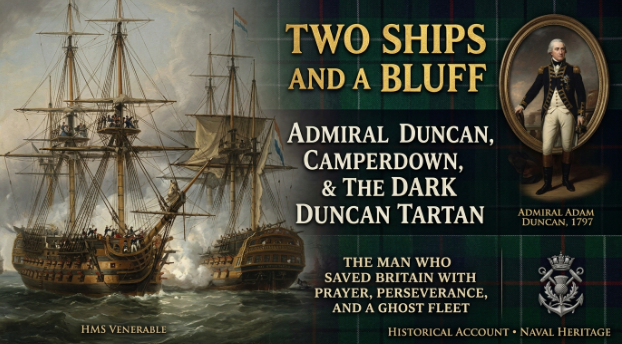
Two Ships and a Bluff: Admiral Duncan, Camperdown, and the Dark Duncan Tartan
The story of the Duncan tartan is closely connected with Admiral Adam Duncan, the Dundee-born naval commander whose name became associated with one of Scotland’s darker tartan patterns. In the last week of May 1797, Admiral Adam Duncan stood on the quarterdeck of his flagship, HMS Venerable, off the Dutch coast, and watched the rest of his fleet sail away.
Britain was at war with revolutionary France and with the Dutch Republic, which France had swallowed. Duncan’s job was to keep the Dutch fleet bottled up in the Texel, its base at the mouth of the Zuider Zee, so that it could not come out and carry a French army to Ireland. He had done the job for two years. Now, in a single month, the crews of the Royal Navy had risen in mutiny, first at Spithead and then at the Nore, over pay, food and brutal officers. The ships of the North Sea fleet, ordered to sea, had turned round one by one and gone back to join the mutineers.
By the time Duncan reached his station he had two ships left. Venerable, and the fifty-gun Adamant. Inside the Texel lay a Dutch fleet of fifteen ships of the line.
The phantom fleet
What he did next has been told in every history of the Navy since.
He kept the blockade. Venerable and Adamant took station off the entrance to the Texel, in sight of the Dutch lookouts, and all day long Duncan made signals. He hoisted flags ordering ships to close up, to alter course, to tack in succession. He signalled to a rear-admiral commanding the rear division, and to captains commanding the van. The signals were addressed to nobody. There was nobody there. But from the shore, and from the mastheads of the Dutch ships, it looked exactly as though the British admiral had his whole fleet just over the horizon and was manoeuvring it. The Dutch stayed in port.
He kept it up for days, until the mutiny collapsed and his ships came back.
He had already dealt with mutiny on his own flagship in his own way. When a deputation of Venerable’s crew came aft to demand that the ship join the others, Duncan, who was six feet four and one of the largest men in the service, listened, then reached out, took hold of the ringleader, and held him over the ship’s side by the collar with one hand. “My lads,” he said to the rest, “look at this fellow, who dares to deprive me of the command of the fleet.” Venerable did not mutiny.
Camperdown
On 11 October 1797 the Dutch came out at last, under Admiral de Winter, and Duncan caught them off the village of Camperduin, on a lee shore with the wind blowing them towards the sand. He did not form a line of battle. He drove at them in two loose columns, broke through their line in two places, and fought it out at close range with the Dutch gunners, who were as good as any in Europe. By evening eleven Dutch ships had struck, de Winter was a prisoner on Venerable’s quarterdeck, and the threat to Ireland was over. It was one of the bloodiest sea battles of the age.
Duncan was made Viscount Duncan of Camperdown. He was a Dundee man, born in the town in 1731, and the city gave him a hero’s welcome. His son built Camperdown House on the hill above the town, and its park, one of the largest in Scotland, is still called Camperdown. There is a statue of the admiral in the city centre, and his portraits show exactly the kind of man who could hold a sailor over a rail with one hand.
A clan that may not exist
The tartan that carries his surname has a more doubtful history than he does.
Duncan is an old Gaelic personal name, Donnchadh, borne by two kings of Scots, and as a surname it is found all over the country. The Duncans of Atholl are counted a branch of Clan Robertson, whose Gaelic name, Clann Donnchaidh, means the children of Duncan, after Donnchadh Reamhar, Fat Duncan, who led the clan for Bruce at Bannockburn. Beyond that, the great tartan scholar D. C. Stewart was frank: “No early work shows, nor is much known about any clan Duncan.” He suspected that the tartan sold under the name was a variation of the Davidson.
What is certain is where the pattern was first published. It appears in a French book of 1880, the Clans Originaux, which labels it “Duncan or Leslie of Wards.” It is a dark, cool tartan: a green ground with broad bands of dark blue and black, crossed by fine lines of white and red. Several mills weave a darker version, and it is this that the trade calls the Dark Duncan.
The register adds a modern footnote that would have pleased the admiral. In 2010 the Royal Navy commissioned a tartan to mark the launch of HMS Duncan, the last of its Type 45 destroyers built on the Clyde, named for the victor of Camperdown. Johnstons of Elgin designed it on the base of the Duncan sett, with navy blue, battleship grey, red and gold from the Duncan crest, and purple for the thistle. It may be worn only with the ship’s authority.
Retailers offer the standard Duncan tartan in its darker colouring made to order as kilts, skirts, sashes and scarves, or sold by the yard, and the usual Modern and Ancient versions alongside it.
Dundee, a Saturday in May
Bill Duncan is sixty, a retired chief petty officer, and he spent the last three years of his career in the Royal Navy on the ship named after a man who may or may not have been his ancestor. He has a photograph of HMS Duncan in his hall, and a copy of the admiral’s portrait, and he will tell anyone who asks that the family came from the same town as the admiral, which is true of a great many families in Dundee.
His daughter is getting married in the Caird Hall in three weeks. She has asked him to wear the kilt. He has never owned one. Twenty-two years in the Navy left him with a great respect for uniform and no idea where civilians get theirs.
His son-in-law-to-be, an accountant with a clan of his own, told him to find a proper Scottish outfitter and let them do the work. Bill, a methodical man, looked at several. The scottish shop he settled on was Scottish Kilt, on the grounds that it made every kilt to the customer’s measurements rather than in sizes, that it carried more than five thousand tartans including the dark Duncan he wanted, and that it sold the jacket, sporran, hose, shoes and the rest alongside, so that a man who knew nothing could buy the whole rig in one place and have it all match.
He measured himself as instructed. Waist at the navel, which at sixty was a number he preferred not to dwell on. Hips. Waist to mid-kneecap, kneeling on the kitchen floor with his wife holding the tape and laughing. He ordered eight yards, pleated to the sett, with a charcoal Argyll jacket and waistcoat for an afternoon wedding, a black leather semi-dress sporran, dark blue hose to match the band in the cloth, and red flashes to pick up the fine line. He asked for all the metal in antique silver, because bright chrome reminded him of the mess.
It arrived in six weeks. He put it on in the bedroom and stood in front of the mirror at attention, out of habit.
“Well?” said his wife.
“It’s dark,” said Bill, with satisfaction. “It’s very dark. The admiral would have liked that. Sea-going colour.”
“Your daughter wants to know if you’re going to make a speech about Camperdown.”
“I’m going to make a short speech about my daughter,” said Bill, “in which Camperdown will feature.”
At the wedding his old shipmates, three of them, turned up in the Duncan tartan too, having ordered it from the same place on his say-so. Somebody asked whether it was the ship’s tartan.
“That one you need permission for,” said Bill. “This is the family’s. Whether there’s a family is another question. But there was an admiral, and he held a mutineer over the side by his collar, and he bluffed the Dutch navy with two ships and a signal book, and if I can’t wear his colours to my own girl’s wedding then I don’t know what they’re for.”
The signals
Adam Duncan won Camperdown with courage and seamanship, but he held the Texel with nerve alone: two ships, a bag of flags, and the plain refusal to let the enemy know how little he had. It is the kind of story a navy tells its young sailors on purpose.
The tartan named for his surname has an uncertain pedigree, and the scholars say so. It does not seem to matter. A dark green and blue cloth, sea-going colour, worn to a wedding in the city that gave him his welcome home, by a man who served on his ship, is about as good a claim to it as anyone could make.